From idea to market-ready product, our SIGNS solutions make every stage easier, faster. Discover How We Help

Views: 287 Author: Landea Signs Publish Time: 2026-08-08 Origin: Site


Content Menu
● What Is the Difference Between 12V and 24V LED Systems?
● 12V vs. 24V LED Systems at a Glance
● Why Voltage Drop Matters in Large Illuminated Signs
● When a 12V LED System Is the Better Choice
>> Strengths of 12V LED Systems
● When a 24V LED System Is the Better Choice
>> Strengths of 24V LED Systems
● Large Sign Voltage Decision Framework
>> 2. Calculate the Real Electrical Load
>> 3. Review Cable Distance and Cable Size
>> 4. Design Power Injection Before Fabrication
>> 5. Verify the Installed System Under Load
● Expert Insight: Choose System Architecture, Not Just Voltage
● Cost Comparison: Initial Price vs. Lifetime Value
● Recommended Voltage by Sign Type
● Final Recommendation for Large Scale Signs
● FAQ
>> Is 24V always better than 12V for LED signs?
>> Does 24V make illuminated letters brighter?
>> Can I connect 12V LED modules to a 24V power supply?
>> How can I prevent voltage drop in channel letters?
>> How much power-supply capacity should an LED sign have?
>> Should outdoor illuminated signs use 12V or 24V?
>> Can a large sign use both 12V and 24V systems?
Choosing between 12V and 24V LED systems is not simply a component decision. For large-scale illuminated letters, channel letters, light boxes, and architectural signage, voltage affects brightness consistency, wiring complexity, power-distribution design, installation time, maintenance access, and long-term operating reliability.
At Landea Signs Co., Ltd., we evaluate voltage as part of the complete sign-engineering plan—not as an isolated specification. A compact indoor logo may perform perfectly with a 12V LED system. However, a large storefront fascia, tall building lettering, or long illuminated logo often benefits from a 24V LED system because it manages current and voltage drop more effectively across extended wiring runs.
The right answer depends on the sign's dimensions, LED layout, module load, cable distance, installation environment, and service requirements. This guide explains how to choose the best LED voltage for large-scale signs with practical, manufacturer-level decision criteria.
Both 12V and 24V systems are low-voltage direct-current LED solutions commonly used in illuminated signage. They normally include LED modules or LED strips, a compatible constant-voltage power supply, low-voltage wires, connectors, and optional dimming or control components.
The central difference is current.
For the same power demand, a 24V LED system uses approximately half the current of a comparable 12V system.
The relationship is simple:
Power=Voltage×Current
If a sign needs 120 watts:
- At 12V, the system draws approximately 10 amps.
- At 24V, the system draws approximately 5 amps.
Lower current can reduce resistance-related losses in cables and LED connections. This becomes especially important when illuminated letters are large, power supplies are remote, or several letters are connected across a long storefront.
It is important to avoid one common misconception: 24V does not automatically make every LED module brighter. Brightness depends on the module design, LED quantity, optical lens, drive current, module spacing, face material, and power quality. The practical advantage of 24V is usually more stable performance over longer runs.
| Factor | 12V LED System | 24V LED System |
|---|---|---|
| Best application | Small signs and short wiring runs | Large signs and longer wiring runs |
| Current at equal wattage | Higher | Lower |
| Voltage-drop risk | Higher over distance | Lower over distance |
| Maximum practical run | Shorter, depending on module specifications | Longer, depending on module specifications |
| Cable requirement | May require thicker cable for long runs | May allow more efficient cable sizing |
| Cutting flexibility | Often more flexible for compact layouts | May have longer cut increments with strip products |
| Power distribution | More injection points may be needed | Fewer injection points may be needed |
| Upgrade suitability | Suitable for existing 12V infrastructure | Strong option for new large-scale installations |
| Typical sign use | Small channel letters, cabinet signs, indoor logos | Large channel letters, long fascia signs, architectural lettering |
This table provides a starting point only. The module manufacturer's data sheet, the actual wire length, and the total load must always guide the final design.
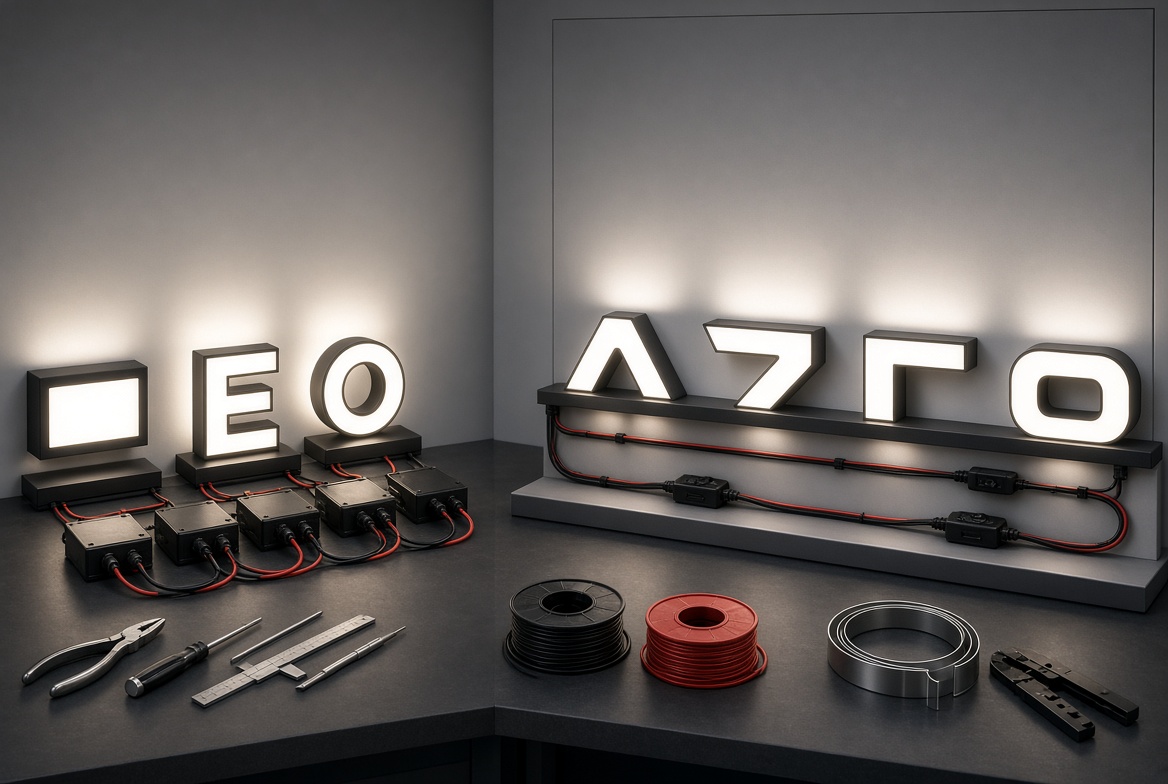
Voltage drop is the most important reason to compare 12V vs. 24V LED systems for large scale signs.
Every cable, terminal, splice, and LED circuit has electrical resistance. As current travels through those components, some voltage is lost. If the voltage reaching LEDs at the far end becomes too low, the result can include:
- Uneven brightness between the beginning and end of a letter or sign.
- Visible dimming in the farthest illuminated sections.
- Color inconsistency, particularly in white LEDs.
- Reduced lighting output in deep or long channel letters.
- Additional heat at undersized cable or poor connections.
- Higher service risk over the sign's working life.
For the same load and cable resistance, 24V systems draw less current. Since voltage drop is influenced by current, the 24V configuration generally handles distance better.
For example, consider a long illuminated wordmark with the power supply located inside a building, while the letters are mounted outside on a façade. A 12V design may require larger conductors, more power injection points, or separate power supplies closer to the letters. A 24V design can often simplify the distribution plan while preserving more consistent illumination.
That does not mean 24V eliminates voltage drop. Long runs, undersized wire, overloaded power supplies, corroded terminals, and poor splices can still create visible problems. Engineering remains necessary at either voltage.
A 12V LED system remains a practical and reliable choice in many sign projects. It should not be treated as an outdated option.
We commonly consider 12V for projects with compact dimensions, short wire paths, and easy power-supply access.
A 12V system can be a strong fit for:
- Small front-lit channel letters.
- Indoor reception logos.
- Retail display lettering.
- Compact cabinet signs.
- Small reverse-lit letters with nearby drivers.
- Existing signs designed around 12V modules.
- Projects requiring highly flexible LED-strip cutting intervals.
- Simple replacement or retrofit work where 12V components are already installed.
For short runs, the performance difference between 12V and 24V may be minimal. In these cases, choosing 12V can offer wider component availability and straightforward integration with existing sign hardware.
The primary strengths are flexibility and familiarity.
Many LED modules, LED strips, dimmers, controllers, and sign-service components are available in 12V versions. For small letters with limited internal space, compact 12V modules may be easier to arrange around returns, narrow strokes, and tight curves.
A 12V solution can also make sense when the project has several small, separate illuminated elements instead of one long connected run. Each element can receive a short, dedicated power feed, limiting voltage-drop exposure.
The weakness of 12V becomes more apparent as the sign grows. Higher current means that cable quality, cable cross-section, branch length, and connection quality become more critical.
A design that works well for a 300 mm indoor logo may not be suitable for a 12-meter outdoor channel-letter installation. When designers stretch a 12V system beyond its intended layout, the sign may look acceptable during initial testing but develop inconsistent illumination under full load or after connection aging.
For many new large-format projects, 24V is the preferred choice because it supports cleaner power distribution across longer distances.
This is particularly valuable for fabricated letters, long linear signage, and exterior installations where drivers cannot be mounted directly behind every illuminated area.
A 24V LED system is often recommended for:
- Large front-lit channel letters.
- Long building fascia signs.
- Multi-letter brand names.
- Long LED strip runs in light boxes.
- Airport, mall, and wayfinding signage.
- Deep halo-lit letters.
- Architectural edge-lighting features.
- Outdoor signs with remote power-supply locations.
- Large illuminated logos with multiple lighting zones.
In practical sign fabrication, 24V can reduce the number of parallel feeds needed to maintain even lighting. This helps make the wiring layout more organized, especially inside long letter sets or behind a large sign panel.
The main benefit is distance.
At equal wattage, lower current allows power to travel farther with less loss. This can improve illumination uniformity and reduce the need for excessive power injection.
A 24V design may also reduce cable bulk. This is useful when wires must be routed through narrow letter returns, aluminum raceways, steel frames, or limited wall cavities.
For installers, fewer injection points can mean fewer splices and fewer potential failure locations. For building owners, that can translate into a cleaner service plan over the life of the sign.
A 24V LED module must be paired with a correctly rated 24V power supply. A 12V supply cannot properly operate a 24V LED product, while supplying excessive voltage to a 12V product can damage it.
Also, not all 24V products are identical. Maximum module quantity per chain, recommended cable length, wattage per module, IP rating, operating temperature, and dimming compatibility must be verified product by product.
Before selecting 12V or 24V, evaluate the project through the following process.
Do not calculate the entire sign as one number only. Divide the sign into lighting zones based on letter groups, cabinet sections, logo components, or separate illumination circuits.
For each zone, record:
- LED module quantity.
- Wattage per module or per meter.
- Total zone wattage.
- Wire distance from the power supply.
- Required brightness level.
- Installation location.
- Access for future service.
This prevents a common planning error: selecting the correct power supply by total wattage but overlooking uneven distribution across individual long runs.
Use the LED supplier's rated wattage rather than estimating from the number of letters alone.
Total Load=Number of Modules×Wattage per Module
Then add a sensible operating margin. A power supply should not be designed to run continuously at its absolute maximum capacity. A commonly used planning approach is to size the driver with approximately 20% spare capacity, subject to the power-supply manufacturer's requirements.
For example, if one lighting zone requires 160 watts:
160W * 1.2 = 192W
A suitable driver selection would need to safely support at least 192 watts, while also matching the required output voltage.
Cable distance includes the complete path from the power supply to the LED load—not only the visible sign width.
Measure:
- Driver-to-sign distance.
- Cable routing inside the raceway or wall.
- Internal wiring through each letter.
- Return-path distance.
- Distance to secondary injection points.
A large sign with a power supply 15 meters away may need a different design than an equally sized sign with drivers installed directly behind the letters.
Power injection should be planned on the electrical drawing, not added later after dimming appears.
For long signs, consider:
- Feeding from both ends.
- Feeding the middle of long LED-strip sections.
- Dividing letters into separate circuits.
- Using dedicated power supplies for distant sign zones.
- Locating drivers close to loads where service access allows.
The goal is not to use the fewest wires. The goal is to deliver stable voltage to every illuminated component.
Final testing should include more than turning the sign on.
A professional commissioning check should confirm:
1. The voltage at the power-supply output.
2. The voltage at the first LED section.
3. The voltage at the farthest LED section.
4. Brightness consistency across every letter.
5. Secure polarity and terminal connections.
6. Power-supply temperature after operating under load.
7. Proper sealing and strain relief for outdoor wiring.
This test is especially valuable for large exterior signs, where correcting wiring after façade installation can be expensive.
The best illuminated sign is built around a complete system architecture.
A 24V LED system with poor wiring, overloaded drivers, low-quality modules, or inaccessible power supplies can still fail prematurely. Conversely, a carefully designed 12V system can deliver excellent results in a small, well-planned sign.
From a fabrication perspective, the more important questions are:
- Where will power supplies be installed?
- Can technicians access them safely?
- How many modules are connected to each circuit?
- What is the real cable length?
- Is the sign exposed to rain, heat, dust, salt air, or vibration?
- Does the letter depth allow the correct LED module spacing?
- Can the sign maintain consistent illumination after years of operation?
For large channel-letter projects, 24V frequently provides a stronger foundation because it gives the electrical layout more tolerance. That tolerance matters when a design moves from a workshop drawing to a real building with structural obstacles, long cable routes, and difficult installation conditions.
A 12V system may appear less expensive at the component level in some projects. However, the correct comparison is the total installed cost.
| Cost Area | Potential 12V Impact | Potential 24V Impact |
|---|---|---|
| LED modules | Can be economical for small signs | May have a higher unit price for some products |
| Cable | Larger cable may be required on long runs | Lower current may simplify cable selection |
| Power injection | More points may be necessary | Fewer points may be required |
| Installation labor | More routing and splicing in large projects | Cleaner layout for longer runs |
| Maintenance | More connections can create more service points | Fewer connection points may simplify servicing |
| Large-sign uniformity | Requires careful distribution planning | Better tolerance for extended distribution |
For a compact sign, 12V may offer the best value. For a large illuminated sign, 24V can reduce complexity and help avoid costly brightness corrections later.
| Sign Type | Recommended Starting Point | Why |
|---|---|---|
| Small indoor logo | 12V | Short runs and compact layouts |
| Small front-lit channel letters | 12V or 24V | Depends on cable distance and module selection |
| Large storefront letters | 24V | Better long-run power distribution |
| Long fascia sign | 24V | Lower voltage-drop risk across the sign length |
| Deep halo-lit letters | 24V | Useful when drivers are remotely located |
| Large light box | 24V | Supports long LED-strip or module runs more effectively |
| Retrofit sign with 12V hardware | 12V | Avoids incompatible replacement components |
| Architectural illuminated feature | 24V | Better suited to long, continuous lighting zones |
For large-scale illuminated lettering, 24V LED systems are usually the more practical choice when wiring runs are long, letter sets are extensive, or consistent brightness is essential from one end of the sign to the other.
Choose 12V when the sign is compact, cable distances are short, and the existing infrastructure or module design supports a simple, well-controlled installation.
The most reliable approach is to begin with the sign drawing, divide it into electrical zones, calculate each load, select compatible modules and drivers, and confirm the voltage at the farthest point before final installation. Voltage should support the sign design—not force the design to compromise.
Landea Signs Co., Ltd. can help you develop a custom illuminated lettering solution with the right LED module layout, voltage selection, driver placement, wiring strategy, face material, and fabrication structure for your project. Send us your sign drawing, dimensions, installation location, and illumination requirements for a tailored technical proposal.
No. A 24V LED system is generally better for longer cable runs and larger sign layouts, but 12V can be ideal for smaller signs, short-distance power feeds, and projects using existing 12V components.
Not automatically. Brightness depends on LED module performance, module density, optical design, driver quality, letter depth, and face material. A 24V system mainly improves the ability to maintain consistent output over longer runs.
No. The power supply voltage must match the LED module's rated voltage. Connecting a 12V LED module to 24V power can cause overheating, immediate failure, or permanent damage.
Use correctly sized cable, follow maximum module-run recommendations, divide large signs into separate lighting zones, install power injection points where required, and measure voltage at the farthest LED location under load.
Calculate the total LED load using the module or strip data sheet, then provide an appropriate operating margin. A common planning method is to allow roughly 20% additional capacity, while following the power-supply manufacturer's loading guidance.
Either can be used when designed correctly. For large outdoor signs, 24V is often preferred because remote driver locations and longer distribution routes are more common. The selected modules, drivers, wiring, enclosures, and connections must also be suitable for the outdoor environment.
Yes, but only when the circuits are intentionally separated and clearly labeled. Each LED load must receive the correct voltage from its compatible driver. Mixing voltages without a defined electrical plan creates avoidable installation and maintenance risks.
- [Graphics Pro — Making a Choice: Benefits of 12V and 24V LED Signage Systems] [graphics-pro]
- [Graphics Pro — Rock the Volt: The Many Choices in Powering LED Signage Systems] [graphics-pro]
- [Grimco — How to Eliminate Voltage Drop in Your Illuminated Signs] [connect.grimco]
- [Flexfire LEDs — White LED Sign Modules Specification Sheet] [flexfireleds]
- [UL Solutions — Requirements for Components Used in Industrial Control Panels] [ul]
- [Aussie 3D Fabrications — 24V vs. 12V LED Systems for Signage] [aussie3dfab.com]


