From idea to market-ready product, our SIGNS solutions make every stage easier, faster. Discover How We Help

Views: 222 Author: Landea Signs Publish Time: 2026-05-02 Origin: Site


As a signage manufacturer who has walked hundreds of buildings with facility managers, I've seen one pattern again and again: ADA signage is often treated as an afterthought—until an inspection, a complaint, or a lawsuit arrives. Done well, though, ADA‑compliant signs do far more than "check a box": they protect your brand, lower legal risk, and make your space genuinely easier to navigate for everyone. [rimkus]

When Congress passed the Americans with Disabilities Act in 1990, it fundamentally changed how businesses think about the built environment. At its core, ADA signage is about equal access to information: making sure people with visual, mobility, and cognitive disabilities can move through your building with confidence. [boomtownsigns]
From my experience working with overseas brands entering the U.S. market, three realities drive serious investment in compliant signs: [identiti]
- Legal and financial risk: Non‑compliance can lead to fines, lawsuits, failed inspections, and costly last‑minute retrofits. [rimkus]
- Human impact: Inconsistent, low‑contrast, or missing signs are not just inconvenient; they can be dangerous in emergencies or crowded environments. [blinksigns]
- Brand and UX: Visitors judge your professionalism by how easy it is to find a restroom, a conference room, or an exit; good ADA signage is invisible UX design that just works. [georgeandwilly]
If you operate in offices, hospitality, retail, healthcare, education, or public facilities in the U.S., ADA‑compliant signage is not optional—it is part of how you operate responsibly in 2026. [allaccessible]
The original blog you shared correctly notes that compliance depends on a sign's purpose and whether it identifies a permanent space. Building on that, current guidance and enforcement in 2025–2026 focus on four core elements: [novapolymers]
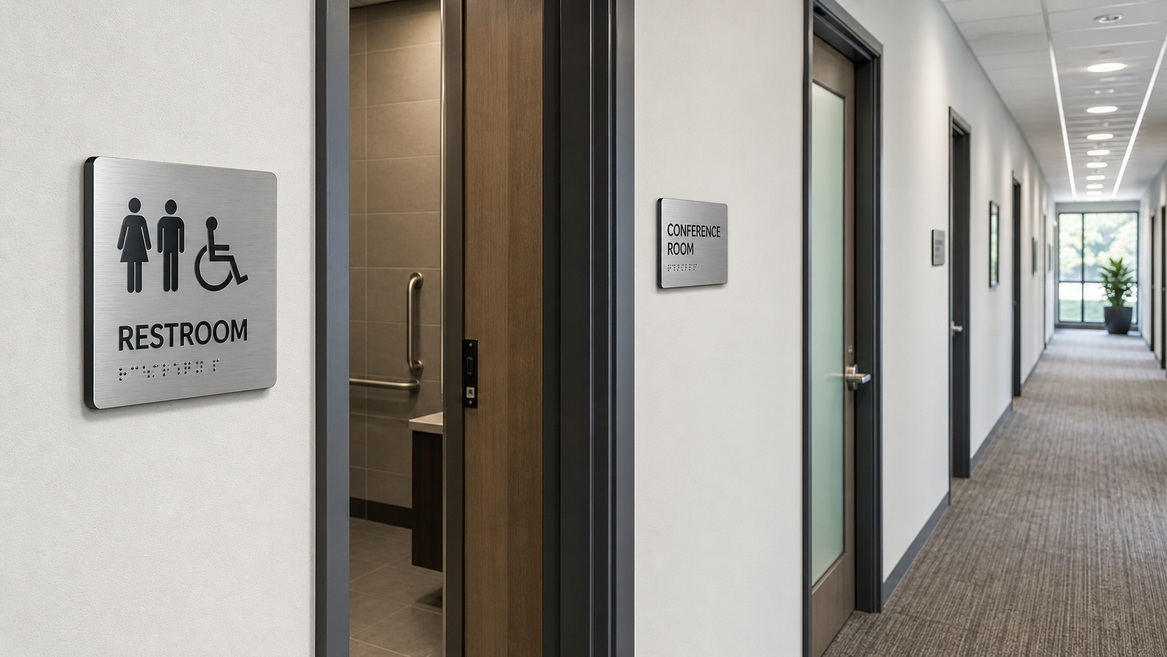
Under the ADA Standards, signs identifying permanent rooms and spaces must use tactile characters and Braille, with strict rules for design and placement. Common examples include: [solartint]
- Restrooms and locker rooms
- Conference rooms and training rooms
- Offices and reception areas
- Mechanical/electrical rooms, IT closets, storage rooms
- Stairwells, exits, and areas of refuge
By contrast, purely temporary signs (less than 7 days), building directories, menus, logos, and certain back‑of‑house signs are usually exempt from tactile requirements, though they still need to be readable. [access-board]
> From an operator's perspective, the simplest rule is: if the room use won't change often, treat the sign as "permanent" and design it to be fully ADA compliant. [solartint]
Modern codes and best practices emphasize visual clarity, especially for people with low vision. Key expectations include: [novapolymers]
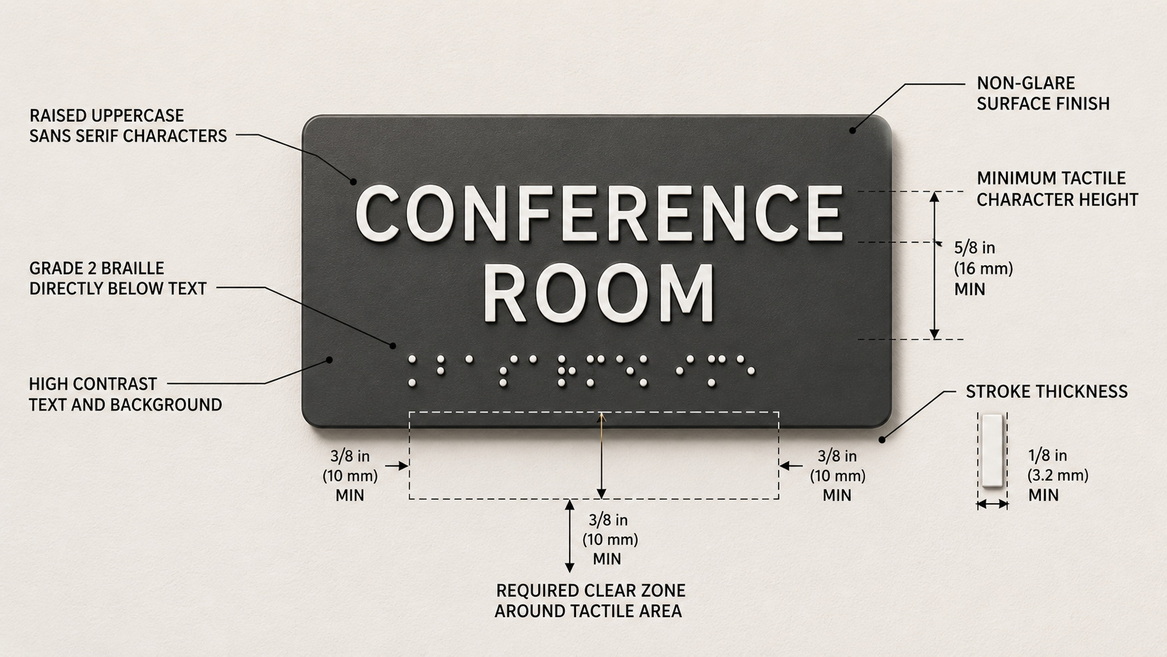
- Sans serif fonts only (e.g., Helvetica, Arial, Futura), avoiding scripts, condensed, extended, or italic fonts. [signsofourtimes]
- Character height typically in the 5/8 inch to 2 inch range for tactile text, adjusted to viewing distance. [signsofourtimes]
- High contrast between text and background (light‑on‑dark or dark‑on‑light), with many experts targeting at least a 70% contrast difference. [boomtownsigns]
- Non‑glare finish to prevent reflections under artificial lighting, especially in corridors and lobbies. [identiti]
For clients, I often frame it this way: if your signage looks great on Instagram but is unreadable from three meters away in real lighting, you have a compliance and UX problem. [georgeandwilly]
Tactile and Braille elements are the heart of ADA signage. Current guidance typically requires: [access-board]
- Raised characters in uppercase, with specific stroke thickness and spacing for finger readability. [signsofourtimes]
- Grade 2 Braille (contracted) with rounded dots, placed directly below the corresponding text and aligned horizontally. [novapolymers]
- Precise dot diameter and spacing, following ADA and ANSI A117.1 specifications. [identiti]
In practice, this is where many low‑cost signs fail: Braille that is too flat, mis‑aligned, or mistranslated is not just "imperfect"—it is non‑compliant. [dnsigns]
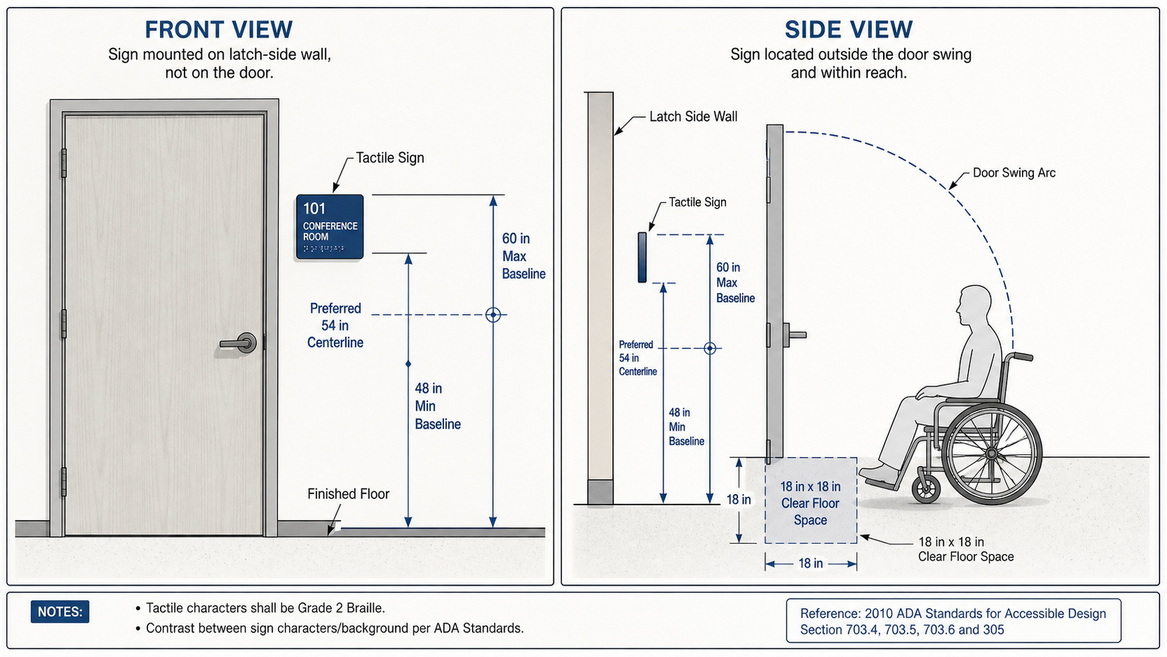
Even perfectly designed signs can fail inspection if mounted incorrectly. Core rules include: [blinksigns]
- Tactile sign baseline between 48 and 60 inches above the finished floor (AFF), measured to the baseline of the lowest raised character. [access-board]
- Latch‑side wall mounting for door‑related signs: usually on the wall adjacent to the latch side, with adequate clear floor space so a person using a mobility aid can approach and read the sign. [solartint]
- Overhead signs must provide at least 80 inches of head clearance and generally should not project more than 12 inches into the circulation path. [blinksigns]
- Parking facility signs and exterior wayfinding follow their own height and protrusion rules, which vary by jurisdiction. [blinksigns]
A simple field checklist—height, distance from door edge, clear space, and no glare—prevents expensive re‑installation later. [solartint]
The original article correctly points out that compliant signage belongs in permanent rooms and safety‑critical areas. From an operational and UX standpoint, this is how we typically map signage in office and commercial environments: [georgeandwilly]
- Restrooms and changing rooms (including gender‑neutral and accessible family restrooms)
- Conference rooms, focus rooms, training spaces
- Reception, lobby, and key service counters
- Exits and stairwells, especially fire‑exit routes and areas of refuge
- Back‑of‑house rooms that staff need to find quickly: electrical, mechanical, IT, storage, janitorial
Even when not strictly required, many clients now choose ADA‑style signage for: [georgeandwilly]
- "Employees only", "No smoking", and "Authorized personnel" signs
- Changing rooms in retail, gyms, and pools
- Multi‑tenant directory and floor‑level markers
- Wayfinding nodes in large campuses (arrows, icons, floor maps)
> In user research, we consistently see that coherent, ADA‑informed signage across a whole facility dramatically reduces "Where is…?" questions at reception. [dnsigns]
The original blog notes that it is possible to keep ADA signs "on brand"—this is absolutely true, and critical in 2026 when signage is part of your spatial branding. [dnsigns]
From manufacturing projects we handle for overseas brands entering the U.S., three strategies work well: [signsofourtimes]
1. Brand‑aligned color palettes with compliant contrast
- Choose one or two brand colors that still provide enough contrast for legibility. [boomtownsigns]
- Use your brand accent colors on borders, icons, or backplates while keeping text contrast high.
2. Custom materials and finishes that stay non‑glare
- Brushed metals, textured acrylic, or wood‑grain laminates can look premium while still meeting non‑glare requirements when finished correctly. [dnsigns]
- Avoid mirror‑polished metal or glossy glass in primary ADA signs.
3. Integrating logos and pictograms gracefully
- Logos, brand marks, and universal icons (restroom, wheelchair, stairs, elevator) can be embedded without interfering with tactile areas or Braille. [identiti]
- The key is hierarchy: keep tactile text and Braille in a clean, predictable area, using graphics as supporting elements.
As a manufacturer, this is where we add the most value: translating your brand guidelines into a fully compliant, buildable sign family. [georgeandwilly]
Most online guides stop at the 2010 ADA Standards, but enforcement and best practices have evolved. As of 2025–2026, several trends are shaping how we design and produce ADA signage: [sweetsign]
Recent guidance and local codes are pushing harder on clear contrasts, consistent typography, and non‑glare finishes, especially in emergency routes and high‑traffic circulation paths. Inspectors are more willing to question "stylish but hard‑to‑read" signs. [rimkus]
Newer enforcement patterns require more robust, clearly legible signage for: [rimkus]
- Fire exits and areas of refuge
- Evacuation maps and instructions
- Hazard warnings and equipment locations
These often require higher illumination, more robust materials, and sometimes photoluminescent features.
While static signs are still the compliance foundation, some jurisdictions now expect digital signage and kiosks to include accessible alternate formats such as text‑to‑speech or screen‑reader compatibility. In practice, this means your digital wayfinding and room booking displays must be considered part of the accessibility strategy—not a separate design track. [allaccessible]
States and cities with diverse populations increasingly require or recommend: [sweetsign]
- Gender‑neutral restroom icons alongside traditional symbols
- Universal pictograms for key services (information, elevators, first aid)
- Additional language support in public buildings
For international brands, harmonizing U.S. ADA expectations with global brand iconography is now a strategic design task, not an afterthought. [sweetsign]
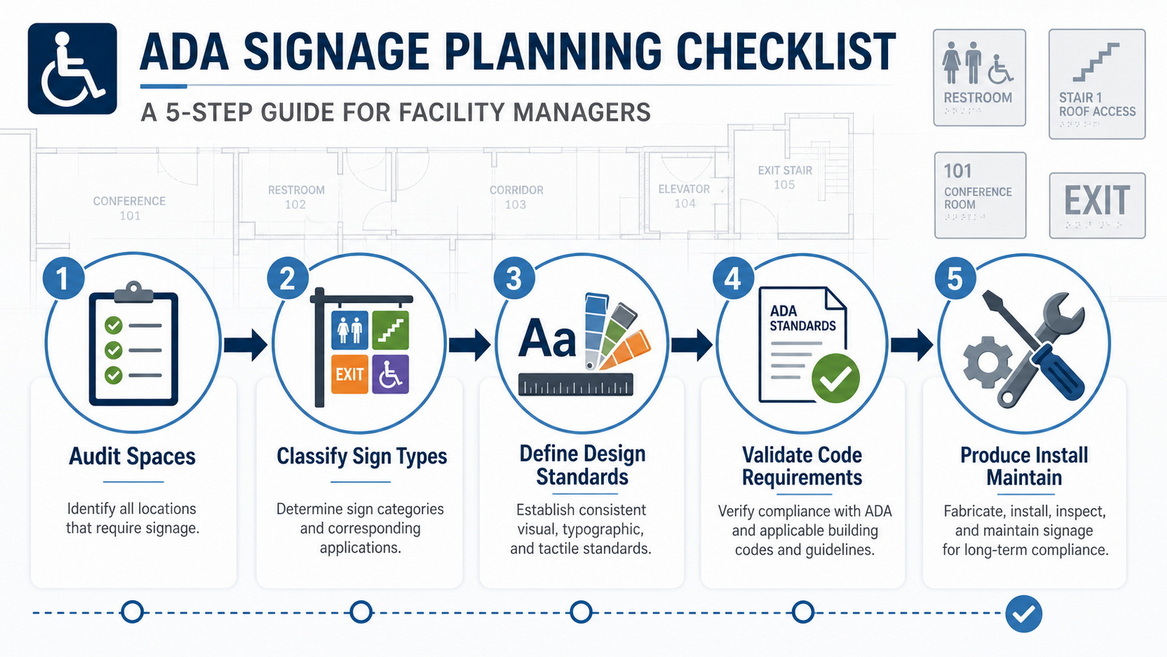
To move from "we know we need ADA signs" to a compliant, branded system, I generally walk clients through a structured process. [access-board]
- Walk each floor and list all permanent rooms and spaces.
- Identify circulation paths: entrances, corridors, elevators, stairs, exits.
- Note locations that already cause confusion or complaints from visitors.
Group your needs into clear categories: [access-board]
- Room identification signs (with tactile + Braille)
- Directional signs (visual only but high‑contrast and non‑glare)
- Informational signs (policies, hours of operation, safety instructions)
- Overhead and hanging signs
- Exterior and parking signs
Create a simple internal standard or work with your manufacturer to specify: [novapolymers]
- Approved fonts and minimum character sizes
- Color combinations that maintain compliant contrast
- Allowed materials and finishes (e.g., acrylic, metal, wood, laminates)
- Pictograms and iconography set, including ADA wheelchair symbol and restroom icons
This "mini design manual" becomes the reference for all future orders.
Because ADA interacts with local building codes (e.g., California Title 24, New York regulations), always verify: [sweetsign]
- Federal ADA requirements (2010 Standards, current DOJ guidance)
- State‑specific rules and stricter provisions
- Local enforcement patterns shared by your architect or general contractor
Working with an experienced supplier familiar with U.S. projects dramatically lowers your risk here.
- Use experienced fabricators who understand tactile production, accurate Braille, and consistent mounting templates. [access-board]
- Follow a documented installation checklist for height, distance from door, clear approach space, and mounting method. [solartint]
- Schedule periodic checks to confirm nothing has been relocated, covered, or damaged, and that any remodeled spaces receive updated signage. [rimkus]
Below is a practical snapshot of common sign types and key compliance expectations used in office and commercial projects. [boomtownsigns]
| Sign Type | Typical Use | Tactile & Braille | Mounting Height & Placement | Visual Requirements |
|---|---|---|---|---|
| Restroom identification | All public and staff restrooms | Yes, raised letters + Grade 2 Braille | 48–60 in AFF, latch‑side wall with clear approach space | High contrast, non‑glare, standard pictograms |
| Room identification | Conference rooms, offices, storage rooms | Yes, for permanent rooms | 48–60 in AFF, near latch side or at corridor entry | Sans serif fonts, correct character height |
| Directional signs | Arrows to restrooms, exits, departments | Usually no tactile, Braille optional | Often overhead or wall‑mounted along paths | High contrast, sufficiently large text |
| Exit and stair signs | Exits, stairwells, areas of refuge | Yes for identification at doors | Similar 48–60 in AFF for tactile signs; overhead for larger wayfinding | Strong contrast, may require illumination |
| Parking and exterior | Accessible parking, building entrances | Braille/tactile varies by location | Heights often ≥60 in AFF, visible from vehicles | Weather‑resistant materials, clear symbols |
As an OEM signage factory supporting brands, wholesalers, and producers, our role is to translate complex ADA rules into reliable, repeatable product lines that fit your brand and budget. [access-board]
Typical ways we support overseas partners include:
- Design adaptation: Converting existing non‑ADA designs into compliant layouts for the U.S. market while preserving core brand elements. [signsofourtimes]
- Material and process selection: Recommending substrates, finishes, and production methods that deliver consistent tactile depth, crisp Braille, and durable finishes across large runs. [access-board]
- Code‑aware engineering: Building templates that respect ADA and typical state requirements for character size, spacing, and clear zones around tactile areas. [identiti]
- Scalable production for rollouts: Ensuring that a multi‑site rebrand or new store opening program can be supplied with consistent signage across all locations.
For international brands, having a single, experienced OEM partner means you only solve the ADA puzzle once—then replicate that solution across projects and markets where U.S. codes apply. [identiti]
If you are responsible for facilities, brand rollout, or procurement, the most effective next step is simple: audit one representative building with an ADA lens. Walk it as a first‑time visitor who has low vision or relies on tactile information, and note every point where signage is missing, confusing, or hard to read. [blinksigns]
From there, you can work with a specialist manufacturer to design a coherent, compliant signage family—covering ADA‑required plaques, wayfinding, and branded accents—so that every new project and retrofit moves you in the right direction instead of adding more one‑off signs. [georgeandwilly]
1. Are all signs in my building required to be ADA compliant?
No. ADA primarily applies to signs that identify permanent rooms and spaces, as well as certain directional and safety signs. Temporary signs, menus, and most logos are usually exempt, though it is still wise to design them for basic readability. [access-board]
2. Can I use my brand font for ADA signs?
Often you can use a version of your brand font if it meets ADA criteria: sans serif, not condensed or italic, with sufficient stroke width and spacing. If your brand font is decorative or script‑like, you can reserve it for non‑tactile graphic elements and use a clean sans serif for tactile and critical text. [novapolymers]
3. Do digital directory screens replace ADA wayfinding signs?
Not yet. While digital signage is increasingly expected to offer accessible formats, static ADA‑compliant signs remain the backbone of navigation and emergency information. Think of digital as a complement, not a full replacement. [allaccessible]
4. How often should I review my building for ADA signage compliance?
Most experts recommend reviewing signage whenever you remodel, change room functions, or rebrand, and conducting a general accessibility review every few years. Regulatory updates and evolving best practices make occasional refreshes both prudent and cost‑effective. [rimkus]
5. What is the biggest mistake businesses make with ADA signage?
The most common and costly mistake is leaving signage decisions to the very end of a project, which leads to rushed, piecemeal purchases and failed inspections. Integrating ADA signage into early design and budgeting produces better UX, stronger branding, and smoother approvals. [solartint]
1. ADA Signage Guide – Office Sign Company Blog.
2. U.S. Access Board – ADA Standards, Chapter 7: Signs (Designations of permanent rooms, tactile requirements, and exemptions). [access-board]
3. U.S. Access Board – ADA Guides, Signs PDF (informational and directional signs guidance). [access-board]
4. Nova Polymers – "Your 2026 Guide to ADA Sign Design" (font, Braille, and contrast best practices). [novapolymers]
5. ADA Signage Guide 2025 – Signs Of Our Times (letter sizes, tactile character design, production considerations). [signsofourtimes]
6. Solar Tint – "ADA Sign Requirements: Complete Guide to Compliance" (installation checklist and sign types). [solartint]
7. Blink Signs – "ADA Sign Placement & Installation Guide 2025" (mounting heights, protrusion limits, and 2025 updates). [blinksigns]
8. BoomTown Signs – "Why Updating To New ADA Standards Matters In 2026" (restroom sign expectations and 2026 emphasis on clarity). [boomtownsigns]
9. Identiti – "ADA Signage Requirements in 2025: A Compliance Guide for Businesses" (Braille, digital signage, and local code integration). [identiti]
10. George & Willy – "Office Signage Guide 2026: Types, Materials & ADA Tips" (office sign types and branding considerations). [georgeandwilly]
11. DN Signs – "ADA Signage: Accessible & Compliant Custom Signs" (benefits of working with experienced ADA fabricators). [dnsigns]
12. Rimkus – "ADA Standards for Accessible Design Compliance Guide 2026" (maintenance, inspections, and evolving enforcement). [rimkus]
13. AllAccessible – "2026 US Accessibility Regulations: What's Changing and How to Prepare" (emerging trends and regulatory changes). [allaccessible]
14. SweetSigns – "ADA Signs 2026 Compliance & Design Guide" (local jurisdiction example and inclusive symbol use). [sweetsign]


