From idea to market-ready product, our SIGNS solutions make every stage easier, faster. Discover How We Help

Views: 273 Author: Landea Signs Publish Time: 2026-10-13 Origin: Site


Content Menu
● Backlit vs Non-Illuminated Hotel Entrance Signs: Quick Comparison
● What Are Backlit Hotel Entrance Signs?
>> Why the Mounting Surface Matters
● What Are Non-Illuminated Hotel Entrance Signs?
>> When Non-Illuminated Lettering Works Well
● Nighttime Legibility: Which Sign Helps Guests Find the Entrance?
>> Readability Depends on More Than Brightness
● Brand Experience: Architectural Accent or Material Statement?
● Installation, Weather Exposure, and Maintenance
>> Backlit Signs Require Coordinated Electrical Planning
>> Non-Illuminated Signs Still Need Maintenance
● Five-Year Cost Comparison: Evaluate the Whole System
>> Illustrative Energy Calculation
● A Practical Nighttime Site Test Before Ordering
>> Step 1: Document the Arrival Routes
>> Step 2: Check Lighting Dependence
>> Step 3: Test Representative Samples
>> Step 4: Agree on Acceptance Criteria
>> Step 5: Review After Installation
● Three Hotel Entrance Scenarios
>> Resort With Dark Stone Cladding
● Accessibility and Local Approval
● Choosing a Personalized Solution With Landea Signs Co., Ltd.
>> Are Backlit Hotel Entrance Signs Always Easier to Read?
>> Can Non-Illuminated Hotel Signs Work at Night?
>> Are Backlit Signs Suitable for Dark Brick Walls?
>> Do Non-Illuminated Signs Cost Less?
>> Can a Backlit Hotel Sign Be Dimmed?
>> Does Illuminated Hotel Branding Replace Required Exit Signs?
Choosing between backlit vs non-illuminated hotel entrance signs becomes especially important when your property sits on a dim street, behind landscaping, or beneath a deep entrance canopy. Guests need to recognize the hotel, identify the correct doorway, and approach with confidence. An attractive sign that disappears after sunset cannot fully perform that job.
Visibility should lead the decision, followed by architectural fit, operating costs, maintenance access, and local requirements. Backlit lettering provides its own illumination, while non-illuminated lettering depends on available light.
At Landea Signs Co., Ltd., our focus is personalized illuminated lettering solutions. Our recommendation is to evaluate the entrance as a complete arrival environment—not simply choose whichever sign looks better in a daytime rendering.
| Decision factor | Backlit hotel entrance signs | Non-illuminated hotel entrance signs |
|---|---|---|
| Lighting method | Rear-facing LEDs illuminate the mounting surface | No internal light source |
| Low-light performance | Can remain recognizable without separate façade lighting | Depends on ambient or external lighting |
| Visual character | Dimensional lettering with a halo effect | Material-focused, understated appearance |
| Initial project scope | Letters, electrical components, wiring, and controls | Letters and mounting; external lighting if needed |
| Electricity use | Consumes power while illuminated | No direct sign electricity use |
| Maintenance | Cleaning plus electrical inspection and servicing | Primarily cleaning, finish, and mounting checks |
| Best-fit setting | Dark entrances with a suitable mounting background | Entrances already receiving dependable light |
| Main limitation | Halo quality depends on the wall and installation | Nighttime legibility can deteriorate as surrounding light falls |
Neither option is universally superior. The practical question is whether guests can identify the entrance under its actual nighttime conditions.
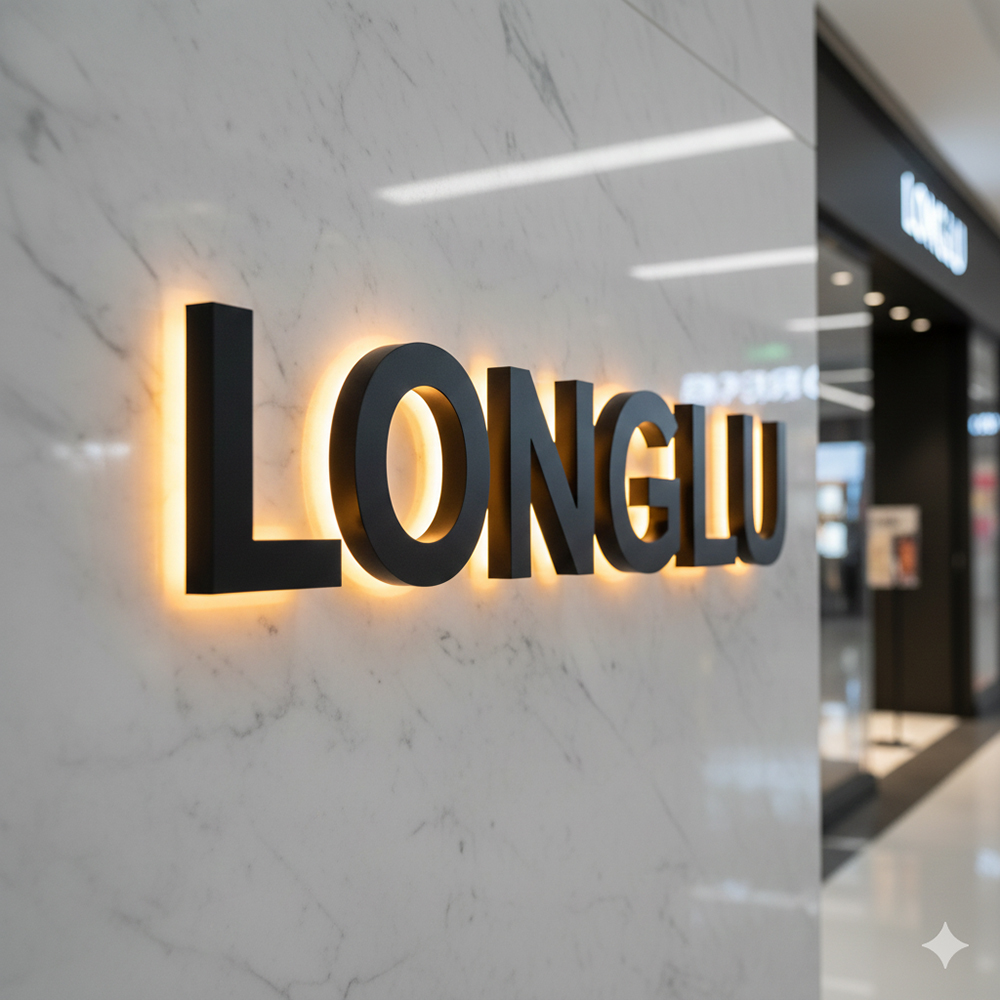
Backlit hotel entrance signs typically use reverse-lit, or halo-lit, channel letters. Their opaque faces create a dimensional daytime appearance, while LEDs direct light backward onto the mounting surface.
The reflected light forms a halo around each character. This differs from front-lit lettering, where light passes through the letter face.
For this comparison, "backlit" means halo-lit dimensional lettering—not a lightbox with an illuminated translucent panel.
The wall becomes part of the lighting system.
A light-colored, matte surface generally produces a more even halo. Dark masonry absorbs more light, while rough stone and deep mortar joints can interrupt its distribution. Glossy finishes may create distracting reflections.
Before approving custom backlit hotel signs, evaluate:
- Wall color, texture, and reflectivity.
- Letter size, stroke width, and spacing.
- Distance between letters and the wall.
- LED layout and output.
- Visibility from the actual arrival direction.
A sample letter on the intended wall is more informative than a glowing effect added to a digital rendering.
Non-illuminated hotel entrance signs have no internal lighting. Their appearance depends on material, finish, dimensional depth, and surrounding illumination.
They can suit heritage hotels, restrained architectural concepts, and entrances already served by reliable canopy or façade lighting.
However, "non-illuminated" does not necessarily mean the complete entrance identification system uses no electricity. A sign illuminated by a separate spotlight still relies on powered lighting.
This option deserves consideration when:
- Existing entrance lighting reaches the full sign.
- Lettering contrasts clearly with the background.
- Guests approach at relatively short distances.
- New electrical routing would be disruptive.
- Planning restrictions discourage internally illuminated signage.
Its suitability should be confirmed after dark. A bright lobby does not automatically illuminate lettering mounted outside the entrance.
For genuinely dark locations, backlit lettering is usually the stronger starting point because it does not depend entirely on incidental light.
Nevertheless, illumination cannot compensate for lettering that is too small, crowded, or poorly positioned.
Consider three separate tasks:
1. Detection: Can guests notice the sign?
2. Recognition: Can they read the hotel name?
3. Orientation: Can they identify the correct entrance?
A luminous logo may satisfy the first task without completing the other two. Likewise, a readable hotel name above a vehicle entrance may not clearly identify the pedestrian doorway.
Review the sign from taxi drop-off points, sidewalks, parking approaches, and accessible arrival routes.
A stronger halo is not automatically a better halo. Excessive output can compete with the architecture and create unwanted reflections or light spill.
DarkSky International's outdoor-lighting principles emphasize purposeful, targeted, low-level, controlled, and warmer-colored lighting. Applied to entrance signage, that means specifying enough light for recognition without treating maximum brightness as the objective.
Dimming can help balance the sign against surrounding façade lighting, provided the selected electrical system supports it.
Both sign types can communicate quality. They achieve it differently.
Backlit lettering creates a nighttime outline and separates the hotel name visually from the façade. It can suit boutique properties and contemporary entrances seeking a controlled architectural accent.
Non-illuminated lettering puts greater emphasis on material and craftsmanship. A carefully chosen metal finish may complement stone, timber, or traditional detailing without introducing another luminous feature.
From a design-review perspective, I would prioritize consistency across daytime and nighttime conditions. A sign should not feel refined during the day but overpowering after sunset.
Neither option guarantees increased bookings. Its immediate purpose is clearer identification and a more coherent arrival experience.

Beyond the lettering itself, a backlit installation requires decisions about power routing, driver location, controls, mounting, and service access.
For projects in the United States, UL Solutions identifies UL 48 as the standard for electric signs and distinguishes dry-, damp-, and wet-location applications. Other markets have their own approval frameworks.
Ask the supplier and installer:
- What approval documentation applies to the complete sign?
- Is the assembly suitable for its actual weather exposure?
- Where will electrical components be located?
- How will technicians access replaceable parts?
- How will mounting penetrations and water management be handled?
A component rating alone should not substitute for reviewing the complete installation.
Removing internal lighting eliminates one maintenance category, not every maintenance requirement.
Both options need suitable materials, compatible fixings, appropriate finishes, and periodic inspection. Coastal exposure, cleaning methods, and access equipment should be discussed before manufacture.
For backlit lettering, request a practical replacement procedure. An inexpensive electrical component can become costly to service if reaching it requires specialist access equipment.
A useful comparison includes installation, electricity, maintenance, and access costs—not just the quoted letter price.
Use this framework:
Five-year ownership cost = supplied sign + installation + electrical work + electricity + maintenance + access costs.
Suppose a backlit installation draws 100 watts at the electrical input and operates for 12 hours daily.
- Annual electricity: 0.1 kW × 12 × 365 = 438 kWh.
- At $0.20 per kWh: $87.60 annually.
- Five-year electricity: $438, assuming unchanged usage and tariff.
These are illustrative assumptions, not Landea product specifications or a performance guarantee.
For a non-illuminated sign, include any dedicated external lighting in the same calculation. If suitable entrance lighting already exists and would operate regardless, identify that shared cost separately.
This prevents a misleading comparison between a complete backlit installation and unlit letters that still need additional lighting.
A nighttime assessment can reveal problems that drawings overlook.
Photograph the entrance from the sidewalk, drop-off area, parking route, and accessible approach. Record approximate viewing distances and obstructions.
Identify which lights illuminate the proposed sign position. Determine whether they remain on throughout operating hours or change with timers, neighboring businesses, or landscape controls.
Compare a non-illuminated material sample and a backlit sample at the proposed location. Use the intended finish and wall background wherever practical.
Define what the installation must accomplish before production:
- Readable hotel name from agreed viewpoints.
- Clearly identifiable entrance.
- Acceptable halo consistency.
- No objectionable spill toward guestrooms or neighboring properties.
- Accessible maintenance arrangements.
Inspect the finished sign after dark and adjust compatible controls where necessary. Camera images can exaggerate glow, so include direct observation rather than judging photographs alone.
The following are hypothetical planning examples, not documented customer projects.
A hotel sits between brightly lit businesses, but its own doorway is recessed. Backlit lettering is a sensible candidate because the hotel should not rely on neighboring lights remaining on.
The design still needs sufficient letter size and a suitable wall background.
A traditional hotel has evenly distributed canopy lighting and restrictions on luminous additions. Non-illuminated dimensional lettering may provide clear identification while preserving the intended appearance.
Verify nighttime contrast before confirming the finish.
A resort wants a soft halo on deeply textured, dark stone. A backlit sample may reveal weak or uneven reflection.
Possible responses include a compatible backer panel, a different mounting position, or non-illuminated lettering with carefully controlled external lighting. Increasing LED output should not be the automatic solution.
Decorative hotel branding should not be confused with required accessibility or life-safety signage.
The U.S. Access Board distinguishes requirements according to sign function and location. Certain permanent room and space identification signs require visual and tactile features, while applicable visual criteria address matters such as contrast and non-glare finishes.
A large hotel-name sign is therefore not automatically a substitute for required entrance identification, directional information, or exit signage.
Confirm local requirements for sign dimensions, electrical approval, illumination, operating hours, and heritage restrictions before production.
For low-light hotel locations, begin with backlit lettering when independent nighttime identification is essential. Consider non-illuminated lettering when dependable existing lighting already provides clear visibility.
To discuss a personalized solution with Landea Signs Co., Ltd., send:
- Daytime and nighttime entrance photographs.
- Logo artwork and approximate sign dimensions.
- Wall material and installation height.
- Main guest viewing distances.
- Project location, budget range, and opening schedule.
Request a proposal that explains the lettering construction, mounting approach, lighting assumptions, and maintenance access—not simply an attractive visual.

No. They are useful in low light, but readability still depends on letter size, contrast, spacing, viewing distance, and halo quality.
Yes, when dependable ambient or external lighting illuminates the lettering adequately. Confirm performance during a nighttime site assessment.
They can be, but dark, textured surfaces may weaken or interrupt the halo. Test a sample and consider a suitable backer panel.
They can have a simpler initial scope. However, dedicated external lighting, electrical installation, and maintenance may narrow the overall cost difference.
Yes, if the LEDs, drivers, and controls are compatible. Include dimming requirements in the specification rather than assuming they can be added later.
No. Hotel branding and required life-safety identification serve different functions. Review the applicable accessibility and building requirements separately.
1. U.S. Access Board. "Chapter 7: Signs." Guidance on sign scoping, visual requirements, tactile identification, contrast, and non-glare finishes. [Read the guidance]. [access-board]
2. U.S. Access Board. "Chapter 4: Accessible Means of Egress." Explains accessibility requirements associated with egress identification and the distinction between tactile and illuminated exit signage. [Read the guidance]. [access-board]
3. DarkSky International. "Five Principles for Responsible Outdoor Lighting." Framework for useful, targeted, low-level, controlled, and warmer-colored outdoor lighting. [Read the principles]. [darksky]
4. UL Solutions. "Electric Sign Certification and Sign Component Solutions." Overview of electric-sign standards, custom-sign certification, and environmental installation categories. [Read the overview]. [ul]
5. S2 Signs. "Halo-Lit & Reverse-Lit Channel Letters." Trade guidance on reverse-lit construction and how mounting-surface properties affect halo appearance. [Read the technical discussion]. [s2signs]


