From idea to market-ready product, our SIGNS solutions make every stage easier, faster. Discover How We Help

Views: 222 Author: Landea Signs Publish Time: 2026-06-07 Origin: Site


Content Menu
● Why 2025 Is a Turning Point for Advertising Signage
● Core Keywords and Search Intent (Expert Note)
● Lessons from 2025's Best Signage Projects
>> Mixed Materials for Visual Depth
>> Precision Metal for Corporate and Institutional Brands
>> PVC and Formed Plastic Done Right
● Advertising Signage Trends for 2025 and Beyond
>> Trend 1: Lighting as a Signature Design Element
>> Trend 2: Color Consistency Across Markets
>> Trend 3: Functional Storytelling with Plaques and Directional Signs
● How an OEM View Changes Your Signage Strategy
>> What Successful Projects Have in Common
>> The Role of Process and Quality Systems
● Inside an OEM Signage Project: 6 Steps from Idea to Installation
>> Step 1: Quote and Design Approval
>> Step 2: Deposit and Production Start
>> Step 3: Production Updates and In-Process QC
>> Step 4: Final Inspection and Pre-Shipment Validation
>> Step 5: Shipping, Packaging, and Documentation
>> Step 6: After-Sales Support
● Example Project Types We Manufacture for Global Brands
● How to Plan Your Own "Best Signage Project" in 2026
>> 1. Define the Real-World Job of the Sign
>> 2. Choose Materials and Lighting with Lifecycle in Mind
>> 3. Involve the Factory Early
>> 4. Plan for Multi-Market Scalability
● CTA:
● FAQs: Advertising Signage Projects and OEM Manufacturing
As a Chinese OEM signage manufacturer working behind many global brand programs, I've seen first-hand how 2025 has pushed advertising signage toward smarter illumination, bolder materials, and more collaborative design-to-fabrication workflows. In this article, I'll review the best signage project trends of 2025 from both a practitioner and industry-expert perspective, and show how factories like Landea Signs Co., Ltd. help foreign brands, wholesalers, and producers turn concepts into market-ready products. [geminimade]

2025 marked a year where craftsmanship, innovation, and partner success became inseparable in signage projects. Brands no longer want just "a sign"; they want architectural-grade visual assets that strengthen identity, guide people, and work across multiple markets. [geminimade]
From our vantage point on the factory floor, three forces are reshaping the market:
- Material intelligence: Smart use of acrylic, metals, and engineered plastics instead of single-material solutions. [geminimade]
- Lighting as design, not afterthought: Halo-lit, backlit, and edge-lit systems now define the brand mood, not just visibility. [geminimade]
- Deeper OEM collaboration: Designers, sign shops, and factories increasingly co-engineer projects for cost, lead time, and compliance.
For international buyers, this means your signage partner can no longer be "just a supplier"; they must be a strategic manufacturing ally with strong process control and global standards experience.
From an SEO strategist's view, the primary target keyword for this content is "best signage projects of 2025", supported by related phrases such as "advertising signage trends 2025," "OEM signage manufacturing," and "custom illuminated signs for brands." These phrases align with buyers who are: [geminimade]
- Benchmarking signage ideas and design directions.
- Searching for manufacturing partners to execute similar projects.
- Comparing materials and lighting options before specifying a supplier.
Many of the best signage projects of 2025 share several technical and design characteristics that make them perform in the real world, not just in portfolios. [geminimade]
Projects such as SPATCO's large-scale letters used acrylic and flat-cut aluminum together, with letter heights ranging from 3″ to 30″. This kind of mixed-material design delivers: [geminimade]
- Strong contrast (metal vs. acrylic).
- Multi-layer depth without overly complex structures.
- Long-term durability when paired with high-performance coatings.
On our own production lines, we see more requests exactly like this: acrylic faces with aluminum returns, or metal logos combined with acrylic backers, optimized for shipping and installation in North America and Europe.
Medical, education, and transit applications increasingly favor metal-on-acrylic laminates and fabricated stainless-steel letters. These deliver a clean, corporate-ready aesthetic with: [geminimade]
- Fine detailing on letter edges.
- Rigid performance in both interior and exterior environments.
- Compatibility with halo-lit LED systems for premium feel.
Our engineering teams often advise clients to switch from solid metal to fabricated or laminated structures to reduce weight and cost while maintaining a high-end appearance.
PVC and formed plastic are no longer "cheap options"—they're intelligent, scalable choices when executed properly. Successful 2025 projects used: [geminimade]
- 3/8″ PVC letters in multiple heights with custom paint matching. [geminimade]
- Custom formed plastic letters up to 41″ high but lightweight for easier installation. [geminimade]
For large quantity rollouts, especially big-box retail or QSR chains, our factory frequently combines vacuum-formed plastic components with modular LED systems to balance cost, repeatability, and visual impact.
The Gemini 2025 project roundup highlights several themes that align closely with what we see in OEM manufacturing orders. [geminimade]
Halo-lit stainless-steel letters at projects like Nbisiing Secondary School show how backlit and halo-lit systems have become central to brand expression. In practice, effective illuminated signage now focuses on: [geminimade]
- Even illumination with diffused acrylic backs and quality LEDs.
- Careful color temperature selection to match brand mood.
- Serviceability, with modules and drivers accessible for maintenance.
At Landea, we design UL-compliant LED assemblies specifically for North American safety and performance standards, which is critical for long-term brand trust.
Projects using Colorlast finishes and carefully controlled paint systems underscore how important color accuracy has become. For global brands, a red or blue that looks different between Europe and the U.S. is no longer acceptable. [geminimade]
Our response has been to implement:
- Standardized paint recipes tied to RAL and Pantone references.
- Retained color plaques for recurring clients and rollout programs.
- Batch-level quality checks for every large order.
Bronze plaques and multi-sign campus solutions in the 2025 roundup show how wayfinding and storytelling signage has evolved beyond simple labels. Today, it must: [geminimade]
- Support accessibility and ADA standards where required.
- Combine text, icons, and textures to guide diverse user groups.
- Provide long-term durability in high-touch locations.
This is why a significant share of our 2026 content and R&D is dedicated to ADA-compliant and vandal-resistant signage for schools and public environments.
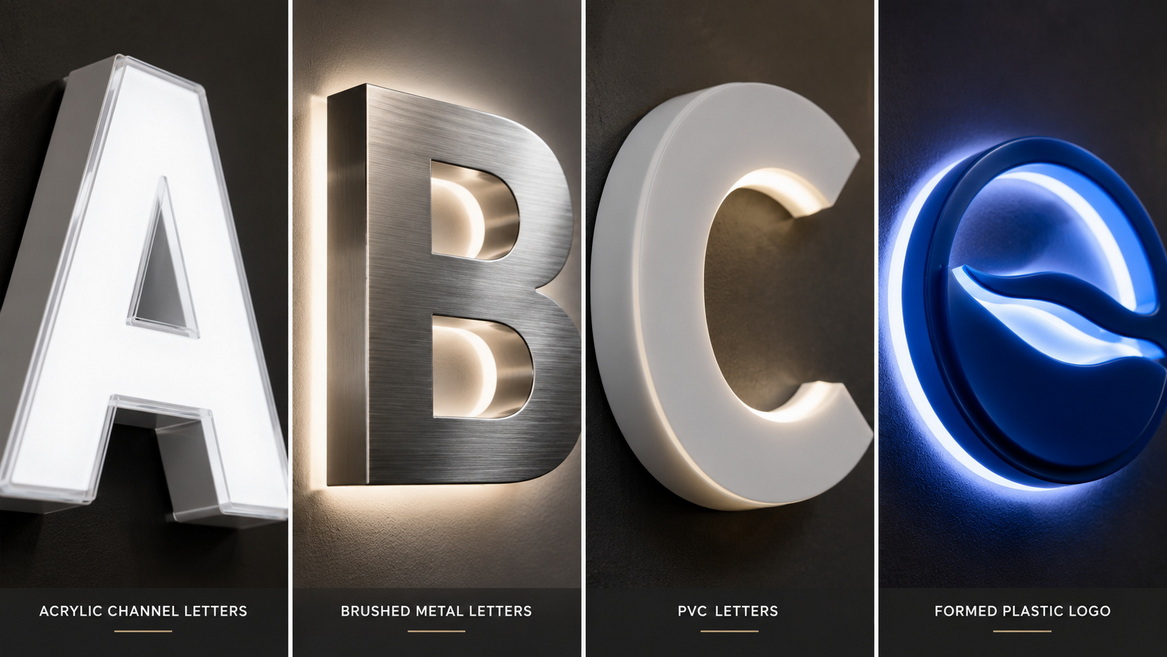
As an OEM manufacturer, we see thousands of real projects—approved, paid for, and installed—across more than 120 countries and regions. That perspective changes how we evaluate what truly qualifies as a "best signage project."
Across industries, the projects that deliver long-term success share several operational features:
- Early collaboration between design teams, sign companies, and factories.
- Clear technical drawings and realistic tolerance expectations.
- Alignment on target certifications (UL, local fire codes, ADA, etc.).
Our internal data shows that when customers engage us at the concept stage, we can avoid redesign cycles and reduce production delays, which is crucial for global rollouts.
Landea's model is built around a vertically integrated, ISO 9001-certified quality management system, supported by a 10-stage quality protocol and a dedicated QC unit. For overseas buyers, this translates into:
- Lower defect rates and fewer replacements.
- Predictable lead times—even on large orders (e.g., a 92% on-time delivery rate on a single project exceeding 1,000,000 USD).
- Traceability for every stage of production, from materials to shipping documentation.
In an era where brands are judged on every touchpoint, these process details are as important as design itself.
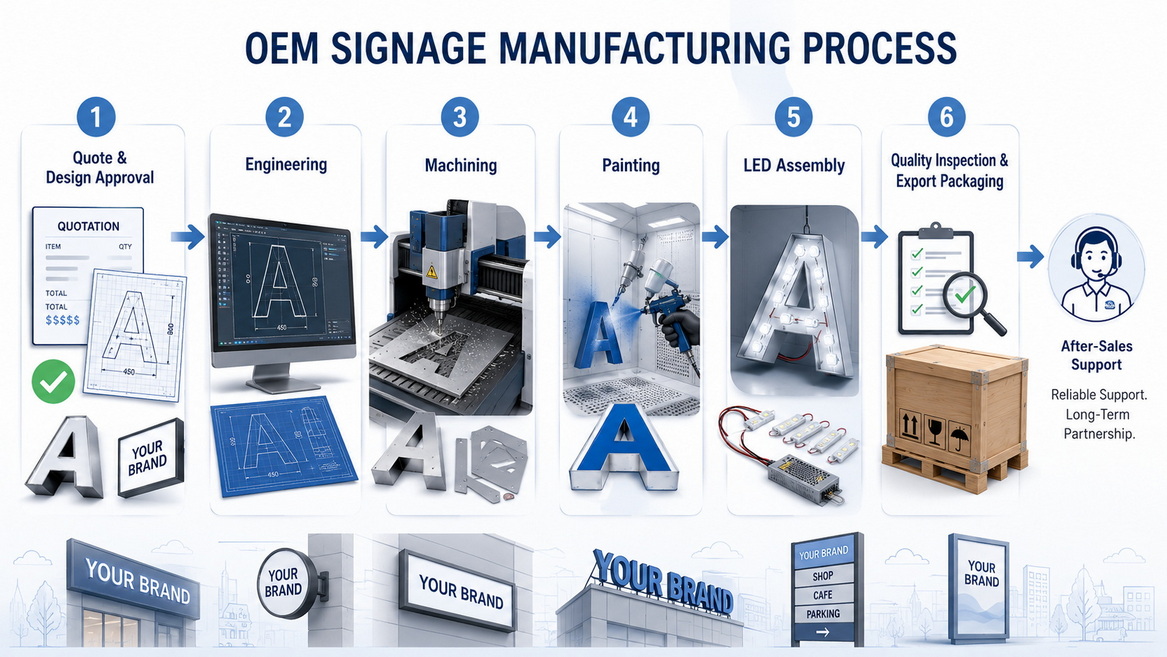
To make this more practical for sign companies, distributors, and brand owners, here's how a typical OEM advertising signage project flows in our factory.
You submit artwork, brand guidelines, and basic specs (dimensions, materials, lighting preferences). We respond with:
1. A detailed quotation, usually valid within a 12-hour decision window.
2. Up to four rendering concepts for complex signage sets, to align visual and technical expectations.
Only after your final sign-off do we move to production files and tooling.
A 50% deposit triggers the project into the factory schedule. At this stage, our engineering team:
- Reviews structural integrity and mounting methods.
- Confirms LED layout and power requirements if illuminated.
- Finalizes material sourcing, especially for metals and custom finishes.
Throughout fabrication, our QC team runs multi-stage inspections, including:
- Material verification and sampling.
- First-article inspection for new models.
- In-process checks for welds, paint, and LED performance.
Clients often receive photo or video updates, which simplifies internal approvals on the buyer side.
Before packing, we perform a final audit:
- Visual inspection for defects and finish inconsistencies.
- Lighting tests under real power conditions.
- Measurement checks against original drawings.
This stage is where we catch issues that could lead to on-site installation problems.
Once approved, we:
- Build custom packaging and templates to support safe transit and easy on-site layout.
- Prepare export documentation and tracking for your logistics team.
This is especially important for channel letters, lightboxes, and delicate acrylic features.
Post-delivery, we continue to support:
- Installation guidance and wiring clarifications.
- Maintenance advice for LEDs and exterior finishes.
- Issues handling with a complaint rate consistently below 5%.
This end-to-end support is what turns a single project into a long-term manufacturing partnership.
Below is an overview of key advertising signage categories our factory produces and how they align with 2025 trends. [geminimade]
| Signage Type | Typical Use Cases (2025) | Key Features and Options |
|---|---|---|
| Illuminated channel letters | Storefront branding, malls, QSR, automotive dealers | Front-lit, backlit, or combination lighting; aluminum or stainless returns; acrylic faces; UL-compliant LED modules |
| Custom lightbox signs | Retail displays, wayfinding, transportation hubs | Edge-lit or backlit panels; fabric or acrylic faces; slim profiles; modular sizes for rollouts |
| Blade and projecting signs | High-street retail, hospitality, pedestrian zones | Double-sided illumination; formed or fabricated metal frames; weather-resistant coatings |
| Cast and etched metal plaques | Corporate headquarters, schools, memorials | Bronze or aluminum substrates; raised/recessed copy; Colorlast or custom paint finishes |
| ADA and directional signage | Hospitals, schools, offices, public buildings | Tactile lettering, Braille, high-contrast color schemes; vandal-resistant and weatherproof options |
| Safety and traffic-related signs | School crossing, parking, facility safety | Reflective films, high-visibility colors, impact-resistant materials |
This mix reflects the same design priorities seen in Gemini's 2025 showcase—just viewed from the manufacturing side, where material, cost, and compliance constraints must be solved at scale. [geminimade]
If you want your next project to appear on a future "best signage projects" list, a structured planning approach is essential. Here is a practical framework based on real OEM experience.
Before thinking about materials, clarify:
- What behavior the sign should prompt (enter, buy, donate, register, etc.).
- What environment it must survive (UV, humidity, vandalism, interior lighting).
- What regulations it must meet (UL, local codes, ADA).
This directly drives choices around size, illumination type, and structural design. [yesco]
Think beyond first-year aesthetics:
- For long-term exterior branding, choose fabricated metal or high-grade acrylic with proven coatings.
- For budget-sensitive rollouts, consider PVC or formed plastic combined with thoughtful lighting. [geminimade]
- Match LED color temperature to interior or exterior ambiance, and specify serviceability upfront.
An experienced OEM can simulate cost, weight, and durability trade-offs before you commit.
Instead of sending final drawings and asking for a quote, treat your OEM partner as a co-designer on the technical side:
- Request feedback on mounting points and installation methods.
- Ask for alternatives if your design is over-engineered or too heavy.
- Align on packaging and logistics during the design phase for smoother rollouts.
In our own projects, early engagement often reduces total project time and lowers risk of on-site surprises.
If your brand or client operates in multiple countries, plan for:
- Standardized modules that can be reused across locations.
- Centralized color and material libraries for consistency.
- A manufacturing partner with experience shipping to your target regions (e.g., Europe, North America, Middle East, Asia).
This is where factories with international offices and established logistics networks add significant value.
Share your artwork or project brief with Landea Signs, and our engineering team will provide drawings, material suggestions, and a custom quote—often within 12 working hours.
1. What makes a signage project one of the "best" in 2025?
A top-tier signage project in 2025 balances distinctive design, reliable performance, and efficient manufacturing. It uses materials and lighting that suit the environment, maintains brand consistency, and can be replicated or scaled without compromising quality. [geminimade]
2. Why should I work with an OEM signage manufacturer instead of a local shop only?
An OEM partner gives you access to industrial-scale capabilities, international certifications, and cost-optimized production, while your local sign shop focuses on installation and local coordination. This combination is especially powerful for multi-location rollouts and export projects.
3. How long does it take to produce custom illuminated signage for export?
Lead times depend on complexity and volume, but a typical cycle—from approved drawings to ready-to-ship goods—ranges from 3 to 6 weeks, excluding shipping transit. Early technical alignment and fast feedback on renderings can significantly shorten this timeline.
4. What certifications should I look for when choosing an OEM signage factory?
For international projects, prioritize factories with ISO 9001-certified quality management and UL compliance experience for illuminated products. These credentials reduce regulatory risk and support consistent quality across orders.
5. Can one OEM supplier handle different signage types (channel letters, plaques, ADA signs, etc.)?
Yes, advanced OEM facilities like Landea integrate multiple production lines—metal fabrication, acrylic processing, ADA printing, and LED assembly—under one system. This allows you to consolidate sourcing, simplify communication, and maintain consistent quality across diverse signage types.
1. Gemini. "Best Signage Projects of 2025: Celebrating Craftsmanship, Innovation, and Partner Success." Gemini Sign Products Blog. Accessed June 2026.
https://geminimade.com/blog/best-signage-projects-of-2025-celebrating-craftsmanship-innovation-and-partner-success/
2. Gemini. "Interior Signage Trends to Grow Your Business in 2025." Gemini Sign Products Blog. Accessed June 2026.
https://geminimade.com/blog/interior-signage-trends-2025-gemini-sign-shop/
3. Landea Signs Co., Ltd. "Customized Illuminated Signs, ADA Signs, Lightbox and OEM Signage Manufacturing." Official Website. Accessed June 2026.
https://www.landeasigns.com
4. Federal Heath. "From Concept to Completion: The Process of Custom Signage Manufacturing." News & Insights, 20 July 2023. Accessed June 2026.
https://federalheath.com/company/news-insights/from-concept-to-completion-the-process-of-custom-signage-manufacturing
5. Impact Sign Company. "Custom Illuminated Signs for Outdoor Business Use." Product Guide. Accessed June 2026.
https://www.impactsigns.com/business-signs/exterior-lighted-signs/
6. YESCO. "Top Exterior Signage Trends for 2025: Shaping the Future of Outdoor Branding." Blog, 9 August 2024. Accessed June 2026.
https://www.yesco.com/shaping-the-future-of-outdoor-branding-top-exterior-signage-trends-to-watch-for-in-2025/
7. AA Signs. "Top 10 Trends in Business Signage Design for 2025." Blog, 11 December 2024. Accessed June 2026.
https://aasign.com/business-signage-design-trends/
8. Sebago Signworks. "Top Signage Trends for 2025." Blog, 30 January 2025. Accessed June 2026.
https://sebagosignworks.com/top-signage-trends-for-2025/
9. FASTSIGNS. "The Future Is Now: Digital Signage Trends in 2025." Blog, 1 January 2025. Accessed June 2026.
https://www.fastsigns.com/blog/about-products/digital-signage/the-future-is-now-digital-signage-trends-in-2025/
10. CR Signs. "Innovative Signage Trends for 2025: Transforming Outdoor Advertising." Blog, 29 November 2024. Accessed June 2026.
https://www.crsignsinc.com/post/innovative-signage-trends-for-2025-transforming-outdoor-advertising


