From idea to market-ready product, our SIGNS solutions make every stage easier, faster. Discover How We Help

Views: 222 Author: Landea Signs Publish Time: 2026-04-26 Origin: Site


As someone who has spent years helping international brands and OEM partners plan and manufacture their board room signs and corporate office signage, I've seen how the right signs quietly transform a space—and how poor choices kill first impressions. In this guide, I'll walk you through strategy, design, materials and implementation so you can upgrade your boardrooms and offices with signage that actually supports your business goals. [speedpro]

Board rooms and corporate offices are where investors, partners and top clients decide whether they trust your brand. Well‑planned signage reinforces professionalism, wayfinding and brand consistency in every interaction. [tuppsigns]
From our factory experience working with OEM customers in Europe and North America, we see three recurring outcomes when signage is done right:
- Stronger brand perception at the entrance and in meeting rooms. [flexlume]
- Smoother visitor journeys thanks to clear wayfinding and room identification. [sarasotasignshop]
- Better employee engagement, as internal spaces feel more organized, premium and aligned with company culture. [mvix]
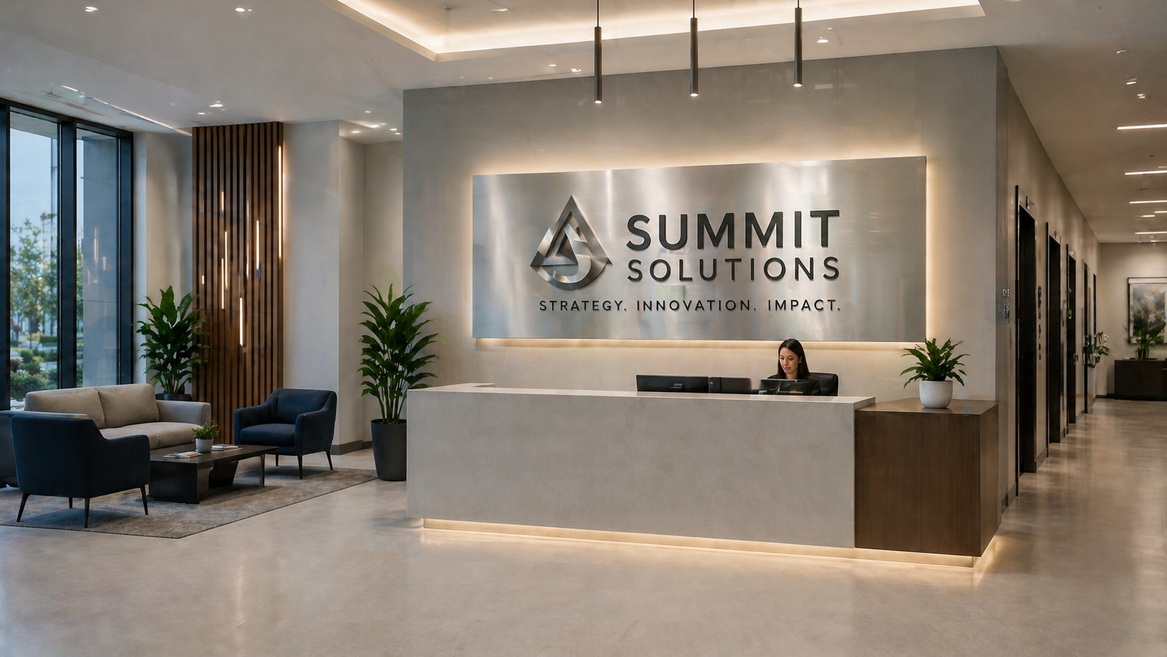
Your lobby sign is often the first "board room sign" your visitor sees before they ever enter the board room itself. It should: [carolinasignsandwonders]
- Use your primary logo and corporate colors. [agcsigns]
- Be readable from the main entrance and waiting area. [ontargetagency]
- Use premium materials (acrylic, aluminum, stainless steel, backlit letters) to signal quality. [printstop.co]
From a factory point of view, we see brushed aluminum logo panels and acrylic logo signs with standoff mounts as the most common—and cost‑efficient—choices for lobby areas.
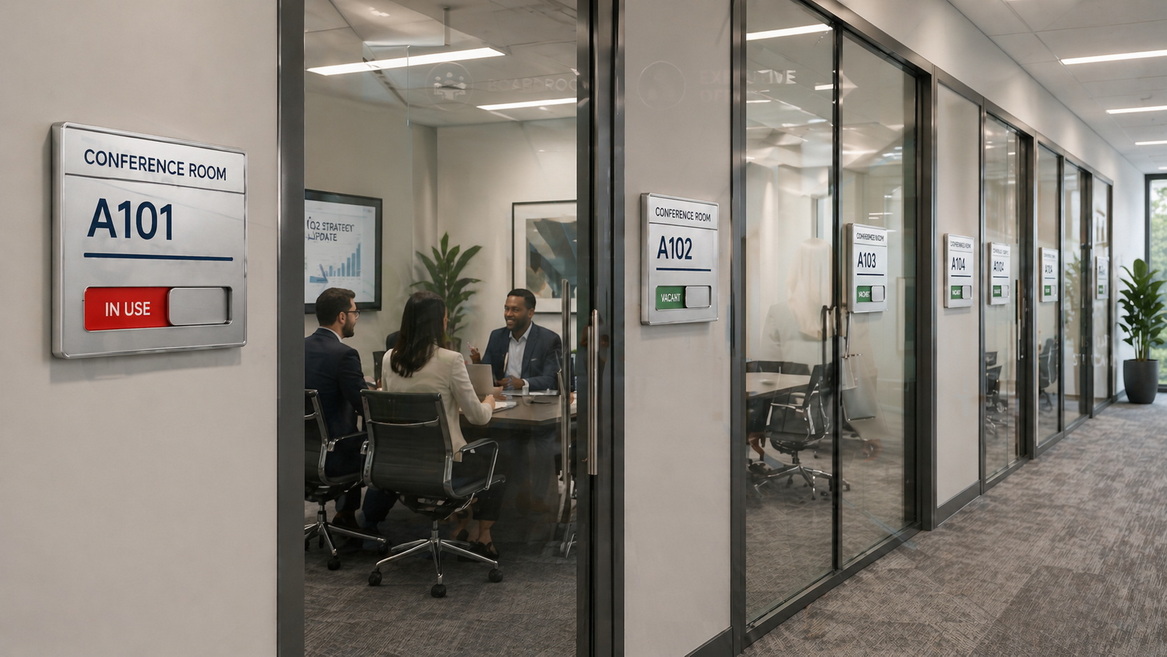
Board room door signs need to be instantly clear, even from a distance. A typical configuration includes: [sarasotasignshop]
- Room name (e.g., "Board Room", "Executive Conference Room").
- Optional room number for larger buildings.
- Changeable messages such as "In Use / Vacant" using sliding or insert signs. [mvix]
Sliding message signs are particularly popular with our OEM clients because they reduce meeting interruptions and can be manufactured in aluminum or acrylic with a simple, durable mechanism.
Conference room signs overlap with board room signage but often need extra functionality. Consider: [carolinasignsandwonders]
- Static signs (room name + capacity).
- Digital meeting room displays integrated with calendars. [mvix]
- Wall graphics indicating booking guidelines or etiquette. [carolinasignsandwonders]
If your budget is limited, start with high‑contrast static signs and plan a later phase to add digital solutions.
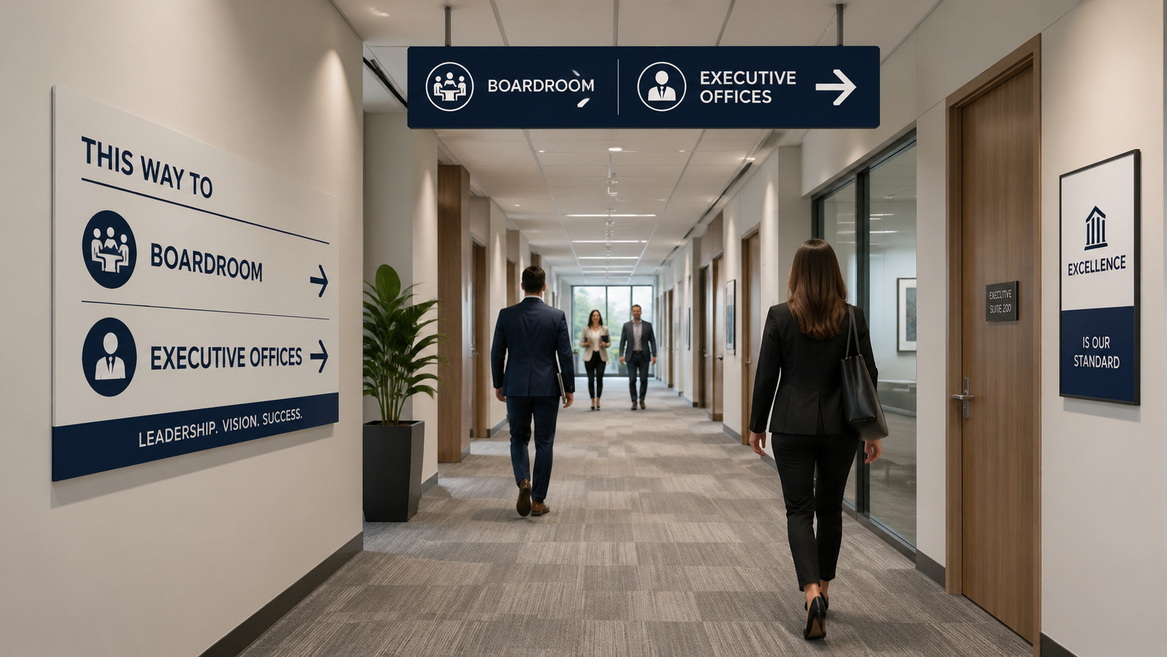
Nothing creates stress like not knowing where to go before an important meeting. Effective wayfinding starts at the entrance and leads visitors seamlessly to the lobby, board room and key offices. [sarasotasignshop]
Good directional signs:
- Follow a consistent design system (colors, icons, fonts). [thesignpack]
- Use arrows and simple wording like "Board Room →" or "Executive Offices – 3F". [ontargetagency]
- Are installed at all decision points (elevators, corridor intersections, reception). [ontargetagency]
Office name plates help visitors identify decision‑makers quickly, especially in corporate headquarters with many departments. Popular options include: [sarasotasignshop]
- Door mounted plates with name + title + department.
- Interchangeable inserts for high staff turnover.
- Desk name blocks for executives and receptionists.
As a manufacturer, we recommend modular systems for global companies, because they reduce replacement cost when people change roles.
An effective sign guides the eye from the main message to supporting details. To achieve this: [agcsigns]
- Make the room name the largest element.
- Place secondary information (capacity, schedule, phone extension) below or beside it in smaller text. [agcsigns]
- Keep margins generous to avoid a cluttered look. [agcsigns]
In real projects, we see many clients initially request fancy fonts that look beautiful on a screen but fail in the corridor. We strongly recommend:
- Use clean, sans‑serif fonts like Helvetica or similar equivalents for readability. [printstop.co]
- Ensure sufficient color contrast (e.g., dark lettering on light background). [thesignpack]
- Aim for font sizes that stay legible from expected viewing distance—larger for long corridors or open lobbies. [printstop.co]
Your board room signs are a physical extension of your brand guidelines. Maintain consistency by: [tuppsigns]
- Matching logo colors and fonts used in other brand touchpoints.
- Repeating key visual elements (icon style, edge radius, material finish) across all interiors.
- Choosing one or two base finishes (e.g., brushed aluminum + matte black acrylic) for a cohesive look.
Over years of OEM production, several material–finish combinations have proven especially effective for board rooms and corporate offices:
| Sign Type | Common Materials | Typical Finish / Effect |
|---|---|---|
| Board room door sign | Aluminum, acrylic | Brushed metal plate with printed acrylic face (agcsigns) |
| Lobby / reception logo sign | Acrylic, stainless steel, LED modules | Backlit 3D letters, halo glow on wall (tuppsigns) |
| Wayfinding directional signs | Aluminum composite, acrylic, PVC | Matte non‑glare surface, high contrast text (agcsigns) |
| Office name plates | Modular aluminum profiles, acrylic inserts | Interchangeable slots with printed inserts (sarasotasignshop) |
Acrylic and aluminum remain the most requested materials because they balance durability, premium appearance and cost, particularly for OEM projects shipped internationally. [printstop.co]
From working with international wholesalers and brand owners, this is the step‑by‑step approach that consistently produces good outcomes:
1. Map key zones
List all spaces that touch clients and executives: lobby, reception, board room, main conference rooms, CEO / CXO offices, key departments and corridors. [speedpro]
2. Define sign types per zone
For each space, define what you actually need: door signs, wall signs, wayfinding, digital displays, window graphics, etc. [speedpro]
3. Create a simple sign schedule
Build a spreadsheet with quantities, sizes, materials and installation locations. This is exactly what we use at factory level to quote and produce accurately.
4. Align design with brand guidelines
Share your brand manual (logo files, color codes, typography) with your signage provider to avoid rework and inconsistencies. [tuppsigns]
5. Prototype key signs first
For board room and lobby signs, request design proofs and, if possible, one physical sample before mass production, especially for OEM and multi‑site rollouts. [ontargetagency]
6. Plan installation and maintenance
Review wall conditions, power access for illuminated signs, and future replacement needs (e.g., name plate inserts). [carolinasignsandwonders]
Many companies still choose their corporate office signs purely based on aesthetics. Yet small data points can dramatically improve effectiveness. For example: [thesignpack]
- Footfall patterns can tell you where large, high‑contrast directional signs are essential. [speedpro]
- Meeting room usage data can justify investing in digital room signs versus static plates. [mvix]
- Visitor feedback about getting lost or being late to meetings is a signal that your current signage is failing. [sarasotasignshop]
On the manufacturing side, we increasingly see corporate clients ask for standardized room IDs and QR codes on signs, which allows them to link to digital room info, maps, or booking systems. This combination of physical signage and digital layers is becoming a practical standard in modern offices. [mvix]
Without naming specific brands, here are typical scenarios we encounter as an OEM signage manufacturer:
- Global tech headquarters
The client wanted minimalist black‑and‑white board room signs, but their corridors had very low natural light. We recommended higher contrast with a matte white background and bold black lettering plus a subtle accent line in brand color. Legibility improved significantly, and the final result still felt upscale. [thesignpack]
- Financial institution board rooms
The client originally used printed paper signs in frames for room names and schedules. We migrated them to aluminum sliding signs with "In Session / Available" windows, plus a standardized typography system across all floors. Meeting interruptions dropped and visitors reported an easier time finding rooms. [agcsigns]
- Manufacturing company corporate office
For a company with many international visitors, we added pictograms and bilingual text to wayfinding and room signs. This reduced confusion and reflected their global brand positioning more accurately. [ontargetagency]
These cases show a pattern: small design and system choices often matter more than extreme creativity when your goal is clarity and professionalism. [thesignpack]
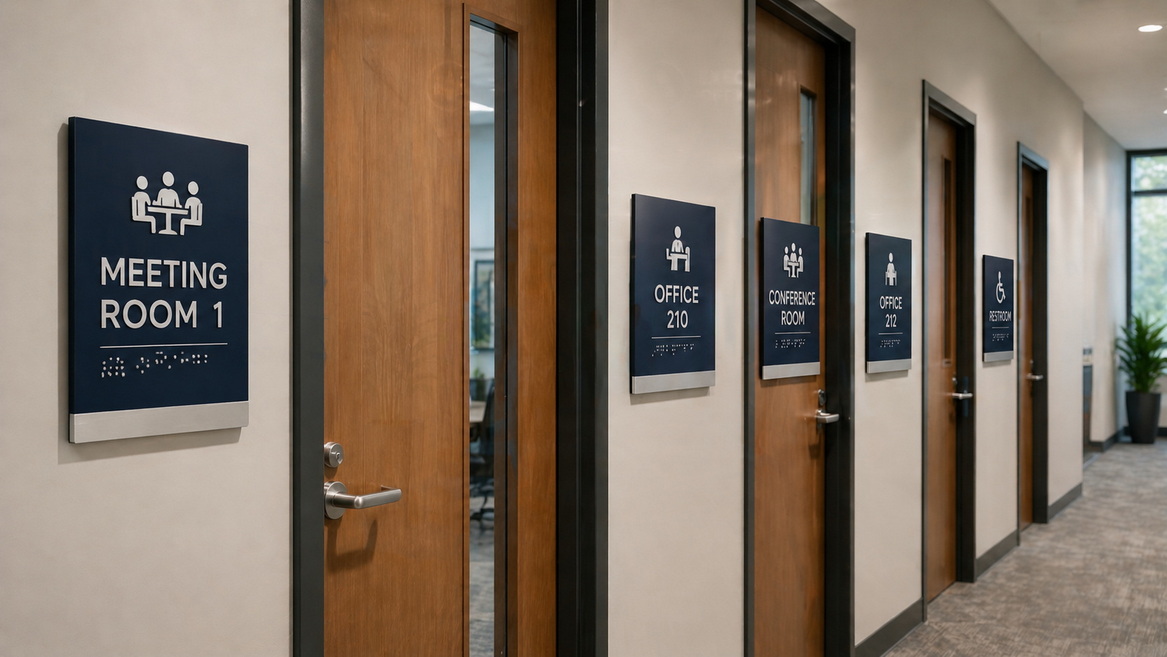
In many markets, especially North America and Europe, corporate office signs need to respect accessibility guidelines (such as tactile lettering or specific mounting heights) to support users with visual impairments. Key practices include: [carolinasignsandwonders]
- High color contrast for text and background. [agcsigns]
- Clear, non‑decorative fonts and adequate text size. [printstop.co]
- Consistent placement so users can predict where to find information on doors and walls. [ontargetagency]
Even if your local law does not strictly enforce these elements, adopting them shows respect for all visitors and employees—and reduces future retrofit costs if regulations tighten. [carolinasignsandwonders]
When you work with an experienced OEM factory, you are not just buying products—you are borrowing years of trial‑and‑error across different markets. In our own projects, we routinely support clients with:
- Design optimization (adjusting layouts, fonts and materials for mass production without losing brand integrity). [agcsigns]
- Cost engineering (suggesting material substitutions or modular systems that maintain appearance while reducing long‑term costs). [printstop.co]
- Packaging and logistics for multi‑site rollouts, with clear labeling that matches your sign schedule.
For international brands, we can also produce unbranded or dual‑branded packaging for wholesale and distribution, as well as tailor mounting systems to local installation habits. This kind of behind‑the‑scenes detail is often the difference between a smooth global rollout and a series of local frustrations.
If your board room signs and corporate office signage were installed more than a few years ago, they probably no longer reflect your brand, your technology or your workplace culture. [flexlume]
- Audit what you currently have using the steps above.
- Identify gaps in visibility, consistency and accessibility.
- Then partner with a specialist manufacturer who can convert that plan into durable, high‑quality products.
As an OEM‑focused factory, Landea Signs Co., Ltd. can support you from design refinement through production and international shipping for board room signs, corporate office signs, wayfinding and modular name plate systems. You can treat us as your behind‑the‑scenes production team while your brand stays front and center with your clients.
1. What is the difference between board room signs and regular conference room signs?
Board room signs usually serve higher‑stakes spaces (executive and investor meetings), so they typically use more premium materials and finishes than standard conference room signs, but design principles of clarity and branding remain the same. [tuppsigns]
2. How do I choose the right material for my board room sign?
Consider brand image, lighting conditions, wall surface and budget: acrylic and aluminum are versatile and cost‑effective, while stainless steel and backlit letters create a more prestigious impression. [ontargetagency]
3. Do I really need wayfinding signs if my office is not very large?
Even in smaller offices, a few well‑placed directional signs reduce confusion for visitors, improve professionalism and support a smoother experience from entrance to board room. [mvix]
4. How can I ensure my office signs are accessible and compliant?
Use high contrast, readable fonts, consistent placement and, where required, tactile lettering and appropriate mounting heights according to local guidelines or international best practices. [thesignpack]
5. What information should appear on a corporate office door sign?
Typically include room name or occupant name, title and department; in shared or high‑turnover spaces, modular inserts or sliding "In Use / Vacant" panels add flexibility and reduce future replacement costs. [sarasotasignshop]
1. WebFX – SEO Best Practices for Sign Companies. <https://www.webfx.com/industries/professional-services/sign-companies/seo/> [webfx]
2. Yoast – Tips and Tricks to Write SEO‑Friendly Blog Posts. <https://yoast.com/seo-friendly-blog-post/> [yoast]
3. SEOClarity – SEO Content Writing Guide to Creating Authoritative Content. <https://www.seoclarity.net/blog/seo-content-writing> [seoclarity]
4. Marketer Milk – How to Write SEO Blog Posts That Rank and Convert. <https://www.marketermilk.com/blog/how-to-write-seo-blog-posts> [marketermilk]
5. SpeedPro – Corporate Signage Marketing Strategy. <https://www.speedpro.com/blog/steps-to-develop-a-corporate-signage-marketing-strategy/> [speedpro]
6. TuppSigns – How to Design Corporate Office Signs That Reflect Your Brand. <https://tuppsigns.com/how-to-design-corporate-office-signs-that-powerfully-reflect-your-brand-identity/> [tuppsigns]
7. Sarasota Sign Shop – Using Interior Signs to Make Your Business Look More Professional. <https://sarasotasignshop.com/6-ways-to-use-interior-signs-to-make-your-business-space-look-more-professional/> [sarasotasignshop]
8. Flexlume – Corporate Signage Ideas to Elevate Your Brand. <https://www.flexlume.com/blog/utilize-these-corporate-signage-ideas-to-elevate-your-brand-and-transform-your-headquarters> [flexlume]
9. Mvix – 7 Ways to Use Meeting Room Signs for Your Corporate Office. <https://www.mvix.com/blog/7-ways-to-use-meeting-room-signs-for-your-corporate-office> [mvix]
10. On‑Target – Best Practices for Signage. <https://www.ontargetagency.com/faqs/what-are-on-targets-best-practices-for-signage> [ontargetagency]
11. AGC Signs – Signage Design Best Practices: What Works, What to Avoid. <https://www.agcsigns.com/blog/signage-design-best-practices-what-works-amp-what-to-avoid> [agcsigns]
12. PrintStop – Beginner's Guide to Signboard Design. <https://www.printstop.co.in/blog/business-sign-board-design> [printstop.co]
13. Carolina Signs & Wonders – Office & Corporate Signage Guide. <https://www.carolinasignsandwonders.com/resources/office-corporate-signage> [carolinasignsandwonders]
14. The Sign Pack – Design Principles for Effective Signage. <https://www.thesignpack.com/design-principles-for-effective-signage/> [thesignpack]


