From idea to market-ready product, our SIGNS solutions make every stage easier, faster. Discover How We Help

Views: 222 Author: Landea Signs Publish Time: 2026-06-08 Origin: Site


Content Menu
● What Makes a Great Signage Installation Partner?
● Why Your Installation Partner Matters So Much
● Experience and Expertise: Questions You Must Ask
● Tools, Equipment, and On-Site Capabilities
● Reputation, Reliability, and Communication
● Cost vs Value: Avoiding the "Cheapest Bid" Trap
● Coordinating Between Manufacturer and Installer
● Compliance, Safety, and Local Regulations
● Real-World Scenario – A Multi-Site Brand Rollout
● Practical Checklist for Choosing a Signage Installation Partner
● Clear Call to Action for Brands and OEM Buyers
● FAQs About Choosing a Signage Installation Partner
For international brands, wholesalers, and OEM producers, your signage installation partner is often the difference between a flawless brand experience and an expensive rework. As a manufacturing-side signage specialist working with overseas clients, I've seen projects succeed—or fail—based on that "last mile" execution on site. [brillitydigital]
In this guide, I'll walk you through how to choose a reliable advertising signage installation partner, share lessons from the field, and outline a practical checklist you can use before you hand over your next project.

A strong signage installation partner is more than a local contractor with ladders and drills. They act as an extension of your brand, protecting your reputation from the moment the crates are opened on site until the last screw is tightened. [brillitydigital]
From my experience supporting overseas brands as an OEM manufacturer, the best partners consistently deliver on three dimensions:
- Technical excellence (they know signage, not just construction).
- Process reliability (they communicate clearly and meet deadlines).
- Brand sensitivity (they understand your customer-facing standards).
If any one of these three fails, your beautifully manufactured sign can still end up misaligned, poorly lit, or non-compliant with local rules.
For many buyers, their first real-world contact with your brand is your signage—on a storefront, at a factory gate, or inside a retail environment. If the installation is sloppy, they will not blame the installer; they will blame your brand. [brillitydigital]
A poor partner can create problems such as:
- Permitting issues that delay openings or require expensive redesign.
- Electrical or safety failures that cause downtime or hazards.
- Visual inconsistencies with your brand guidelines across locations.
On the other hand, a great installation partner turns your OEM-manufactured signs into a consistent, high-impact experience across different markets and site conditions.
Core keyword focus: signage installation partner, commercial sign installation
Before you sign any contract, evaluate the experience and expertise of your signage installation partner, especially with the types of signs you actually produce. [brillitydigital]
Key questions to ask (and why they matter):
1. How many years have you been installing commercial signage?
Long-term experience usually correlates with better problem-solving when site conditions don't match the drawings. [brillitydigital]
2. Can you show relevant projects similar to mine?
Ask for cases with illuminated channel letters, large exterior fascia signs, or complex interior wayfinding—whatever matches your product line. [brillitydigital]
3. Which sign types are you most experienced with?
For example:
- Channel letters
- Flat cut letters
- Lightboxes and cabinet signs
- Pylons and totems
- Interior directional signage
4. Do you have formal training or certifications?
Look for any electrical, construction, or industry certifications that prove they can work safely and compliantly.
5. How do you handle unexpected challenges on site?
Their answer will reveal whether they escalate early, send photos, and involve your technical team—or just improvise and hope you never find out.
A professional installation partner should be able to answer these questions clearly, provide references, and share evidence of past performance.
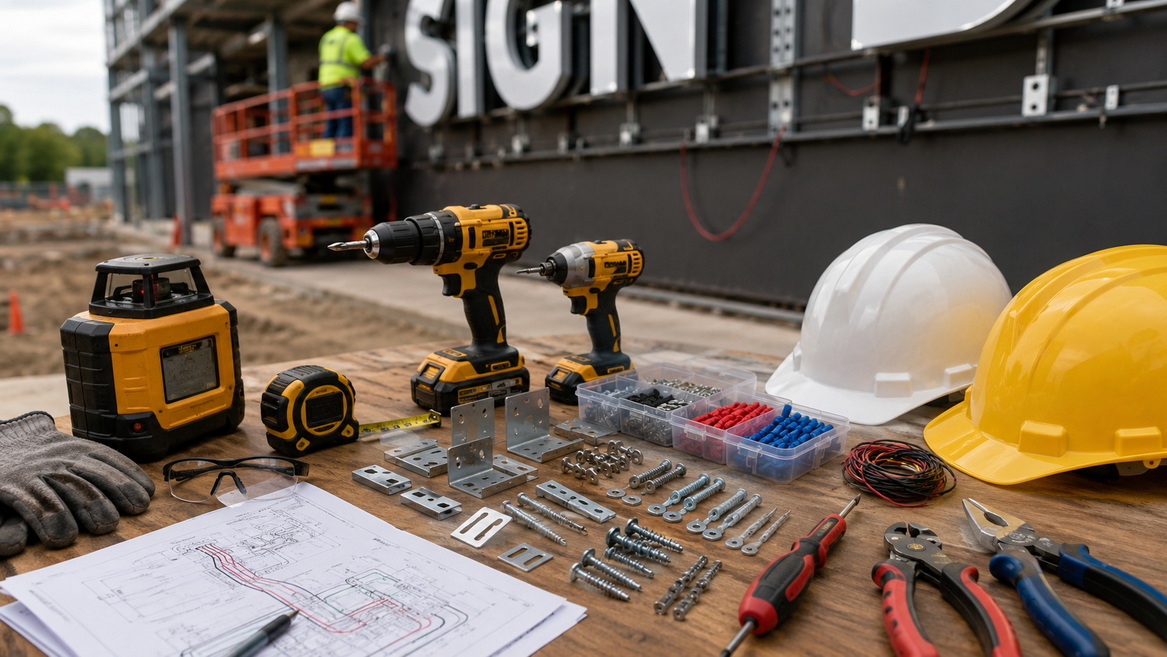
For OEM brands shipping signs worldwide, you often cannot physically be on site. This makes it critical that your installation partner has the right equipment and safety practices. [brillitydigital]
At a minimum, your partner should demonstrate:
- Proper lifting and access equipment: cranes, boom lifts, scaffolding, or other devices capable of handling your sign's weight and installation height. [brillitydigital]
- Electrical expertise for illuminated signage: ability to connect to separate power circuits, understand load calculations, and comply with local codes. [brillitydigital]
- Precision tools for alignment: laser levels, templates, and jigs for accurate spacing, especially with channel letters and modular systems. [brillitydigital]
Large, heavy, or high-mounted signs demand specialized equipment and trained operators. Underestimating this can lead to damaged signs, unsafe working conditions, or visible misalignment that ruins the final look.
Even technically strong installers can create headaches if they are unreliable or difficult to communicate with. In cross-border projects, communication and transparency are almost as important as technical skill. [semrush]
When evaluating reputation:
- Check reviews, testimonials, and case studies from other B2B clients, especially multi-site rollouts or retail chains. [brillitydigital]
- Ask for a portfolio of previous installations, including before/after images, night shots of illuminated signs, and complex site conditions they've handled. [brillitydigital]
- Understand their communication workflow:
- Who is your day-to-day contact?
- Do they provide installation photos at key milestones?
- How do they report issues that require design changes or factory support?
A trustworthy partner is open about their process, shares documentation proactively, and treats your brand's standards as seriously as you do.
Price is always under pressure in OEM projects, but in signage installation, "cheap" can quickly become "expensive" when things go wrong. [brillitydigital]
Instead of focusing on the lowest price, evaluate total value, including:
- Installation quality and alignment with brand standards.
- Compliance with permits and safety rules, reducing legal risk.
- Long-term durability, which lowers rework and maintenance costs. [brillitydigital]
Even seemingly simple signs can fail prematurely if installed poorly—water ingress, poor anchoring, or bad electrical connections can all shorten lifespan and damage your brand.
As a Chinese OEM signage manufacturer, we often act as the technical bridge between overseas brand owners and their local installers. When that collaboration works well, everyone wins.
Best practices that have helped our clients:
- Early technical alignment
Share installation drawings, mounting details, and power requirements before production is finalized. This gives the installer a chance to raise site constraints early.
- Standardized documentation
Provide clear manuals, mounting templates, wiring diagrams, and labeled components in the crate so the installer knows exactly how each element fits together.
- Photo-based quality checks
Request staged photos: unpacking, bracket installation, wiring, alignment checks, night-time illumination, and final views from customer sightlines.
By treating the installer as part of your extended production line, you drastically reduce surprises during that final mile.
One area many international brands underestimate is local compliance. Even the best-manufactured sign can be rejected, delayed, or removed if it doesn't meet local codes or permit conditions.
Your signage installation partner should be able to:
- Handle or support permit applications, including drawings, structural calculations, and sample photos where required. [brillitydigital]
- Follow local electrical and building codes, especially for illuminated and high-mounted signs.
- Comply with safety regulations for working at height, lifting operations, and public-area work.
When we work with partners abroad, we often adapt details like mounting systems or power configurations to reflect local standards shared by the installer. This collaboration greatly reduces compliance risks while keeping the brand look consistent.
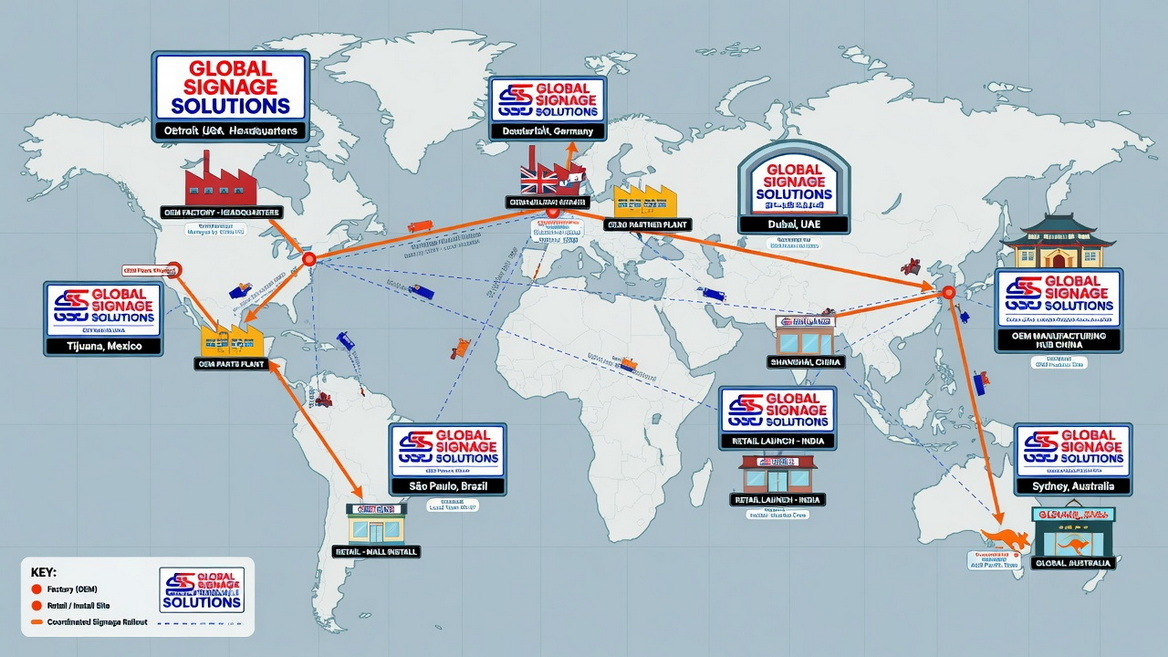
To illustrate how the right signage installation partner makes a difference, consider a common scenario: a brand is updating its image across multiple locations in different countries.
Typical challenges include:
- Different façade materials (concrete, glass, metal panels) needing different fixation methods.
- Inconsistent power access and varying local electrical standards.
- Local rules on sign size, illumination, and placement.
In projects like this, we have seen three success factors:
1. Centralized design and manufacturing
The brand works with a single OEM factory for consistent quality and branding.
2. Pre-qualified local installation partners
In each country or region, the brand selects installers who already have experience with similar signs and can prove compliance.
3. Unified technical standards and reporting
We provide consistent technical drawings and kits, while installers agree to follow a shared documentation and photo-reporting template.
When these elements are in place, brands can roll out dozens of locations with consistent visual impact and predictable timelines.
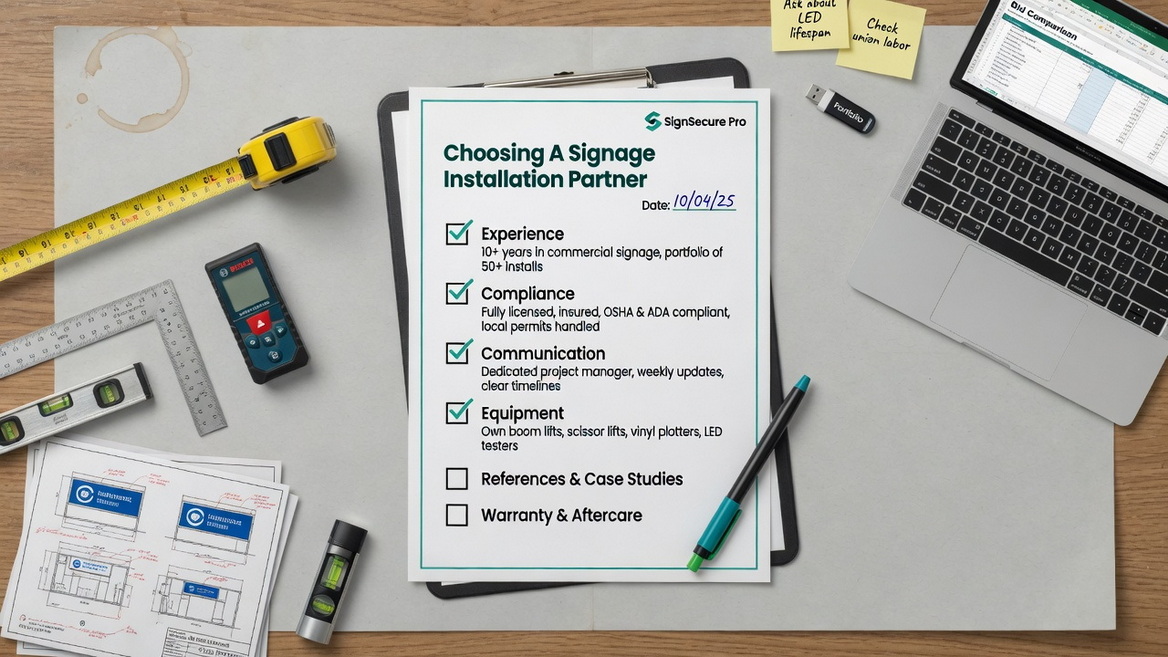
To make this actionable, here is a checklist you can use before confirming any commercial signage installation partner for your next project.
Company profile and expertise
- Proven experience with your sign types (e.g., channel letters, lightboxes, pylons).
- Documented track record in both interior and exterior installations. [brillitydigital]
- Relevant training or certifications, especially for electrical work.
Equipment and capacity
- Access to proper lifting and access equipment for the required height and weight. [brillitydigital]
- Adequate tools for precise alignment and safe work.
- Backup crews or resources for urgent or multi-site projects.
Process and communication
- Clear project manager or coordinator assigned to you.
- Standard reporting, including photos and as-built documentation.
- Agreed escalation process when site conditions don't match drawings.
Compliance and safety
- Understanding of local permit requirements and electrical codes.
- Documented safety procedures for working at height and in public spaces.
Commercial terms and value
- Transparent pricing, including any travel, access equipment, and disposal fees.
- Warranty on installation workmanship.
- Willingness to sign NDAs or brand-protection agreements when working with OEM products.
Using this checklist helps you evaluate partners objectively and protect your brand's investment.
If you are a brand owner, wholesaler, or producer planning your next signage project, now is the time to upgrade how you select and manage your installation partners.
- Review your current partner using the checklist above.
- Identify gaps in expertise, equipment, or communication.
- Shortlist new partners who can collaborate closely with your OEM manufacturer.
When you work with a manufacturing specialist like us, we can help you evaluate local installers, adapt technical designs to site conditions, and support remote quality control so that every location reflects your brand at its best.
Ready to discuss your next advertising signage project or need help assessing a local installation partner? Reach out to our team and share your project drawings, timelines, and target locations—we'll help you build a reliable installation strategy from factory to final site.
1. Why can't my general contractor just install my signs?
Most general contractors lack specialized tools and experience for illuminated or complex signage systems, which can lead to alignment, safety, or electrical issues. A dedicated signage installation partner understands the technical and visual requirements specific to signs.
2. How early should I involve the installer in my project?
Ideally, you should involve your installation partner once initial design concepts and sizes are ready, before final manufacturing. This allows them to flag site constraints and recommend mounting and power solutions early.
3. What information should I send to a potential installation partner for a quote?
Provide drawings, elevations, sign dimensions, mounting details, photos of the site, and any known electrical or structural constraints. The more accurate your information, the more realistic their quote and schedule will be.
4. How do I manage quality if my factory is overseas and the installer is local?
Use standardized documentation, request step-by-step photos, and set clear acceptance criteria in advance. Your OEM manufacturer can often help design templates, wiring schemes, and checklists that the local installer follows.
5. What are the most common mistakes when choosing a signage installation partner?
Typical mistakes include choosing purely based on price, not verifying experience with similar sign types, ignoring compliance and permit requirements, and failing to agree on communication and reporting standards.
1. Gemini Signage. "Choosing the Right Signage Installation Partner – What to Consider in a Signage Installation Partner."
<https://geminimade.com/blog/consider-a-signage-installation-partner/> [brillitydigital]
2. Semrush. "Google E-E-A-T: What It Is & How It Affects SEO."
<https://www.semrush.com/blog/eeat/> [semrush]
3. HubSpot. "Is Your Website EEAT-compliant? What Developers Should Know."
<https://blog.hubspot.com/website/eeat-compliance> [blog.hubspot]
4. TopRank Marketing. "E-E-A-T and SEO: Optimizing for Google's Guidelines."
<https://www.toprankmarketing.com/blog/eeat-seo-google-guidelines-experience-expertise-authority-trust/> [toprankmarketing]
5. AWAI. "B2B Blogging: What Every Writer Needs to Know."
<https://www.awai.com/b2b-copywriting/b2b-blogging/> [awai]


