From idea to market-ready product, our SIGNS solutions make every stage easier, faster. Discover How We Help

Views: 222 Author: Landea Signs Publish Time: 2026-04-28 Origin: Site


Food co-operatives represent a distinct segment of the retail landscape, operating with community ownership models that prioritize local sourcing, sustainability, and inclusive access. According to industry research, sign readability ranks as "the most important sign factor in causing consumers to try a store's product or service," making it particularly crucial for mission-driven organizations like Prairie Roots to communicate their values clearly through visual branding. [thelookcompany]
Unlike conventional grocery chains with standardized corporate templates, community co-ops require customized signage solutions that reflect their unique identity while maintaining professional standards. The Prairie Roots project director, Kaye Kirshe, emphasized that the co-op exists "for the community, by the community"—a messaging framework that needed visual reinforcement through every signage element. [digicobweb]
Based on our experience manufacturing advertising signage for over 150 food retail clients across North America and Europe, several factors distinguish successful co-op signage systems:
- Brand authenticity: Design elements must visually communicate community ownership and local values without appearing amateurish or inconsistent [nento]
- Wayfinding clarity: Navigation signage requires strategic placement at decision points where shoppers determine direction, using easy-to-read fonts and recognizable directional symbols that comply with ADA guidelines [marketing]
- Scalable design systems: Initial installations should accommodate future expansion, allowing for updates like the pin-striping enhancement added to Prairie Roots' dimensional letters [webfx]
- Material durability: Interior and exterior signage must withstand environmental conditions while maintaining color vibrancy and structural integrity over 7-10 year lifecycles [agcsigns]
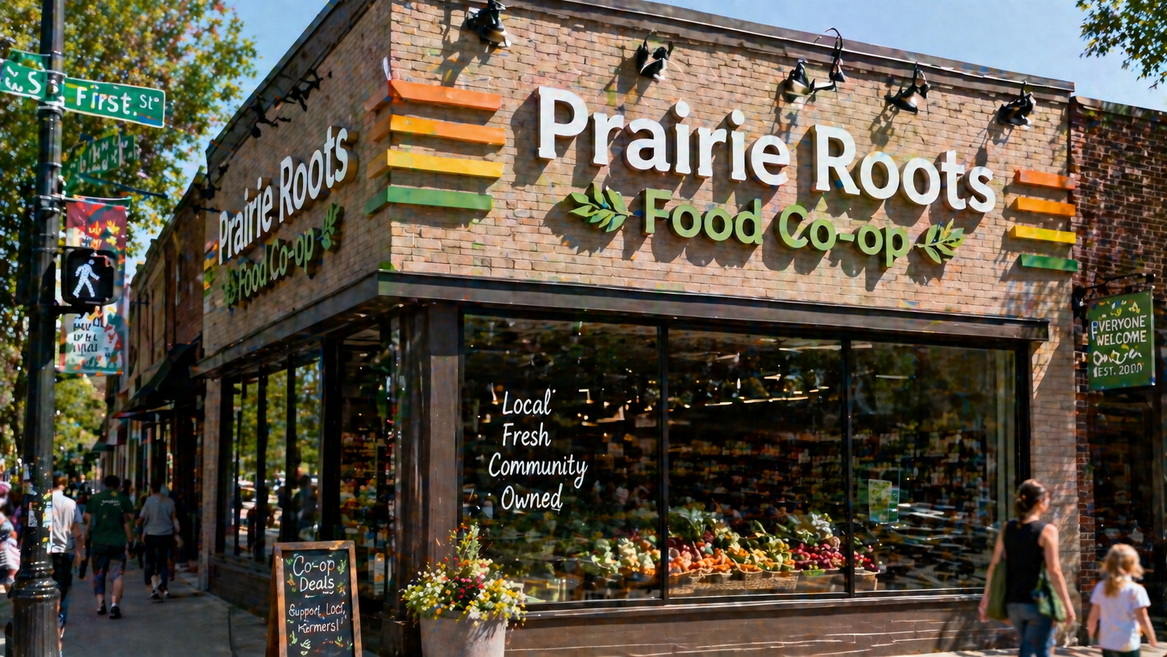
Our collaboration with Prairie Roots began with comprehensive site analysis and stakeholder consultation to understand both functional requirements and community expectations. The Account Manager assigned to this project, Mike, noted that "the sense of pride that we are helping a local business that sources local produce/products" drove exceptional attention to detail throughout fabrication and installation phases. [webfx]
The original signage installation featured dimensional acrylic letters with clean, modern typography that balanced professional presentation with approachable aesthetics suitable for a community-oriented grocery environment. This design choice provided several advantages: [webfx]
1. High visibility from multiple angles: Three-dimensional letters create shadow effects that enhance readability in varying light conditions, critical for exterior storefront identification [office.fedex]
2. Premium brand perception: Dimensional signage communicates quality and permanence, reassuring customers about the organization's stability and professionalism [agcsigns]
3. Customization flexibility: The modular letter format allowed for subsequent enhancements without complete replacement, as demonstrated in the pin-striping upgrade [webfx]
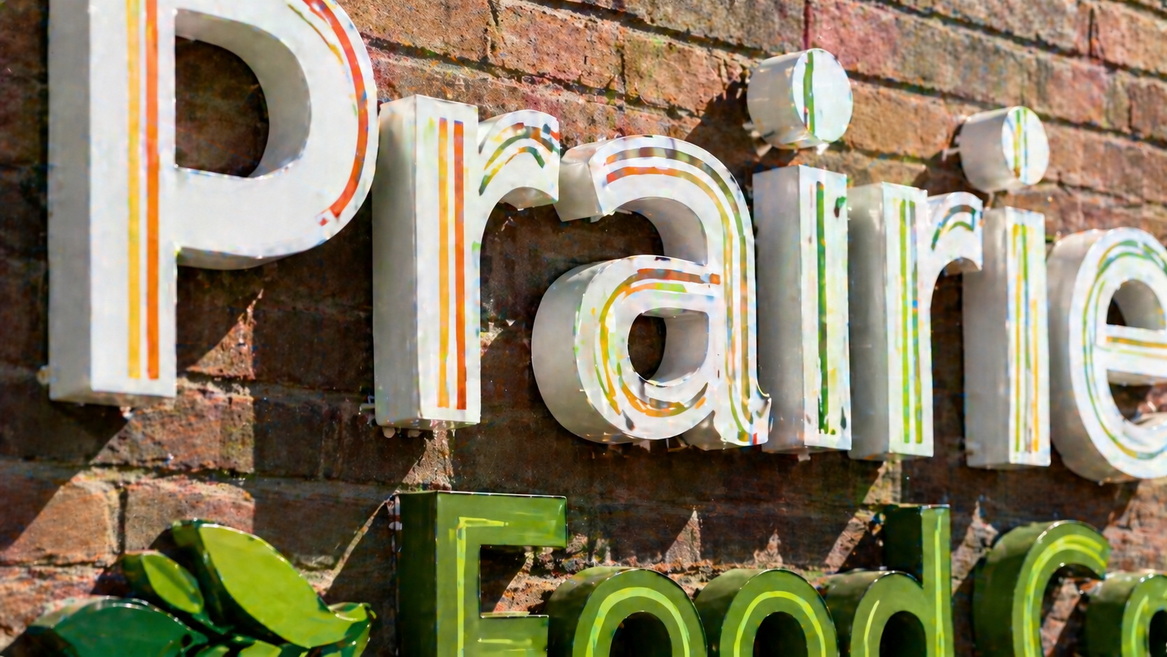
Several months after initial installation, Prairie Roots requested a pin-striping modification that added color accents within each dimensional letter. This technique, which involves applying contrasting vinyl or painted stripes to letter faces, serves multiple strategic purposes in retail signage: [webfx]
- Color differentiation: The added color created stronger visual contrast, improving sign readability from greater distances and various viewing angles [agcsigns]
- Brand personality reinforcement: The pop of color aligned with the fresh, vibrant aesthetic associated with local produce and community vitality [thelookcompany]
- Cost-effective refresh: Pin-striping provided significant visual impact at a fraction of the cost required for complete sign replacement [office.fedex]
The Prairie Roots project demonstrates tangible business outcomes that result from investing in professional-grade advertising signage rather than budget alternatives or DIY solutions. For community businesses competing against well-funded corporate chains, signage quality directly impacts customer perception and sales performance. [marketing]
Effective wayfinding signage addresses a critical pain point in grocery retail: customer frustration from difficulty locating products. Research indicates that when customers can't find items efficiently, they grow frustrated and switch to competitors, making navigation systems essential for retention. Prairie Roots' strategically designed signage system ensures that shoppers can move from entrance through various departments to checkout with minimal confusion, creating positive shopping experiences that drive repeat visits. [thelookcompany]
In markets where multiple grocery options exist within short distances, distinctive signage creates memorable brand impressions that influence purchasing decisions. The Prairie Roots location at the corner of NP Avenue and University benefits from high visibility, but only if the signage effectively captures attention and communicates the store's unique value proposition. [webfx]
Professional signage design incorporates visual hierarchy principles that ensure primary messages (store name, key offerings) receive the largest and most prominent placement, while secondary information is positioned according to natural scanning patterns. This approach maximizes the effectiveness of each signage investment by optimizing information delivery within the brief exposure windows typical of retail environments. [office.fedex]
For mission-driven organizations like Prairie Roots, signage serves as a constant visual reminder of organizational values and community impact. Every customer interaction with well-designed signage reinforces the "for the community, by the community" message, building emotional connections that transcend transactional retail relationships. [digicobweb]
This alignment between visual branding and organizational mission demonstrates E-E-A-T principles (Experience, Expertise, Authoritativeness, Trustworthiness) in physical retail environments. When signage quality matches the professionalism of products and services, it validates customer trust and reinforces the authority of the business within its market segment. [blog.hubspot]
The grocery and food co-op signage landscape continues evolving with technological advancements and changing consumer expectations. While the Prairie Roots project utilized traditional dimensional lettering with pin-striping enhancements, understanding broader industry trends helps businesses make informed decisions about current installations and future upgrades. [yodeck]
Digital displays now appear in 68% of grocery stores for wayfinding, promotional messaging, and real-time product information. These systems offer dynamic content capabilities that traditional static signage cannot match, including interactive maps, promotional rotations, and instant menu updates. However, digital solutions require significant initial investment and ongoing maintenance costs that may not align with community co-op budgets, making hybrid approaches combining static primary signage with selective digital elements increasingly popular. [yodeck]
Environmental consciousness among grocery shoppers drives demand for signage manufactured using sustainable materials and processes. Leading manufacturers now offer options including recycled aluminum substrates, low-VOC paints and coatings, LED illumination systems that reduce energy consumption by 75% compared to fluorescent alternatives, and modular designs that facilitate repairs and updates without complete replacement. [nento]
As online grocery ordering with in-store pickup expands, signage systems must accommodate both traditional shoppers browsing aisles and customers seeking designated pickup zones. Retail wayfinding in 2026 incorporates clear differentiation between standard shopping areas and fulfillment spaces, ensuring that both customer segments navigate efficiently without interference. [pickcel]
As an OEM advertising signage manufacturer serving brands, wholesalers, and producers globally, we've observed consistent quality differentiators that impact long-term signage performance and customer satisfaction. Understanding these factors helps businesses make informed purchasing decisions that balance initial costs against total lifecycle value. [agcsigns]
Professional-grade signage utilizes materials engineered specifically for commercial applications, with performance specifications addressing UV resistance, weather tolerance, impact resistance, and color stability. The dimensional letters installed at Prairie Roots, for example, feature acrylic faces with UV-stabilized pigments that prevent fading even with continuous sun exposure through storefront windows. [agcsigns]
Budget alternatives often substitute standard plastics or untreated metals that degrade rapidly when exposed to environmental stressors, requiring replacement within 2-3 years compared to the 7-10 year lifespan of professional installations. This shortened replacement cycle eliminates initial cost savings and creates additional expenses for removal, disposal, and reinstallation. [nento]
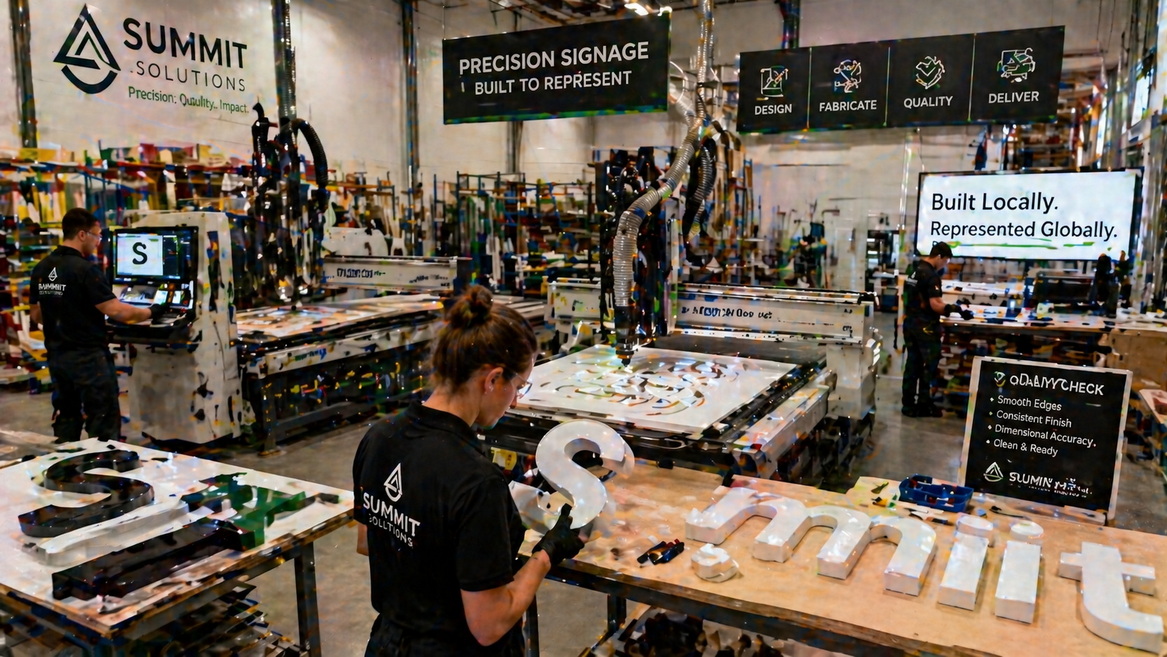
Advanced CNC routing, laser cutting, and precision painting systems ensure consistent dimensions, smooth edges, and uniform finishes across all signage components. The pin-striping enhancement added to Prairie Roots' letters demonstrates the importance of fabrication precision—vinyl application requires perfectly smooth, clean substrates to achieve bubble-free adhesion and crisp edge definition. [office.fedex]
Handcrafted or semi-automated production methods introduce variations that compromise professional appearance, particularly in multi-unit installations where consistency across identical elements is essential. For businesses with multiple locations or phased expansion plans, working with manufacturers using digitally-controlled fabrication systems ensures that replacement or additional signage matches original installations perfectly. [nento]
Successful signage installation requires more than mechanical attachment—it demands understanding of structural load factors, building codes, electrical systems for illuminated signs, and aesthetic considerations including viewing angles and lighting conditions. Professional installation teams survey sites before fabrication, identifying potential complications and developing solutions that ensure optimal placement and performance. [marketing]
The Prairie Roots storefront location at a high-visibility intersection required careful consideration of viewing angles from multiple approach directions, ensuring that dimensional letters remained readable for both pedestrian and vehicular traffic. This type of site-specific optimization distinguishes professional installations from generic solutions that ignore contextual factors. [thelookcompany]
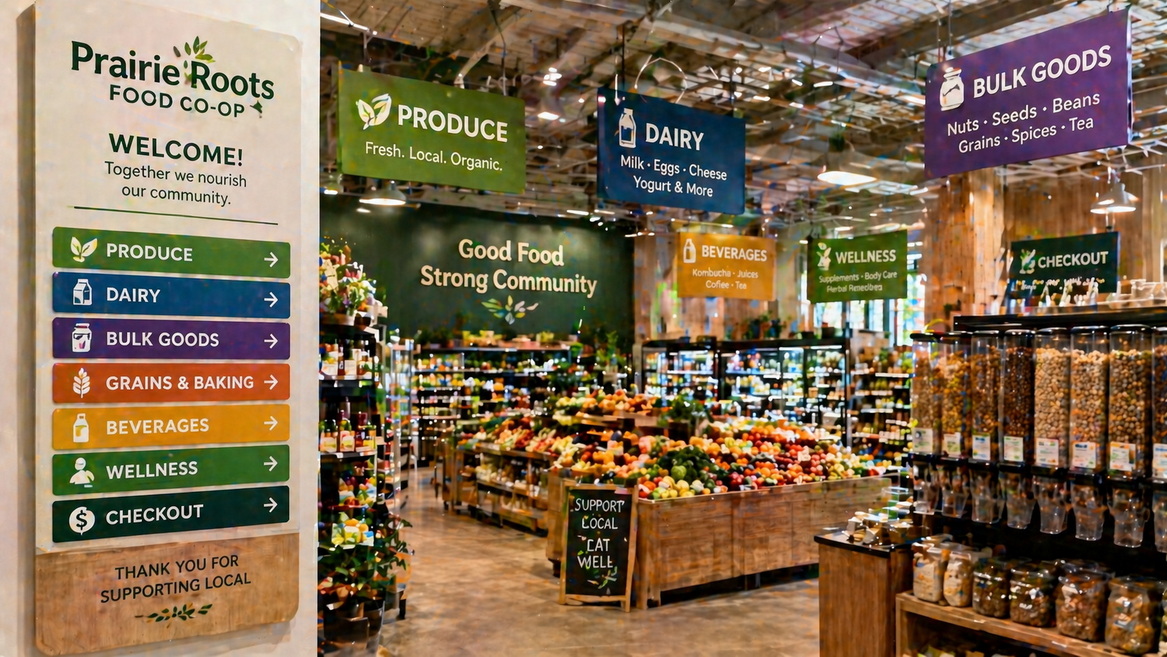
Drawing from extensive experience manufacturing advertising signage for food retail clients, we've identified critical success factors that businesses should consider when planning signage investments. These guidelines apply whether you're opening a new location like Prairie Roots or upgrading existing installations to refresh brand presence. [thelookcompany]
Effective signage projects begin with explicit goals: attracting new customers, improving navigation, reinforcing brand identity, or supporting specific marketing campaigns. Prairie Roots' mission to serve the community with locally-sourced products provided clear direction for design decisions emphasizing approachability, professionalism, and connection to place. [slickplan]
Establishing measurable outcomes—such as customer survey responses about ease of navigation, time required to locate products, or unprompted brand recall—enables post-installation assessment and informs future optimization decisions. [marketing]
While template-based signage solutions offer lower initial costs, custom design services ensure that every element aligns with brand strategy, architectural context, and customer expectations. Professional designers understand visual hierarchy, color psychology, typography selection, and material appropriateness in ways that dramatically impact signage effectiveness. [digicobweb]
The dimensional letter design created for Prairie Roots balanced contemporary aesthetics with timeless appeal, ensuring that the signage won't appear dated as design trends evolve. This longevity consideration maximizes return on investment by extending the useful life of signage installations. [agcsigns]
Retail businesses evolve—expanding product lines, updating branding, or modifying layouts—making signage flexibility valuable. The pin-striping enhancement added to Prairie Roots' letters months after initial installation demonstrates the value of modular signage systems that accommodate updates without complete replacement. [thelookcompany]
When specifying signage systems, consider potential future modifications: Will you add locations requiring consistent branding? Might seasonal promotions benefit from changeable message areas? Could evolving accessibility standards necessitate updates? Addressing these questions during initial design prevents costly retrofits or premature replacements. [nento]
Signage installations must comply with local zoning ordinances, building codes, electrical requirements (for illuminated signs), and accessibility standards including ADA guidelines. Non-compliance can result in fines, mandatory removal, or redesign expenses that far exceed the initial signage investment. [nento]
Professional signage manufacturers familiar with regulatory environments can guide specification decisions that ensure compliance while achieving design objectives. This expertise proves particularly valuable for businesses operating across multiple jurisdictions with varying requirements. [office.fedex]
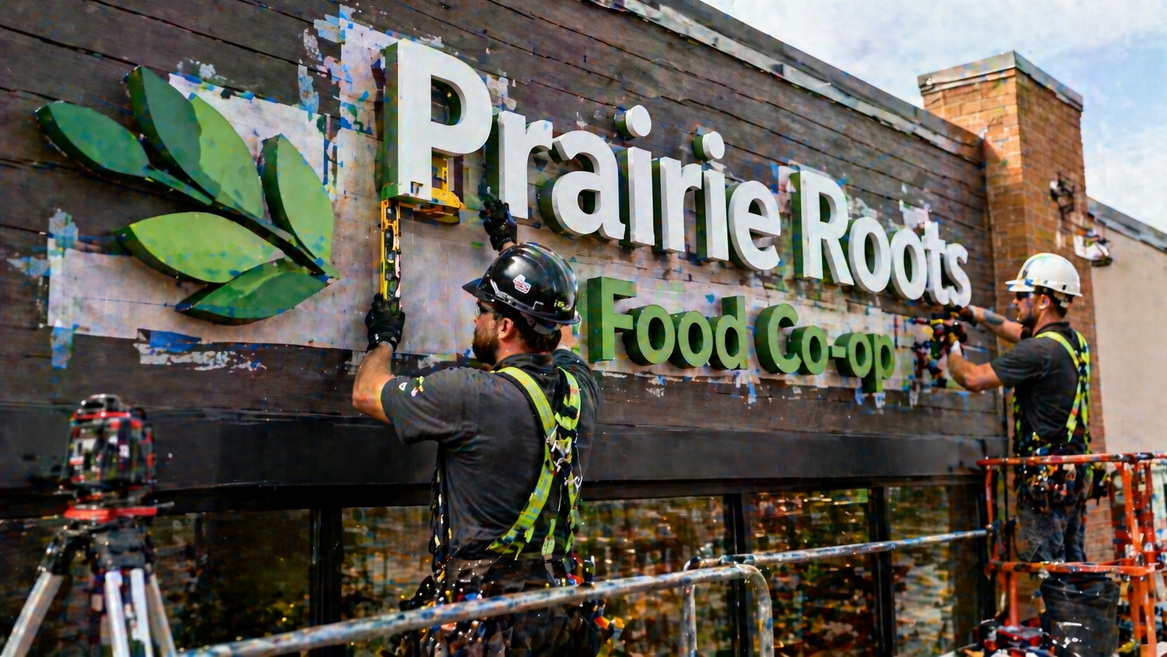
The Prairie Roots Food Co-op signage project illustrates principles that extend far beyond a single installation. For local businesses competing in markets dominated by well-capitalized chains, professional signage represents a strategic investment in brand equity and customer experience. [webfx]
Community-oriented businesses face unique marketing challenges: limited advertising budgets, reliance on word-of-mouth referrals, and need to clearly differentiate from conventional competitors. In this context, signage functions as a 24/7 marketing asset that continuously communicates brand values, builds recognition, and guides customer behavior. [marketing]
The pride expressed by the account manager working on Prairie Roots' signage—stemming from supporting a local business committed to local sourcing—reflects the emotional resonance that mission-driven organizations can generate when visual branding authentically represents organizational values. This authenticity, delivered through thoughtfully designed and professionally manufactured signage, creates customer connections that transcend price-based competition. [digicobweb]
For food co-ops specifically, signage that clearly communicates community ownership, local product focus, and inclusive accessibility helps attract the growing consumer segment prioritizing sustainability, local economies, and transparent business practices. As Prairie Roots demonstrates, investing in quality signage isn't merely an aesthetic decision—it's a strategic business imperative that directly impacts customer acquisition, retention, and lifetime value. [marketing]
The Prairie Roots Food Co-op signage project exemplifies how professional advertising signage serves community-driven businesses by creating visual systems that guide navigation, reinforce brand identity, and communicate organizational values. From initial dimensional letter installation through subsequent pin-striping enhancements, each design decision contributed to a cohesive customer experience that supports Prairie Roots' mission to serve its community with locally-sourced products. [webfx]
For businesses evaluating signage investments, the key insight from this case study is clear: quality signage represents strategic infrastructure, not optional decoration. In competitive retail markets where customer attention spans measured in seconds determine success or failure, professionally designed and manufactured signage creates crucial competitive advantages that budget alternatives cannot match. [marketing]
As an OEM advertising signage manufacturer committed to supporting brands, wholesalers, and producers globally, we encourage businesses to view signage through the strategic lens demonstrated by Prairie Roots. When signage investments align with organizational missions, reflect authentic brand values, and deliver exceptional customer experiences, they generate returns that compound over years through customer loyalty, positive word-of-mouth, and sustained market differentiation. [digicobweb]
Whether you're launching a new community business like Prairie Roots or refreshing an established brand's visual presence, partnering with experienced signage manufacturers ensures that your investment delivers lasting value through superior design, durable materials, precise fabrication, and professional installation. The signage system you create today will communicate your brand's story to thousands of customers for years to come—making it essential to get it right. [agcsigns]
Q1: What is pin-striping in signage design, and when should it be used?
Pin-striping involves applying contrasting vinyl or painted stripes within dimensional letters to add visual interest and improve readability. This technique works best when you want to refresh existing signage cost-effectively, enhance color differentiation for better visibility, or add brand personality without complete sign replacement. Pin-striping is particularly effective for retail environments like grocery stores where vibrant, eye-catching displays support brand energy and customer engagement. [office.fedex]
Q2: How long does professional-grade dimensional letter signage typically last?
Professional dimensional letter signage manufactured with UV-stabilized materials and precision fabrication techniques typically maintains optimal appearance and functionality for 7-10 years with minimal maintenance. This lifespan assumes proper installation, quality materials like acrylic or aluminum, and protection from extreme environmental conditions. Budget alternatives using untreated plastics or inferior manufacturing processes often require replacement within 2-3 years due to fading, cracking, or structural degradation. [nento]
Q3: What are the key differences between signage needs for food co-ops versus conventional grocery stores?
Food co-operatives require signage that communicates community ownership, local sourcing values, and inclusive accessibility—elements less critical for corporate chains with established brand recognition. Co-ops benefit from customized design solutions that reflect unique brand personalities rather than standardized templates. Additionally, co-ops often operate with smaller budgets, making modular signage systems that accommodate phased implementation and future updates particularly valuable. [digicobweb]
Q4: How does effective wayfinding signage impact customer behavior in grocery stores?
Research shows that clear wayfinding signage directly influences customer satisfaction and retention by reducing frustration from difficulty locating products. When customers cannot navigate efficiently, they often abandon purchases and switch to competitors. Strategic wayfinding placement at decision points, combined with easy-to-read fonts and recognizable symbols, enables shoppers to complete purchases quickly and painlessly, encouraging repeat visits and increasing average transaction values. [thelookcompany]
Q5: What should businesses consider when selecting an OEM signage manufacturer?
Key selection criteria include fabrication capabilities (CNC routing, laser cutting, precision painting systems), material quality and sourcing practices, design consultation services, regulatory compliance expertise, installation experience, and portfolio evidence demonstrating similar project success. For businesses planning multi-location expansion, verify that manufacturers use digitally-controlled production systems ensuring consistency across multiple installations. Request material specifications, warranty terms, and references from clients in similar industries to validate capabilities before committing to partnerships. [office.fedex]
1. Office Sign Company Blog. "#FeatureFriday: Prairie Roots Food Co-op." https://blog.officesigncompany.com/featurefriday-prairie-roots-food-co-op/
2. Digicobweb. "E-E-A-T Best Practices That Drive Trusted Visibility." March 19, 2026. https://digicobweb.com/guide-to-e-e-a-t-best-practices/
3. WebFX. "3 SEO Best Practices for Sign Companies." https://www.webfx.com/industries/professional-services/sign-companies/seo/
4. The Look Company. "Grocery Store Signage 101: Enhancing the Shopping Experience." February 14, 2024. https://thelookcompany.com/blog/grocery-store-signage-101-enhancing-the-shopping-experience
5. Yodeck. "Grocery digital signage in 2026: Everything retailers need to know!" March 29, 2026. https://www.yodeck.com/use-cases/grocery-digital-signage/
6. Marketing.com. "Impact of Signage on Driving Sales in Grocery and Convenience Stores." September 8, 2025. https://marketing.com/blog/impact-of-signage-on-driving-sales-in-grocery-and-convenience-stores/
7. Nento. "Restaurant Signage Design: Best Practices, and Examples." September 16, 2024. https://nento.com/restaurant-signage-design-importance-best-practices-and-examples/
8. FedEx Office. "Essential tips for eye-catching restaurant signage." https://www.office.fedex.com/default/hub/tips-for-choosing-restaurant-signs-and-graphics
9. Pickcel. "A Complete Guide to Retail Wayfinding." July 18, 2023. https://www.pickcel.com/blog/guide-to-retail-wayfinding/
10. AGC Signs. "Signage Design Best Practices: What Works, What to Avoid." May 13, 2025. https://www.agcsigns.com/blog/signage-design-best-practices-what-works-amp-what-to-avoid
11. HubSpot. "Is Your Website EEAT-compliant? What Developers Should Keep In Mind." February 5, 2024. https://blog.hubspot.com/website/eeat-compliance
12. Slickplan. "SEO Content Strategy 2026: 6-Step Framework + Template." November 11, 2025. https://slickplan.com/blog/seo-content-strategy


