From idea to market-ready product, our SIGNS solutions make every stage easier, faster. Discover How We Help

Views: 222 Author: Landea Signs Publish Time: 2026-06-09 Origin: Site


Content Menu
● Advertising Signage Design for Interiors and Exteriors – A Practical OEM Guide
● Why Interior and Exterior Signage Design Must Start with Environment
>> Ask the Right Environment Questions First
● Interior Advertising Signage – Detail, Perception, and Brand Experience
>> Finish and Lighting – Your First Impression Inside
>> Proportion, Viewing Distance, and White Space
>> Interior Sign Types that Drive Impact
● Exterior Advertising Signage – Durability, Visibility, and Compliance
>> Material Selection for Harsh Outdoor Conditions
>> Visibility, Viewing Distance, and Message Hierarchy
>> Installation, Structure, and Safety
● Interior vs. Exterior Signage – Key Design Considerations at a Glance
● OEM Manufacturer's Perspective – Designing for Scalability and Consistency
>> Standardizing Systems Without Losing Creativity
>> Integrating Digital and Traditional Signage
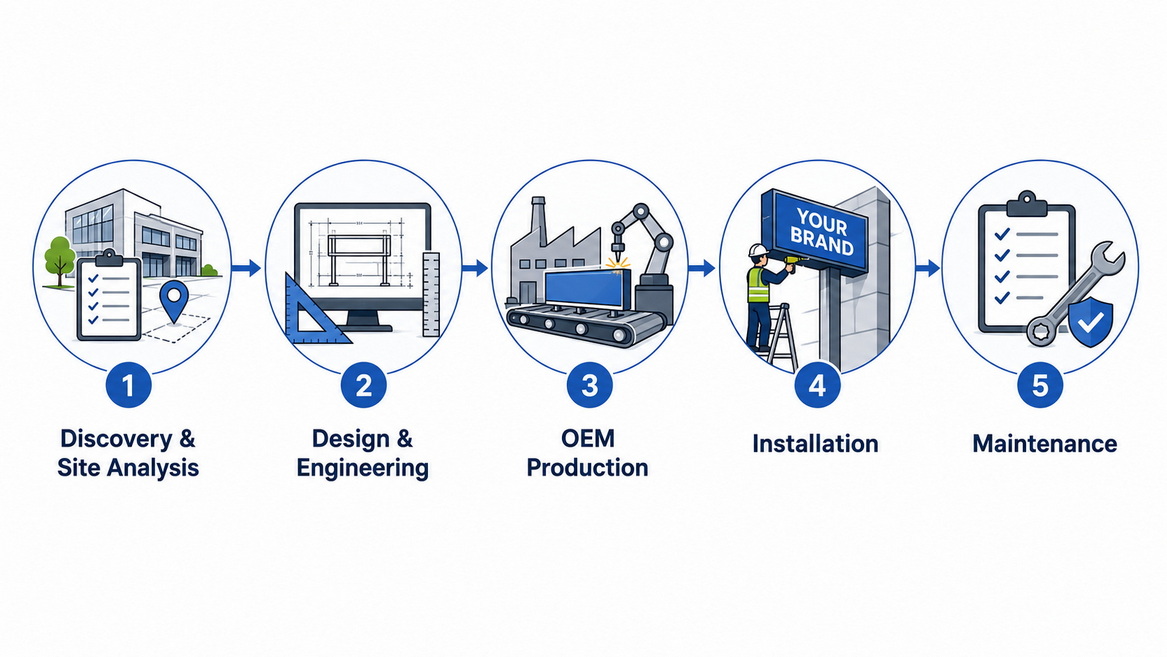
● A Practical Workflow for Interior and Exterior Signage Projects
>> Step 1 – Discovery and Site Analysis
>> Step 2 – Concept and Prototype
>> Step 3 – Engineering and Material Finalization
>> Step 4 – Production, Quality Control, and Logistics
>> Step 5 – Installation, Maintenance, and Lifecycle Review
● Enhancing UX and Conversions with Better Signage Content
>> Clear Messaging and Calls to Action
● When to Partner with an OEM Advertising Signage Factory
● Call to Action – Plan Your Next Interior or Exterior Signage Project
● FAQs
As a signage manufacturer working with global OEM and brand partners, I've seen interior and exterior advertising signage make or break a space—both visually and commercially. In this guide, I'll walk you through how to plan, design, and manufacture signs that look beautiful on day one and still perform five years later, using real shop-floor experience and current industry best practices. [thehandhgroup]

Effective advertising signage is not just a decorative element; it is a working asset that has to sell, guide, and reinforce your brand in very different environments. Interior and exterior conditions, viewing distance, and material choices all determine whether that asset delivers long‑term ROI or becomes a maintenance headache. [duncan-parnell]
On real projects, the biggest failures usually come from underestimating the installation environment, not from the logo file. Before you even sketch a design, you should document:
- Is the sign indoors or outdoors, or partly sheltered?
- Is the site coastal, high‑humidity, high‑UV, or near landscaping and water features?
- What is the mounting substrate (glass, drywall, ACM, brick, concrete, steel)?
- Typical viewing distance and angle (corridor, lobby, street, highway).
- Expected service life and maintenance constraints.
Experienced manufacturers know that finishes and coatings can fail quickly in harsh environments if they are specified for aesthetics instead of durability. For example, decorative indoor finishes that rely on delicate coatings will break down under prolonged UV or salt exposure. [duncan-parnell]

Interior signs are typically viewed at close range, under controlled lighting, and within carefully designed architectural spaces. That means every small design and fabrication decision—edge quality, finish uniformity, mounting hardware—directly affects perceived brand quality.
As one experienced layout specialist noted, indoor signage finish is often the first impression after a visitor steps inside. Minor imperfections in paint, gloss level, or edge polishing are immediately visible at eye level and can make premium brands feel inexpensive.
Best practices for interior advertising signage:
- Use matte or satin finishes to minimize glare in bright lobbies and highlight architectural textures. [thehandhgroup]
- Reserve high‑gloss finishes for soft‑lit, high‑end environments where reflections feel deliberate, not distracting.
- Match color temperature of nearby lighting (warm vs cool) so the sign doesn't look "off" or mismatched to the space.
- Consider integrated lighting (halo‑lit letters, backlit panels) to create a focal point without overpowering the room. [duncan-parnell]
Interior signage often fails because designers overspecify letter height or crowd too much content into a small footprint. Industry design principles emphasize legibility, visual hierarchy, and balanced negative space. [kdmpop]
Practical guidelines:
- Define the primary purpose (brand wall, promotion, wayfinding, compliance) before choosing size and content. [duncan-parnell]
- Scale letters according to typical corridor or lobby viewing distance, not just wall size.
- Maintain generous white space around the wordmark or message to elevate perceived quality and focus attention. [thehandhgroup]
- Design for multiple angles—floating letters, subtle spacers, and intended shadow play can make a flat wall feel dynamic.
For advertising and branding inside buildings, manufacturers commonly produce:
- Dimensional logo walls (metal, acrylic, or illuminated letters).
- Retail shelf‑edge and end‑cap signage systems.
- Wayfinding and directory systems for malls, campuses, and offices. [duncan-parnell]
- Compliance and safety signs that still align with the brand language.
A consistent interior sign family—using coherent materials, typography, and finishes—helps brands feel designed, not assembled from random pieces.
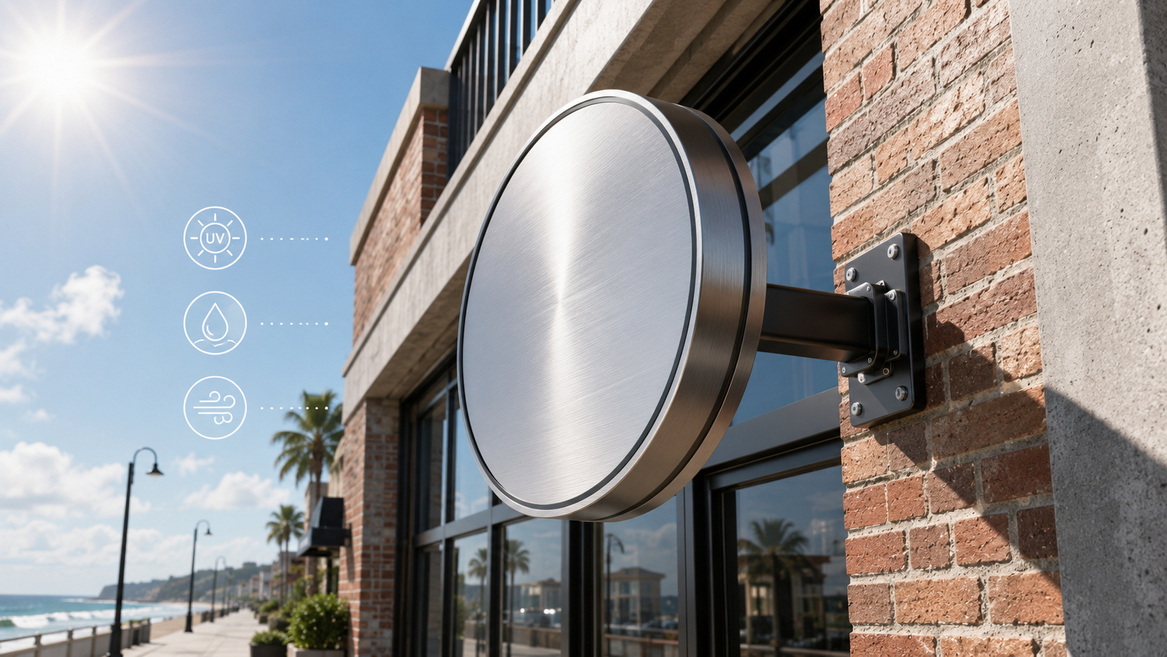
Outdoor advertising signage must survive UV, rain, wind, temperature swings, and vandalism while remaining legible from long distances. Here, material science and structural engineering can be just as important as graphic design. [duncan-parnell]
Experienced OEM factories know to specify metals, plastics, and coatings according to environment rather than price alone. For coastal or high‑humidity climates, corrosion‑resistant materials like anodized aluminum or 316 stainless steel are often recommended for longer life. [duncan-parnell]
Typical exterior choices and when to use them:
- Anodized aluminum: Lightweight, corrosion‑resistant, good for channel letters and panels in many climates.
- 316 stainless steel: Superior corrosion resistance for coastal, chemical, or high‑pollution zones.
- High‑performance acrylics and polycarbonates: Stable and UV‑resistant for illuminated faces and logos. [duncan-parnell]
- High‑solids or fluoropolymer coatings: Better color retention under UV than basic paints. [duncan-parnell]
Using indoor‑grade decorative finishes outdoors, especially in strong sun, often leads to peeling, chalking, or fading within a short period. Getting this wrong increases warranty costs for manufacturers and erodes trust with brand owners.
Outdoor advertising must be readable in seconds, often from moving vehicles, which is why signage experts emphasize simplicity and clear call‑to‑action. [kdmpop]
Best practices for exterior readability:
- Use large, bold typefaces with high contrast between background and letters. [kdmpop]
- Keep primary messages short enough to read in under five seconds at typical approach speed. [kdmpop]
- Establish clear hierarchy: headline, optional sub‑line, then call‑to‑action (URL, arrow, offer). [kdmpop]
- Adjust letter height and sign area to viewing distance and road speed, not just available façade size. [duncan-parnell]
From a manufacturer's perspective, a sign is only as good as its installation and support structure. Outdoor signage must be designed with substrate compatibility, hardware selection, and safety in mind. [duncan-parnell]
Key considerations:
1. Substrate and anchoring – Brick, concrete, glass, and sandwich panels all require different mounting methods.
2. Structural stability – Hardware and framing must withstand wind loads and potential impact; this is a crucial liability issue. [duncan-parnell]
3. Regulatory compliance – Local zoning, building codes, and safety regulations (such as OSHA and ADA in the U.S.) can dictate size, placement, and accessibility. [duncan-parnell]
4. Maintenance access – Design for serviceability, especially for illuminated or digital signage where components need replacement.
Working with professional installers or engineering partners is strongly recommended for large exterior systems, especially in high‑traffic public areas. [duncan-parnell]
| Factor | Interior Advertising Signage | Exterior Advertising Signage |
|---|---|---|
| Design focus | Detail, finish quality, integration with interiors | Long‑distance visibility, impact, brand recognition duncan-parnell |
| Viewing conditions | Close range, controlled lighting, longer dwell time | Variable light, weather, short viewing window, motion thehandhgroup |
| Material priorities | Precision finishes, tactile quality, refined textures | Durability, corrosion resistance, UV stability duncan-parnell |
| Message style | Brand storytelling, wayfinding, room identification | Clear, concise offers and directions, strong CTA kdmpop |
| Installation | Seamless fixings, hidden hardware, clean interfaces | Engineered structure, code compliance, safe access duncan-parnell |
As an OEM factory serving overseas brands, wholesalers, and producers, you are not just producing one sign; you are often building a repeatable system. That requires upstream thinking that many designers and end‑clients don't see.
For multi‑location rollouts and long‑term partnerships, manufacturers tend to:
- Create standardized sign families (modules and sizes) for storefronts, interiors, and wayfinding.
- Define approved material stacks for different climate zones (standard, coastal, high‑UV).
- Pre‑engineer typical fixing methods for the most common substrates in target markets. [duncan-parnell]
- Produce detailed installation manuals and hardware kits to reduce on‑site errors.
This "design for manufacturing" approach preserves brand consistency across different regions while keeping costs predictable and lead times short.
Recent industry trends point to increasing integration of printed, fabricated, and digital signage to support omnichannel marketing. For OEMs and sign shops, this means thinking beyond a single panel or lightbox. [marketingeye]
Common integration patterns:
- Static logo wall plus digital screen for campaigns and seasonal content. [marketingeye]
- Outdoor pylon or fascia signage with embedded LED message centers.
- Interior wayfinding with digital directories that can be updated centrally.
From an OEM perspective, the value is in building durable housings, clean cable management, and service‑friendly designs while allowing clients to update campaign content digitally.
To align with Google's E‑E‑A‑T principles and professional manufacturing processes, it helps to follow a clear, repeatable project workflow. [stellarcontent]
- Capture client goals (branding, promotion, navigation, compliance).
- Document environment, viewing distance, traffic patterns, and regulatory constraints. [duncan-parnell]
- Collect brand assets (logos, color codes, fonts) and previous signage examples.
- Create scaled design proposals with clear message hierarchy and mockups from key viewing angles. [thehandhgroup]
- Validate legibility for both day and night conditions where applicable.
- For larger programs, fabricate a pilot set to test installation and real‑world performance.
- Select material combinations based on environment, budget, and service life.
- Confirm structural requirements and mounting methods with engineering partners. [duncan-parnell]
- Document specifications in a format that can be consistently reproduced in OEM production.
- Use standardized work instructions and quality checkpoints for repeat orders.
- Inspect surface quality, color consistency, and illumination uniformity at multiple stages.
- Plan packaging and shipping to protect delicate finishes and minimize on‑site damage.
- Provide installation drawings, hardware lists, and maintenance recommendations.
- Encourage periodic inspections for outdoor signs to catch early corrosion or coating issues. [duncan-parnell]
- Review performance data and client feedback to refine designs for the next production cycle. [semrush]
Even the best‑built signage underperforms if the content or UX is confusing. Modern content and SEO frameworks emphasize clear intent, focused topics, and user‑centric design. [business.adobe]
For advertising signage, every word carries weight. Content strategy guidelines suggest focusing each asset on a single, well‑defined idea and guiding users toward a specific action. [business.adobe]
Practical tips:
- Use headline‑grade copy: one key message, not three. [kdmpop]
- Make the brand or offer the visual anchor; avoid cluttering the sign with secondary messages. [thehandhgroup]
- Include a direct CTA where appropriate: visit, call, scan, enter, or explore. [kdmpop]
- Align sign messaging with landing pages or in‑store experiences to avoid friction. [business.adobe]
For overseas brands, wholesalers, and product manufacturers, partnering with an experienced OEM signage factory offers several advantages.
You should consider engaging an OEM partner when:
- You need scalable production for multi‑site rollouts or franchise programs.
- Your project involves complex materials, illumination, or structural engineering.
- You want consistent quality and color matching across regions and batches.
- You require design‑for‑manufacturing feedback rather than just a "print‑what‑you‑send" service. [duncan-parnell]
An OEM partner that understands both interior and exterior conditions can help you avoid costly rework and design signage systems that perform reliably across different markets.
If you are planning a new advertising signage program—whether for retail, hospitality, corporate, or industrial environments—start by documenting your environment, viewing distances, and brand goals in detail. Then involve a specialist OEM signage manufacturer early, so materials, structure, and visual design can be optimized together instead of in isolation. [semrush]
A well‑designed, well‑manufactured sign can quietly work for your brand 24/7 for years. If you are ready to develop durable, high‑impact interior and exterior signage for global markets, reach out to a dedicated OEM signage factory to discuss your specifications, drawings, and rollout timeline today.
Q1: What is the main difference between interior and exterior advertising signage?
Interior signage focuses on finish quality, detail, and integration with the built environment, while exterior signage focuses on visibility, durability, and structural safety in changing weather and light. [duncan-parnell]
Q2: How do I choose materials for outdoor signs in coastal or high‑humidity areas?
In coastal or high‑humidity climates, corrosion‑resistant materials such as anodized aluminum and 316 stainless steel, combined with high‑performance coatings, are often recommended for longer service life. [duncan-parnell]
Q3: How can I make sure my signage is easy to read from a distance?
Use bold, high‑contrast typefaces, limit your message to a few words readable in under five seconds, and size letters according to viewing distance and traffic speed rather than available wall space. [thehandhgroup]
Q4: Why should I involve an OEM signage manufacturer early in the project?
Early collaboration allows the manufacturer to optimize materials, structure, and installation methods for your environment, reducing failures, shortening lead times, and improving cost predictability. [duncan-parnell]
Q5: How does good signage content relate to digital marketing and SEO?
Clear, user‑focused messaging and strong calls‑to‑action on physical signage align with broader content and SEO best practices, driving offline‑to‑online journeys and supporting consistent brand experiences. [siteimprove]
- Gemini Signage. "3 Factors to Consider When Designing for Interiors and Exterior Signage." [Link].
- Duncan‑Parnell. "Guide to Creating Effective Signage." [Link]. [duncan-parnell]
- The H&H Group. "6 Essential Sign Design Principles." [Link]. [thehandhgroup]
- KDM. "Best Practices for Creating Effective Retail Signage." [Link]. [kdmpop]
- Adobe Business. "Content marketing: Basic strategies and how to get started." [Link]. [business.adobe]
- Siteimprove. "A creator's guide to SEO content strategy." [Link]. [siteimprove]
- Stellar Content. "The Complete Guide to Google E‑E‑A‑T." [Link]. [stellarcontent]
- Semrush. "Google E‑E‑A‑T: What It Is & How It Affects SEO." [Link]. [semrush]
- Marketing Eye. "Digital Signage That Should Be a Part of Your Marketing Strategy." [Link]. [marketingeye]


