From idea to market-ready product, our SIGNS solutions make every stage easier, faster. Discover How We Help

Views: 222 Author: Landea Signs Publish Time: 2026-04-27 Origin: Site


As someone who has spent years helping overseas brands and manufacturers design and produce office signage at scale, I can tell you this: the signs you put on your desks and tables quietly decide how professional, organized, and trustworthy your workspace feels. In this in‑depth guide, I'll walk you through the desktop and tabletop signs every office really needs, how to choose the right structures and materials, and what we've learned on the factory floor producing OEM signage for clients in North America and Europe. [georgeandwilly]

Desktop and tabletop signs are small, self‑standing signs placed on reception counters, workstations, meeting tables, and service points to display names, roles, directions, status messages, promotions, or safety information. Unlike wall signs, they sit directly in the user's line of sight and are often read at close range, which means materials, finish, and typography matter even more. [marcomm.tamu]
From an OEM manufacturer's perspective, we see three main roles for these signs in modern workplaces:
- Branding: Nameplates, logo blocks, and premium wood or metal bases send a strong signal about your brand's taste and positioning. [federalheath]
- Wayfinding and information: Tent signs and changeable signs guide visitors, manage queues, and explain procedures without overloading wall space. [valota]
- Operations and safety: Status messages ("Meeting in Progress"), desk hoteling information, and check‑in instructions keep hybrid teams and visitors on the same page. [siteimprove]
When I first toured a large client's HQ, I noticed something small but telling: the lobby looked expensive, but the receptionist's desk had a faded paper name tag taped to a plastic stand. Within minutes, their own team acknowledged that visitors often asked, "Is this the right place?" [siteimprove]
Strong office signage improves:
- First impressions: A polished metal or wood nameplate at reception instantly feels intentional and trustworthy. [georgeandwilly]
- Navigation: Directional and status signs reduce interruptions, especially at service counters and hot‑desking areas. [marcomm.tamu]
- Brand consistency: Using the same fonts, colors, and materials across your entire signage system reinforces your visual identity. [federalheath]
Think of each desktop sign as a micro‑touchpoint of your brand—small, but seen dozens of times per day by staff and visitors. [georgeandwilly]
This section maps directly to what many offices already buy, but reframed with practical decision criteria instead of just product catalogs. [siteimprove]
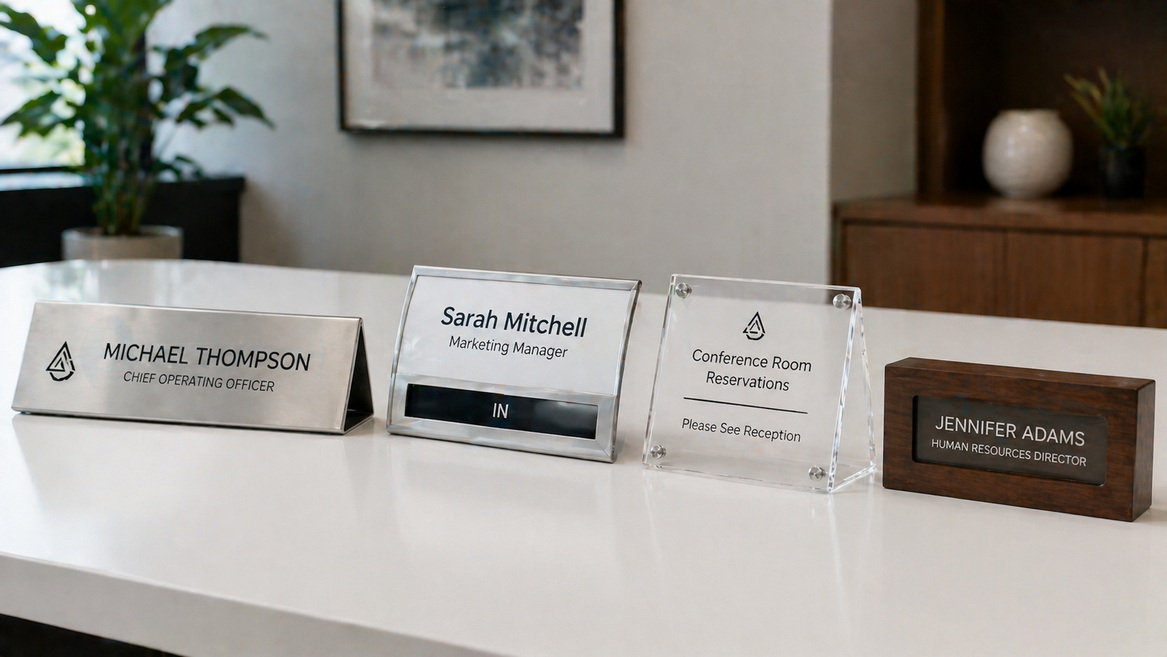
Metal desk name plates are the classic office signage everyone recognizes from reception desks and executive offices. [georgeandwilly]
Key advantages:
- Premium appearance: Printed or engraved metal (aluminum, stainless, or coated steel) instantly looks more professional than plastic or paper. [federalheath]
- Interchangeable inserts: Many frames allow you to slide in new inserts as people change roles, which is critical for fast‑growing teams. [siteimprove]
- Optimal viewing angle: Angled bases ensure the text faces visitors instead of pointing straight up at the ceiling. [siteimprove]
As a manufacturer, we often recommend metal frames for:
- Front desks and concierge counters
- Manager and director workstations
- Client‑facing meeting rooms
Changeable message signs are designed for offices that update messages frequently—event venues, coworking spaces, training centers, and busy lobbies. [marcomm.tamu]
Typical uses include:
- Daily schedules and welcome messages
- "Now serving" counters or ticket windows
- Rotating promotions or announcements
From a UX perspective, these signs work best when:
- The design is simple, with high contrast and one clear main message. [valota]
- Inserts can be printed in‑house on standard media (paper, film, or thin plastic). [siteimprove]
- The size matches the viewing distance; 8.5"x11" is common because it's readable from several meters away. [marcomm.tamu]
For OEM clients, we frequently build aluminum or ABS frames with anti‑glare lenses, designed so front‑desk staff can change content in seconds without tools. [federalheath]
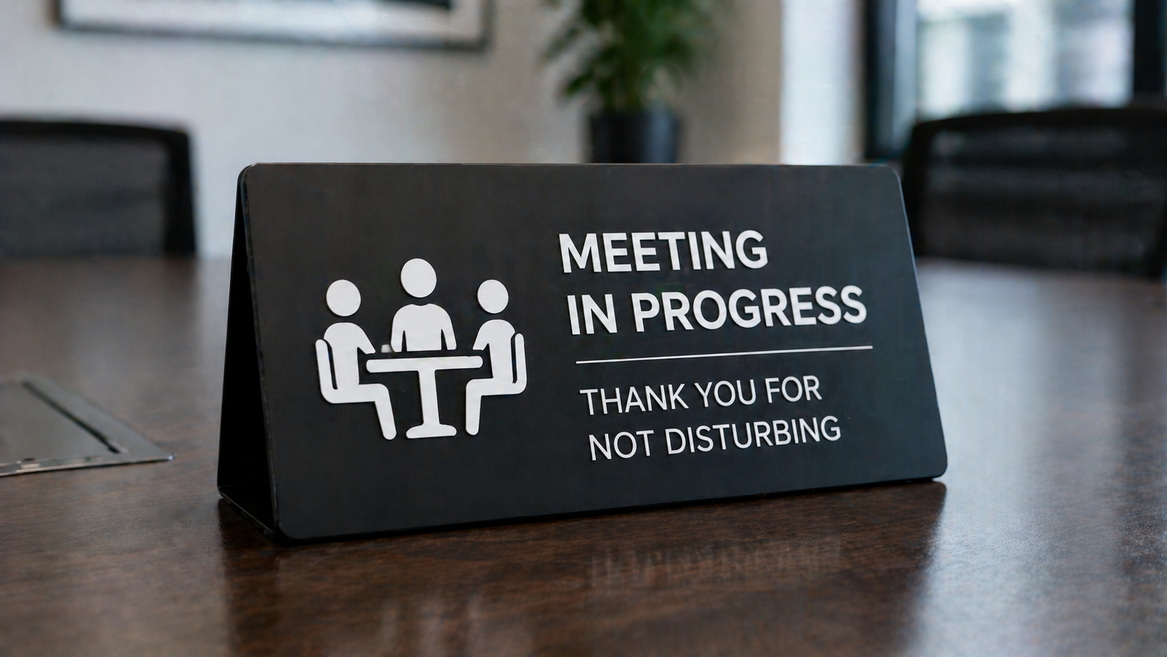
Engraved tent signs—also called A‑frame, bent, or folded signs—are among the most versatile and cost‑effective tabletop options. [siteimprove]
Best uses:
- "Please wait here" or "Line starts this way" messages on counters
- "Reserved" and "Meeting in Progress" on tables and doors
- Food service counters, where messages differ on each side ("Gluten‑Free / Contains Nuts") [siteimprove]
Why offices keep ordering them in bulk:
- Low cost and light weight
- Double‑sided messaging
- Durable acrylic in many standard colors, plus custom Pantone matching for brand consistency [georgeandwilly]
UX tip: Keep the text extremely concise—3–5 words per side—so people can grasp it in one glance. [valota]
Double‑insert counter signs stack two inserts in one frame, turning a small footprint into a dual‑purpose communication tool. [siteimprove]
Common configurations we see:
- Top: company logo, Bottom: staff name and role
- Top: room number, Bottom: contact details or Wi‑Fi information
- Top: language A, Bottom: language B for multilingual environments [siteimprove]
Because the inserts are interchangeable and low‑cost, facilities teams like these signs for spaces with frequent role or function changes, such as flexible meeting rooms and shared service counters. [georgeandwilly]
Curved desktop signs have become a design trend in corporate interiors, especially in tech and creative offices. [siteimprove]
Key benefits:
- Modern aesthetic: The subtle curve adds a softer, contemporary look compared to straight‑edged frames. [georgeandwilly]
- Flexible inserts: Durasol, metal, and paper inserts can all be swapped as needed, covered by a removable clear lens. [siteimprove]
- Cost‑effective: Lightweight aluminum or extruded profiles help keep price points accessible for large rollouts. [federalheath]
When we manufacture these for OEM clients, we usually standardize the profile and then customize lengths, colors, and end caps to match each client's brand and budget. [federalheath]
For law firms, financial advisors, universities, and luxury hospitality brands, solid wood desk signs remain a favorite. [georgeandwilly]
Why high‑end buyers choose them:
- Natural materials: Walnut, beech, oak, or engineered woods with visible grain convey warmth and tradition. [federalheath]
- Reverse‑engraved acrylic: Text engraved on the back of clear acrylic creates a crisp, frosted effect protected from surface wear. [siteimprove]
- Metal accents: Small details, like gold screws or hardware, elevate the perceived value. [federalheath]
These signs are especially effective when you want visitors to feel they are dealing with seasoned professionals rather than a temporary operation. [georgeandwilly]
Gold‑frame desk signs are a shortcut to a more sophisticated look, often used in boardrooms, government agencies, and luxury retail. [georgeandwilly]
Practical points:
- Works well with dark inserts (black with white or gold text) for high contrast. [federalheath]
- Complements traditional interior design with brass, marble, or dark wood finishes. [federalheath]
- Modular construction allows inserts to be replaced when staff titles change. [siteimprove]
From the manufacturing side, we usually recommend PVD‑coated or anodized finishes for better scratch resistance and color stability over time. [federalheath]
Combining a desk nameplate with a business card holder is a small design decision that has a big impact in sales‑driven roles. [siteimprove]
Best suited for:
- Sales representatives and account managers
- Consultants and independent professionals
- Front‑of‑house roles where contact details matter [siteimprove]
Benefits:
- Cards are always visible and within arm's reach
- Reduces desk clutter and separate plastic card trays
- Offers more surface area for branding on the sign and card deck simultaneously [georgeandwilly]
Many of our OEM customers opt for rosewood‑style finishes or matte black bodies with laser‑engraved metal nameplates, combining classic and modern elements in one piece. [federalheath]
The original article covers classic sign types well, but modern offices have new challenges: hybrid work, hot‑desking, accessibility, and brand‑driven interiors. Below are added sections that reflect what we now see in 2025–2026 projects. [georgeandwilly]
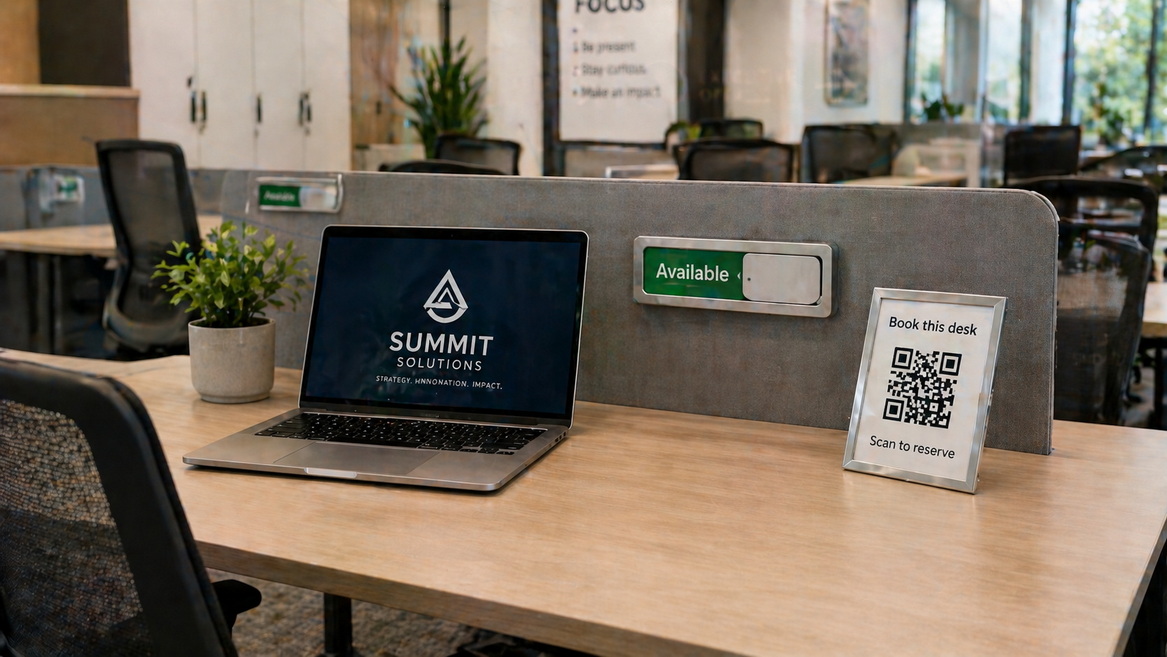
In hybrid offices, desks are often shared and booked via software, which means static nameplates alone no longer work. We increasingly manufacture: [valota]
- Sliding status bars ("In Use / Available / Cleaned")
- Small QR code plaques that link to booking or check‑in systems
- Reversible tents ("Reserved / Available") for hoteling zones [marcomm.tamu]
Good practice for hybrid signage:
- Keep content unambiguous: one status per surface. [valota]
- Use consistent colors (e.g., green for available, red for in use) across all locations. [valota]
- Ensure signs are removable and reusable as seating layouts evolve. [valota]
Even small desktop signs can help or hinder accessibility. While full ADA compliance often focuses on wall signs, applying similar principles improves usability for everyone. [georgeandwilly]
Key recommendations based on current accessibility guidance:
- Use high contrast between text and background; avoid low‑contrast pastel combinations. [federalheath]
- Choose simple, sans‑serif fonts and avoid all‑caps for longer messages. [valota]
- Use non‑glare finishes where possible to prevent reflections under overhead lighting. [georgeandwilly]
For critical status or safety messages, consider tactile icons or pairing the sign with an accessible digital channel (QR code to an accessible web page). [marcomm.tamu]
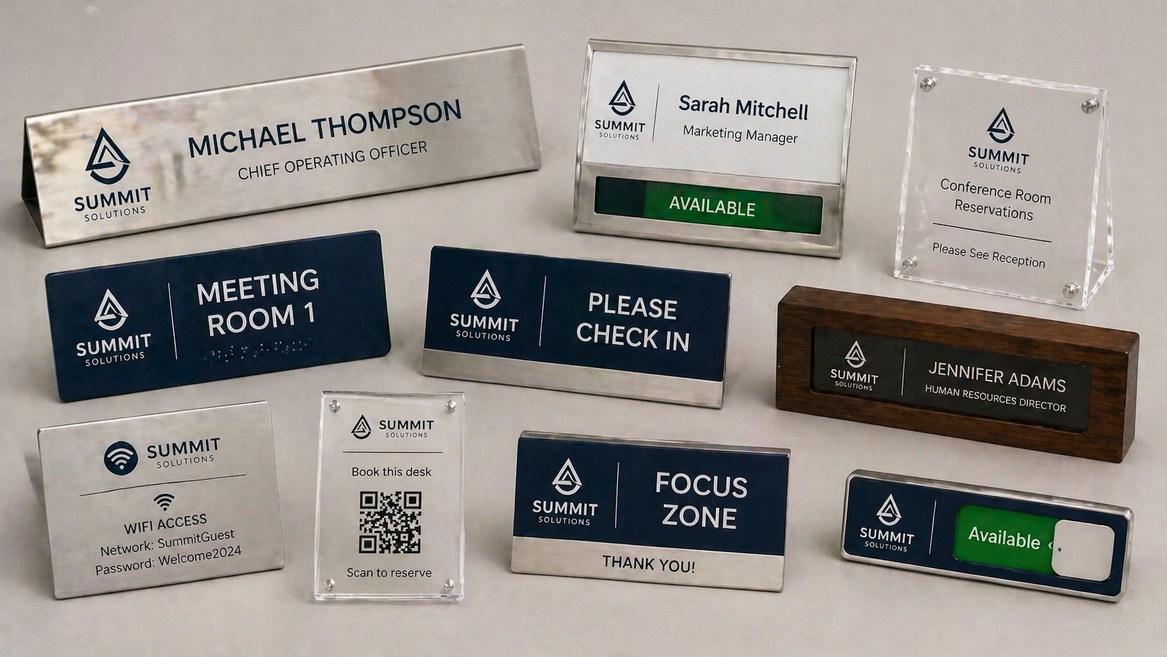
From the factory side, the most successful rollouts treat desktop signs as part of a system, not as one‑off purchases. [firstpagesage]
When we work with overseas brands and wholesalers, we help them:
- Standardize core profiles: e.g., one aluminum extrusion for desk, door, and wall signs, cut at different sizes. [federalheath]
- Define a material palette: metals, acrylics, and woods that align with the brand's visual language. [georgeandwilly]
- Create SKU families: so distributors can stock a small set of components and still serve many end‑user scenarios. [firstpagesage]
This OEM approach reduces inventory complexity, makes reorders easier, and ensures offices in different countries still look like part of the same brand. [huble]
| Sign type | Typical use case | Look & feel | Flexibility of message | Best for |
|---|---|---|---|---|
| Metal desk name plate | Names, titles, reception | Modern, professional | Medium (insert‑based models) | Corporate offices, reception |
| Changeable message desktop sign | Schedules, announcements, events | Functional, bold | High (DIY printed inserts) | Lobbies, training centers |
| Tent / A‑frame sign | Short instructions, status, "Reserved" | Simple, low‑cost | High (double‑sided) | Counters, cafeterias, meeting rooms |
| Double‑insert counter sign | Logo + name, room + info | Formal, structured | Medium (two inserts) | Service desks, multilingual areas |
| Curved interchangeable desk name plate | Names, roles, small messages | Contemporary, sleek | High (easy insert swaps) | Tech and creative offices |
| Solid wood desk name plate | Executives, professors, premium reception | Classic, warm | Low–medium (plate changes) | Law firms, finance, education |
| Gold‑frame desk sign | High‑prestige roles, boardrooms | Luxurious, traditional | Medium (insert change) | Government, luxury hospitality |
| Sign + business card holder | Sales, client‑facing professionals | Practical, polished | Medium (plate + cards) | Sales teams, consultants |
When overseas customers brief us on OEM desktop signage, the projects that go smoothly usually answer these questions first. [firstpagesage]
1. Purpose: Is this primarily for identification, wayfinding, promotion, or status messaging? [siteimprove]
2. Environment: Office, retail, restaurant, healthcare, or industrial? Indoor only, or near windows and sunlight? [georgeandwilly]
3. Branding requirements:
- Color standards (Pantone or RAL)
- Font usage
- Logo placement and minimum sizes [federalheath]
4. Update frequency: How often will the message or name change? Daily, monthly, or rarely? [marcomm.tamu]
5. Budget and volume: High‑volume rollouts can justify custom profiles and tooling to achieve better long‑term unit costs. [firstpagesage]
If you are a distributor or brand buyer, aligning these points with your signage manufacturer early will save weeks of sampling and revisions. [huble]
Sign design can succeed or fail before you ever get to materials. Based on real‑world deployments and institutional guidelines, here are proven practices: [marcomm.tamu]
- Prioritize legibility: Use at least 1 inch of letter height per 10 feet of viewing distance for key text, even on small signs near circulation routes. [federalheath]
- Apply the 3×5 rule for highly glanceable messages: 3 lines of 5 words or 5 lines of 3 words. [marcomm.tamu]
- Avoid clutter: one main message per sign; secondary information should be smaller and clearly separated. [valota]
- Keep contrast high: dark text on a light background or vice versa performs best under varied lighting. [georgeandwilly]
- Use consistent iconography: if you use icons (Wi‑Fi, no phone, meeting, etc.), keep style and meaning consistent across your office. [valota]
These design principles not only help visitors and employees read signs quickly, they also align with general accessibility and digital signage best practices. [marcomm.tamu]
Even the most beautiful sign fails if it's hidden behind a monitor or a flower pot. [marcomm.tamu]
From site audits and client feedback, good placement patterns include:
- Reception: Nameplate near the front edge of the desk, angled toward incoming visitors. [georgeandwilly]
- Meeting rooms: Small tabletop sign centered on the main table edge facing the door, plus any "Do Not Disturb" tent sign near the entrance. [marcomm.tamu]
- Open offices: Status signs at the side of monitors, not on top, to avoid being blocked by screens. [valota]
- Counters and check‑out points: Tent signs placed where the queue naturally forms, not behind the cashier. [marcomm.tamu]
If you are planning a large rollout, consider creating a simple internal "sign map" that documents where each type of desktop or tabletop sign is expected to be used. [huble]
As a Chinese factory specialized in advertising signage and architectural sign systems, we often work behind the scenes for foreign brands, wholesalers, and other sign producers. [huble]
Here is how a typical OEM collaboration on desktop and tabletop signs looks:
1. Concept and sampling: You share your brand guidelines and reference photos; we propose materials, profiles, and prototype structures. [huble]
2. Engineering and optimization: We refine dimensions and assembly methods for mass production, focusing on durability, ease of insert change, and packaging safety. [firstpagesage]
3. Pilot order and feedback: Small batches go to your key offices or clients; we collect feedback on readability, build quality, and finish consistency. [firstpagesage]
4. Scale‑up and customization: Once the core system is set, we can add language variants, sizes, and special editions for different regions or campaigns. [huble]
For distributors, this approach lets you offer a complete "office signage kit" under your own brand without investing in your own factory. [firstpagesage]
To turn these insights into a practical project, follow this simple roadmap:
1. Audit your current signage
- List where desktop and tabletop signs already exist and where confusion still happens. [marcomm.tamu]
2. Define your core sign family
- Choose 3–5 key types (e.g., metal nameplate, tent sign, curved sign, hybrid status sign, card‑holder sign). [siteimprove]
3. Align with your brand
- Lock in materials, colors, and fonts with your marketing or brand team. [federalheath]
4. Create prototypes and test
- Install samples in a single department for 2–4 weeks and gather feedback from staff and visitors. [huble]
5. Roll out with an OEM partner
- Once finalized, work with your signage manufacturer to standardize SKUs and packaging so future reorders stay consistent and cost‑efficient. [firstpagesage]
If you are a brand, wholesaler, or signage producer looking for a reliable OEM partner for desktop and tabletop office signs, you can collaborate with a specialist factory like Landea Signs Co., Ltd. to develop a consistent, scalable signage system tailored to your brand and markets. Reach out with your current sign photos and brand guidelines, and we can help you engineer a complete desk and tabletop signage range—from metal and wood nameplates to hybrid‑ready changeable signs—ready for global distribution. [huble]
1. What is the best material for office desk nameplates?
Metal and solid wood are the most popular for premium nameplates because they balance durability, professional appearance, and long‑term color stability. Acrylic and high‑pressure laminates are excellent options when cost and weight are top priorities. [georgeandwilly]
2. How often should I update my desktop signage?
You should update desk and table signage whenever roles, room functions, or key information changes, and formally review the entire system at least once a year. For hybrid offices or event spaces, some signs may need weekly or even daily content changes, which is why interchangeable insert systems are so valuable. [firstpagesage]
3. Are small desktop signs relevant for accessibility?
Yes. Even though accessibility regulations typically focus on wall‑mounted signs, applying high contrast, non‑glare finishes, and readable fonts to desktop signs improves the experience for many users. For critical messages, consider pairing physical signs with digital channels that support screen readers and zoom. [valota]
4. How can I keep my office signage on brand across multiple locations?
Standardize a core signage system—including profiles, materials, and color codes—and work with an OEM partner who can produce the same structures consistently for all regions. Provide internal guidelines showing example installations so new offices follow the same patterns. [huble]
5. What is the difference between tent signs and changeable message signs?
Tent signs are usually small, engraved or printed pieces designed for short, static messages on one or both sides, while changeable message signs are larger frames built to hold printed inserts that can be replaced frequently. Tent signs are ideal for simple instructions and status, whereas changeable frames suit schedules, promotions, and more detailed information. [marcomm.tamu]
1. Office Sign Company. "Desktop and Tabletop Signs Every Office Needs."
<https://blog.officesigncompany.com/desktop-and-tabletop-signs-every-office-needs/> [siteimprove]
2. George & Willy. "Office Signage Guide 2026: Types, Materials & ADA Tips."
<https://www.georgeandwilly.com/en-dk/blogs/blog/the-ultimate-guide-to-office-signage-types-ada-design> [georgeandwilly]
3. Texas A&M University Marketing & Communications. "Digital Signage Best Practices."
<https://marcomm.tamu.edu/digital-signage/best-practices/> [marcomm.tamu]
4. Federal Heath. "Design Best Practices for Business Signage."
<https://federalheath.com/company/news-insights/design-best-practices-for-business-signage> [federalheath]
5. First Page Sage. "SEO Content Best Practices for 2026."
<https://firstpagesage.com/seo-blog/seo-content-best-practices/> [firstpagesage]
6. Huble. "Maximising your online visibility with an SEO content strategy."
<https://huble.com/blog/seo-content-strategy> [huble]
7. Valota. "Best Practices for Workplace Digital Signage Content & Design."
<https://valota.live/best-practices-for-workplace-digital-signage-content-design/> [valota]


