From idea to market-ready product, our SIGNS solutions make every stage easier, faster. Discover How We Help

Views: 218 Author: Landea Signs Publish Time: 2026-08-31 Origin: Site


Content Menu
● Why brightness control has become essential
● What is a dimmer-controlled sign?
● Dimmer-controlled signs: the business case
>> Better visual comfort and legibility
>> Lower energy use when output is reduced
>> Less risk of costly remanufacture
● Fixed-brightness signs: when they create problems
● How to specify a dimmer-controlled sign
>> 1. Define the site and viewing conditions
>> 2. Request measurable performance information
>> 3. Plan the lighting schedule
>> 4. Commission, document, and review
● Choosing the right control level
● FAQ
>> Are dimmer-controlled signs always more expensive?
>> Can an existing LED sign be upgraded with a dimmer?
>> Does dimming make a sign less visible?
>> Is PWM dimming suitable for illuminated lettering?
>> Do French illuminated signs have to turn off at night?
>> What is the difference between DALI and a basic dimmer?
>> What information should I send before requesting a quotation?
For an illuminated sign, brighter is not automatically better. A sign must remain legible in strong daylight, yet avoid glare, neighbourhood complaints, unnecessary electricity use, and local compliance problems after dark.
At Landea Signs Co., Ltd., we see this decision shape the long-term outcome of custom illuminated lettering projects. A fixed-brightness sign may appear less expensive at quotation stage, but a dimmer-controlled sign gives the owner a practical way to adapt to changing daylight, trading hours, site conditions, and local rules—without remanufacturing the sign.
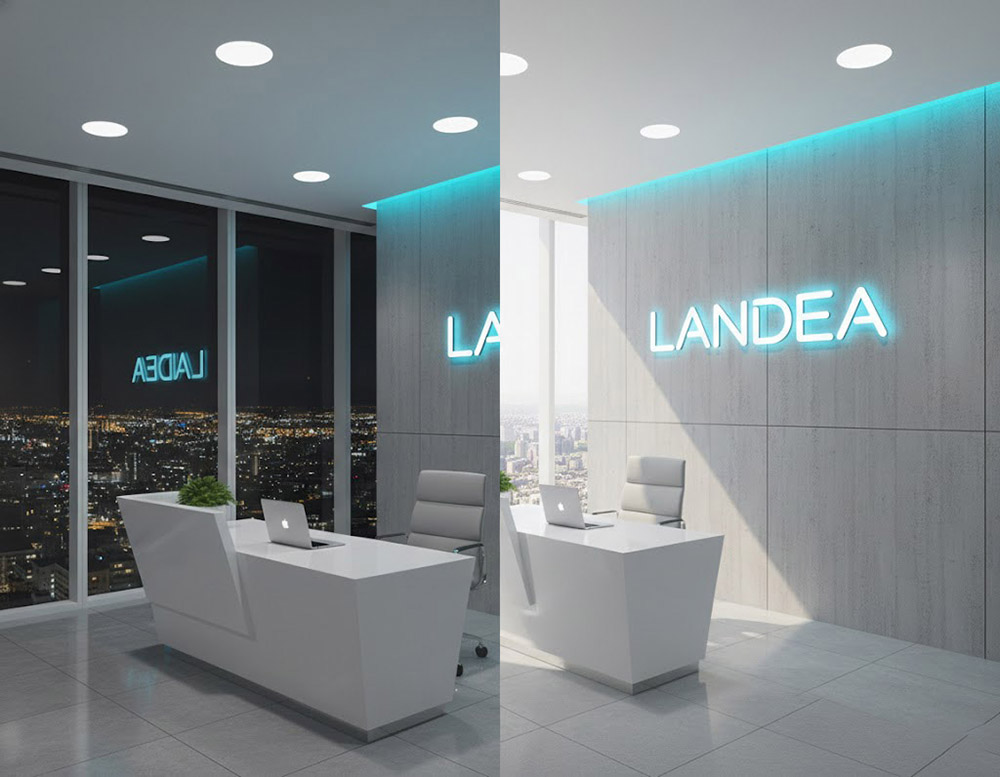
Outdoor environments are not constant. A storefront facing direct afternoon sun needs a different light output from the same storefront at 11 p.m. A fixed-brightness sign cannot respond to that difference: it may look weak during the day and excessively bright at night.
For businesses operating in Europe, brightness management can also be a compliance issue. In France, illuminated signs must be switched off between 1 a.m. and 6 a.m. when the business they identify has ceased operating. Where a business closes or opens between midnight and 7 a.m., the sign must be turned off no later than one hour after closing and may be switched on one hour before reopening. Exceptions can apply for specific events established by local or prefectural order.
It is important to distinguish national rules from local requirements. Europe does not have one binding, universal regulation that sets all outdoor-lighting brightness limits across every country. Requirements vary by country, municipality, zoning area, heritage district, façade type, and sign category. That makes adaptable lighting specification more valuable—not less.
A well-designed LED sign dimming system helps project teams respond to real operating conditions rather than guessing the correct brightness before installation.
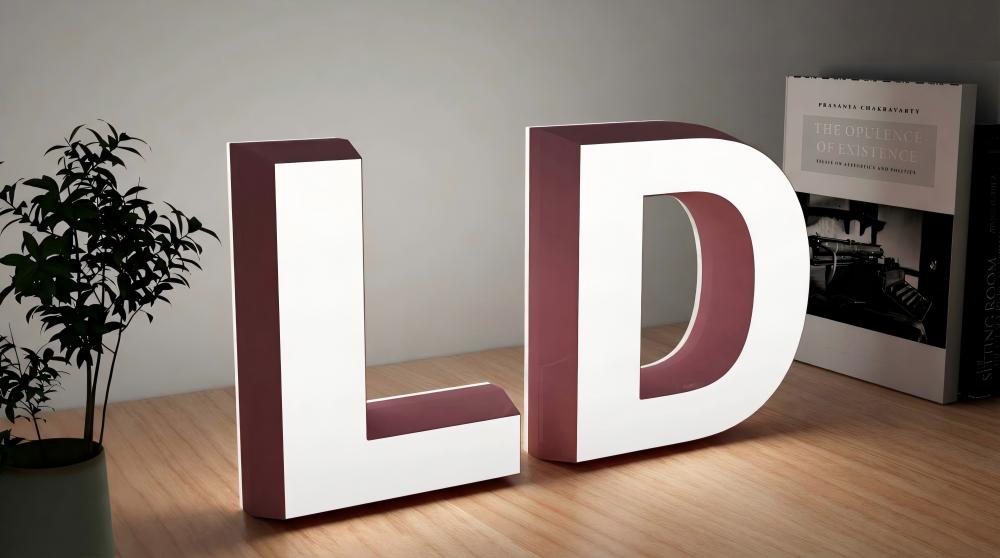
A dimmer-controlled sign is an illuminated sign whose LED output can be reduced or increased after installation. Control may be as simple as a local dimmer, or as advanced as a scheduled, sensor-based, networked lighting-control system.
The objective is straightforward:
- Higher output when daylight competes with the sign
- Lower output at dusk and in low-traffic periods
- Scheduled reduction or shutoff after business hours
- A practical adjustment path if the installed sign is too bright or too dim
Unlike a fixed-brightness sign, the light level does not have to remain permanently locked at the factory setting.
| Control method | How it works | Best fit |
|---|---|---|
| Manual dimmer | An installer or site manager adjusts the output locally | Small projects with stable operating hours |
| Timer or astronomical clock | The sign follows pre-programmed operating and dimming schedules | Retail, hospitality, and commercial sites |
| Photocell sensor | The system responds to ambient daylight | Locations with significant day-to-night change |
| 0–10 V control | Output follows an analogue control signal | Straightforward commercial installations |
| DALI control | Addressable digital control supports precise scenes, groups, and repeatable settings | Multi-sign sites, branded estates, or building-control integration |
| Remote smart control | A controller enables schedule updates and monitoring without site visits | Distributed locations and managed property portfolios |
DALI stands for Digital Addressable Lighting Interface. It is an internationally standardized digital communication protocol for lighting-control devices, designed to provide accurate, repeatable control of light output.
Many LED sign dimming systems use PWM, or pulse-width modulation. Instead of continuously lowering LED current in the same way, PWM switches the LED drive signal on and off at a high frequency. The controller changes the proportion of each cycle during which the LED is on—known as the duty cycle—to change perceived brightness.
For example:
- A 100% duty cycle delivers full programmed output
- A 50% duty cycle produces approximately half the average light output
- A 10% duty cycle creates a low-level night setting
The quality of the driver, LED modules, control compatibility, wiring, and programming matters. A dimmer is not a universal add-on. It must be specified as part of a compatible system from the beginning.
The strongest argument for LED sign brightness control is not simply energy. It is appropriate visibility.
A bright sign can enhance recognition when it competes with sunshine, street lighting, vehicle headlights, or a visually busy retail setting. But a high-output sign in a dark street can create glare, overwhelm the façade, and make the lettering uncomfortable to view.
With a dimmer-controlled sign, a business can create distinct light scenes rather than choosing one compromise level:
- Day mode for strong ambient light
- Evening mode for normal customer traffic
- Late-night mode for lower light output
- Closed mode for automatic shutoff where required
This approach supports brand presentation. Channel letters, halo-lit lettering, face-lit signs, and combination-lit letters can retain their intended visual character without being overdriven during every hour of operation.
LEDs are inherently controllable and can work with sensors and lighting controls to enable energy savings through daylight response, occupancy sensing, and local light-level control.
However, energy savings should be calculated for the actual project—not assumed from a headline claim. Savings depend on:
- Installed wattage
- Daily operating schedule
- Dimming profile by hour
- Local electricity price
- Driver efficiency at lower output
- Whether lighting is switched off or merely reduced
- Maintenance and replacement planning
A simple illustration shows why operating schedules matter.
Assume a sign uses 1,000 W at full output and operates for 12 hours each day. If it runs at full output for six hours and at 30% output for the remaining six hours, its estimated daily consumption is:
(1.0 kW×6 h)+(0.3 kW×6 h)=7.8 kWh
A fixed-brightness sign running at 1,000 W for all 12 hours would consume 12 kWh per day. In this illustration, scheduled dimming reduces daily energy use by 35%. The exact result for any sign must be based on the approved electrical specification and operating plan.
For exterior lighting, networked controls can further reduce energy and operating costs while potentially extending fixture life.
LED products do not usually fail like a traditional incandescent lamp. Instead, they gradually lose light output over time. Useful life is often expressed as the operating period until a product reaches 70% of its initial light output, commonly called L70. High-quality white LED products may have useful lives of 30,000 to 50,000 hours or more, depending on design and operating conditions.
Running an illuminated sign at a lower output during low-demand periods can reduce thermal and electrical stress. That does not create an unlimited lifetime, and it does not replace good thermal design, correct driver loading, weather protection, or maintainable construction. But it can help the system avoid spending every operating hour at maximum output.
For buyers, the practical question is: What light level does the sign need at each hour—not what maximum output can it reach?
Fixed-brightness signs can become expensive when the installed brightness is wrong.
If the sign is too dim in daylight, it may not deliver the intended visibility. If it is too bright after dark, the owner may face complaints, a landlord request, a local authority issue, or a poor customer experience. With a fixed-output system, the possible remedy may involve replacing drivers, revising LED modules, reworking the letter construction, or remanufacturing the sign.
A dimmer-controlled sign provides an adjustment margin after installation. The installer or facilities team can tune the output rather than reopening the entire manufacturing decision.
This matters especially for:
- International projects with unfamiliar local site conditions
- New retail concepts and flagship façades
- Hotels, restaurants, and mixed-use developments
- Signs installed near residential buildings
- Projects subject to landlord, mall, airport, or heritage-area approvals
A fixed-brightness sign is not inherently poor quality. It can be appropriate for a simple indoor application, a controlled environment, or a project with clear and stable lighting requirements.
The limitation is inflexibility.
| Decision factor | Dimmer-controlled sign | Fixed-brightness sign |
|---|---|---|
| Brightness adjustment | Adjustable after installation | Set at one level |
| Day-to-night adaptation | Can use schedules, sensors, or manual settings | Same output throughout operation |
| Energy management | Output can be reduced when full brightness is unnecessary | Uses its programmed operating output whenever switched on |
| Operating-hour changes | Schedules can be updated | Requires external switching only, with no brightness adjustment |
| Compliance response | Offers a route to implement dimming or shutoff strategies | May require hardware changes if the output is unsuitable |
| LED operating stress | Can reduce time spent at high output | May run at the same high level for all operating hours |
| Upfront cost | Higher due to compatible drivers, controllers, and commissioning | Usually lower initially |
| Lifecycle flexibility | Stronger | Limited |
The key point is not that every project requires the most complex control architecture. It is that the sign should be engineered with the level of flexibility the site actually needs.

The best results begin before production. A control system cannot compensate for an unclear brief, inadequate LED design, or an unrealistic daytime-visibility requirement.
Provide the manufacturer with practical information:
- Installation city and country
- Indoor or outdoor location
- Direction of the façade and direct-sun exposure
- Viewing distance and viewing angle
- Nearby residences, roads, windows, or heritage buildings
- Operating hours and seasonal changes
- Existing building-management or lighting-control systems
- Local sign permit conditions, if available
For a retailer in a dense urban street, "visible at night" is not enough. The team needs to understand whether the sign will be viewed from across a narrow pavement, a road junction, a parking area, or a distant approach route.
Avoid approving a sign based only on a bright product photo. Ask for a technical submittal that identifies:
- LED module and driver make or specification
- Input voltage and estimated system wattage
- Dimming method and compatible control equipment
- Target operating profiles, such as day/evening/night
- Weather-protection rating where relevant
- Access method for maintenance
- Control-wiring requirements
- Test or commissioning procedure
The target is not merely "dimmable." The target is a sign that can be commissioned reliably at the project site.
A useful starting schedule may look like this:
| Operating period | Example output | Purpose |
|---|---|---|
| Daylight business hours | 80–100% | Compete with ambient daylight |
| Dusk to evening | 50–75% | Maintain clear branding without excessive glare |
| Late evening | 20–40% | Reduce visual impact and power demand |
| Closed period | 0% or locally permitted minimum | Meet operating policy and local requirements |
These are example ranges, not universal settings. Final values should be established during on-site commissioning and checked against applicable local rules.
After installation, test the sign in real conditions:
1. Inspect it in daylight, dusk, and darkness.
2. Confirm that dimming is smooth and stable across the specified range.
3. Check the time schedule, sensor response, and automatic shutoff function.
4. Record the final programmed settings.
5. Revisit settings after the first weeks of operation, particularly after customer or neighbour feedback.
This final step is often ignored. In our experience, successful illuminated lettering is not just manufactured; it is tuned to the location.
Choose a manual dimmer when the project is small, the sign is easy to access, and operating conditions rarely change.
Choose a timer or photocell when the project needs reliable daily adjustment without a complex management system.
Choose DALI or remote control when there are multiple signs, several zones, changing opening hours, facilities-management involvement, or a need for repeatable branded lighting scenes. DALI systems are designed to be scalable and robust, while DALI-2 provides a certification program based on the current protocol.
Choose a fixed-brightness sign only when the environment is controlled, the required output is clear, and the owner accepts that future adjustment will be limited.
A dimmer-controlled sign is a long-term operating strategy, not just an electrical feature. It helps owners balance daytime visibility, nighttime comfort, energy consumption, future site changes, and project-specific compliance needs.
For international buyers, the most valuable advantage is flexibility. Instead of treating brightness as a permanent factory decision, you retain the ability to adjust it after the sign reaches its real-world environment.
Landea Signs Co., Ltd. can help you specify custom illuminated lettering with the right LED modules, compatible dimming method, control strategy, and production documentation for your project. Share your artwork, installation country, façade photos, operating hours, and preferred control method to receive a tailored sign recommendation.
Yes, the initial cost is usually higher because compatible dimmable drivers, controllers, sensors, programming, or additional wiring may be required. However, the lifecycle value can be stronger when a project benefits from lower operating output, easier adjustment, and reduced risk of later rework.
Sometimes. It depends on the existing LED modules, drivers, power supply capacity, wiring layout, and access conditions. A technical inspection is needed before promising a retrofit solution.
Not when it is specified properly. The purpose is to provide the right brightness for the conditions. A well-programmed sign can use higher output in daylight and lower output at night, preserving legibility while reducing glare.
PWM can be suitable when the LED modules, drivers, and controller are designed to work together. The full system should be evaluated for dimming range, visual consistency, flicker performance, and installation requirements.
Under Article R581-59 of the French Environmental Code, illuminated signs must be switched off between 1 a.m. and 6 a.m. when the identified activity has stopped, subject to defined timing rules and possible exceptional-event exemptions. Local requirements can also apply.
A basic dimmer typically adjusts one circuit locally. DALI is a digital lighting-control protocol that supports standardized, repeatable control and can address lighting equipment within a wider control system. It is better suited to projects that require zones, schedules, scenes, or centralized management.
Send the sign design or logo, dimensions, installation photos, country and city, indoor/outdoor conditions, operating hours, required brightness behavior, electrical supply, and any permit or landlord requirements. This information helps the manufacturer recommend an appropriate dimming solution.
1. [French Environmental Code, Article R581-59] — Rules on nighttime shutoff of illuminated signs, operating-hour exceptions, and restrictions on flashing signs. [legifrance.gouv]
2. [Décret n° 2022-1294 du 5 octobre 2022] — French provisions concerning the shutdown requirements for illuminated advertising and illuminated signs. [legifrance.gouv]
3. [DALI Alliance: DALI protocol key features] — Explanation of DALI's standardized and repeatable dimming control capabilities. [dali-alliance]
4. [DALI Alliance: DALI-2 and IEC 62386] — Overview of DALI as a scalable digital lighting-control protocol and the DALI-2 certification program. [dali-alliance]
5. [U.S. Department of Energy: LED Basics] — Information on LED controllability, integration with sensors and controls, and typical useful-life concepts. [energy]
6. [U.S. Department of Energy: Purchasing Energy-Efficient Exterior Lighting] — Lifecycle-cost context for exterior LED lighting and networked controls. [energy]
7. [Light Pollution in EU Law: Unveiling Shadow Governance] — Analysis indicating that no single binding EU-wide framework explicitly regulates light pollution across all Member States. [cambridge]


