From idea to market-ready product, our SIGNS solutions make every stage easier, faster. Discover How We Help

Views: 211 Author: Landea Signs Publish Time: 2026-07-28 Origin: Site


Content Menu
● Why ADA Signage Matters in Educational Facilities
● Do Schools Need ADA Signage?
● Do Colleges Need ADA Signage?
● School vs. College Signage Needs
● What Signs Are Usually Required?
● Campus Wayfinding as a System
● Schools and Colleges in One Table
● FAQ
>> 1. Are schools required to have ADA signage on every door?
>> 2. Do colleges need Braille on signage?
>> 3. What is the biggest difference between school and college signage?
>> 4. Can temporary printed signs replace ADA signs?
>> 5. What makes a sign easier to read?
For schools and colleges, ADA signage is not just a compliance item; it is a core part of how people find their way safely and independently across a campus. The difference is that schools often serve younger users and more controlled environments, while colleges deal with larger, more complex, and more autonomous traffic patterns, which changes how signage should be planned and installed.

Accessible signage supports navigation, safety, and dignity. In education settings, it helps students, staff, visitors, and contractors identify restrooms, classrooms, offices, exits, elevators, accessible routes, and other permanent spaces without relying on assistance.
A well-designed signage system does more than satisfy a rulebook. It reduces confusion, shortens decision time in crowded hallways, and supports inclusive movement for people with visual impairments, mobility limitations, and temporary injuries.
For manufacturers and campus planners, this means the sign program must be treated as part of the building's circulation system, not as decoration added at the end. The best results come from consistency in layout, placement, contrast, materials, and tactile communication.
Yes, schools need ADA signage when the signs identify permanent rooms, accessible routes, or regulated spaces. Public school districts must comply with Section 504 and the ADA, and private schools that serve the public or receive federal funding may also have accessibility obligations depending on the facility and use.
In K-12 environments, the focus is usually on making essential destinations easy to recognize. That includes classrooms, restrooms, nurse stations, administrative offices, assembly areas, accessible entrances, elevators, and emergency routes.
Schools also need signs that support children, parents, and visitors who may be unfamiliar with the building. Clear, simple, and durable signage is especially important in hallways where traffic changes throughout the day and where directions must be understood quickly.
Yes, colleges need ADA signage as well, and in many cases the requirement is even more operationally important because campuses are larger and more complex. Colleges and universities must make public programs and facilities accessible, which includes signage for academic buildings, dormitories, libraries, dining halls, labs, recreation areas, and public-use spaces.
Compared with schools, colleges usually have more building types, more floors, more decision points, and more first-time users. Students often move independently, so wayfinding needs to work without constant human assistance.
This is where campus signage becomes a strategic system. The goal is not only to identify rooms but also to create a predictable navigation experience across multiple buildings, entrances, and pathways.
The standards are similar, but the user experience is different. Schools tend to prioritize simplicity, safety, and child-friendly clarity, while colleges need broader wayfinding coverage, more technical accuracy, and stronger consistency across a larger environment.
2222
The practical takeaway is simple: schools need signs that are easy to understand at a glance, while colleges need signs that remain coherent across a much larger environment. Both need tactile and visual communication where required, but the scale and user journey are not the same.
Accessible signs are typically used to identify permanent rooms and spaces. These often include classroom doors, office doors, restrooms, stairways, elevators, exits, and directional signs that guide users to accessible routes or important facilities.
Common sign features include:
- Visual characters for sighted users.
- Raised tactile characters for touch-based reading.
- Braille for blind and low-vision users.
- Non-glare finishes to improve legibility.
- High contrast between text and background.
Some signs are exempt, such as temporary notices, building addresses, occupant names, and certain directories. Still, exemptions do not reduce the need for strong wayfinding planning in a school or college environment.
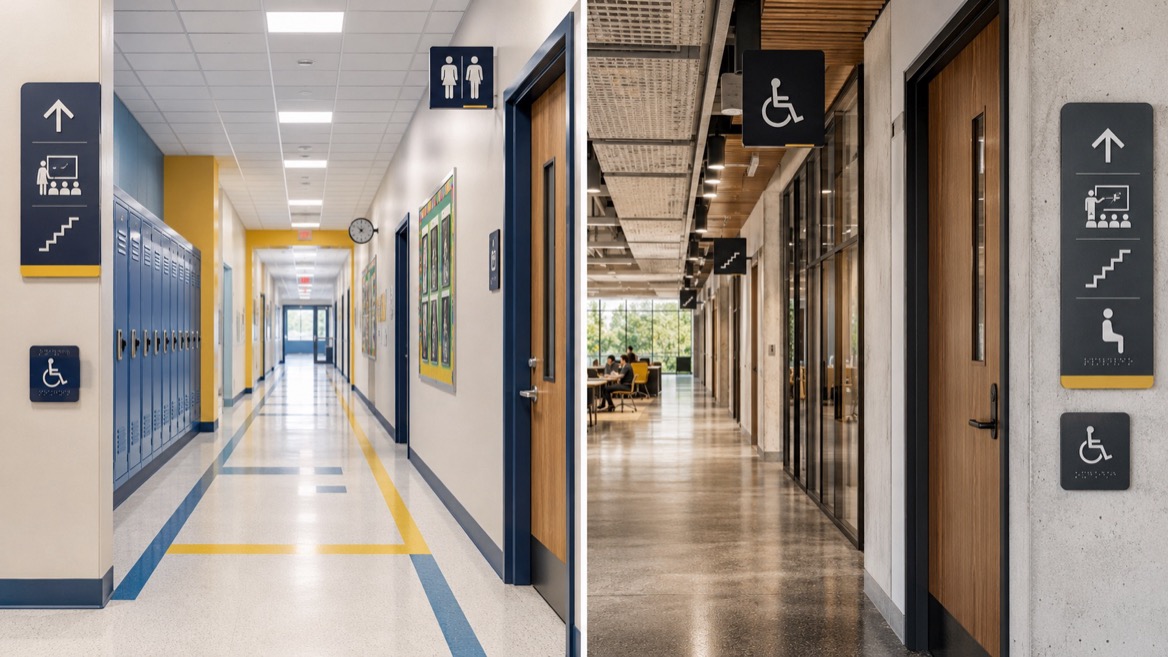
Placement matters as much as content. Signs are commonly installed on the latch side of doors and at a consistent height so users can locate them before reaching the doorway or entering the room.
The design should also support quick reading under real campus conditions. That means avoiding decorative fonts, choosing strong contrast, and using layouts that remain readable under mixed lighting and frequent use.
A practical sign system for education facilities should follow these principles:
1. Place signs consistently.
2. Use the same visual language across the campus.
3. Keep room identification simple.
4. Use tactile elements where required.
5. Test sightlines from walking height, not just on a desk mockup.
That last point is especially important. A sign can technically exist and still fail in practice if it is hidden by an open door, placed too far from the handle side, or visually lost in a busy corridor.
The strongest signage programs are designed as systems rather than individual products. On a campus, users make repeated decisions: where to enter, where to turn, which floor to reach, and how to find a specific room or service.
That is why schools and colleges should combine room IDs, directional signs, maps, and accessible route markers. When these elements work together, users spend less time searching and more time focusing on learning, teaching, or campus services.
For manufacturers, this is where custom fabrication adds real value. A well-executed signage package can unify materials, mounting methods, tactile precision, and branding while still respecting accessibility requirements.
Many facilities fail not because they ignore signage entirely, but because they install signs that look good and still do not function well. One common mistake is inconsistent sign placement from building to building, which breaks user expectations and makes navigation harder.
Another issue is treating accessible signs as standalone compliance items instead of part of the campus navigation flow. If directional signs do not connect clearly to room signs, users still have to ask for help, which weakens the whole system.
Other frequent problems include:
- Poor contrast in low-light corridors.
- Signs mounted too high or too low.
- Overuse of icons without clear text.
- Temporary or printed signs used where permanent identification is needed.
- Missing tactile features on permanent spaces.
A campus signage audit should be simple enough to repeat and detailed enough to catch problems. The goal is to identify where people get lost, where signs are missing, and where the sign hierarchy is inconsistent.
Use this process:
1. Walk the campus as a first-time visitor.
2. Track every decision point from arrival to destination.
3. Check room identification on permanent spaces.
4. Verify tactile and Braille installation where required.
5. Review contrast, height, and visibility from multiple angles.
6. Document gaps by building, floor, and use zone.
7. Prioritize fixes based on traffic and risk.
This process works well for both schools and colleges, but colleges usually need more documentation because of their size and the number of user groups they serve.
From a manufacturing standpoint, educational signage should balance compliance, durability, and brand consistency. Schools often need cost-effective, easy-to-maintain sign families, while colleges may require broader material options, modular replacement parts, and campus-wide identity systems.
The best projects start with a sign schedule. That schedule should define room numbers, mounting heights, tactile requirements, color standards, materials, and installation locations before production begins.
For a manufacturer like Landea Signs Co., Ltd., this is where custom solutions matter most. A strong production partner can help institutions standardize their visual system while adapting to different building types, traffic levels, and user needs.
| Area | Schools | Colleges |
|---|---|---|
| Typical users | Students, teachers, parents, visitors, younger children | Students, faculty, staff, visitors, contractors, international users |
| Main objective | Fast recognition and safe movement | Complex wayfinding across a large campus |
| Signage style | Clear, simple, highly readable | Systematic, scalable, multi-building consistency |
| Common use spaces | Classrooms, restrooms, gymnasiums, offices, cafeterias | Lecture halls, labs, dorms, libraries, student centers, parking structures |
| Planning challenge | Age-appropriate clarity | Campus-wide coordination and maintenance |
This side-by-side view shows that the underlying accessibility principle is the same, but the execution must match the facility type. The more complex the campus, the more valuable a structured sign strategy becomes.
Schools and colleges both need ADA signage, but they need it for slightly different reasons and in different ways. Schools benefit from simple, child-friendly clarity, while colleges need a scalable navigation framework that supports independent movement across a larger and more diverse environment.
For facilities teams, architects, and procurement managers, the smartest next step is to audit existing signs, identify permanent spaces that need tactile identification, and standardize the entire system before new production begins. If your campus needs a custom ADA signage plan, now is the right time to build one that is readable, durable, and easy to maintain.
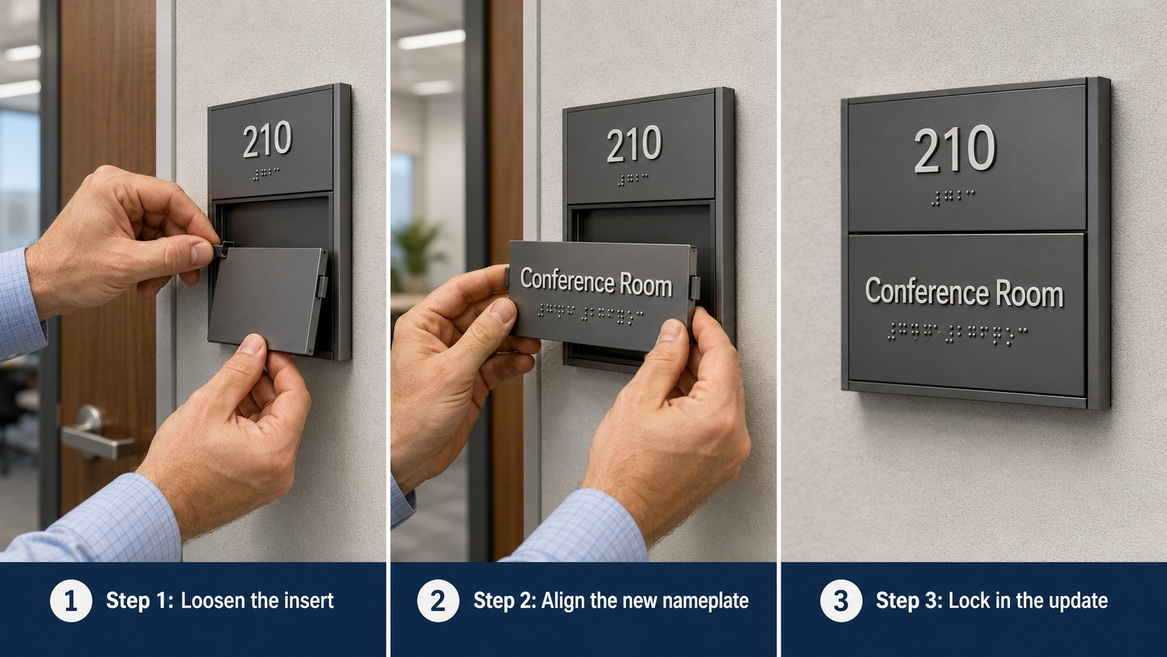
Not every door requires the same treatment, but permanent rooms and regulated spaces usually need accessible identification signs when the space functions qualify.
Braille is required on tactile signs for many permanent spaces and is a core part of accessible room identification in higher-education facilities.
Schools usually need simpler and more direct navigation, while colleges need broader wayfinding across multiple buildings and user groups.
Temporary signs may be exempt in some situations, but they do not replace required permanent signage for rooms and spaces that need accessible identification.
Strong contrast, non-glare surfaces, clear type, correct mounting height, and consistent placement all improve readability.
1. [ADA Requirements for Education Facilities]
2. [ADA Accessible Signage - International Sign Association]
3. [ADA Signs for Education - Braille Access Solutions]
4. [Best Practices for Implementing Wayfinding Signage]
5. [Chapter 7: Signs - U.S. Access Board]
6. [ADA Accessibility Standards - U.S. Access Board]
7. [Accessibility in Digital Signage: Ensuring Inclusivity on Campus]


