From idea to market-ready product, our SIGNS solutions make every stage easier, faster. Discover How We Help

Views: 228 Author: Landea Signs Publish Time: 2026-10-09 Origin: Site


Content Menu
● How Engraved and Printed Hotel Room Number Signs Differ
>> Engraved Signs: Numbers Formed Within the Material
>> Printed Signs: Numbers Applied to a Surface
● Engraved vs Printed Hotel Room Number Signs: Comparison Table
● Which Hotel Room Signs Resist Scratches Better?
>> Exposed Engraving Has a Structural Advantage
>> Protected Printing Changes the Comparison
● Cleaning Chemicals: An Often-Overlooked Durability Factor
● Sunlight, Humidity, and Material Selection
>> UV Resistance Belongs to the Material System
>> Moisture Makes Edges and Mounting Important
● How Long Do Engraved and Printed Hotel Signs Last?
● A Practical Sample-Testing Plan Before Ordering
>> Step 1: Obtain Comparable Finished Samples
>> Step 2: Establish Acceptance Criteria
>> Step 3: Reproduce the Cleaning Routine
>> Step 4: Escalate Testing Where Necessary
● Compare Lifecycle Cost, Not Just Purchase Price
● Choosing the Right Construction for Different Hotels
>> Busy Hotels With Simple Room Numbers
>> Boutique Hotels With Detailed Visual Branding
>> Hotels Planning Future Rebranding
● Accessibility: Recessed Engraving Is Not Raised Lettering
● Specify Your Hotel Room Signs With Landea Signs Co., Ltd.
● FAQs
>> Are Engraved Hotel Room Number Signs Always More Durable?
>> Can Printed Hotel Room Signs Withstand Frequent Cleaning?
>> Do Engraved Numbers Lose Their Color?
>> Is UV Printing Automatically Suitable for Outdoor Hotel Signs?
>> Which Option Is Better for Custom Hotel Branding?
>> What Should a Hotel Send With a Quotation Request?
Engraved vs printed hotel room number signs: which option stays readable and attractive after years of cleaning, guest contact, and daily operation? For comparable exposed-face constructions, engraving generally offers the stronger starting point because the number is cut into the material rather than carried entirely by surface ink. However, protected, second-surface printed signs can outperform poorly specified engraved alternatives.
At Landea Signs Co., Ltd., our approach to personalized advertising signage starts with the application—not simply the production method. A quiet interior corridor, a beachfront property, and a frequently disinfected hotel floor require different specifications.
The practical question is therefore not just "engraved or printed?" It is: which complete sign construction will preserve readability, appearance, and secure installation under your hotel's actual conditions?
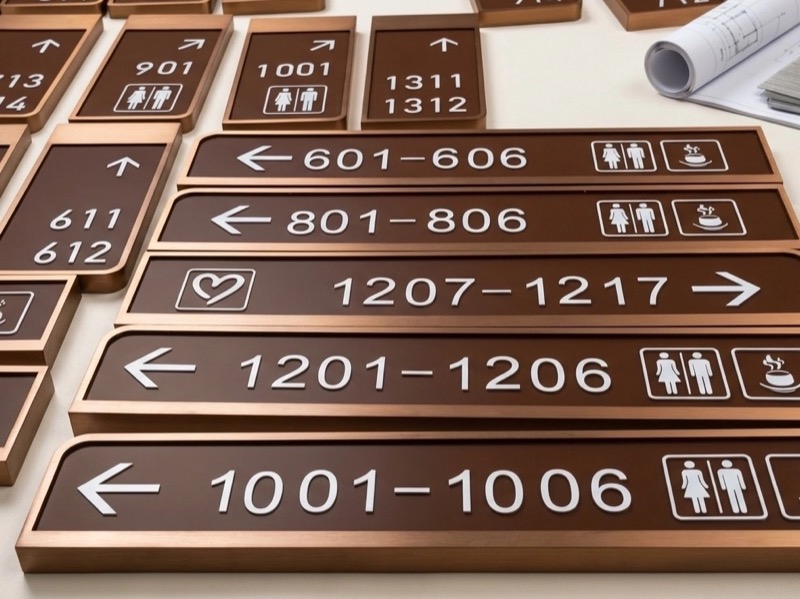
Engraving removes material to create lettering or numbers. Common constructions include:
- Two-layer engraving plastic, where cutting through the surface reveals a contrasting core.
- Metal plaques with recessed numbers, sometimes filled with paint.
- Reverse-engraved acrylic, where the artwork is cut into the back and viewed through the front.
These constructions behave differently. A contrasting-core number does not depend on a surface ink layer. A paint-filled metal number remains physically recessed if the paint deteriorates, but its visual contrast may decline.
Reverse engraving offers another advantage: the front remains smooth while the lettering sits behind it. However, scratches on that front surface can still affect appearance and visibility.
Printed hotel room number signs also cover several constructions:
- Direct-to-surface printing on rigid panels.
- Printed film applied to a backing panel.
- Printed graphics protected by a compatible overlaminate.
- Second-surface printing behind transparent acrylic.
With second-surface printing, guests and cleaners contact the clear front panel rather than the ink itself. This changes the durability comparison substantially.
A purchasing specification that says only "printed acrylic" is incomplete. It should identify the printed surface, protective layers, ink system, and mounting method.
The following comparison describes typical construction-related advantages, not guaranteed performance for every product.
| Decision factor | Engraved signs | Printed signs |
|---|---|---|
| Exposed-number wear | Recessed or contrasting-core numbers are less dependent on an exposed graphic layer | Exposed ink or film depends on adhesion and abrasion resistance |
| Protected construction | Reverse engraving places lettering behind a smooth face | Second-surface printing shields ink behind a clear face |
| Cleaning compatibility | Depends on substrate, finish, and any paint fill | Depends on ink, laminate, substrate, and cleaner |
| Sunlight resistance | Requires a suitable material grade and color | Requires a suitable ink and protective construction |
| Design flexibility | Strong for simple numbers and restrained designs | Strong for multicolor graphics, imagery, and gradients |
| Accessibility | Recessed engraving alone does not create raised characters | Flat printing alone does not create raised characters |
| Repairs | Recesses may remain, but contrast or finish can require restoration | Replaceable graphics may simplify updates if designed accordingly |
| Best comparison basis | Finished assembly and maintenance conditions | Finished assembly and maintenance conditions |
When a number is physically recessed, light wear across the surrounding face does not automatically remove its geometry. That is the fundamental durability advantage of engraving.
However, "still present" is not the same as "still easy to read." A scratched background, damaged paint fill, or reduced contrast can make an engraved number less effective.
For procurement, evaluate both physical survival and usable readability. A plaque that remains attached but no longer communicates clearly has failed its purpose.
Surface-printed numbers expose their graphic layer to contact unless another layer protects them.
Second-surface printed hotel room signs place that graphic behind acrylic. Routine front-face wiping does not directly rub the ink. Reverse-engraved acrylic follows a similar protective principle.
Neither construction makes the outer panel scratch-proof. The advantage is separation: the wear surface and the number-forming layer are not the same surface.
For busy corridors, compare these protected constructions before assuming all printed signs are less durable.
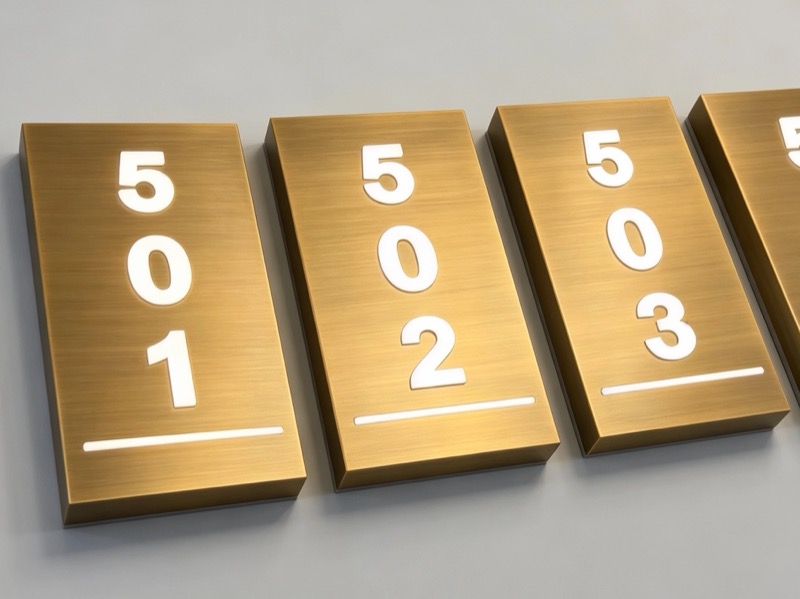
Hotels need signs that tolerate the actual housekeeping routine, not an idealized cleaning method.
Relevant variables include:
- Cleaner chemistry and concentration.
- Required contact time.
- Wiping pressure and frequency.
- Cloth or pad abrasiveness.
- Whether residue is rinsed away.
- Chemical exposure around panel edges.
Manufacturer guidance for finished graphics distinguishes between different protective constructions. Some cleaning restrictions apply specifically to digitally printed graphics with clear coats; others apply to graphics with overlaminates or screen-print clears.
This is why "chemical-resistant" needs qualification. Ask which chemicals were evaluated, at what concentration, and on which finished assembly.
From a specification standpoint, I would prioritize written compatibility with the hotel's approved cleaners over a broad claim of "premium durability."
Do not change a required disinfectant dilution merely to protect signage. Instead, choose a sign construction compatible with the approved cleaning procedure.
Engraving does not make a substrate immune to sunlight. An unsuitable engraving sheet can lose color or appearance even though the recessed number remains.
Material suppliers distinguish between indoor products, UV-stable products, and outdoor-weatherable grades. Some color finishes within a product range have different suitability.
Likewise, UV-cured printing describes how an ink cures; it does not, by itself, establish a particular outdoor service life.
For corridors with substantial daylight or exterior guest-room entrances, request specifications for the exact substrate, color, ink, and protective layer.
In humid or exposed locations, evaluate the complete construction rather than the decorative face alone.
Questions should include:
- Can moisture reach the graphic or backing?
- Are applied-film edges exposed?
- Is the mounting system suitable for the wall finish?
- Are hardware and substrate appropriate for the environment?
A durable graphic cannot compensate for an unsuitable backing or unreliable attachment. Environmental suitability must cover the whole assembly.
There is no defensible universal lifespan for either category.
A statement such as "engraved signs last ten years" or "printed signs last three years" ignores material grade, sunlight, maintenance, installation, and the hotel's acceptance standard.
Supplier weatherability figures also need context. An exterior colorfastness statement is not automatically an indoor hotel lifespan, and it is not necessarily a warranty for the complete sign.
Ask suppliers to separate:
1. Expected appearance retention.
2. Graphic adhesion or integrity.
3. Substrate performance.
4. Mounting performance.
5. Written warranty coverage and exclusions.
This produces a more useful comparison than an unsupported number of years.
A finished sample is more informative than a photograph or a generic material description.
The following is a proposed procurement workflow, not a standardized laboratory test or a substitute for formal certification.
Request the intended substrate, number design, finish, protective layers, and mounting arrangement.
Comparing bare engraving sheet with laminated printed signage would not represent the proposed finished products fairly.
Record baseline photographs under consistent lighting. Agree on unacceptable changes, such as:
- Reduced number contrast.
- Visible ink transfer.
- Peeling or edge lift.
- Surface haze or discoloration.
- Loose mounting.
- Loss of tactile features.
Define failure before testing, not afterward.
Use the approved cleaner, dilution, contact time, and wiping material.
Record the number of cycles and inspect both the face and edges. Accelerated wiping can compare samples under a shared procedure, but it cannot automatically predict years of service.
For substantial projects, request suitable laboratory evaluation.
ASTM D3359 addresses coating adhesion by tape testing, primarily on metallic substrates. Its scope and limitations matter; it is not a universal finished-sign durability rating. Testing plastics requires an appropriately agreed method and interpretation.
The lower quotation is not necessarily the lower-cost choice.
A practical ownership model includes:
> Total ownership cost = purchase + installation + cleaning-related upkeep + replacement materials + replacement labor.
Also consider operational consequences. Replacing signs across an occupied hotel requires scheduling, access, and coordination.
Request separate pricing for:
- Initial production and installation.
- Individual replacement room numbers.
- Small repeat orders.
- Replaceable graphic components.
- Spare mounting hardware.
I would also ask how future replacements will match the approved color, typography, and finish. A durable sign program needs reproducibility, not merely a strong first batch.
The following are specification scenarios, not reported customer case studies.
Contrasting-core engraved signs are a sensible starting point when numbers are straightforward and exposed graphic wear is a concern.
The selected material must still match cleaning and environmental requirements.
Second-surface printed acrylic deserves consideration where multicolor artwork or visual depth matters.
The construction protects the ink from front-face handling, while the outer surface still needs an appropriate finish and maintenance routine.
Consider separating permanent room identification from changeable decorative elements.
A replaceable background or branding panel can make future updates easier without requiring every component to be discarded.
This is a design recommendation, not a claim that every modular system has lower ownership cost.
Durability and accessibility are separate requirements.
For permanent-room identification covered by U.S. accessibility requirements, relevant provisions include raised characters and braille, together with applicable visual, placement, and mounting criteria.
Recessed engraved numbers alone do not satisfy a raised-character requirement. Flat printed numbers alone do not either.
Both methods can form part of a compliant construction when the required tactile elements and other features are correctly specified.
For projects outside the United States, verify the applicable local requirements. Do not accept "accessible signage" as a complete specification without checking the finished design and installation.
Choose the construction around your operating conditions rather than the production-method label.
For a personalized quotation from Landea Signs Co., Ltd., send your room-number schedule, preferred design, installation environment, and cleaning requirements. Request a finished sample and written construction details before approving full production.
That approach turns "engraved vs printed" into a practical decision about readability, maintenance, and long-term value.
No. Engraving has a structural advantage over comparable exposed printing, but material quality and protection matter. A protected printed sign can be a stronger choice than an unsuitable engraved assembly.
They can when the finished construction is compatible with the cleaning procedure. Second-surface printing protects ink from direct front-face wiping, but the clear panel and edges still require evaluation.
They can. Paint-filled recesses may lose contrast, and engraving materials have product-specific color stability. A physically intact number is not necessarily a clearly readable number.
No. UV curing does not establish outdoor durability by itself. Verify the exact ink, substrate, protection, exposure conditions, and supplier performance documentation.
Printing generally offers more flexibility for multicolor imagery and gradients. Engraving suits simple, restrained number designs. Protected constructions can combine durability with either aesthetic approach.
Provide the room-number schedule, artwork, dimensions, installation photographs, exposure conditions, approved cleaners, accessibility requirements, and replacement expectations. These details allow a meaningful construction recommendation.
1. U.S. Access Board. [Chapter 7: Signs]. Guidance on permanent-room identification, tactile characters, braille, visual characteristics, and installation. [access-board]
2. U.S. Access Board. [2010 ADA Standards: Chapter 7—Communication Elements and Features]. Technical requirements relevant to sign characters and tactile placement. [access-board]
3. 3M. [Instruction Bulletin: Maintenance, Revision A, December 2024]. Construction-specific cleaning guidance, cleaner restrictions, and precautions against excessive abrasion. [multimedia.3m]
4. Rowmark. [Glossary & Icon Legend]. Definitions and qualifications concerning UV stability, exterior weatherability, and protective layers. [rowmark]
5. Rowmark. [Reverse Rotary/Laser Engraving and Paint Filling Rowmark Products]. Explains underside engraving and protection of the finished front surface. [rowmark-ram.s3.amazonaws]
6. Rowmark. [LaserMax]. Product information illustrating why suitability must be checked for individual material finishes. [rowmark]
7. ASG Companies. [Second Surface Acrylic Printing Guide]. Explains rear-face printing viewed through protective acrylic. Used for construction mechanics, not as evidence of unlimited durability. [asg-companies]
8. ASTM International. [ASTM D3359-23: Standard Test Methods for Rating Adhesion by Tape Test]. Scope, application, and limitations of coating adhesion testing. [store.astm]


