From idea to market-ready product, our SIGNS solutions make every stage easier, faster. Discover How We Help

Views: 222 Author: Landea Signs Publish Time: 2026-04-29 Origin: Site


In this guide, I will walk you through the essential office signage every modern workplace needs, how to design them for accessibility and branding, and how to future‑proof your signage as your business grows. As a manufacturer at Landea Signs Co., Ltd., we have spent years producing OEM signage for international brands and facility managers, so the recommendations below are based on what actually works in real offices, shops, clinics, and factories. You will also see practical tips drawn from Google's E‑E‑A‑T best practices to help your content and signage support your online visibility as well. [blog.hubspot]

When I audit a new client's workplace, the signage experience is usually the first thing I test: how quickly can a first‑time visitor find the reception, restroom, and emergency exit without asking for help. In most buildings, gaps in ADA signs, wayfinding, and safety labeling create confusion, increase liability, and quietly damage the brand's perceived professionalism. [developers.google]
Effective office signage delivers three critical outcomes. [nytlicensing]
- Compliance and safety: ADA and emergency signs reduce legal risk and help protect staff and visitors. [webfx]
- User experience: Clear wayfinding reduces stress, improves visitor flow, and shortens check‑in times. [teamwti]
- Brand consistency: Professional signage turns every corridor and door into a touchpoint for your visual identity. [attentiongetters]
From a digital perspective, the same clarity you build into your physical signage—consistent naming, clear hierarchy, and labeled paths—mirrors the structure Google expects on your website, reinforcing both offline and online trust. [publisherdesk]
ADA‑compliant signage is not just a legal checkbox; it is the foundation of an inclusive workplace. These signs typically mark permanent rooms and spaces (restrooms, conference rooms, exits) with tactile lettering and Braille so that people with visual impairments can navigate independently. [developers.google]
From an expert standpoint, I advise clients to prioritize ADA signs in four areas. [webfx]
- Room identification: Restrooms, meeting rooms, staff rooms, and utility rooms. [developers.google]
- Floor and stair signage: Floor numbers and stair identifiers for emergency services and evacuees. [webfx]
- Tactile exits: Clearly marked exit doors with raised text and Braille. [developers.google]
- High‑contrast design: Strong contrast between text and background, non‑glare finishes, and standardized pictograms. [webfx]
At Landea Signs, our OEM ADA signage systems can be customized with your brand colors while still respecting contrast ratio, height, and tactile requirements in your target market. This is where working directly with a specialist manufacturer protects you from costly retrofits after inspections. [autusdigital]
Your entry signage is your first promise to customers: "We are open, and here is what you can expect." Clear business hour signs on doors or windows prevent frustration, reduce phone calls about opening times, and set expectations for service windows. [webfx]
For B2B environments, I recommend treating entrance signage like a mini information hub. [nytlicensing]
- Hours of operation for weekdays, weekends, and holidays. [webfx]
- Contact options (phone, website, QR code) for after‑hours inquiries. [attentiongetters]
- Access instructions (ring bell, use intercom, bring ID, delivery door, etc.). [nytlicensing]
Digitally, make sure your posted hours match your Google Business Profile and website; inconsistent signals are a common local SEO issue that hurts both walk‑in traffic and online trust. [attentiongetters]
If visitors often walk into your reception and say, "Where do I go now?", your wayfinding design is failing. Wayfinding signage covers everything from lobby directories to corridor arrows and floor maps, guiding people step by step through an unfamiliar environment. [teamwti]
In our OEM projects, we approach wayfinding as a layered system. [autusdigital]
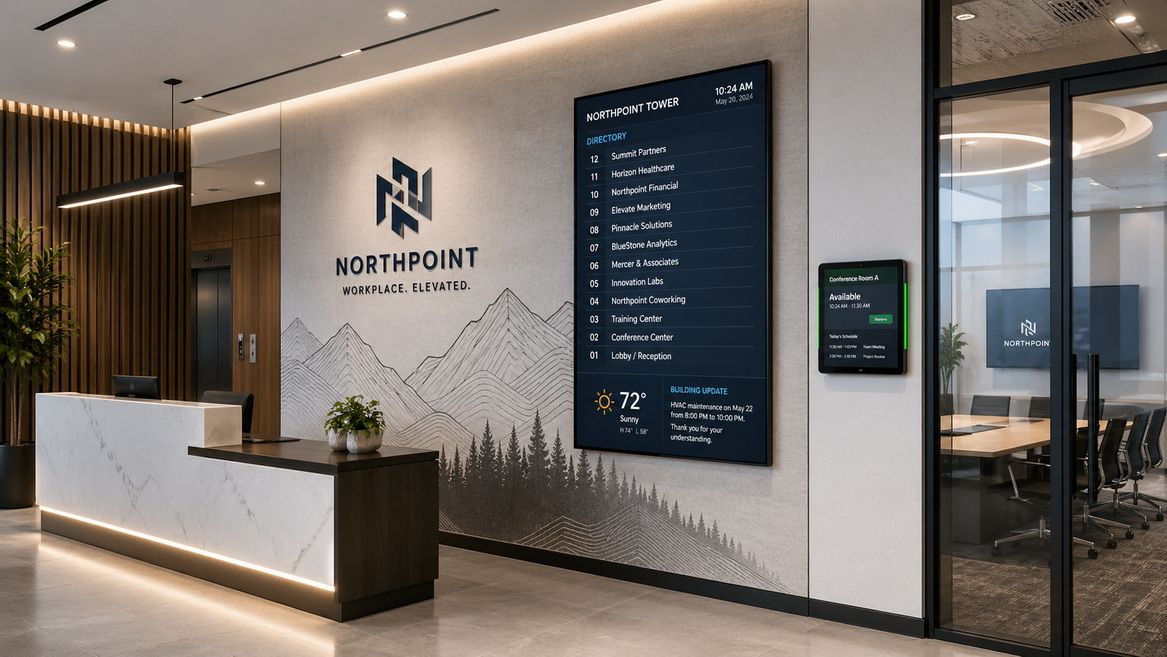
- Global orientation: Lobby directories and building maps showing the overall layout. [webfx]
- Directional cues: Arrow signs, overhead signs, and wall graphics at every major junction. [webfx]
- Destination labels: Door signs for suites, departments, and key rooms. [webfx]
A simple rule I use on site: a visitor should never walk more than 10–15 meters without seeing confirmation that they are still on the right path. When you design signage with that principle, you can literally see anxiety drop and movement become smoother in busy spaces like hospitals, campuses, and office towers. [teamwti]
Emergency and exit signs are the one category you hope people never need—but when they do, they must be instantly visible and unambiguous. Most regions require compliant illuminated exit signs, evacuation route diagrams, and labels for fire equipment and alarms. [developers.google]
From a risk‑management standpoint, I encourage clients to conduct an annual "blind walk‑through." [publisherdesk]
1. Turn down the lights to simulate poor visibility.
2. Walk typical evacuation routes as if you were a first‑time visitor.
3. Note any places where exit or stair signs are blocked, too small, or poorly lit.
As a manufacturer, we often integrate LED illumination, photoluminescent materials, and standardized pictograms so your emergency signage remains visible even in power failures. This directly supports both staff safety and regulatory audits. [attentiongetters]
Once the essentials are in place, brand signage and environmental graphics transform your building from a neutral shell into a physical extension of your identity. This includes logo wall signs, reception signs, motivational wall graphics, glass decals, and large‑format prints that subtly reinforce your values. [nytlicensing]
For international clients, we design these elements with repeatable systems: modular brand color palettes, standardized logo placements, and consistent typography across all regions. This consistency strengthens recognition and makes it easier for your team to brief local contractors in different countries. [publisherdesk]
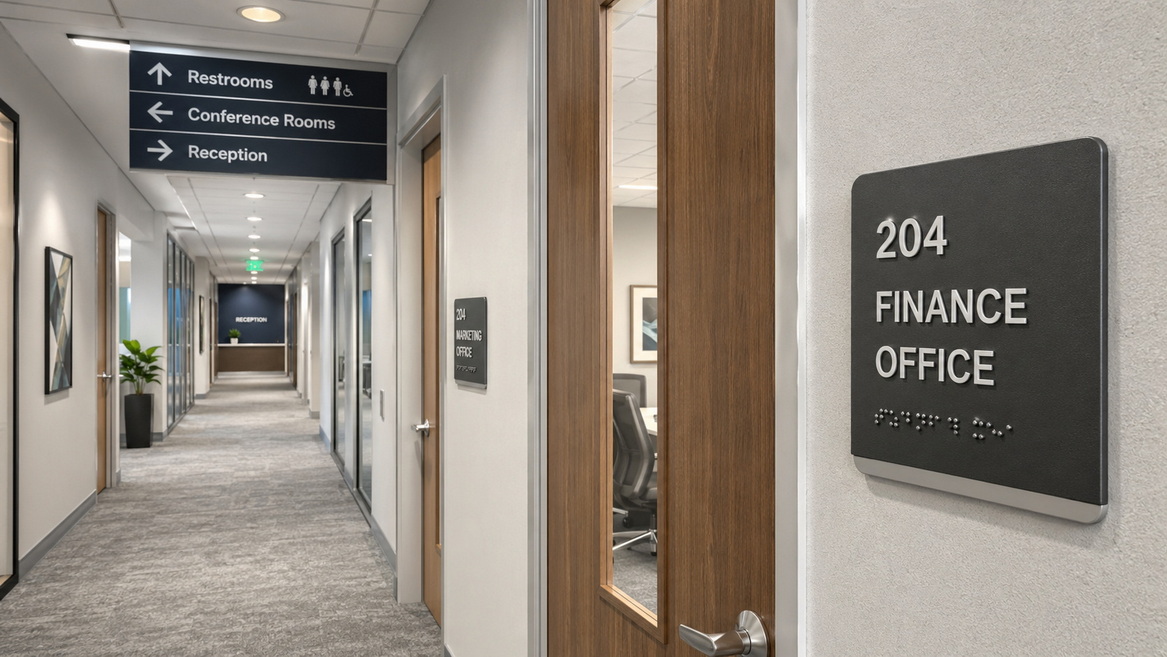
Most companies buy signs reactively—"we need a restroom sign"—instead of designing a coherent signage system. That usually leads to mismatched styles, duplicated messages, and wasted budget. [publisherdesk]
Based on dozens of international OEM projects, here is a practical planning framework. [autusdigital]
1. Audit your current space: Walk every route a visitor, employee, and delivery driver might use, and list every decision point where a sign is needed. [teamwti]
2. Prioritize by risk and impact: First cover ADA and emergency signage, then wayfinding, then branding and promotional graphics. [developers.google]
3. Standardize your sign families: Define consistent sizes, materials, fonts, and colors for door signs, directories, and safety labels. [nytlicensing]
4. Create a signage schedule: Use a spreadsheet listing sign code, location, content, and installation height so projects are easy to repeat or expand. [autusdigital]
5. Partner with a specialist manufacturer: Work with an OEM factory that understands both local regulations and international export requirements. [autusdigital]
This approach not only streamlines procurement but also supports your long‑term brand governance, especially if you manage multiple offices or franchise locations. [nytlicensing]
After reviewing many client locations and competitor websites, we see the same signage mistakes repeatedly. [webfx]
- Inconsistent terminology: Using "Meeting Room A" on one sign and "Conference A" on another confuses visitors and staff. [teamwti]
- Poor contrast and readability: Stylish but low‑contrast signs may look luxurious in photos but are hard to read in real life. [developers.google]
- Ad‑hoc additions: Temporary printed signs taped to walls gradually undermine the professional look of your space. [nytlicensing]
- No documented standard: Without a basic signage guideline, every new manager orders something different. [autusdigital]
The fix is straightforward: define a simple signage style guide and work with one core OEM manufacturer so every new sign follows the same rules. Over time, this reduces cost per unit and protects your brand image across all your locations. [nytlicensing]
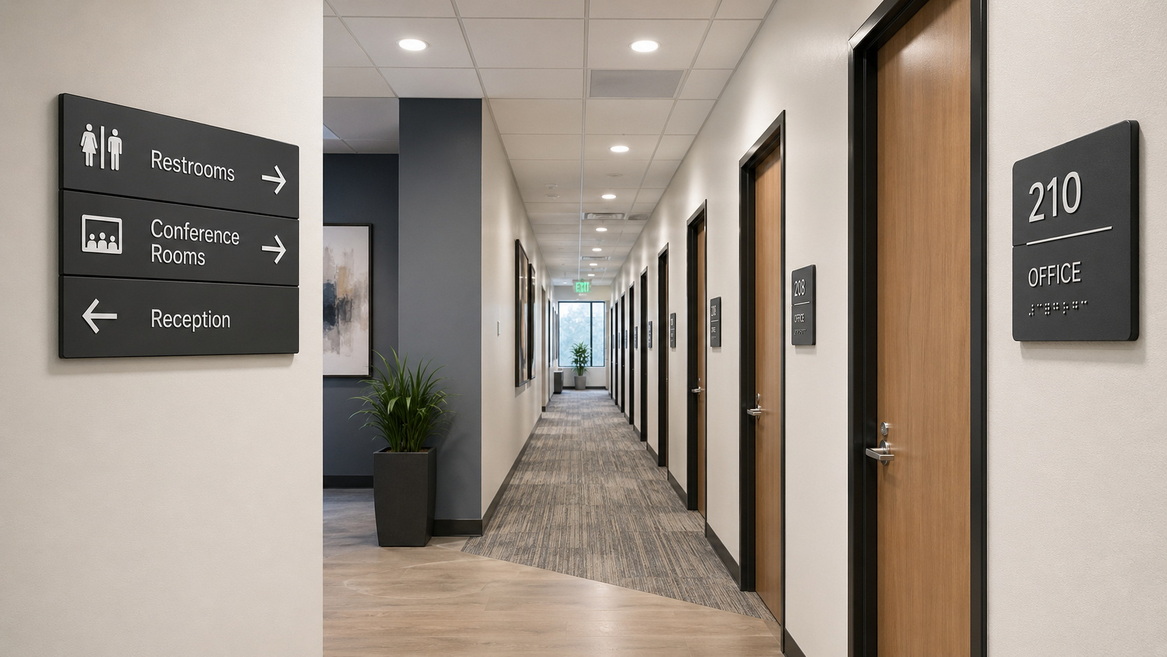
An overlooked but crucial decision is what your signs are made of and how they will perform over time. In high‑traffic offices, cheap materials can scratch, fade, or peel, leading to frequent replacements and a neglected look. [attentiongetters]
When advising overseas clients, we usually guide them through three questions. [autusdigital]
- Where will the sign live? Interior corridor, sun‑exposed window, humid restroom, or outdoor facade all require different specs. [webfx]
- How long should it last? A temporary construction sign may only need 6–12 months, while lobby logos should look pristine for many years. [attentiongetters]
- What maintenance is realistic? Some finishes show fingerprints less, clean easily, or resist vandalism better. [attentiongetters]
As an OEM factory, we can match these requirements with metals, acrylics, composites, or vinyl systems that balance cost, appearance, and lifespan for your specific use case. [autusdigital]
Good signage design borrows heavily from UX and wayfinding principles: clarity first, style second. When we co‑create sign systems with international brands, we typically focus on four UX pillars. [teamwti]
- Clarity of message: Use short, action‑oriented labels (Reception, Restrooms, Exit, Deliveries) and standard pictograms. [developers.google]
- Consistency of hierarchy: Keep fonts, sizes, and color coding consistent so visitors can instantly recognize sign types. [teamwti]
- Visibility and placement: Install signs at eye level, avoid visual clutter, and ensure viewing distance matches text size. [developers.google]
- Multilingual support where needed: For international offices, combine icons with two languages to minimize cognitive load. [nytlicensing]
These same principles translate directly into a better website experience: descriptive headings, clear labels, and logical navigation that help users and search engines understand your content. [tatarek.co]
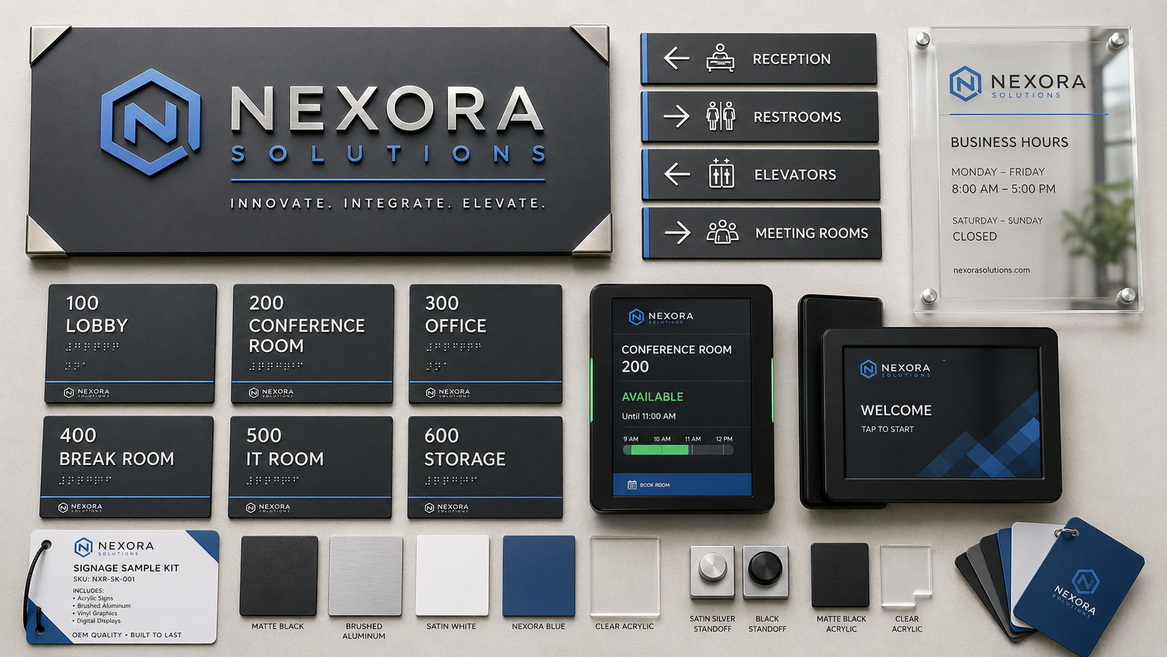
As a China‑based signage manufacturer, Landea Signs Co., Ltd. partners with overseas brands, wholesalers, and producers who need reliable OEM office signage solutions. Our role is to translate your brand standards and local compliance requirements into scalable production that delivers consistent results across locations. [autusdigital]
For office signage projects, we typically support clients by. [autusdigital]
- Engineering ADA, wayfinding, and emergency sign families that align with your typography and color palette.
- Producing branded business hour signs, reception logos, and environmental graphics for multi‑site rollouts.
- Providing technical drawings, installation instructions, and packaging that simplify local implementation.
This integrated approach lets your team focus on strategy, content, and customer experience, while we take care of the manufacturing complexity behind the scenes. [autusdigital]
Use this condensed checklist to evaluate your current space or brief your next project. [webfx]
| Task | Key Question | Status |
|---|---|---|
| ADA room signs | Are all permanent rooms labeled with tactile signs and Braille where required? webfx | ☐ |
| Wayfinding | Can a first‑time visitor find reception, restrooms, and exits without asking staff? webfx | ☐ |
| Emergency signage | Are exit signs, stairs, and evacuation routes clearly marked and illuminated? webfx | ☐ |
| Business hours | Are opening times, contact details, and access instructions visible at the entrance? webfx | ☐ |
| Branding | Do lobby and corridor signs consistently reflect your brand identity? webfx | ☐ |
| Materials | Are signs durable and suitable for their environment (indoor/outdoor, humidity, sunlight)? webfx | ☐ |
| Consistency | Do you have a documented signage standard and preferred OEM supplier? webfx | ☐ |
If you are planning a new workspace, renovating an existing office, or standardizing signage across multiple locations, now is the ideal time to define a coherent, future‑proof signage system. Share your floor plans, brand guidelines, and local regulations with us at Landea Signs Co., Ltd., and we can help you design and manufacture office signage that is compliant, on‑brand, and ready for international rollout. [autusdigital]
1. What office signs are legally required in most workplaces?
Most jurisdictions require ADA‑style accessible signs for permanent rooms, clearly marked exits, and emergency information such as evacuation routes and fire equipment labels, subject to local building codes. [developers.google]
2. How often should we update or review our office signage?
You should review signage whenever you change floor layouts, add departments, or update branding, and at least once a year to check for damage, visibility issues, or regulatory changes. [teamwti]
3. Can one signage system work across multiple countries?
Yes, if it is built as a flexible system: core design rules remain consistent, while local partners adjust language, legal symbols, and installation standards for each market. [nytlicensing]
4. What is the best material for office door signs?
The "best" material depends on your environment and budget, but durable options like aluminum, acrylic, and high‑quality laminates tend to perform well in indoor office corridors. [attentiongetters]
1. Office Sign Company Blog. "Go‑To Guide For Essential Office Signage."
<https://blog.officesigncompany.com/go-to-guide-for-essential-office-signage/> [blog.officesigncompany]
2. Google Search Central. "Search Engine Optimization (SEO) Starter Guide."
<https://developers.google.com/search/docs/fundamentals/seo-starter-guide> [developers.google]
3. HubSpot. "Is Your Website EEAT‑Compliant? What Developers Should Keep In Mind."
<https://blog.hubspot.com/website/eeat-compliance> [blog.hubspot]
4. WebFX. "3 SEO Best Practices for Sign Companies."
<https://www.webfx.com/industries/professional-services/sign-companies/seo/> [webfx]
5. Attention Getters. "Signage SEO: How Your Business Sign Can Help With Online and Local Search Visibility."
<https://attentiongetters.com/signage-seo-how-your-business-sign-can-help-with-online-and-local-search-visibility/> [attentiongetters]
6. The Publisher Desk. "10 Essential E‑E‑A‑T Best Practices to Boost Your Website's Credibility."
<https://www.publisherdesk.com/google-e-e-a-t-best-practices/> [publisherdesk]
7. Pawel Tatarek. "How to Write A B2B Blog Post [Step‑by‑Step Guide]."
<https://tatarek.co.uk/b2b-blog-post/> [tatarek.co]
8. Team WTI. "Content Strategy and Google's E‑E‑A‑T Principles."
<https://teamwti.com/your-content-strategy-high-quality-content/> [teamwti]
9. Autus Digital. "SEO For Sign Companies."
<https://www.autusdigital.com/industries-served/seo-for-sign-companies/> [autusdigital]
10. xsign. "6 Tips for Creating Effective Office Signage."
<https://xsign.com/6-tips-for-creating-effective-office-signage/> [xsign]
11. Moz. "Beginner's Guide to SEO (Search Engine Optimization)."
<https://moz.com/beginners-guide-to-seo> [moz]
12. Semrush. "What Is Google SEO? A Beginner's Guide to Ranking Higher."
<https://www.semrush.com/blog/google-seo/> [semrush]
13. Innovation Visual. "Google's EEAT Guidelines – How To Remain Compliant."
<https://www.innovationvisual.com/knowledge-hub/resources/google-eeat-guidelines-how-to-remain-compliant> [innovationvisual]
14. Horizon Sign Company. "Beginner's Guide To Office Signs: 5 Ways To Build Better Workspaces."
<https://horizonsignco.com/beginners-guide-to-office-signs-5-ways-to-build-better-workspaces/> [horizonsignco]
15. Michigan Sign Shops. "A Guide On Where & How To Install Signs Around Your Business."
<https://michigansignshops.com/business-sign-guide/> [michigansignshops]


