From idea to market-ready product, our SIGNS solutions make every stage easier, faster. Discover How We Help

Views: 277 Author: Landea Signs Publish Time: 2026-08-07 Origin: Site


Content Menu
● Why Illumination Method Matters for Pylon Signs
● External Floodlighting: How It Works and Where It Excels
● Internal LED Illumination: How It Works and Where It Excels
● Head-to-Head Comparison Table
● Real-World Cost Impact: What the Numbers Show
● Practical Decision Framework for Pylon Sign Buyers
● An Industrial Manufacturer's Perspective
● Making the Right Choice for Your Pylon Sign
Choosing between external floodlighting and internal LED illumination for pylon signs is one of the most consequential decisions a business makes when investing in outdoor signage, because it directly shapes visibility, energy costs, and long-term maintenance expense.

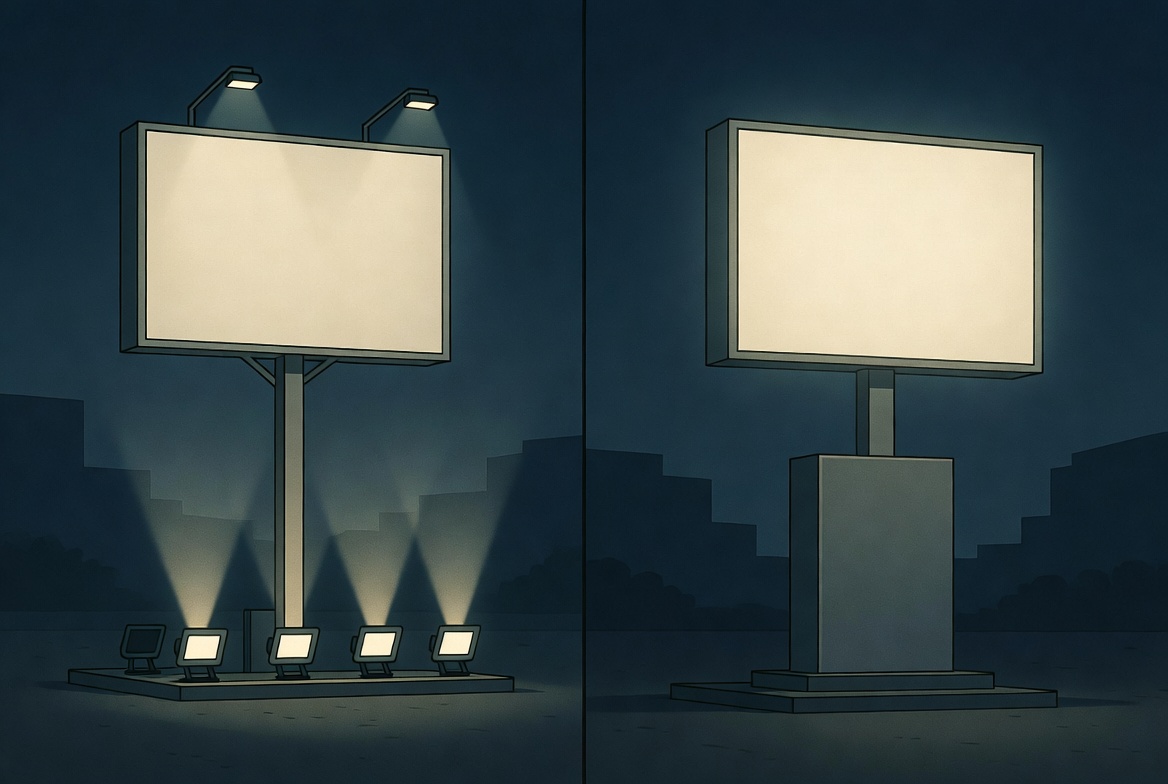
A pylon sign only works if it is seen, and seen clearly, at any hour and from any distance a driver or pedestrian might encounter it. External floodlighting relies on strategically placed floodlights outside the sign structure to wash light across the face, while internal LED illumination embeds LED modules or panels directly inside the sign cabinet to light the face from behind. Both methods deliver 24-hour visibility, but they diverge sharply in energy consumption, uniformity, installation complexity, and lifetime cost — the four factors that matter most to facility managers and brand owners evaluating a new pylon sign investment.
At Landea Signs Co., Ltd., we manufacture custom illuminated lettering and pylon sign systems for clients across retail, hospitality, automotive, and industrial sectors, and we are frequently asked to weigh these two illumination strategies against a client's specific site conditions, budget, and branding goals.
External floodlighting uses fixtures mounted on poles, brackets, or the ground to project light onto the sign face from outside the cabinet. For tall pylon and highway signs, distance is the core challenge, which is why these installations typically demand narrow-beam, high-wattage LED flood lights capable of projecting light further while maintaining clarity.
Key characteristics of external floodlighting:
- Beam angle matters: tall pylon signs generally need a narrower 60°–90° beam for concentrated illumination, while wider 90°–120° beams suit shorter monument signs.
- Fixtures are external, so they remain accessible for adjustment, cleaning, or replacement without opening the sign cabinet.
- Performance depends heavily on correct aiming; misaligned floodlights create hot spots, shadows, or glare that reduce legibility at a distance.
- Weather exposure means floodlight housings and lenses require periodic cleaning and sealing checks to prevent moisture ingress.
External floodlighting can be a practical retrofit option for older pylon structures where internal wiring for LED modules was never installed, since it avoids reworking the cabinet interior.
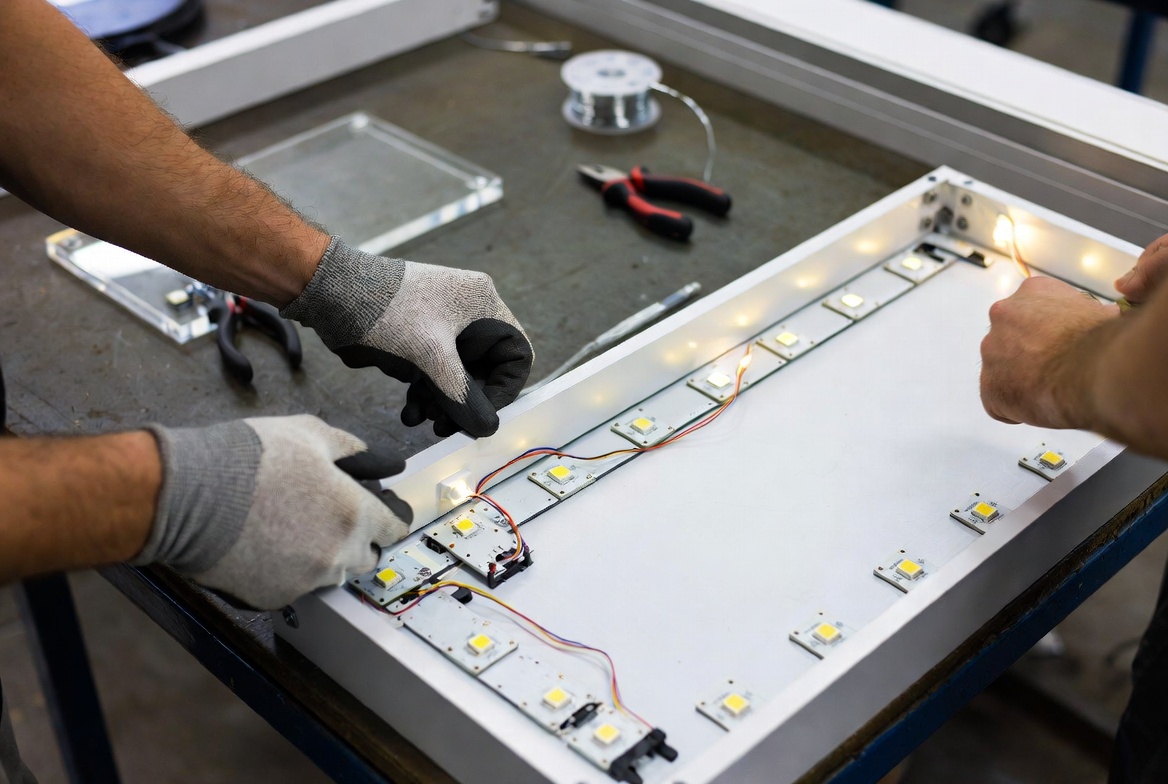
Internal LED illumination places LED modules, strips, or panels directly inside the sign cabinet, lighting the face from behind for consistent brightness and energy efficiency. This is now the dominant approach for new pylon sign construction because it produces even, glare-free illumination without depending on external aiming accuracy.
Key characteristics of internal LED illumination:
- Light distribution is uniform across the entire face, since diffusion is engineered into the panel or acrylic face rather than relying on line-of-sight from an external fixture.
- Internal LED signs typically use 12–20 watts per foot, compared with 60–80 watts per foot for older fluorescent internal lighting, translating into major energy savings.
- The sealed cabinet design protects components from wind, rain, and dust more effectively than exposed floodlight fixtures.
- Color temperature and RGB programmability are easier to control internally, supporting dynamic branding effects like combination lighting or animated color changes.
| Factor | External Floodlighting | Internal LED Illumination |
|---|---|---|
| Light uniformity | Depends on fixture placement and aiming; risk of hot spots | Naturally even across the face |
| Energy use | Higher wattage needed to cover distance | 12–20 W/ft, far lower than legacy internal lighting |
| Installation complexity | Simpler retrofit on existing structures | Requires wiring integration inside the cabinet during build |
| Weather resistance | Fixtures exposed to elements, need regular sealing checks | Components sealed inside cabinet, better long-term protection |
| Maintenance access | Easy external access for bulb/fixture swaps | Requires opening cabinet for LED module or power supply service |
| Best fit | Retrofits, budget-limited upgrades, very tall structures | New builds, brand-forward signage, energy-conscious operators |
Independent industry data helps quantify the difference. A 20-foot storefront sign using older fluorescent tubes consumes roughly 1,200 watts, while an equivalent internal LED sign uses just 300 watts — a saving of 900 watts per hour of operation. Running that sign 12 hours daily produces 10.8 kWh saved per day, or about 3,942 kWh annually, which at a typical commercial electricity rate of $0.12 per kWh equates to roughly $473 in annual savings per sign. Over a 10-year LED lifespan, that single conversion can exceed $4,700 in total savings. Larger monument and pylon signs show similar patterns: fixtures that once drew 2,000–3,000 watts now operate on 400–600 watts after LED conversion, with superior brightness.
Broader LED-versus-legacy comparisons reinforce this trend. LED sign lighting converts 70–90% of energy into visible light, whereas traditional lighting technologies waste most input energy as heat, using only 10–20% for actual illumination. This efficiency gap is a major reason internal LED illumination has become the default specification for new pylon sign programs among brand owners tracking facility operating costs.
Before committing to either illumination method, we recommend clients work through a short evaluation process:
1. Assess the existing structure. If the pylon already has internal wiring conduits, internal LED conversion is usually more cost-effective than adding floodlights.
2. Measure viewing distance and mounting height. Very tall highway-facing pylons may still benefit from supplemental narrow-beam floodlighting even when internal LEDs are the primary source.
3. Calculate 10-year operating cost, not just upfront price. Basic non-illuminated or externally lit pylon signs can start around $5,000–$10,000, while high-end LED-illuminated pylon signs with custom design range from $20,000–$50,000 or more, but the latter often recovers the premium through lower electricity and maintenance costs.
4. Plan for maintenance access. Internal LED cabinets require occasional service for LED modules, power supplies, or wiring, so design the cabinet with accessible service panels from the start.
5. Confirm local electrical and signage regulations, including voltage standards and any certifications required by local authorities before installation begins.
From a manufacturing standpoint, the choice is rarely binary. Many of our clients at Landea Signs Co., Ltd. combine methods: internal LED illumination handles the primary letterforms and logo panel for crisp, even branding, while supplemental external floodlighting highlights architectural or structural elements of the pylon base. This hybrid approach, increasingly common in premium retail and hospitality projects, delivers both uniform readability and dramatic nighttime presence.
We also see a growing preference for RGB-programmable internal LEDs among brands that rotate seasonal promotions or want dynamic color effects without replacing the sign face, a flexibility that static external floodlighting simply cannot match. For clients exporting signage internationally, we further account for voltage differences (commonly 110–120V in the US versus 220–240V in Europe) and local certification requirements during the internal LED module design phase.
Internal LED illumination is the stronger long-term choice for most new pylon sign installations, offering better energy efficiency, uniform brightness, and lower lifetime operating costs. External floodlighting remains a viable, lower-upfront-cost option for retrofits, very tall structures, or supplemental architectural lighting. If you are planning a new pylon sign or upgrading an existing structure, Landea Signs Co., Ltd. can assess your site, viewing distance, and branding goals to recommend the illumination system that maximizes visibility while minimizing long-term cost. Contact our engineering team today for a custom pylon sign consultation and quote.
1. Which is cheaper upfront: external floodlighting or internal LED illumination?
External floodlighting is often cheaper to install initially, especially as a retrofit on existing structures, since it avoids reworking the cabinet interior.
2. Does internal LED illumination really save money over time?
Yes. Converting to internal LED can cut sign-related electricity costs by 60–80% and, on a typical sign, generate over $4,700 in savings across a 10-year lifespan.
3. Can external floodlighting still work for very tall pylon signs?
Yes, but it requires narrow-beam, high-wattage fixtures (60°–90° beam angle) to project light effectively over long distances without losing clarity.
4. How much maintenance does internal LED illumination require?
Internal LED cabinets need periodic service for LED modules, power supplies, wiring, or controls, so accessible service panels should be built into the design.
5. Is a hybrid approach combining both methods common?
Yes. Many premium projects use internal LEDs for the main letterforms and external floodlights to accent structural or architectural features of the pylon base.
6. What voltage should I specify for internal LED pylon signs sold internationally?
Voltage standards vary by region, commonly 110–120V in the United States and 220–240V in Europe, so this must be confirmed during design.
- Best LED Flood Lights for Signs — [signindustry.com]
- Energy-Efficient LED Sign Conversions: Slash Your Electricity Costs — [ledsignsource.com]
- Pylon Sign Cost Analysis: Maximizing Value for Your Business — [signsandsuch.com]
- Pylon Signs: Everything You Need to Know — [aaasign.com]
- The Science Behind LED Power Consumption and Efficiency — [ledlightexpert.com]
- Pylon Sign Cost Breakdown: Height, Lighting & More — [signmonkey.com]
- Pylon Signage: Types, Benefits, Uses, Design, Regulations — [signtorch.com]
- LED vs Traditional Neon Signs: Cost & Energy Guide — [neonfilter.com]
- Custom Illuminated Lettering for Global Brands: An OEM Manufacturer's Perspective — [Landea Signs]


