From idea to market-ready product, our SIGNS solutions make every stage easier, faster. Discover How We Help

Views: 248 Author: Landea Signs Publish Time: 2026-07-30 Origin: Site


Content Menu
● What ADA Compliance Usually Requires
● When Gender Neutral Signs Work Best
● When Compliance Needs More Attention
● Design Choices That Improve Both
● Industry Insight From Manufacturing
● Expert Recommendation For Buyers
● FAQ
In modern facilities, restroom signage must do more than identify a door. It must support accessibility, communicate clearly, and reflect the values of the business using it.
That is why many owners, architects, and procurement teams now compare gender neutral bathroom signs with ADA compliant bathroom signs before placing an order. The two are closely related, but they are not the same thing. One focuses on inclusivity and social design intent, while the other focuses on physical accessibility requirements that help people navigate a space independently.
For manufacturers like Landea Signs Co., Ltd., this distinction matters. A well-designed sign can satisfy code-related expectations, strengthen brand trust, and improve the visitor experience at the same time.

Gender neutral bathroom signs are restroom signs that avoid male/female division and use language or symbols that welcome all users. Common terms include "All-Gender Restroom," "Unisex Restroom," "Family Restroom," or "Restroom." These signs are often chosen by workplaces, schools, retail spaces, healthcare facilities, and public venues that want to create a more inclusive environment.
ADA compliant bathroom signs are signs that meet accessibility standards for tactile text, braille, contrast, finish, placement, and readability. In other words, ADA compliance is about how the sign is physically designed and installed so that more people can use it effectively, especially people with visual impairments.
The key point is simple: a sign can be gender neutral without being compliant, and a compliant sign can still use gender-neutral language. Businesses should think about both goals together, not separately.
The biggest difference lies in purpose. Gender neutral signage is about identity and inclusion. ADA compliant signage is about access and usability.
Here is a simple way to compare them:
| Aspect | Gender Neutral Bathroom Signs | ADA Compliant Bathroom Signs |
|---|---|---|
| Main goal | Create an inclusive restroom message | Support accessibility and code-related readability |
| Language | All-gender, unisex, family, restroom | Usually restroom identification with compliant text and symbols |
| Visual style | Flexible and brand-driven | Controlled by accessibility standards |
| Braille / tactile text | Not always included | Required for many permanent room signs |
| Placement rules | Flexible | Specific mounting height and location rules |
| Business value | Inclusion, comfort, modern branding | Accessibility, usability, reduced compliance risk |
For buyers, the lesson is important: language alone is never enough. A restroom sign may sound inclusive, but if it lacks the right tactile features or placement, it may still fail the job.
Restroom signage has become more visible because expectations have changed. Visitors now look for spaces that feel welcoming, easy to understand, and respectful of different needs. At the same time, accessibility enforcement and facility audits remain a real concern for property owners and managers.
From a branding perspective, restroom signs are no longer minor hardware items. They are part of the overall user journey. A visitor notices the sign before they use the restroom, and that moment influences how professional, organized, and considerate a facility feels.
From a procurement perspective, the best approach is to treat restroom signs as a long-term investment. Choosing the wrong sign may create avoidable replacement costs, inspection issues, or installation rework.
Although exact requirements can vary by jurisdiction and project type, compliant restroom signage for permanent rooms commonly includes several design elements:
- Raised tactile characters that can be read by touch.
- Braille, usually Grade 2, placed below the raised text.
- High contrast between text and background.
- Non-glare finish to improve visibility.
- Correct placement beside the door, typically on the latch side.
- Appropriate mounting height, often with tactile characters positioned between 48 and 60 inches above the finished floor.
These details may look small, but they make a major difference for users who rely on them. A sign that is too high, too reflective, or placed on the wrong side of the door can be frustrating or unusable.
For manufacturers, this means production precision matters. Material choice, engraving depth, font selection, and installation guidance all affect the final result.
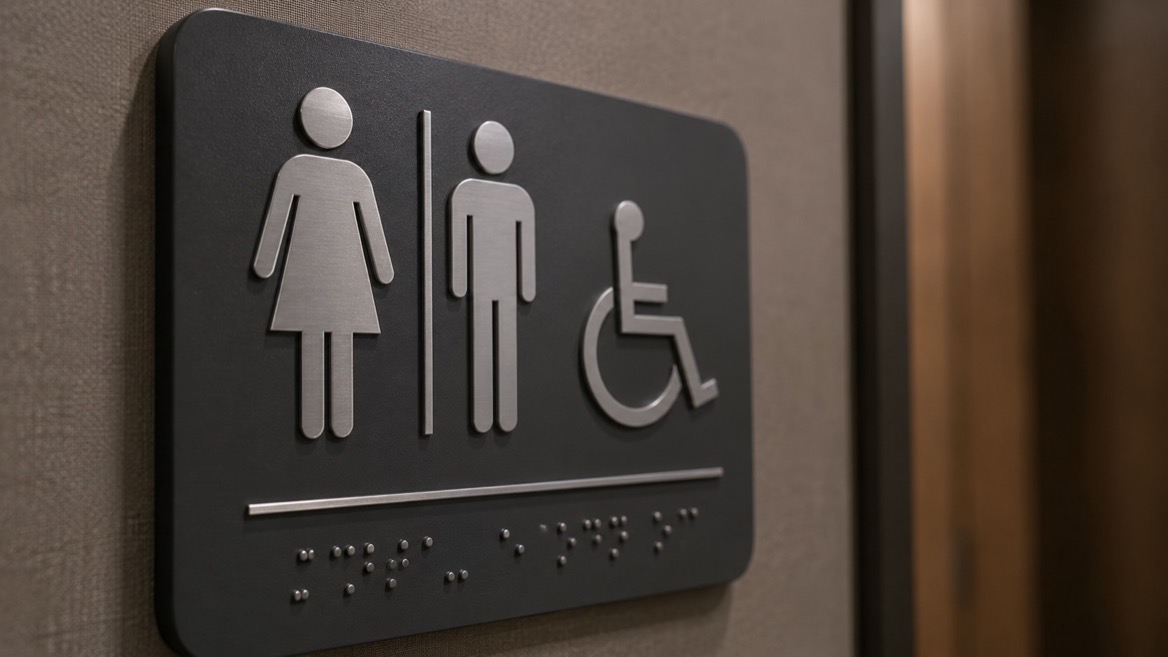
Gender neutral restroom signs are especially effective in spaces that want to communicate openness and simplicity. They are commonly used in:
- Offices and co-working spaces.
- Hospitality venues.
- Retail environments.
- Educational campuses.
- Healthcare and wellness centers.
- Public-facing corporate buildings.
They are also useful when a facility offers a single-user restroom, a family restroom, or a private accessible restroom. In those cases, the sign can reduce confusion and improve comfort for different user groups.
The strongest gender neutral signs are clear at a glance. They avoid crowded graphics, use easy-to-read wording, and match the architecture and brand of the property. A good design should feel welcoming without becoming visually noisy.
Some businesses assume that any restroom sign with simple wording is enough. That is a costly mistake. If a restroom is part of a permanent room designation, the sign usually needs tactile and braille elements, and it must be installed in the right location.
This matters most in:
- Offices with permanent restroom doors.
- Hotels and guest facilities.
- Malls and shopping centers.
- Manufacturing plants with visitor access.
- Medical and laboratory environments.
- Government and civic buildings.
In these settings, the sign must support both navigation and usability. If the sign is compliant in content but poor in placement, the user experience still breaks down.
A practical rule for buyers is this: do not approve artwork before confirming installation rules. A beautiful render is not enough if the sign cannot be mounted correctly.
The best restroom signage solves two problems at once. It should communicate inclusion and remain easy to use.
Strong design choices include:
- Simple wording such as "All-Gender Restroom" or "Restroom."
- High-contrast color pairings like black on white or white on dark matte finishes.
- Sans-serif typography for better readability.
- Minimal visual clutter so the sign can be scanned quickly.
- Consistent icon style across the facility.
- Durable materials that resist wear in high-traffic areas.
When these choices are combined correctly, the sign serves both the visitor and the facility manager. That is where manufacturing expertise becomes valuable. A supplier should be able to guide the client from concept to finish without forcing a trade-off between style and function.
Before ordering restroom signs, buyers should confirm the following:
1. What is the restroom type? Single-user, shared, family, or permanent multi-user.
2. What language should appear on the sign? Restroom, all-gender restroom, unisex, or family restroom.
3. Does the project require tactile text and braille? If yes, the layout must be designed accordingly.
4. Where will the sign be mounted? Wall placement and door type affect the final location.
5. What material and finish are best? Non-glare finishes often work better for accessibility.
6. Will the sign match the brand style? This matters in hospitality, retail, and corporate settings.
7. Who will install it? Proper installation is part of correct performance.
This checklist is useful for architects, contractors, facility managers, and signage distributors. It reduces revision cycles and prevents costly ordering mistakes.
From a manufacturer's point of view, restroom signage is one of the clearest examples of where customization and standardization must work together.
Customization matters because every project has different branding, language, mounting conditions, and space limitations. Standardization matters because compliance-related elements must remain consistent and reliable.
That is why a good signage supplier should offer:
- Custom wording options.
- Braille and tactile production capability.
- Material and finish recommendations.
- Installation guidance.
- Proofing support before mass production.
- Quality control for repeat orders.
For B2B buyers, this is especially important when signing multiple facilities or rolling out a brand across many locations. A weak signage system creates inconsistency, while a strong one creates trust.
Many restroom sign problems come from avoidable oversights. The most common ones include:
- Using gender-neutral language without tactile or braille features where required.
- Choosing glossy materials that create glare.
- Mounting the sign on the wrong side of the door.
- Using decorative fonts that reduce legibility.
- Overloading the sign with extra icons and words.
- Ignoring the difference between single-user and permanent room signage.
These mistakes are easy to prevent during the design stage. Once signs are manufactured and shipped, corrections become slower and more expensive.
A better process is to review the sign as both a graphic product and a functional device. That mindset helps teams make smarter decisions.
If you are choosing between gender neutral bathroom signs and ADA compliant bathroom signs, do not think of it as an either-or decision. The best outcome is usually a sign that does both.
For most professional facilities, the ideal product will:
- Use inclusive wording.
- Meet accessibility-related physical requirements where applicable.
- Match the brand's interior design.
- Remain easy to read and easy to install.
- Be durable enough for long-term use.
If your building serves the public, this is not a detail to leave to the last minute. Restroom signage should be planned early, approved carefully, and manufactured precisely.
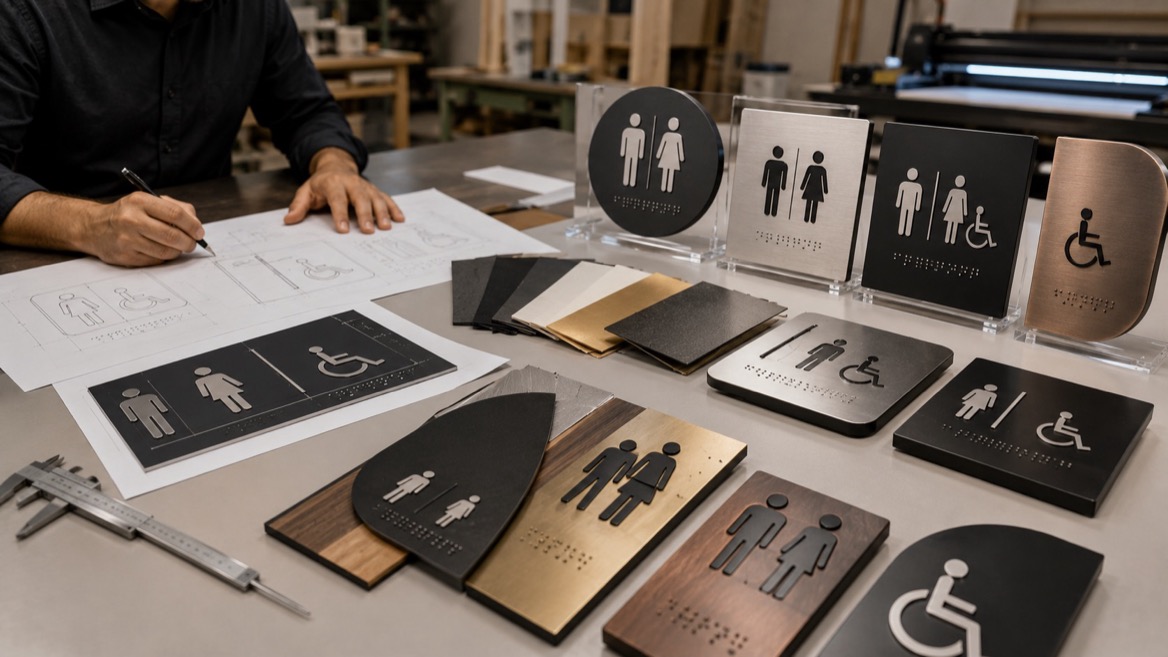
At Landea Signs Co., Ltd., we understand that restroom signage must be both visually consistent and functionally correct. As a manufacturing partner, we focus on personalized signage solutions that support different project needs, from language customization to material selection and production accuracy.
For clients working on commercial buildings, hospitality spaces, industrial facilities, or multi-site rollouts, the right supplier can save time and reduce risk. Our approach is to help customers choose signs that look right, install correctly, and serve the end user well.
If your next project includes restroom sign procurement, the smartest step is to align design, compliance, and installation requirements before production begins.
Gender neutral bathroom signs and ADA compliant bathroom signs are related, but they solve different problems. One helps a facility feel inclusive, while the other helps it function accessibly.
The strongest restroom signage does both. It uses clear language, durable materials, and correct installation details so the sign supports every visitor who walks through the door.
1. Are gender neutral bathroom signs always ADA compliant?
No. A sign can use inclusive language and still miss tactile text, braille, contrast, or placement requirements.
2. What wording is best for inclusive restroom signs?
Common choices include "All-Gender Restroom," "Unisex Restroom," "Family Restroom," and simply "Restroom," depending on the facility type.
3. Do all restroom signs need braille?
Not always, but permanent room identification signs commonly require tactile characters and braille in accessible designs.
4. Can I use a decorative font on restroom signage?
It is better to avoid decorative fonts when readability matters. Sans-serif styles are usually easier to read and more practical.
5. Where should an ADA-style restroom sign be installed?
It is typically mounted on the wall beside the latch side of the door, at the correct height and with enough clear space in front.
6. What is the best material for restroom signage?
The best material depends on the project, but durable, non-glare options are often preferred for both appearance and readability.
1. [ADA Central: Do You Need Gender Neutral Bathroom Signs to Stay ADA Compliant?]
2. [Access Board: Chapter 7 Signs]
3. [George and Willy: Bathroom Signage 2026: ADA Compliance, Styles & Tips]
4. [Little: Supporting Neurodiversity: The Importance of Accessible Signage Design]
5. [ICSEW: Inclusive Bathroom Signage Recommendations]


