From idea to market-ready product, our SIGNS solutions make every stage easier, faster. Discover How We Help

Views: 234 Author: Landea Signs Publish Time: 2026-07-02 Origin: Site


Content Menu
● Introduction: Why Your Signage Font Choice Really Matters
● How Font Choice Impacts Real-World Signage Performance
● Visibility and Readability – Your First Non‑Negotiable
>> Letter Size, Stroke Weight, and Viewing Distance
>> Color and Contrast for Fast Recognition
● Aligning Fonts with Brand Identity and Positioning
>> Matching Font Personality to Brand Essence
>> Brand Consistency Across Channels
● Font Categories and When to Use Them
>> Serif Fonts – Formal, But Use With Care
>> Sans‑Serif Fonts – The Workhorse of Modern Signage
>> Script and Handwritten Fonts – Use Sparingly
>> Display and Decorative Fonts – High Impact, High Risk
● Practical Best Practices for Combining Fonts on a Sign
>> Limit Font Families and Create Hierarchy
● Material, Surface, and Environment – The Manufacturer's Perspective
>> Matching Font to Substrate and Technology
>> Testing Fonts in Real Conditions
● 2026 Typography Trends in Advertising Signage (Expert Insight)
>> Minimalism, Bold Color, and Custom Type
>> 3D Lettering and Eco‑Friendly Signage
● A Step‑by‑Step Process to Choose the Best Signage Font
● OEM Signage Partner's Advice – Working with Landea Signs
● FAQs on Choosing Fonts for Business Signage
When I advise overseas brands on advertising signage and OEM production, the most underestimated decision is almost always the font. The typography on your sign does far more than "look nice": it drives readability, brand recognition, accessibility, and even conversion at the storefront. [seo]
In this expert guide, written from the dual perspective of a signage manufacturer (Landea Signs Co., Ltd.) and a B2B branding strategist, we'll walk through how to choose the best font for business signage, what to avoid, and how to translate design decisions into manufacturable, durable OEM signs that perform in real-world environments. [madegooddesigns]

Font choice is not a purely aesthetic decision; it is a performance variable that determines whether your sign gets read, remembered, and trusted. A beautifully written message printed in the wrong typeface on the wrong material becomes invisible at street speed or unreadable from a distance. [whatfontis]
From our manufacturing floor, we see that brands who treat typography as a strategic asset—testing fonts on actual substrates, under real lighting, and at realistic viewing distances—outperform those who design only on a laptop screen. [fastsigns.co]
When choosing fonts for signage, legibility from a distance is the first filter every design must pass. [seo]
A font that looks perfect at 24 px on a website can fail completely at 2 meters tall on a pylon sign. For physical signage, you are balancing three elements: [madegooddesigns]
- Letter height – must match typical viewing distance and speed (walking vs driving). [fastsigns.co]
- Stroke weight – too thin disappears in bright light; too thick causes letters to merge. [spectrum-signs]
- Character spacing (kerning and tracking) – uneven or tight spacing kills instant legibility. [reliablesigns]
As a practical rule we use in OEM projects: for exterior storefront signage, we favor clean sans‑serif fonts with medium‑bold weight and generous spacing, tested with full‑scale mockups before fabrication. [spectrum-signs]
High‑contrast color pairs like black on white, yellow on black, or white on dark blue consistently outperform low‑contrast combinations. However, contrast must be applied with your brand palette and surroundings in mind: a yellow‑on‑black sign may be readable, but can visually clash on a luxury façade. [reliablesigns]
For OEM signage, we recommend brands create a simple contrast matrix:
| Sign Type | Recommended Font Style | Recommended Contrast |
|---|---|---|
| Street‑facing storefront sign | Bold sans‑serif | Dark text on light facade or vice versa (fastsigns.co) |
| Interior wayfinding | Regular sans‑serif or humanist serif | High contrast, matte finish to avoid glare (madegooddesigns) |
| Safety / warning signage | All caps sans‑serif | Yellow on black or red on white (fastsigns.co) |
| Digital advertising signage | Clean sans‑serif, medium weight | Strong contrast, optimized for LED displays (yodeck) |
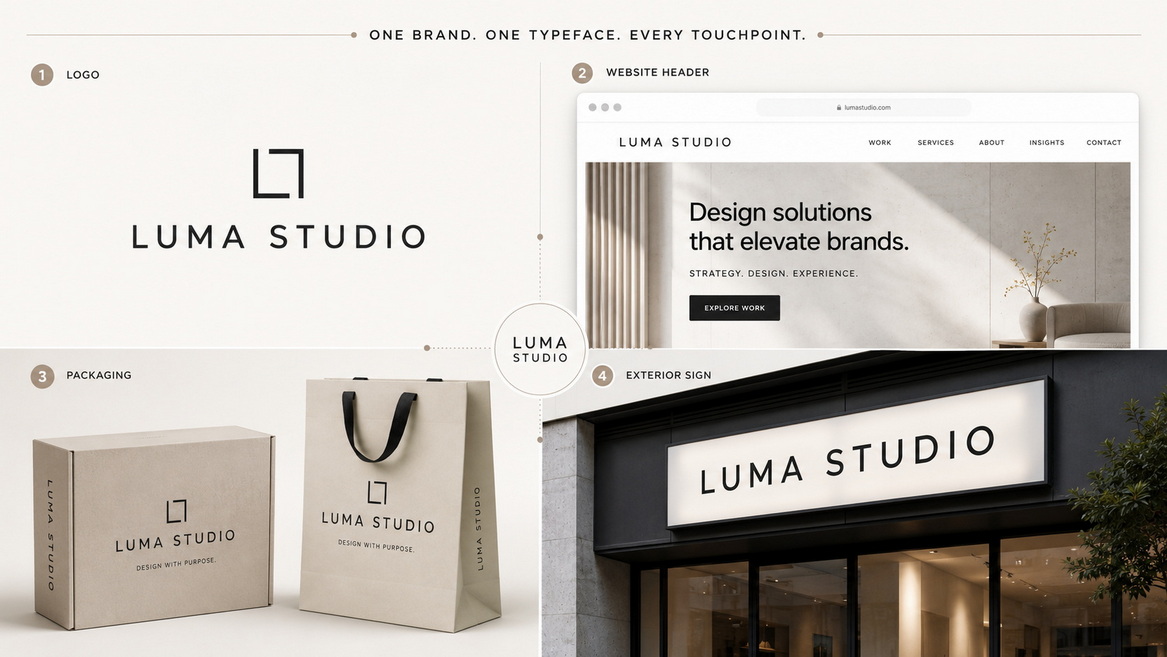
Your signage font is often the first physical expression of your brand that customers see. Using the same or harmonized typefaces across signage, packaging, and digital assets builds recognition and trust. [seo]
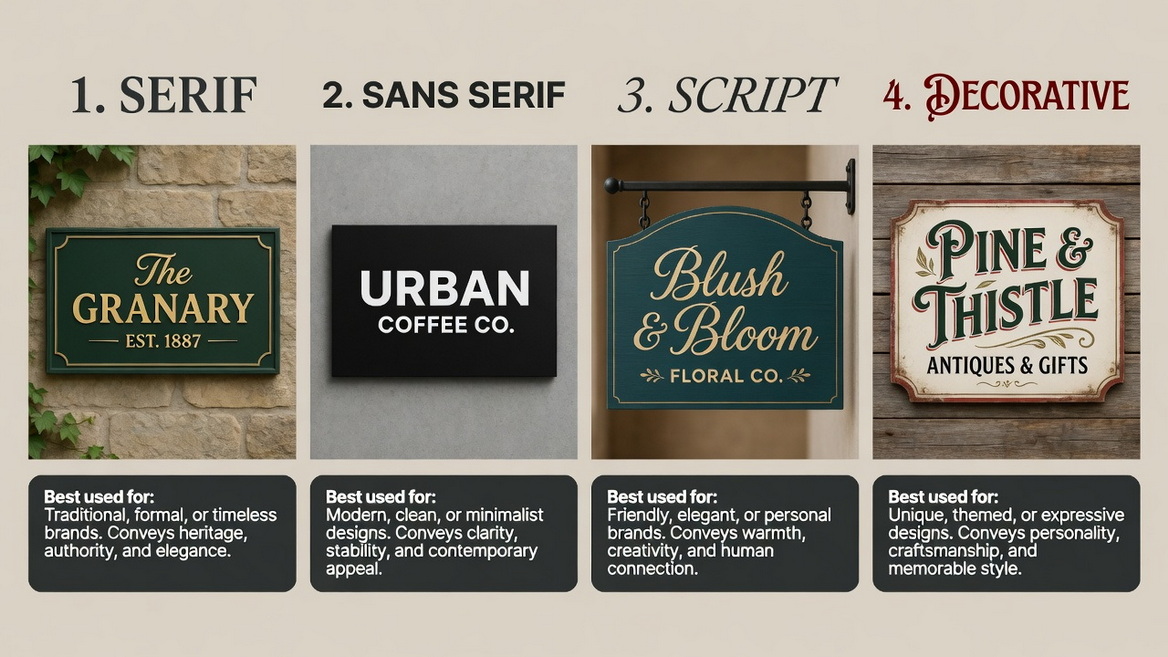
Serif fonts tend to communicate tradition, authority, and elegance, while sans‑serif fonts signal modernity, clarity, and minimalism. Script and decorative fonts, used sparingly, can evoke warmth, boutique charm, or playfulness—but at a significant legibility cost. [spectrum-signs]
When we develop signage for overseas OEM clients, we typically ask three questions before recommending fonts:
1. What is your brand's core personality? (e.g., minimal tech vs heritage craft). [fastsigns.co]
2. How do you want customers to feel at first glance? (safe, excited, relaxed, curious). [spectrum-signs]
3. Where else does this font appear? (logo, website, packaging). [seo]
If your brand is a clean, modern electronics company, a Helvetica or Futura‑style sans‑serif on aluminum channel letters probably fits better than a decorative script. A heritage winery may benefit from a refined serif on carved or illuminated signs to echo tradition. [impactsigns]
Consistency across signage, business cards, brochures, and digital assets is a core recommendation in established signage guides. From a manufacturing perspective, consistency also protects you from production errors: when the font family is standardized, we can keep toolpaths, stroke widths, and lighting layouts predictable across multiple orders. [fastsigns.co]
For OEM brands working with multiple factories, we strongly recommend maintaining a signage typography specification sheet—listing approved fonts, weights, casing rules, and minimum sizes—to avoid visual fragmentation between markets. [impactsigns]
Understanding the main font categories used in signage helps you choose wisely and avoid common pitfalls. [reliablesigns]
Serif fonts (e.g., Times New Roman, Baskerville, Georgia) carry small strokes at letter ends that aid reading in print, especially in longer text blocks. For signage, they work best on smaller copy in interior environments, such as plaques or directory boards, where viewers stand close and read slowly. [madegooddesigns]
However, serif details can be problematic in fabrication, especially for LED lit letters or CNC‑cut metals, where thin strokes may not carry light evenly or may weaken the structure. [spectrum-signs]
Sans‑serifs like Helvetica, Arial, Verdana, Frutiger, and Proxima Nova are widely recommended for business signage because they are clean, highly legible, and scale well. They perform particularly well on: [impactsigns]
- Exterior building signs and channel letters.
- Directional and wayfinding signage.
- Digital displays and LED advertising boards. [yodeck]
From an OEM perspective, sans‑serifs are also easier to cut, engrave, and illuminate consistently, which reduces error rates and cost per unit. [reliablesigns]
Script fonts (e.g., Brush Script, Lucida Calligraphy) and handwriting styles can feel personal and boutique—but they are frequently listed among the worst fonts for professional signage because of poor legibility and amateur aesthetics. [seo]
We recommend limiting scripts to:
- Short brand signatures (e.g., a café's name on a small hanging sign).
- Interior, close‑view decorative elements, not primary wayfinding. [reliablesigns]
In OEM production, scripts raise costs: narrow strokes and complex curves are harder to fabricate cleanly and to light evenly, often requiring design simplification before manufacturing. [spectrum-signs]
Display fonts such as Impact, Marker Felt, and Comic Sans are intentionally loud and stylized, used for headlines or short promotional bursts. While they can draw attention, they easily cross the line into unprofessional or hard‑to‑read if misused. [seo]
Many professional signage guides explicitly recommend avoiding Comic Sans, Papyrus, Curlz, and similar decorative faces in business signage due to their negative brand associations. If you must use a decorative font, keep it short (1–2 words) and pair it with a clean supporting typeface. [fastsigns.co]
Even a strong font can fail if combined poorly with other typefaces. Maintaining hierarchy and clarity is critical. [fastsigns.co]
Most experts advise using no more than two font families on a single sign. A proven structure is: [reliablesigns]
- Primary font (e.g., bold sans‑serif) for main brand or headline.
- Secondary font (e.g., regular serif or humanist sans) for tagline or explanatory text. [spectrum-signs]
You can then create hierarchy using:
- Size (larger for main message, smaller for details).
- Weight (bold vs regular within the same family).
- Color (brand color for name, neutral for supporting text). [impactsigns]
Mixing upper and lower case is generally easier to read than all caps for longer text. We recommend: [fastsigns.co]
- All caps sans‑serif for short, high‑impact words (e.g., EMERGENCY, EXIT). [spectrum-signs]
- Title case or sentence case for wayfinding or instructional text. [spectrum-signs]
Avoid all caps in scripts; multiple guides highlight that this makes the text especially illegible. [fastsigns.co]
One major gap in many design‑only articles is the production reality: the same font behaves differently on acrylic, brushed steel, LED modules, or vinyl. [whatfontis]
The substrate and production method should influence your font choice:
- Metal and acrylic channel letters – favor bold sans‑serifs; thin strokes and fragile serifs can deform or fail under fabrication and installation. [reliablesigns]
- Vinyl signage and printed panels – wider font range is possible, but very fine scripts still risk print loss or blur at scale. [seo]
- Digital LED signage – crisp sans‑serifs with clear pixel geometry perform best on screens. [displaysigns]
Our OEM team at Landea Signs typically creates material‑specific font recommendations, combining design intent with fabrication constraints to avoid costly redesigns once the file reaches the factory.
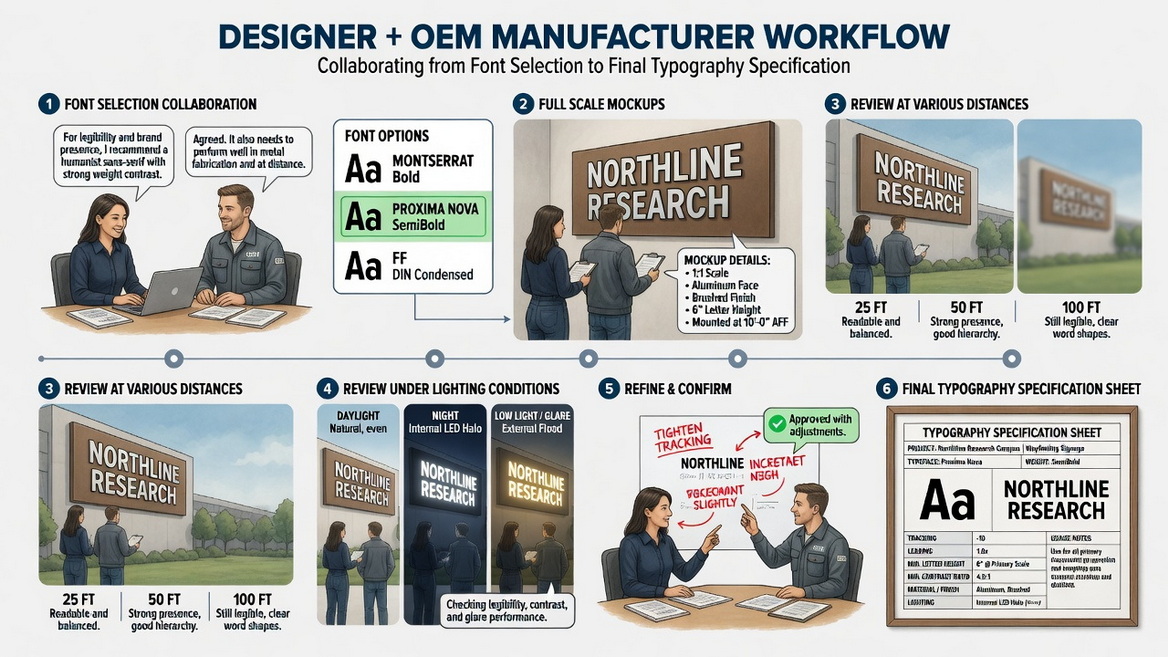
Multiple typography guides stress the importance of testing fonts on the actual surface before final production. In practice, this means: [whatfontis]
- Printing or fabricating a full‑scale sample section.
- Viewing it from typical angles and distances (street, car, mall corridor).
- Checking readability under daylight, night illumination, and mixed lighting. [displaysigns]
Doing this test with your OEM partner can reveal issues with stroke thickness, kerning, and contrast that are invisible in digital proofs.
Current signage and typography resources highlight several key trends relevant to brands updating their physical and digital signage in 2026. [yodeck]
Designers increasingly pair minimal, clean fonts with strong color contrasts and simplified layouts to improve readability in visually noisy environments. We also see more brands investing in custom typefaces that extend across packaging, web, and signage to create a unique, ownable visual language. [displaysigns]
From the manufacturing side, custom fonts are feasible but should be engineered with production constraints in mind—avoiding overly thin details or complex intersections that are hard to fabricate at scale.
Guides on modern signage design note the growth of 3D and layered fonts on building façades, as well as engraved or printed fonts on sustainable materials. If you plan to use 3D lettering, choose fonts with clear, solid shapes that translate well into physical depth; ornate scripts rarely work in this format. [madegooddesigns]
Eco‑friendly signage often relies on engraved sans‑serifs on bamboo, recycled plastics, or powder‑coated metals, where the clarity of the letterform compensates for more subdued color schemes. [displaysigns]
Bringing all of this together, here's an actionable workflow you can follow with your OEM signage partner:
1. Clarify the sign's role. Is this a main brand sign, wayfinding, safety message, or promotional banner? [reliablesigns]
2. Define brand personality. List 3–5 adjectives (e.g., modern, playful, premium, industrial). [seo]
3. Select 2–3 candidate font families. Prioritize legible sans‑serifs for primary messaging; add a serif or subtle script only if brand‑appropriate. [impactsigns]
4. Create mockups at true scale. Apply your brand colors, test contrast, and check hierarchy on realistic backgrounds. [madegooddesigns]
5. Test in real conditions. Print or fabricate sample panels and review at typical distances and lighting conditions. [whatfontis]
6. Validate with users and stakeholders. Ask a few trusted customers or staff which version they read fastest and remember most. [yodeck]
7. Lock a typography specification. Document final fonts, weights, sizes, colors, and casing rules for all future signage orders. [impactsigns]
By following this process, brands can move from subjective taste to evidence‑based font selection, reducing redesigns and ensuring every sign earns its place in the customer journey.
As a China‑based advertising signage factory providing OEM services to overseas brands, we see typography decisions succeed or fail every day along the production line. Our best‑performing projects share several traits:
- They choose clean, robust fonts that survive fabrication, installation, and long‑term exposure without losing clarity. [reliablesigns]
- They maintain a consistent signage typography system across markets, minimizing visual noise and reinforcing brand recognition. [seo]
- They collaborate with their OEM partner early, validating that the chosen font aligns with material, budget, and local regulatory needs. [displaysigns]
If you are planning new signage for an international rollout, involving your manufacturing partner in font selection is not optional—it is a way to protect both design quality and production efficiency.
Q1. What is the single best font for business signage?
There is no universal "best" font, but clean sans‑serifs like Helvetica, Frutiger, Futura, or Proxima Nova consistently perform well for most commercial signage because they are simple, scalable, and highly legible. [impactsigns]
Q2. How many fonts should I use on one sign?
Most professional guides recommend using no more than two font families on a sign—typically one for the main message and one for supporting text—to preserve clarity and visual hierarchy. [seo]
Q3. Are script fonts ever appropriate for signage?
Script fonts can work for short boutique names or decorative interior elements viewed at close range, but they should be avoided for primary wayfinding or safety signage due to poor legibility and higher fabrication complexity. [spectrum-signs]
Q4. Do fonts affect SEO or digital performance?
Fonts primarily affect SEO indirectly: typography impacts readability, accessibility, and user experience, which in turn influence engagement metrics and conversions on digital signage and websites. Using legible, properly scaled fonts improves these UX signals. [cloudexmarketing]
Q5. How can I ensure my chosen font works in manufacturing?
Share your candidate fonts and design files with your OEM signage partner early and request material‑specific advice and sample fabrication. They can flag strokes that are too thin, spacing that will fail at scale, or details that will not illuminate correctly. [whatfontis]
1. ADA Central. "Choosing the Best Font for Signage at Your Business." [seo]
2. MadeGood Designs. "Signage Design: A Complete Guide for 2026." [](https://madegooddesigns.com/signage-design-guide/)
3. WhatFontIs Playground. "Fonts for signs: tips for professional signage." [](https://www.whatfontis.com/blog/fonts-for-signs-tips-for-professional-signage/)
4. Spectrum Signs. "The Importance of Font Choice for Your Company Signage." [](https://www.spectrum-signs.com/blog/font-choice-company-signage)
5. Reliable Signs. "A Simple Guide to the Best and Worst Fonts for Your Signage." [](https://reliablesigns.com/a-simple-guide-to-the-best-and-worst-fonts-for-your-signage/)
6. FASTSIGNS. "What Are the Best Font to Use on Different Signage Types." [](https://www.fastsigns.co.uk/blog/miscellaneous-trending/colours-fonts/how-to-know-which-typefaces-and-fonts-are-the-ea/)
7. Impact Signs. "14 Best Fonts for Signs [+6 To Avoid]." [](https://www.impactsigns.com/best-fonts-for-signs/)
8. Yodeck. "Digital Signage Design: Rules & Best practices [2026 Guide]." [](https://www.yodeck.com/use-cases/digital-signage-design/)
9. Displaysigns. "Typography in Signage: Fonts That Work Everywhere." [](https://displaysigns.ae/typography-in-signage-fonts-that-work-everywhere/)
10. SEO.com. "Do Fonts Matter for SEO?" [](https://www.seo.com/hi/blog/do-fonts-matter-for-seo/)
11. Cloudex Marketing. "Do Fonts Affect SEO? Impact, Best Practices & Fixes." [](https://cloudexmarketing.com/blogs/do-fonts-matter-for-seo/)


