From idea to market-ready product, our SIGNS solutions make every stage easier, faster. Discover How We Help

Views: 220 Author: Landea Signs Publish Time: 2026-08-24 Origin: Site


Content Menu
● Why UL Labels Matter for LED Illuminated Signs
● UL Standards Relevant to Electric Signs
● US, Canada, and Dual-Market UL Marks
● Where to Apply UL Labels on LED Signs
>> Signs With an External Power-Supply Box
>> Signs With Built-In Power Supplies
>> Multi-Housing and Channel-Letter Signs
● A Practical UL Labeling Workflow
>> 1. Confirm the Project Compliance Scope
>> 2. Match the Design to Approved Construction
>> 3. Define the Label Layout Before Production
>> 4. Use Permanent, Environment-Appropriate Materials
>> 5. Photograph and Record Every Finished Unit
● Common UL Labeling Mistakes to Avoid
>> Assuming Every Label Is Interchangeable
>> Labeling a Driver but Not the Complete Sign
>> Changing Components Without Review
>> Applying Labels at an Unauthorized Location
>> Treating US and Canadian Requirements as Identical
>> Buying or Printing Unauthorized Marks
● What Experienced Buyers Should Request
● Our Approach to Illuminated Sign Compliance
● FAQs
>> 1. Does every LED channel letter need its own UL label?
>> 2. Can a UL-listed power supply make the whole sign UL certified?
>> 3. Where should the UL label be placed on a power-supply box?
>> 4. Is a US UL mark valid for Canada?
>> 5. Can a supplier print UL labels independently?
>> 6. What should I give an electrical inspector?
>> 7. What happens if a sign label falls off after outdoor installation?
For LED illuminated signs entering North American projects, the UL label is not a decorative sticker—it is part of the product's compliance identity. Correct labeling helps installers, electrical inspectors, project owners, and buyers verify that an electric sign matches the certified construction evaluated for the intended market.
At Landea Signs Co., Ltd., we approach UL labeling as a manufacturing-control process rather than a final packing-step task. In practical terms, the sign design, LED modules, power supplies, wiring, enclosures, rating information, label type, and label location must all correspond with the applicable certification file and approved production procedure.
This guide explains how to apply UL labels to LED illuminated signs for the United States and Canada, including common labeling layouts for channel-letter signs, power-supply boxes, built-in drivers, and multi-section installations.
> Important: This article is a practical buying and production guide. The exact mark, wording, placement, quantity, and approved components must always follow the manufacturer's current UL certification documentation and Follow-Up Service Procedure.

A UL mark communicates more than a general safety claim. It indicates that a product has been certified to relevant safety requirements within the scope of the certification and carries the registered certification mark authorized by the certification body. In the United States, OSHA recognizes UL as one of the Nationally Recognized Testing Laboratories (NRTLs).
For electric signs, a correct UL label can support smoother project approval because it allows the authority having jurisdiction, installer, distributor, or end customer to identify the certified equipment quickly.
A properly controlled labeling process matters for four reasons:
- Project acceptance: Commercial projects may require an NRTL-certified electric sign before installation approval.
- Electrical safety: The marking should correspond to the tested and approved sign construction, including its electrical rating and enclosure configuration.
- Traceability: A label control number or related production information can help connect the finished sign to approved manufacturing records.
- Buyer confidence: Clear, permanent identification demonstrates that the supplier understands North American compliance expectations.
For many buyers, the real risk is not simply whether a supplier can show a certificate. The key question is whether the actual sign being shipped is built, marked, and documented in the same manner as the certified product.
UL Solutions identifies UL 48 as the core standard for electric signs, while UL 879 is relevant to electric sign components. Depending on the product design, additional component certifications may also apply to power supplies, LED modules, luminaires, wiring, connectors, and enclosures.
| Item | Typical compliance focus | Why it matters |
|---|---|---|
| Complete illuminated sign | UL 48 | Covers electric-sign safety requirements and product-level construction |
| Electric sign component | UL 879 | Relevant where approved components are used within a sign system |
| LED power supply or driver | Applicable component certification | Confirms that the driver is suitable for the approved electrical application |
| LED module | Applicable component certification | Helps ensure compatibility with the approved sign construction |
| Sign enclosure or raceway | Product construction requirements | May contain branch-circuit power, driver(s), wiring, and required identification |
A critical distinction is often missed: a UL Recognized Component is not automatically the same as a UL Listed complete sign.
For example, a power supply may be recognized or certified as a component, but that does not automatically mean the finished illuminated sign has been certified as a complete electric sign. The finished assembly must follow the approved product construction and labeling procedure.
Do not assume that one mark automatically covers both countries. Buyers should confirm the country scope before artwork approval, production, or shipment.
| Destination | What to verify | Buyer action |
|---|---|---|
| United States | The certification mark and product scope cover US requirements | Request the applicable US mark and supporting certification information |
| Canada | The mark and certification scope cover Canadian requirements | Confirm Canadian acceptance, often shown through a Canadian identifier such as "c" |
| United States and Canada | The certification scope covers both markets | Request a dual-market mark only when the certification file authorizes it |
UL marks are controlled marks. OSHA notes that, after certification, an NRTL authorizes the manufacturer to apply its registered certification mark to the product. Therefore, a supplier should never select a label design based only on visual preference or a customer's generic request for a "UL sticker."
The correct mark depends on the certified product category, destination market, approved factory, and active certification status.
The best label location is visible enough for inspection, durable enough for the installation environment, and consistent with the approved manufacturing documentation.
In practice, the label should not be treated as an item to place "wherever there is space." A poor location can create problems if it is concealed after installation, covered by a mounting bracket, damaged by service access, placed across a ventilation opening, or separated from the electrical section it is intended to identify.
This is one of the most common configurations for channel-letter signs and cabinet signs.
A typical arrangement may include:
- An illuminated sign face or sign housing.
- A separate metal or plastic power-supply box.
- One or more LED power supplies.
- Low-voltage wiring running from the power-supply box to individual sign elements.
For this configuration, the outside of the power-supply box is often the most practical location for the complete electric-sign certification mark and electrical identification—provided that this is consistent with the approved construction.
The label should generally be placed on a flat exterior surface that remains accessible after installation. Avoid placing it over:
- Screws or removable fasteners.
- Ventilation slots.
- Cable-entry points.
- Sharp folded metal edges.
- Surfaces exposed to constant abrasion.
Where multiple power supplies are installed, each power supply should also be the correct approved model for the certified sign construction. The individual driver markings should remain legible and should not be hidden in a way that prevents service verification.
When the LED power supply is installed inside the sign housing, labeling requires extra planning. The external sign label must allow an inspector or technician to identify the product, while internal components must remain accessible for maintenance and verification.
For a built-in-driver design, good production practice includes:
1. Confirm the driver model is included in the approved bill of materials.
2. Install the driver in the approved location and orientation.
3. Maintain required spacing, wiring protection, and heat-management design.
4. Apply the external sign identification in the approved location.
5. Ensure service personnel can access the driver without damaging the sign.
6. Record photographs of the internal wiring and final external label before packing.
A durable electrical-sign label may be placed on the back, return, raceway, service panel, or another approved exterior location. The right answer depends on the specific sign construction—not on a one-size-fits-all rule.
Labeling practices for multi-housing signs have evolved. Industry guidance explains that signs consisting of multiple housings connected only by Class 2 field wiring may be treated differently from signs requiring other-than-Class-2 field wiring between sections. In certain multi-housing configurations, a single Electric Sign mark may be placed on the housing containing branch-circuit power, rather than requiring an Electric Sign Section mark on every individual letter.
This matters because many buyers still assume every channel letter must carry an individual label. That assumption can lead to unnecessary artwork changes, visible labels on premium sign faces, or confusion during inspection.
Before production, confirm:
- Whether the sign is shipped as one unit or multiple subassemblies.
- Whether the field wiring is Class 2 only.
- Which housing contains branch-circuit power.
- Whether the project requires a single sign label or section identification.
- What the approved labeling procedure specifies for the exact model.
A strong labeling process begins during engineering—not after the sign is assembled.
Ask the customer where the sign will be installed: the United States, Canada, or both. Also confirm whether the project requires a specific certification mark, electrical rating format, installation document, or third-party inspection.
Before releasing drawings, verify that the sign structure, power supply, LED modules, wire types, connectors, enclosures, and mounting arrangement match the approved product construction.
A common compliance failure occurs when a customer requests a last-minute change—such as a larger driver, a different LED module, or a thinner return depth—without evaluating how that change affects certification scope.
The engineering and quality teams should determine:
- Label type and authorized mark.
- Label location.
- Electrical rating information.
- Required warning wording.
- Production tracking information.
- Whether each section needs identification.
Creating a label-location drawing is especially useful for large channel-letter sets, cabinet signs, pylons, and signs with separate driver boxes.
Outdoor illuminated signs need labels that can remain legible despite moisture, ultraviolet exposure, temperature cycles, cleaning, and installation handling.
A practical choice may include a durable polyester label, protective laminate, metal nameplate, or another approved permanent marking method. The material must be suitable for the finished sign and must comply with the applicable certification procedure.
Do not use ordinary paper labels, removable adhesive stickers, or labels that may peel after outdoor exposure.
Before packing, create a quality record that includes:
- A full view of the completed sign.
- A close-up of the UL label.
- A close-up of the electrical rating label.
- Photos of internal drivers and wiring when applicable.
- Model and order number.
- Packaging identification.
This evidence helps buyers verify production before shipment and can reduce disputes when a site inspector asks for clarification.
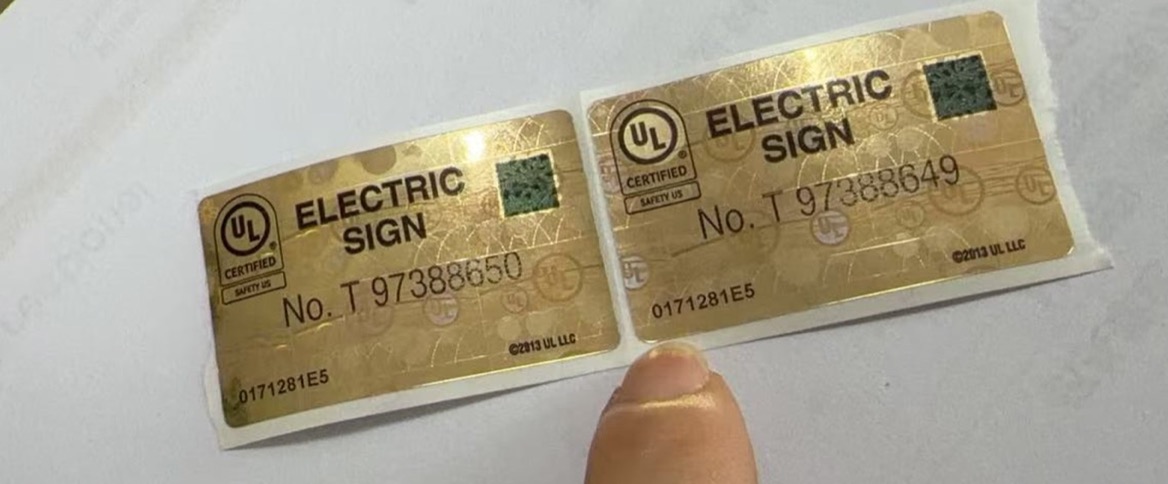
UL marks are not generic artwork. The mark must correspond to the certification type, approved factory, and product scope.
A certified driver alone does not make the assembled product a certified electric sign. The complete sign must follow the relevant product certification requirements.
Substituting LED modules, drivers, wire, connectors, or enclosure materials may affect the approved construction. Even a "similar" part can create a mismatch.
The label must be applied where the applicable procedure requires it. A hidden, removable, damaged, or incorrectly located label can raise questions during inspection.
The destination market should be confirmed before the mark is selected. For projects serving both countries, request documentation that supports the dual-market certification scope.
UL's Authorized Label Supplier Program is designed to protect the integrity of UL marks and deter counterfeiting. UL Solutions states that authorized suppliers are listed in its Product iQ database and are subject to periodic audits of label production and systems.
For a high-value illuminated-sign order, buyers should request more than a certificate image. Ask the supplier for a documentation package that connects the sign you are buying to the compliance claim being made.
A useful pre-shipment checklist includes:
- The supplier's legal company name and manufacturing location.
- Certification scope relevant to the sign type.
- Confirmation of the intended US, Canadian, or dual-market mark.
- Approved electrical ratings for the finished sign.
- Power-supply brand and model information.
- Label-location photos for the completed product.
- Installation instructions.
- Packing list linked to sign sections and power-supply boxes.
- A contact person who can respond to inspector questions.
UL's Follow-Up Services program includes ongoing factory inspections and audits intended to verify that a certified product continues to match the original assessed requirements. UL Solutions states that these inspections can occur at facilities where products are manufactured, assembled, stored, or labeled with UL marks.
That is why serious compliance should be visible in factory records, engineering control, component selection, and final inspection—not only in a label image sent by email.
At Landea Signs Co., Ltd., we help buyers plan compliance into the sign before fabrication starts. Our team reviews the sign configuration, power-distribution layout, driver arrangement, label placement, and destination market requirements as part of the production process.
For channel letters, cabinet signs, logo signs, and custom illuminated signs, we focus on practical details that often affect site approval:
- Clear separation between sign housings and power-supply boxes.
- Accessible labeling locations.
- Component traceability.
- Durable marking materials for outdoor projects.
- Pre-shipment photo records.
- Buyer-friendly documentation for installers and project managers.
A UL label should confirm a controlled product—not compensate for an uncontrolled one.
If you are sourcing a custom LED illuminated sign for the US or Canada, send us your drawings, installation location, voltage requirements, and project deadline. Our team can review the sign layout and prepare a practical compliance and labeling plan before production begins.
Not always. The labeling approach depends on how the sign is constructed, shipped, powered, and field-wired. For some multi-housing signs connected only through Class 2 field wiring, one Electric Sign mark may be applied to the housing containing branch-circuit power rather than placing an individual section mark on every letter.
No. A certified power supply is only one part of the assembly. The completed sign must also comply with the approved construction and product-level certification requirements.
It should be placed on an approved, durable, accessible exterior location that is not blocked by brackets, screws, vents, or installation hardware. The exact location must follow the applicable certification procedure.
Not automatically. The mark and certification scope must specifically cover Canada. Confirm the correct Canadian or dual-market marking with the manufacturer before ordering.
Only when authorized under the applicable UL labeling controls and procedures. UL's Authorized Label Supplier Program exists to protect mark integrity and help deter counterfeit labels.
Provide the visible product mark, electrical rating information, installation instructions, and any applicable manufacturer documentation. A clear photo record of the finished sign, driver box, and labels is also useful.
The sign may become difficult to verify during service, inspection, or insurance review. Use permanent, weather-resistant marking materials appropriate to the installation environment and the approved construction.
1. [Occupational Safety and Health Administration: Nationally Recognized Testing Laboratory Program] — Explains OSHA's NRTL program and the role of registered certification marks.
2. [Occupational Safety and Health Administration: Current List of NRTLs] — Lists UL LLC among OSHA-recognized NRTLs.
3. [UL Solutions: Electric Sign Certification and Sign Component Solutions] — Identifies UL 48 for electric signs and UL 879 for electric sign components.
4. [UL Solutions: Authorized Label Supplier Program for UL Marks] — Describes authorized label suppliers, anti-counterfeiting controls, and periodic audit practices.
5. [UL Solutions: Follow-Up Services] — Explains ongoing factory inspections and audits associated with certified products and UL mark application.
6. [IAEI Magazine: Simplified Labeling for Class 2 Powered Multi-Housing Electric Signs] — Discusses labeling considerations for multi-housing signs with Class 2 field wiring.
7. [International Sign Association: Do U Know UL?] — Provides industry context on changes to section-sign definitions and labeling practices.


