From idea to market-ready product, our SIGNS solutions make every stage easier, faster. Discover How We Help

Views: 243 Author: Landea Signs Publish Time: 2026-09-02 Origin: Site


Content Menu
● Why Hotel Sign Supplier Selection Matters
● 1. Full-Category Manufacturing Capability
>> What a Complete Hotel Sign Package May Include
>> Factory or Trading Company?
● 2. Wayfinding Planning and Design Detailing Ability
>> Look Beyond Concept Renders
● 3. Material Specifications and Process Standards
>> Require Clear Material Descriptions
>> Material Samples Are Not Optional
● 4. Relevant Hotel Experience and Verifiable Case Studies
>> Evaluate Comparable Experience
>> Ask for Evidence, Not Just Images
● 5. End-to-End Delivery, Installation, and After-Sales Service
>> What End-to-End Service Should Cover
>> Clarify the Service-Level Agreement
● 6. Certifications, Compliance, and Risk Controls
>> Certifications Worth Reviewing
>> Accessibility and Safety Must Be Planned Early
● A Practical Hotel Sign Supplier Scorecard
● Final Supplier Checklist Before Signing
● Choose a Supplier That Can Protect the Guest Experience
● FAQs
>> 1. How do I choose a hotel sign supplier?
>> 2. Why should a hotel use one supplier for multiple sign types?
>> 3. What should be included in a hotel sign quotation?
>> 4. What materials are suitable for hotel signs?
>> 5. What is a hotel wayfinding system?
>> 6. Are Braille and tactile signs necessary for hotels?
>> 7. How can I verify whether a sign supplier has real hotel experience?
>> 8. What after-sales support should a hotel sign supplier provide?
Choosing a hotel sign supplier is not simply a matter of comparing the lowest quotation. A hotel sign system affects guest navigation, accessibility, brand presentation, safety communication, maintenance workload, and the final perceived quality of the property.
For developers, hotel owners, architects, procurement teams, and project managers, the real question is: Can the supplier turn a design concept into a reliable, consistent, installable, and durable sign system?
This guide explains the six most important criteria for evaluating a hotel sign supplier, from full-category manufacturing and wayfinding planning to material standards, project experience, delivery controls, and certifications. It also includes a practical supplier scorecard and a pre-order checklist that can be used during tendering or supplier comparison.
At Landea Signs Co., Ltd., we have seen that the most expensive hotel sign problems rarely begin at installation. They often begin much earlier—when a supplier is selected based only on a render, a sample price, or a vague promise of "customization." A strong supplier should be able to manage the full journey from design detailing to production, logistics, installation coordination, and after-sales support.

A hotel is a complex environment. Guests move from the driveway and entrance to the reception desk, elevators, rooms, restaurants, meeting spaces, fitness areas, parking zones, emergency exits, and service facilities. Every sign must help guests make decisions quickly and confidently.
A well-executed hotel sign system should do more than display names and directions. It should support the property's atmosphere, reduce confusion, improve accessibility, protect the brand image, and remain visually consistent over years of daily use.
A weak supplier can create issues that become expensive after the project is already underway:
- Inconsistent colors, fonts, finishes, or dimensions across different areas
- Room number signs that do not match corridor signs or door hardware
- Exterior illuminated signs with uneven brightness or poor weather resistance
- Incorrect mounting methods that damage walls, stone, glass, or cladding
- Missing tactile information for permanent rooms and public facilities
- Late changes caused by incomplete shop drawings
- Materials that look premium in a sample but deteriorate after installation
- Multiple subcontractors with unclear responsibility when defects appear
For this reason, the best hotel sign supplier is not always the company with the lowest unit price. It is the company that can control design accuracy, material consistency, manufacturing quality, project coordination, and service accountability.
The first question should be simple: Can the supplier manufacture the complete hotel sign package?
Hotel projects normally require many different sign types. If a supplier can only make a small portion of the package, the project may need to be divided among several factories. That increases coordination time and makes visual consistency much harder to control.
A capable supplier should be able to produce, or clearly manage, a broad range of hotel sign applications:
- Exterior building name signs
- Illuminated letters and logo signs
- Entrance and canopy signs
- Monument signs and pylon signs
- Directional signs for driveways, parking, and drop-off areas
- Reception signs and lobby identity signs
- Floor directory signs
- Corridor directional signs
- Room number signs
- Room name signs
- Door signs
- Restroom signs
- Restaurant, bar, spa, gym, and meeting-room signs
- Fire safety and emergency evacuation signs
- Back-of-house operational signs
- Braille and tactile signs
- Digital or smart room signs
- Temporary event and conference signs
A hotel sign system is not a collection of unrelated products. It is a connected visual language. The materials, colors, typography, icons, fixing methods, and production tolerances must work together.
Procurement teams should also ask whether the supplier is a real manufacturer or mainly a trading company that outsources production.
A factory-based supplier usually has stronger control over:
- Raw-material purchasing
- Cutting, welding, bending, polishing, painting, printing, and assembly
- Prototype development
- Production schedules
- Quality inspection
- Packaging standards
- Design changes during production
- Accountability when a sign fails or arrives damaged
A supplier that only provides attractive renderings may not have enough control over the actual production process. That gap often becomes visible when the project reaches the shop-drawing, sampling, installation, or replacement stage.
Before shortlisting a hotel sign supplier, ask:
1. Which sign categories are manufactured in-house?
2. Which processes are outsourced?
3. Can you provide factory photos, equipment lists, and production workflow details?
4. Can you produce a coordinated sample kit for different sign categories?
5. How do you control color and finish consistency across metal, acrylic, wood, print, and illuminated signs?
6. Who is responsible if an outsourced component does not meet the approved sample?
A supplier does not need to claim that every process is completed under one roof. However, the supplier should be transparent about what is produced internally, what is coordinated externally, and who owns the final quality responsibility.
A hotel sign supplier should not only "make signs." The supplier should understand how guests move through a hospitality environment.
This is where wayfinding planning becomes important. Wayfinding is the system that helps people understand where they are, where they need to go, and how to get there with minimal stress.
In a hotel, poor wayfinding can create avoidable friction. Guests may struggle to locate elevators, breakfast areas, meeting rooms, accessible entrances, parking exits, or guest rooms. Staff then spend more time answering basic directional questions, while guests may interpret confusion as poor service.
Hospitality wayfinding is widely recognized as part of the guest experience and brand environment, not merely a functional requirement.
A beautiful sign concept is valuable, but it is not enough. The supplier should be able to transform a concept into detailed production and installation documentation.
A professional hotel sign supplier should be able to provide:
- Sign location plans
- Sign coding and numbering systems
- Sign schedules
- Dimensions and elevations
- Material specifications
- Color specifications
- Typography details
- Icon and pictogram details
- Fixing and mounting methods
- Lighting details for illuminated signs
- Electrical requirements where applicable
- Section drawings
- Installation drawings
- Bill of quantities
- Revision-control records
The more complex the hotel project, the more important these documents become.
Shop drawings are where design intent meets construction reality. They help avoid situations such as:
- A wall-mounted sign conflicting with a door swing
- An illuminated sign lacking sufficient cavity depth for wiring or power supplies
- A room sign placed where it cannot be read from the corridor approach
- A metal sign requiring anchors that are unsuitable for the finished wall
- A large exterior sign exceeding structural or access limitations
- A sign design that cannot accommodate tactile characters or Braille
A good supplier asks technical questions early. They do not wait until production begins.
Ask the supplier to explain how they would review a hotel floor plan. A knowledgeable team should discuss:
- Arrival sequence
- Main decision points
- Guest circulation versus staff circulation
- Vertical movement between floors
- Room-number logic
- Emergency routes
- Accessible routes
- Sightlines
- Lighting conditions
- Multilingual needs
- Maintenance access
If the supplier only talks about materials and price, their wayfinding capability may be limited.
A sign can look impressive on the day it is installed and still fail within months if the material selection or finishing process is weak.
For hotel projects, material decisions should reflect location, guest touchpoints, cleaning routines, environmental exposure, maintenance expectations, and brand positioning.
Avoid vague statements such as "stainless steel," "premium acrylic," or "high-quality aluminum." A reliable supplier should identify the actual material grade, thickness, finish, and process.
For example, specifications may include:
| Sign Element | Specification Questions to Ask |
|---|---|
| Stainless steel sign | Is it 304 or 316 stainless steel? What is the thickness? Is the finish brushed, mirror-polished, bead-blasted, or painted? |
| Aluminum sign | Is the panel anodized, powder-coated, painted, or composite? What is the thickness and substrate construction? |
| Acrylic sign | What grade, thickness, color method, and UV-resistance performance are specified? |
| Printed sign | What printing process is used? How is color controlled? Is there a protective coating or laminate? |
| Wood-effect sign | Is it solid wood, veneer, laminate, or printed finish? How does it perform in humid areas? |
| Illuminated sign | What LED brand, color temperature, power supply, wiring method, diffusion system, and service access are included? |
| Tactile sign | Are raised characters, Braille, contrast, non-glare finish, and mounting requirements considered for the local code? |
For exterior signs, the supplier should also explain how the product will handle sunlight, rain, humidity, temperature changes, wind load, dust, and corrosion risk.
Do not approve a major hotel sign package based only on digital images. Physical samples reveal details that renderings cannot show:
- Color accuracy under real lighting
- Surface texture
- Fingerprint resistance
- Edge finishing
- Paint quality
- Letter depth
- Light diffusion
- Tactile readability
- Contrast
- Fixing quality
- Perceived weight and durability
For premium projects, request a sample board or a small mock-up area containing several sign types. For example, a lobby sign, a room number sign, a directional sign, and an illuminated letter can reveal whether the visual system remains consistent across different materials.
Ask the supplier whether its inspection process includes:
- Incoming material inspection
- Dimensional checks
- Color comparison against approved samples
- Surface-finish inspection
- Illumination testing
- Electrical safety checks for illuminated signs
- Adhesion or coating checks where relevant
- Assembly inspection
- Pre-shipment inspection
- Packaging inspection
- Photo documentation before dispatch
Quality management certification can add credibility, but buyers should verify the certificate, scope, issuing body, and validity rather than relying on a logo alone. ISO explains that certification is carried out by external certification bodies—not by ISO itself.
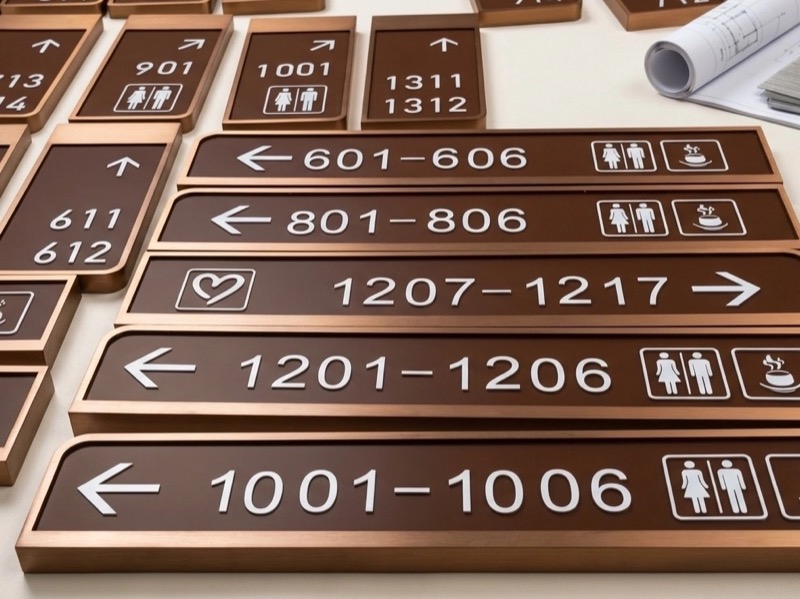
Hotel experience matters because hospitality projects have different demands from retail, office, or residential sign projects.
A supplier may be excellent at producing shopfront signs but lack experience with guest-room numbering, brand-standard compliance, tactile requirements, back-of-house systems, phased installation, and coordination with hotel operators.
The strongest case study is not necessarily the most famous project. The most useful case study is one that is similar to your property in scale, positioning, and complexity.
Ask for projects comparable in:
- Hotel category and brand positioning
- Number of rooms
- Building type
- Number of floors
- Interior and exterior scope
- Number of sign types
- Need for illuminated signs
- Need for multilingual content
- Need for accessibility features
- Renovation versus new-build conditions
- International shipping or remote installation coordination
For example, a supplier that completed a 20-room boutique hotel may not automatically be ready to manage a 500-room resort with multiple restaurants, conference spaces, parking areas, villas, and public amenities.
A supplier portfolio should show more than polished photographs. Ask for:
- Project scope summary
- Sign schedule examples with confidential information removed
- Before-and-after site images
- Production photos
- Sample shop drawings
- Installation method details
- Project timeline
- Reference contacts, where appropriate
- Evidence of how problems were resolved on site
A good reference conversation can reveal whether the supplier met delivery commitments, handled revisions professionally, responded quickly to defects, and supplied replacement components when needed.
Be careful if every portfolio image looks like a concept render or a close-up product photo. Real hotel project experience should include evidence of signs working in real architectural spaces.
A hotel sign package should be managed as a project, not just shipped as merchandise.
The supplier must coordinate production with site readiness, construction sequencing, packaging, delivery, installation conditions, and final handover.
A capable hotel sign supplier should define responsibility across the following stages:
1. Initial brief and design review
2. Site information collection and drawing review
3. Sign schedule development
4. Material confirmation and sample approval
5. Shop drawings and production release
6. Manufacturing and quality inspection
7. Packing and logistics planning
8. Installation guidance or on-site installation
9. Snag-list management
10. Handover documents and maintenance guidance
11. Warranty and replacement support
For international projects, ask how the supplier handles export packing, labeling, shipping documentation, spare parts, and remote installation support.
A service-level agreement, or SLA, helps prevent misunderstandings after delivery. It should state what happens if there is damage, a missing item, an incorrect sign code, a lighting failure, or an installation question.
The SLA should clarify:
- Response time for technical questions
- Response time for defect reports
- Warranty period
- Scope of warranty coverage
- Whether replacement parts are provided
- Whether spare LEDs, drivers, acrylic faces, or fixing hardware are included
- Estimated replacement lead times
- Contact person and escalation process
- Installation support method
- Documentation provided at handover
For illuminated signs, ask a particularly important question: How can maintenance be performed without damaging the finished architecture?
A supplier should plan service access for LEDs, power supplies, wiring, and removable sign faces before installation. If they cannot explain this clearly, maintenance costs may become the hotel's long-term problem.
Certifications alone do not guarantee a successful project, but they can help buyers assess whether a supplier has formalized systems for quality, environmental management, safety, and documentation.
Depending on the project location and scope, buyers may ask about:
- ISO 9001 quality-management certification
- ISO 14001 environmental-management certification
- Occupational health and safety systems
- Electrical safety documentation for illuminated signs
- Fire-related material documentation
- Structural calculations for large exterior signs
- Welding qualifications where required
- Installation qualifications
- Local construction or contractor licensing
- Product testing reports
- Insurance coverage
ISO 9001 focuses on quality-management systems, while ISO 14001 addresses environmental-management systems. Both can indicate that a supplier has documented management processes, although the buyer should still assess actual project execution.
For hotel projects in the United States, signs identifying permanent rooms and spaces generally need to meet requirements for raised characters, Braille, mounting location, contrast, and non-glare finishes under the ADA Standards.
The U.S. Access Board states that tactile sign characters must be positioned within a specified height range of 48 to 60 inches above the finished floor or ground, measured from the tactile character baselines.
For safety communication, ISO 7010 provides internationally registered safety signs covering accident prevention, fire protection, health-hazard information, and emergency evacuation.
These are not details to add after production. They affect sign size, layout, materials, mounting position, artwork, and installation planning from the start.
For projects outside the United States, confirm the applicable local building, fire, accessibility, language, electrical, and installation requirements. A responsible supplier should not make unsupported compliance claims. They should identify the required standards, request project-specific information, and coordinate with the architect, consultant, or local authority where necessary.
To compare suppliers objectively, use a weighted scorecard rather than relying on price alone.
| Evaluation Area | Suggested Weight | What to Review |
|---|---|---|
| Full-category manufacturing | 20% | Product range, factory capability, control of outsourced work |
| Wayfinding and design detailing | 20% | Sign plans, schedules, shop drawings, technical coordination |
| Materials and quality control | 20% | Material grades, samples, testing, inspection process |
| Comparable hotel experience | 15% | Similar completed projects, case-study evidence, references |
| Delivery and after-sales support | 15% | Timeline control, packaging, installation support, warranty, SLA |
| Certifications and risk controls | 10% | Management systems, compliance documentation, safety records |
Price can then be compared as part of the commercial decision, but it should not override major capability gaps.
- Assign each supplier a score from 1 to 5 for every category.
- Multiply the score by the category weight.
- Require evidence for every score above 3.
- Do not give a high score based on verbal claims alone.
- Include procurement, design, construction, and operations representatives in the review.
- Keep a written record of assumptions, exclusions, and outstanding questions.
This method helps teams identify a common issue: a low-priced supplier may appear competitive until missing design work, weak material specifications, delayed deliveries, replacement costs, and site rework are included.
Before awarding a hotel sign project, confirm that the supplier has provided the following:
- A complete sign scope and clear exclusions
- A detailed quotation linked to a sign schedule
- Material specifications with grades, thicknesses, finishes, and colors
- Approved physical samples or mock-ups
- Shop-drawing process and revision-control method
- Project timeline with approval milestones
- Quality-inspection plan
- Packaging and shipping plan
- Installation scope and fixing details
- Warranty terms and after-sales process
- Named project manager and technical contact
- Relevant certifications and verification details
- Comparable hotel case studies
- A clear responsibility matrix for design, production, logistics, installation, and replacement parts
The right hotel sign supplier protects far more than a procurement budget. They help protect guest confidence, brand consistency, property value, operational efficiency, and the long-term appearance of the hotel.
The best results come from selecting a supplier that combines full-category manufacturing, hospitality wayfinding knowledge, robust material standards, relevant project evidence, disciplined delivery management, and dependable after-sales support.
Landea Signs Co., Ltd. provides customized advertising sign, illuminated letter, interior sign, exterior sign, and hospitality wayfinding solutions for hotel projects. If you are preparing a new-build, renovation, resort, boutique hotel, or international hospitality project, share your drawings, sign schedule, design concept, or project requirements with our team. We can help review the scope, identify production risks early, and develop a practical sign solution that matches your brand and construction conditions.
Evaluate the supplier across full-category manufacturing capability, wayfinding and design-detailing ability, materials and quality controls, comparable hotel experience, end-to-end service, and certifications or compliance documentation. Price should be compared only after these requirements are reviewed.
Using one capable supplier can improve design consistency, simplify communication, reduce coordination between factories, and create clearer responsibility for quality, delivery, and warranty support. However, the supplier must genuinely have the ability to manage the full scope.
A professional quotation should identify each sign code, quantity, size, material, finish, illumination details, mounting method, unit price, total price, shipping scope, installation scope, warranty, lead time, exclusions, and payment terms.
The correct material depends on the sign location and use. Common options include stainless steel, aluminum, acrylic, glass, wood veneer, laminate, printed panels, and illuminated letter components. Exterior signs require stronger weather resistance, while guest-touchpoint signs may require durable finishes and easy-clean surfaces.
A hotel wayfinding system is the coordinated use of signs, maps, symbols, colors, room numbering, and directional information to help guests and staff navigate the property efficiently. It covers the guest journey from arrival through public spaces, guest floors, amenities, exits, and service areas.
Requirements depend on the project location and applicable regulations. In the United States, signs identifying permanent rooms and spaces generally require raised characters, Braille, proper placement, contrast, and non-glare finishes under ADA requirements. For other markets, consult local accessibility regulations and the project's design team.
Ask for comparable completed projects, project-scope summaries, site photos, production records, sample drawings, timeline information, and references where available. Look for proof that the supplier managed real hotel conditions rather than only producing concept renderings.
At minimum, the supplier should provide warranty terms, technical contacts, defect-response procedures, replacement-part availability, maintenance guidance, and clear response expectations. For illuminated signs, support should also cover LEDs, drivers, wiring, access methods, and replacement lead times.
1. International Organization for Standardization. "Certification." Explains the role of third-party certification bodies and the value of certification in demonstrating that products or services meet customer expectations. [https://www.iso.org/certification.html] [iso]
2. U.S. Access Board. "Chapter 7: Signs." Provides accessibility guidance for visual and tactile signs, including raised characters and Grade 2 Braille. [https://www.access-board.gov/ada/guides/chapter-7-signs/] [access-board]
3. U.S. Access Board. "Chapter 7: Communication Elements and Features." Details technical provisions for tactile characters, Braille, and sign mounting height. [https://www.access-board.gov/ada/chapter/ch07/] [access-board]
4. U.S. Department of Justice. "2010 ADA Standards for Accessible Design." Sets accessibility requirements for signs in applicable facilities. [https://www.ada.gov/law-and-regs/design-standards/2010-stds/] [ada]
5. U.S. Department of Justice. "Serving Guests Who Are Blind or Have Low Vision." Explains lodging-related sign requirements, including tactile characters, Braille, contrast, non-glare finishes, and permanent-room identification. [https://www.ada.gov/resources/lodging-guide/] [ada]
6. International Organization for Standardization. "ISO 7010:2019—Graphical Symbols: Safety Colours and Safety Signs." Covers registered safety signs for accident prevention, fire protection, health hazards, and emergency evacuation. [https://www.iso.org/standard/72424.html] [iso]
7. DNV. "ISO 9001 and ISO 14001: Differences and Similarities." Explains the distinction between quality-management and environmental-management systems. [https://www.dnv.com/assurance/articles/differences-between-iso-9001-and-iso-14001/] [dnv]
8. RSM Design. "Hotel Signage & Wayfinding." Describes the role of hotel wayfinding in supporting guest navigation, brand identity, and the built environment. [https://rsmdesign.com/markets/hotel-signage] [rsmdesign]


