From idea to market-ready product, our SIGNS solutions make every stage easier, faster. Discover How We Help

Views: 222 Author: Landea Signs Publish Time: 2026-05-04 Origin: Site


As a signage manufacturer who has worked with international brands and OEM partners for years, I've seen how injection molded plastic letters quietly power much of the world's wayfinding, architectural, and storefront signage. They look simple on the surface, but when you understand how they are made, where they perform best, and how they compare with other options, they can dramatically improve the cost‑performance of your projects.

Injection molded plastic letters are dimensional letterforms created by injecting molten plastic into precision molds, then cooling and releasing them as rigid, ready‑to‑use characters. This process produces letters with crisp edges, consistent depth, and a clean, architectural feel that works especially well for functional signage and brand identities.
Unlike formed plastic letters, which are typically vacuum‑formed over molds, injection molded letters come from solid molds and therefore deliver highly repeatable shapes, tight tolerances, and smooth, blemish‑free faces. They are lightweight, easy to handle on site, and durable enough for both indoor and outdoor use.
From an engineering and OEM perspective, the value of injection molded letters lies in their controlled dimensions and stable performance over time.
- Height range: Typically from 2 inches up to 18 inches, covering everything from small directional signs to mid‑scale building identifiers.
- Depth range: Around 3/8 inch up to 1 1/2 inches, providing visible dimensionality without excessive weight.
- Material performance: Recyclable plastic, UV‑stable, and designed to withstand harsh environments such as strong sunlight, rain, or temperature swings.
- Visual effect: Defined depth and sharp edges create a "cast‑metal look" at a significantly lower cost and weight.
For architects, facility managers, and brand owners, this combination of dimensional appearance, durability, and cost efficiency explains why injection molded letters remain a standard choice in the signage toolkit.
In real‑world projects, injection molded plastic letters show their strengths in high‑traffic, high‑visibility environments where clarity and durability matter more than extreme customization.
Typical use cases include:
- Architectural wayfinding: Building numbers, floor identifiers, directional signs in office parks or residential complexes.
- Address letters and house numbers: Street‑facing façades that require clear, legible identification.
- Building and facility signage: Corporate buildings, logistics centers, industrial plants, and hospitals.
- Storefront branding: Retail chains that want a clean, dimensional logo or wordmark without the cost of metal fabrication.
- Educational and institutional signage: Schools, universities, and public facilities that need consistent, code‑compliant identification across multiple buildings.
Because these letters are blemish‑free and offer clean, sharp edges, they read clearly at a distance and maintain a professional appearance even after prolonged use.
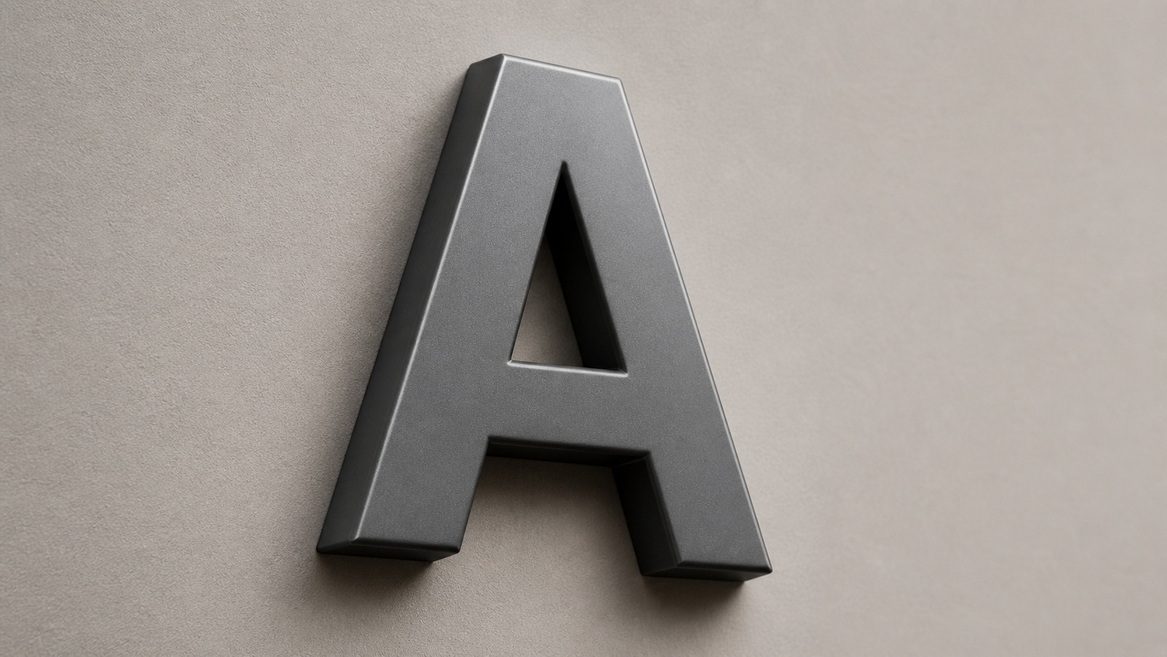
From a design standpoint, injection molded plastic letters focus on standardization and reliability rather than unlimited customization. This is ideal for OEM and wholesale projects where repeatability and lead time are critical.
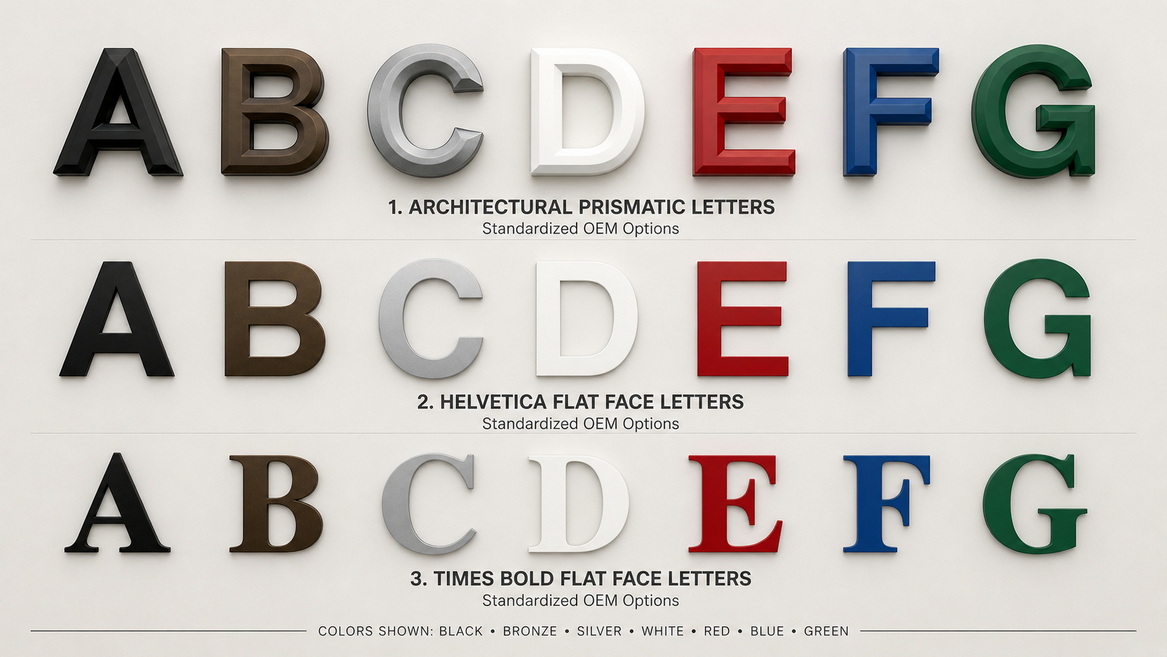
For many manufacturers, including leading brands in the architectural signage market, the standard injection molded range is intentionally limited to a small, proven font set. A typical lineup includes:
- Architectural (prismatic face) – A dimensional, faceted look that mimics engraved or cast metal.
- Helvetica (flat face) – A clean, modern sans‑serif for contemporary brands and wayfinding systems.
- Times Bold (flat face) – A classic serif that reads well on traditional or institutional buildings.
Limiting the font collection allows the factory to maintain precise molding tools, ensure uniform quality, and deliver shorter production cycles.
Injection molded letters usually come with an extensive paint color selection, often using automotive‑grade coatings for UV stability and long‑term durability.
Common options include:
- Standard color charts (e.g., RAL‑like systems or internal palettes).
- Custom paint matching based on a paint name/number and brand provided by the customer.
- Custom color matching via a physical sample, typically at least 3 × 3 inches, with a color‑match fee handled by the paint lab.
Automotive‑quality paint is particularly valuable for outdoor projects, where resistance to fading and chalking directly affects brand consistency.
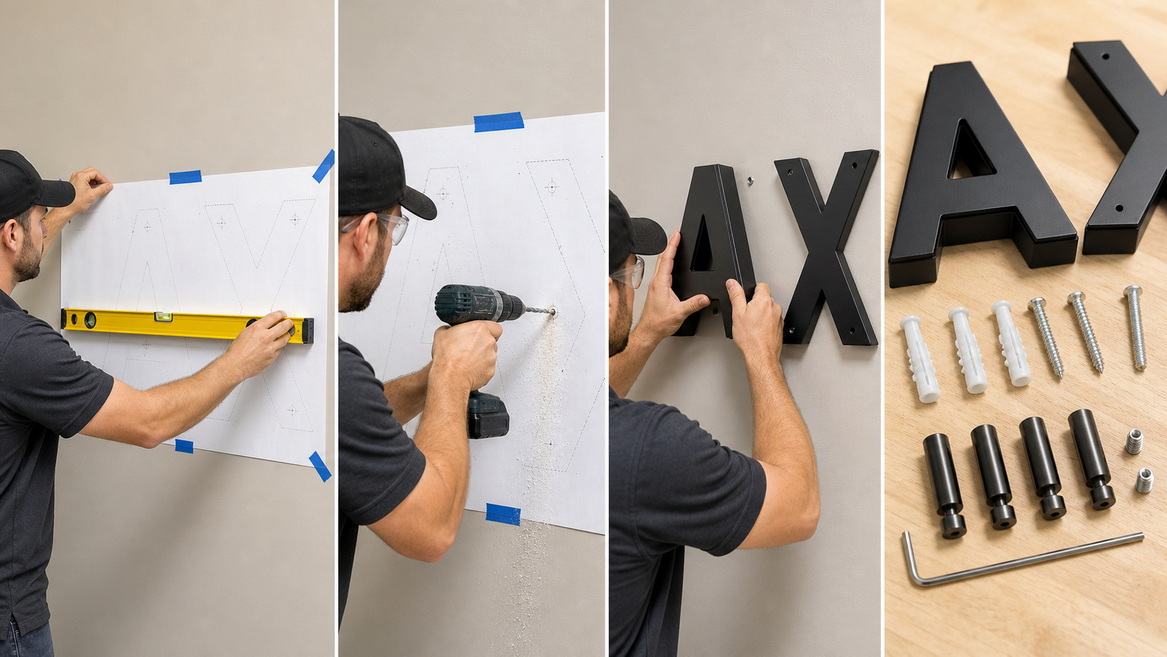
One of the practical advantages of injection molded plastic letters is how straightforward they are to install on site.
- Suitable for even or corrugated surfaces, indoors or outdoors.
- Supplied with standard mounting hardware and installation patterns, which simplify layout and positioning.
- Lightweight construction reduces load on cladding systems and makes handling safer on ladders or lifts.
For OEM customers and wholesalers, including clear mounting patterns and hardware in every shipment reduces installation errors and callbacks, while also improving the end user's perception of product quality.
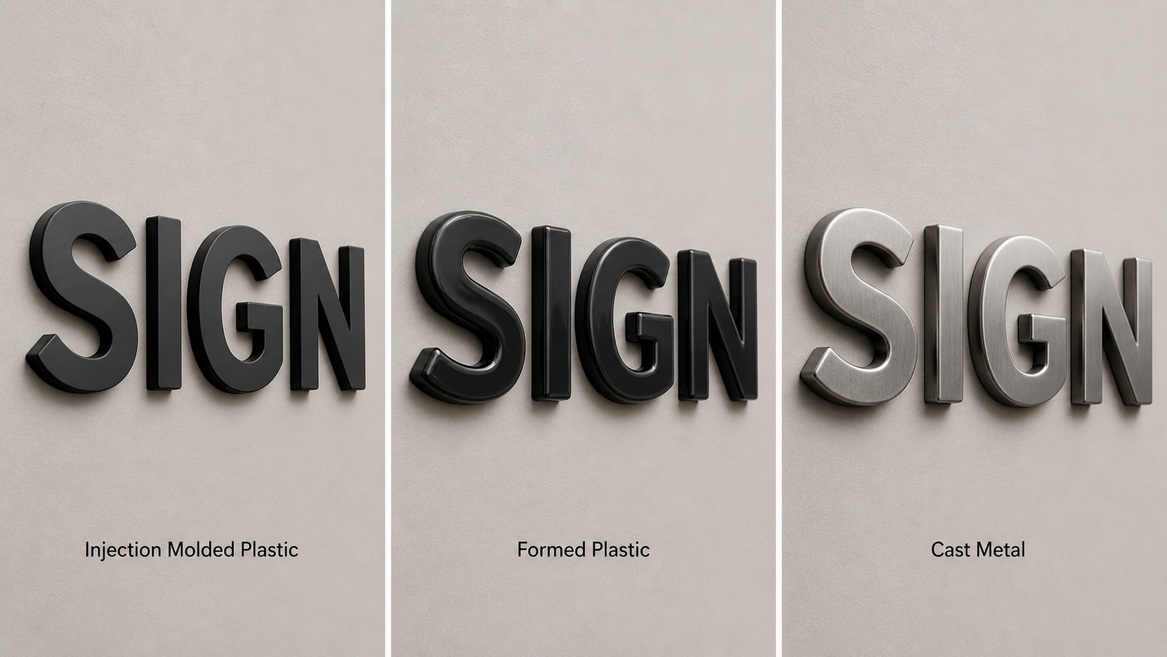
From a procurement and specification viewpoint, the biggest question is often: *When should I choose injection molded letters over other options?* The answer usually comes down to complexity, customization, and budget.
| Feature / Option | Injection Molded Plastic Letters | Formed Plastic Letters | Cast Metal Letters |
|---|---|---|---|
| Dimensional appearance | Yes, defined depth and crisp edges | Yes, but shape depends on forming | Yes, solid dimensional appearance |
| Font flexibility | Limited standard fonts, no custom fonts | Broad, supports custom shapes and logos | High, but molds/tools cost more |
| Lighting integration | Not typically illuminated | Easier to integrate with lighting | Often paired with external lighting |
| Cost level | Lower than cast metal, very cost‑effective | Mid‑range, depends on customization | Highest cost tier |
| Turnaround time | Fast due to standardized tooling | Moderate, especially with custom work | Longer, especially for new tooling |
| Weight & installation | Lightweight, easy to handle | Lightweight to medium | Heavy, needs stronger fixings |
| Visual effect | "Cast‑metal look" without the price | Flexible, from simple to very sculptural | Premium, highly prestigious |
In practice: [sevenatoms]
- Choose injection molded when you need standardized letters, fast lead times, and a clean architectural look.
- Choose formed plastic when you need custom fonts, logos, or integrated lighting effects.
- Choose cast metal when prestige and permanence justify a higher budget and more complex installation.
Consider a global retail brand planning a rollout across 150 locations with tight schedules and consistent branding requirements. [bigmarketing]
Instead of specifying custom fabricated metal letters for every storefront, their signage partner can:
1. Standardize on injection molded plastic letters in Helvetica flat face, with a single custom corporate color matched once in the paint lab.
2. Use a fixed range of letter heights (for example, 6, 8, 10 inches) tailored to typical storefront widths.
3. Ship pre‑patterned installation templates and hardware to local installers worldwide.
This approach reduces engineering time, shortens lead time, and maintains nearly identical visual results at a lower total cost of ownership, while still providing the dimensional depth and professional look the brand expects. [bigmarketing]
From a Google E‑E‑A‑T perspective (Experience, Expertise, Authoritativeness, Trustworthiness), a signage manufacturer or OEM supplier should demonstrate real‑world experience with these materials, not just surface‑level descriptions. [blog.hubspot]
That means openly sharing:
- Specific dimensions, materials, and performance characteristics.
- How and where the product is actually used in the field.
- Installation considerations and limitations, rather than only benefits.
- Cases where another technology (such as formed plastic with lighting) is a better fit.
Leading manufacturers with decades of production history in dimensional signage, plaques, and architectural letters use this level of transparency to position themselves as reliable partners instead of commodity vendors. For OEM factories in China aiming to serve international wholesalers, adopting the same content standards is one of the fastest ways to build long‑term trust online. [marketveep]
For advertising signage and branded environments, injection molded letters support three strategic goals: visibility, consistency, and scalability. [webfx]
1. Visibility
- Dimensional letters catch light and shadow better than flat vinyl, improving readability on façades and interior walls.
- Clean edges and high‑contrast paint colors support fast recognition for drivers and pedestrians.
2. Consistency Across Locations
- Standardized fonts and heights ensure that a brand's signage looks the same whether installed in North America, Europe, or Asia.
- Automotive‑grade paint keeps corporate colors stable over time.
3. Scalability For OEM & Wholesale Projects
- Reusable injection molds allow high volumes without sacrificing quality.
- Clear installation kits reduce training requirements for local contractors.
For an OEM factory like Landea Signs Co., Ltd., integrating injection molded letters into a broader advertising signage portfolio (including channel letters, illuminated signs, and wayfinding systems) creates a versatile offering for foreign brands and wholesalers.
When you are deciding whether injection molded plastic letters are the right choice for a project, walk through this simple 5‑step checklist:
1. Application environment
- Indoor, outdoor, or both?
- Exposure to direct sunlight, moisture, or chemicals?
2. Brand and design requirements
- Can your brand guidelines accept one of the standard fonts?
- Is a "cast‑metal look" acceptable, or is real metal mandatory?
3. Budget and total cost
- Is there pressure to reduce unit cost without sacrificing perceived quality?
- Will using standardized components reduce engineering and approval cycles?
4. Timeline and logistics
- Do you have a fixed opening date or rollout schedule?
- Can standardized letters speed up approvals and production compared with fully custom solutions?
5. Installation constraints
- Are installers experienced signage professionals or general contractors?
- Will they benefit from lighter letters and pre‑printed installation patterns?
If you can answer "yes" to most of these points, injection molded plastic letters are usually a strong fit.
If you are a brand owner, wholesaler, or signage producer looking for a reliable OEM partner for advertising signage and architectural letter solutions, working with a specialist factory that understands both manufacturing and international brand requirements can significantly de‑risk your projects. [sevenatoms]
You can:
- Share your brand guidelines, drawings, or reference photos for evaluation.
- Request material and color recommendations based on your environment and budget.
- Ask for sample packs of standard injection molded letters and finishes to present to stakeholders.
A focused OEM signage manufacturer can help you balance cost, lead time, and brand integrity across multi‑location rollouts, while also supporting you with technical documentation and installation guidance tailored to your markets. [manufacturingsuccess]
1. Are injection molded plastic letters suitable for coastal or high‑UV environments?
Yes, many injection molded systems use UV‑stable materials and automotive‑grade paints designed to withstand strong sunlight and challenging outdoor conditions when properly specified and installed. [bigmarketing]
2. Can I use my own corporate font for injection molded letters?
In most cases, injection molded letters are limited to a small set of standard fonts because of the fixed molds required for production; fully custom fonts are usually better handled with formed plastic or fabricated letters. [sevenatoms]
3. How do injection molded letters compare in cost to cast metal letters?
Injection molded plastic letters are generally more cost‑effective than cast metal because they use less expensive materials and repeatable plastic molds while still achieving a dimensional "metal‑like" look. [bigmarketing]
4. What information should I prepare before requesting a quotation?
To receive an accurate quote, prepare your desired letter height, font style, color (standard or custom), installation surface details, and project location or environmental conditions. [manufacturingsuccess]
5. Can injection molded letters be combined with illuminated signage?
While injection molded letters themselves are not usually internally illuminated, they can be combined with back‑lighting, light boxes, or surrounding illuminated elements as part of a broader signage system; for fully integrated lighting, formed or channel letters may be a better choice. [coffmanmedia]
1. Gemini. "A 3 Minute Summary of Gemini's Injection Molded Plastic Letters." Gemini's Injection Molded Plastic Letters Overview.
2. WebFX. "3 SEO Best Practices for Sign Companies." WebFX. [webfx]
3. MarketVeep. "4 Best Practices for Your Content SEO Strategy in Manufacturing." MarketVeep Blog. [marketveep]
4. SevenAtoms. "SEO for Manufacturing Companies: Best Practices and Tips." SevenAtoms Blog. [sevenatoms]
5. Big Marketing. "Manufacturing SEO: 10 Proven Strategies for Top Rankings." Big Marketing. [bigmarketing]
6. Tiecas. "A Guide to Writing Industrial Blogs | Tips for Manufacturing Content." Tiecas Blog. [tiecas]
7. HubSpot. "Is Your Website EEAT-compliant? What Developers Should Keep In Mind." HubSpot Blog. [blog.hubspot]
8. Productive Blogging. "15 Easy Ways to Improve Your Website's E-E-A-T." Productive Blogging. [productiveblogging]
9. Siteimprove. "A Creator's Guide to SEO Content Strategy." Siteimprove Blog. [siteimprove]
10. Tencent Cloud. Tencent Cloud Developer Blog. [cloud.tencent]


