From idea to market-ready product, our SIGNS solutions make every stage easier, faster. Discover How We Help

Views: 222 Author: Landea Signs Publish Time: 2026-06-14 Origin: Site


Content Menu
● Why We Outgrew Our Old Signage Facility
● What's Different About Our New Location
>> A Larger Manufacturing Floor Designed for Flow
>> Dedicated Rooms for Key Signage Technologies
● How Our New Offices Improve OEM Project Management
>> Private Offices for Technical and Project Teams
>> A Large Conference Room for Strategy and Alignment
● What This Means for Overseas OEM Customers
● An Industry Expert's View: Why Facility Design Matters in Signage Manufacturing
● Practical Criteria to Evaluate an OEM Signage Factory
● From One Sign to a Multi‑Location Rollout: A Typical OEM Workflow
>> Step 1 – Discovery and Technical Alignment
>> Step 2 – Prototyping and Pre‑Production
>> Step 3 – Scaled Production on the New Floor
>> Step 4 – Export, Documentation, and After‑Sales Support
● How We Build Trust: E‑E‑A‑T in Practice
● Visit Our New Facility or Start Your OEM Project
● Frequently Asked Questions (FAQ)
When we decided to relocate our advertising signage manufacturing facility, it wasn't just about finding a bigger warehouse—it was about building a smarter factory that helps our global OEM partners launch, refresh, and scale their brand signage faster and more reliably. From my perspective as someone who has walked production floors for years, the new layout has changed the way we collaborate, solve problems, and deliver on tight deadlines for overseas brands, wholesalers, and producers. [sixthcitymarketing]

The simplest way to explain our move is this: our customers' expectations grew faster than our old building could keep up. [marketingrefresh]
Over the last few years, we saw three clear shifts in the signage projects we handle:
- Larger, more complex multi-location rollouts for retail and hospitality brands. [youtube]
- Higher demand for mixed-technology signage (neon, LED, digital, vinyl, and metal fabrication in one program). [brillitydigital]
- Shorter lead times and stricter quality standards from OEM and private-label customers in North America, Europe, and Australia. [marketveep]
In the old plant, we frequently had to "make space" by moving partially finished signs or pausing one workstream to complete another. That may be acceptable for small shops, but it is not sustainable when you run long-term OEM programs for brand owners who need consistent, repeatable outputs. [moz]
Our new facility gives us a large, open manufacturing space where we can manage multiple large projects at the same time without crowding or bottlenecks. The layout follows a simple principle from lean manufacturing: each sign should move forward through the process with minimal backtracking and handling. [sixthcitymarketing]
To support that, we use:
- Dedicated large worktables for assembly and finishing. [marketingrefresh]
- Mobile tables on rollers that travel with the job from station to station. [marketingrefresh]
- Clearly marked zones for cutting, forming, wiring, testing, and packing. [sixthcitymarketing]
In practice, this means a channel letter set for a U.S. brand and a pylon sign project for a European wholesaler can run in parallel, without competing for space or equipment. [sixthcitymarketing]
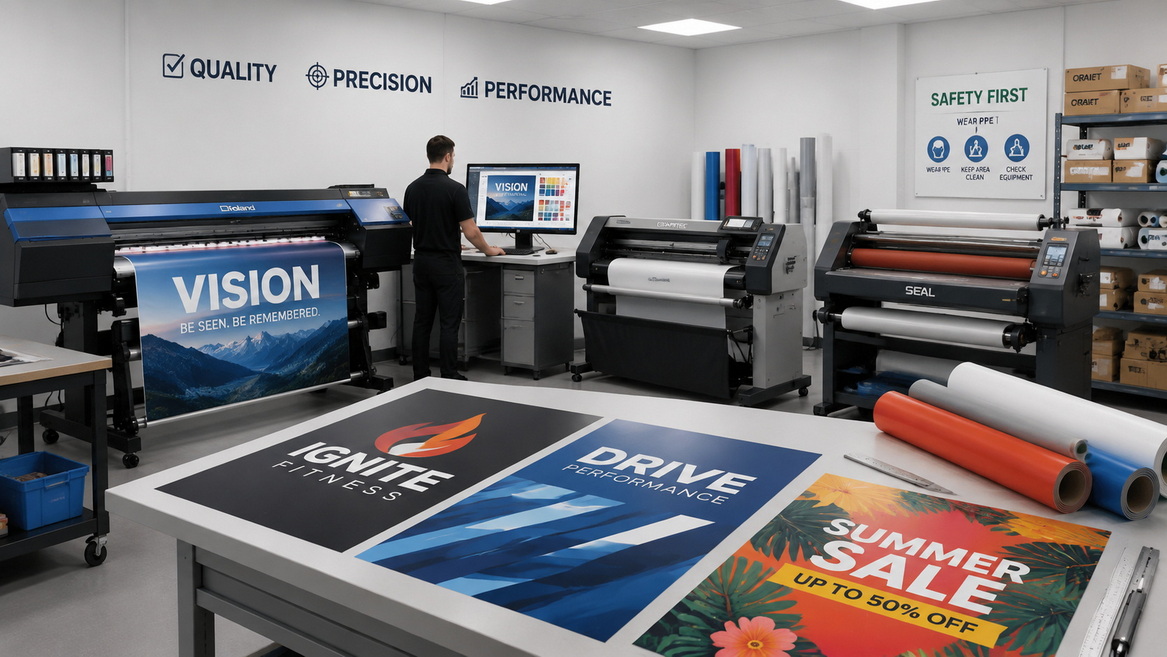
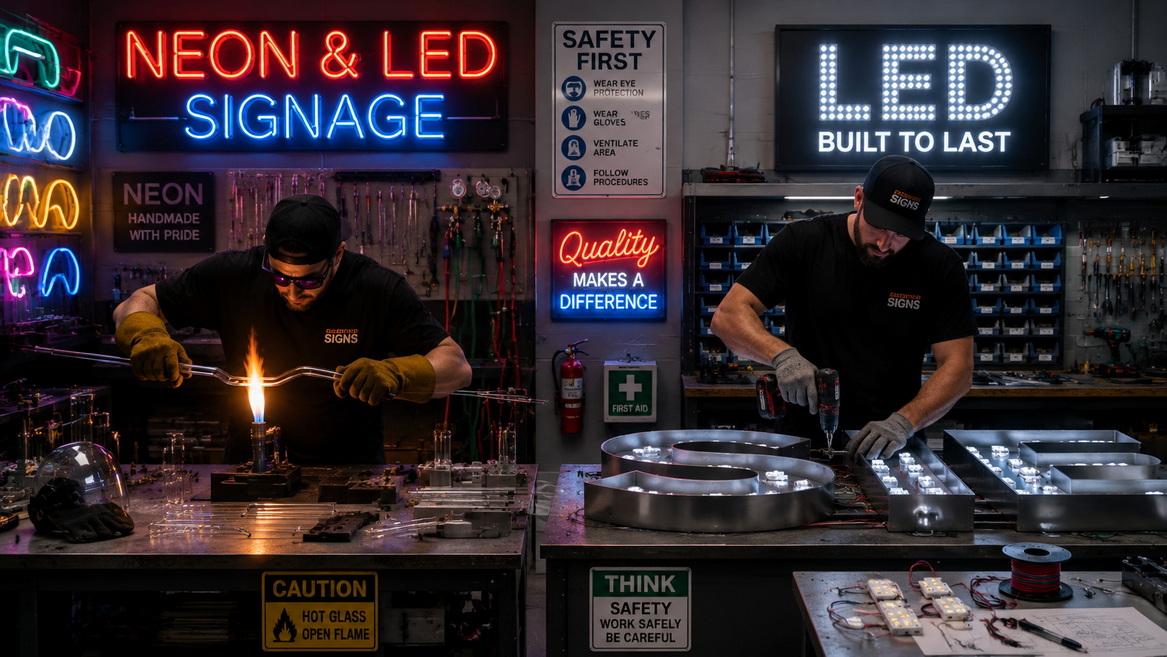
Certain signage processes benefit enormously from controlled environments and specialized equipment, so we allocated dedicated rooms inside the factory: [marketingrefresh]
- Digital & vinyl sign production room – For digital printing, vinyl cutting, and laminating, where dust and humidity control directly affect print quality and color consistency. [marketingrefresh]
- Neon sign production area – For bending glass tubes and assembling neon systems in a space designed around safety, ventilation, and precision. [marketingrefresh]
By separating these processes, we drastically reduce rework caused by contamination, damage in transit between stations, or scheduling conflicts on shared equipment. [sixthcitymarketing]
Beyond the workshop, the new location gives every key team member their own office for private meetings with clients and internal stakeholders. For OEM signage projects, this matters more than most people realize. [marketingrefresh]
In a typical OEM program, we're not just "taking an order." We are:
- Reviewing brand guidelines and technical drawings.
- Aligning on material specs, illumination requirements, and safety standards across markets.
- Coordinating with logistics partners and installation teams. [youtube]
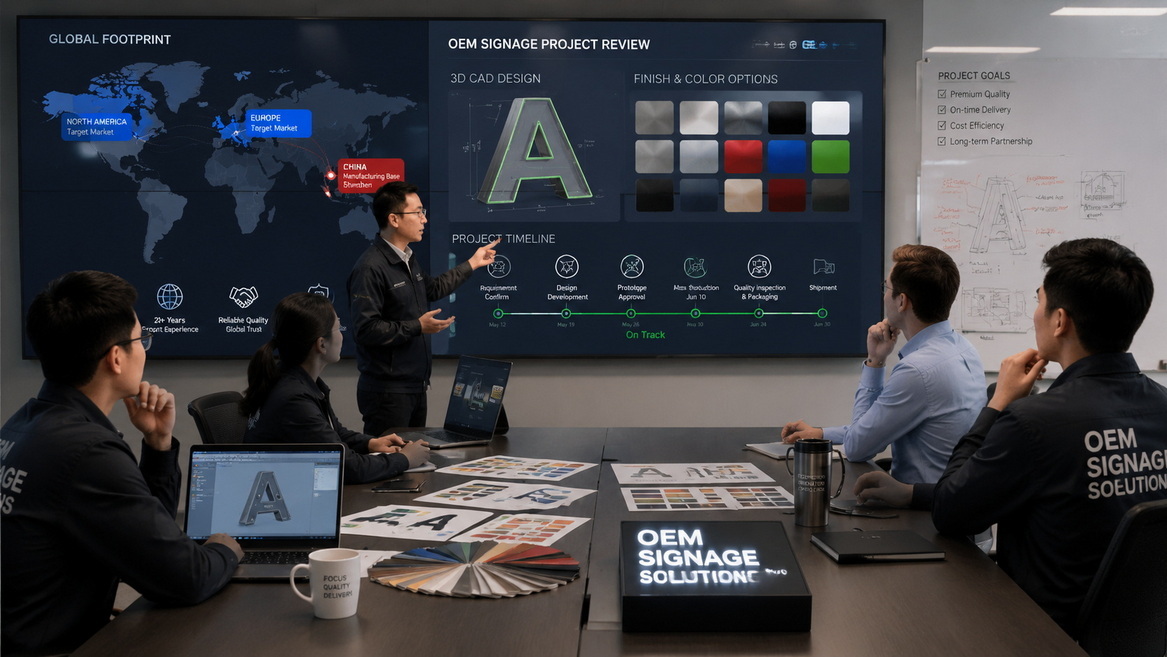
Having quiet, dedicated spaces allows engineers, account managers, and quality leaders to hold focused video calls, walk through CAD drawings, and review samples with overseas clients without factory noise or interruptions. [youtube]
We also added a large conference room where the whole team can sit down together and discuss short-term production priorities and long-term growth goals. In that room, we often run: [marketingrefresh]
- Weekly production planning sessions focused on on-time delivery.
- Design and engineering reviews for new OEM programs.
- Retrospectives on complex signage rollouts to capture learnings. [mostlyserious]
This kind of structured collaboration helps us translate real production experience into better processes and more predictable outcomes for our customers. [semrush]
From a buyer's perspective, the most important question is not "how big is your factory?" but "how does your factory make my life easier?"
Based on our experience working with foreign brand owners, wholesalers, and producers, here are the benefits they notice first:
- Faster lead times thanks to improved workflow and capacity. [sixthcitymarketing]
- Higher consistency in color, brightness, and build quality across multiple orders. [moz]
- Better communication because engineering and project teams have the space and tools to collaborate effectively. [mostlyserious]
- More flexible OEM options, including custom branding, packaging, and documentation that align with the customer's own identity. [marketveep]
When your end customers walk past a storefront or a hotel entrance, they never think about the factory behind the sign. But they immediately feel whether the sign looks professional, on-brand, and reliable. Our facility upgrade is about getting that moment right—again and again, across markets.
Speaking as someone who has spent years in the signage and manufacturing industry, facility design is a proxy for how seriously a supplier takes your brand. [moz]
Well-organized signage factories tend to:
- Use standardized work instructions and quality checklists at each station. [sixthcitymarketing]
- Maintain cleaner, safer environments, which correlates with fewer defects.
- Invest in cross-functional collaboration between design, production, and quality. [semrush]
On the other hand, cramped, disorganized workshops often struggle with:
- Inconsistent color matching and illumination due to uncontrolled conditions.
- Delays caused by rework and miscommunication.
- Difficulty scaling from small runs to regional or global rollouts.
When you evaluate OEM signage partners, look not only at portfolio photos but also at how their facility is organized, how they handle multiple projects simultaneously, and whether they have the space and systems to support your growth.
To make this more actionable, here is a simple framework you can use when assessing any advertising signage OEM partner.
| Factor | What to Look For in a Factory | Why It Matters for You |
|---|---|---|
| Production layout | Clear flow from raw materials to packing, minimal clutter (marketingrefresh) | Reduces errors and shortens lead times |
| Dedicated rooms | Separate areas for digital print, vinyl, neon, LED (marketingrefresh) | Better quality control and fewer defects |
| Capacity & staffing | Enough machines and trained staff for multi-project loads (marketingrefresh) | Supports larger orders and rollouts |
| Project management | Offices, meeting spaces, clear communication channels (marketingrefresh) | Smoother coordination across time zones |
| Quality systems | Documented QC checks, test reports, certifications (sixthcitymarketing) | Lower risk and stronger compliance |
| Experience with OEM | History of white-label or private-label projects (marketveep) | Confidence they can represent your brand standards |
These criteria reflect what we've built into our own new facility and what we advise any serious brand or wholesaler to ask when vetting suppliers.
To show how our expanded facility translates into real work, here's a simplified version of how we handle a new OEM signage program.
- We review your brand guidelines, drawings, and specifications.
- Our engineering team checks structural and electrical requirements for target countries.
- Together we align on materials, illumination, mounting, and safety standards. [marketveep]
- We produce prototypes or first articles using our dedicated digital/vinyl and neon/LED areas.
- We run internal quality checks and share detailed photos, videos, and measurements.
- You test the sample in your market and provide feedback for refinement. [sixthcitymarketing]
Once designs are locked, full production moves across our large manufacturing space:
1. Material preparation and cutting.
2. Forming, welding, or routing as needed.
3. Illumination installation (neon, LED, or hybrid).
4. Painting, finishing, and branding elements.
5. Final assembly, testing, and packaging. [sixthcitymarketing]
Because the layout supports multiple lines, we can run different SKUs or variations simultaneously—ideal for brands that need different sizes or configurations for different store formats.
- We prepare export documentation, labeling, and, where required, testing reports.
- Our team coordinates shipping with your preferred forwarders or our logistics partners.
- After delivery, we stay available for technical questions, replacements, or future expansions. [youtube]
Google's E‑E‑A‑T framework (Experience, Expertise, Authoritativeness, and Trustworthiness) mirrors what serious B2B signage buyers also look for: real-world experience, technical competence, and reliability. [semrush]
Here's how we embody those principles:
- Experience: Our team has years of hands-on experience in OEM and custom signage production, from small boutique brands to large retail chains. [marketingrefresh]
- Expertise: We invest in specialized rooms, processes, and training for digital print, vinyl, neon, and structural fabrication, reflecting modern signage complexity. [moz]
- Authoritativeness: We share case studies, technical insights, and transparent process documentation, allowing buyers to see how decisions are made—not just final photos. [mostlyserious]
- Trustworthiness: Clear contracts, defined quality standards, and responsive communication help reduce risk for overseas partners. [semrush]
For you as a buyer, this means you're working with a factory that not only "makes signs" but understands how signage fits into brand strategy, user experience, and local regulations.
If you are evaluating OEM partners for advertising signage, visiting a working factory is one of the fastest ways to judge capabilities. Our new facility is located at 4773 Ortega St, Unit C, Ventura, CA 93003, just down the road from Eastman Avenue and near Palma Drive. [marketingrefresh]
Whether you visit in person or schedule a video walkthrough, you'll see how our expanded space, dedicated production rooms, and upgraded offices support your business goals—not just our own growth.
If you are a brand owner, wholesaler, or producer looking for a long‑term OEM signage partner, reach out to our team to discuss your next project. Share your drawings, brand guidelines, or even just an initial concept, and we'll show you how our new facility can turn that idea into reliable, scalable signage for your markets.
Q1: What types of advertising signage can you manufacture as an OEM supplier?
We produce a wide range of signage, including illuminated channel letters, lightboxes, pylon signs, wayfinding systems, neon and LED displays, and custom digital/vinyl graphics tailored to brand programs. [sixthcitymarketing]
Q2: How does your new facility help reduce lead times for overseas customers?
Our larger, open production area and dedicated rooms allow multiple projects to run in parallel, reducing bottlenecks, while improved workflow and staffing mean we can handle higher volumes without sacrificing quality. [sixthcitymarketing]
Q3: Can you support multi‑location rollouts for global retail or hospitality brands?
Yes. Our OEM processes are designed for repeatability and scalability, with standardized QC checks, consistent materials, and structured communication so we can support multi‑store or multi‑country rollouts. [marketveep]
Q4: How do you ensure quality and compliance across different markets?
We align with client specifications and relevant local standards, run documented quality checks at each station, and can provide photos, reports, and test data so you can validate compliance in your target markets. [moz]
Q5: What information do you need to provide an accurate OEM quotation?
To quote accurately, we typically need drawings or sketches, dimensions, installation environment, preferred materials and illumination type, target country, order volume, and any special packaging or documentation requirements. [mostlyserious]
1. Dave's Signs. "Daves Signs at a New Location – 4773 Ortega St, Unit C, Ventura, CA 93003." [https://www.davessigns.com/daves-signs-at-a-new-location/] [marketingrefresh]
2. Marketing Refresh. "10 Marketing Ideas For Sign Companies: Which Of These …" [https://www.marketingrefresh.com/blog/marketing-ideas-sign-companies/] [marketingrefresh]
3. Sixth City Marketing. "Manufacturing SEO: Strategy Guide on What Works (and …)" [https://www.sixthcitymarketing.com/2026/02/24/manufacturing-seo-strategies/] [sixthcitymarketing]
4. Semrush. "Google E‑E‑A‑T: What It Is & How It Affects SEO." [https://www.semrush.com/blog/eeat/] [semrush]
5. Moz. "What is Google E‑E‑A‑T? Guidelines and SEO Benefits." [https://moz.com/learn/seo/google-eat] [moz]
6. Mostly Serious. "How to Write Expert Content: A Step‑by‑Step Guide." [https://www.mostlyserious.io/insights/how-to-write-expert-content-step-by-step] [mostlyserious]
7. Brillity Digital. "Small Business Marketing for Signage Companies." [https://brillitydigital.com/industries/signage-companies/] [brillitydigital]
8. Market Veep. "10 Ways a Digital Marketing and SEO Agency Boosts Manufacturing Success." [https://www.marketveep.com/blog/10-ways-a-digital-marketing-and-seo-agency-boosts-manufacturing-success] [marketveep]
9. Copy.ai. "Make E‑E‑A‑T Work for You: SEO Credibility, Simplified." [https://www.copy.ai/blog/eeat] [copy]
10. dscout. "How to Write Compelling User Research Insights in 6 Steps." [https://dscout.com/people-nerds/writing-user-insights] [dscout]


