From idea to market-ready product, our SIGNS solutions make every stage easier, faster. Discover How We Help

Views: 263 Author: Landea Signs Publish Time: 2026-09-29 Origin: Site


Content Menu
● Start With the Viewing Position
● Compare Four Lighting Styles
>> Combination and Specialty Lighting
● Design Letters for Legibility
● Decide Whether to Upgrade or Replace
● Check Safety and Service Access
● Evaluate the Manufacturer's Proposal
● Request a Site-Specific Proposal
>> What is the difference between face-lit and halo-lit letters?
>> Are LED channel letters suitable for outdoor use?
>> How bright should an illuminated storefront sign be?
>> Can an existing neon sign be upgraded to LED?
>> How long will illuminated letters last?
>> What should I send for a custom quotation?
A lit commercial sign should do more than glow. It should make a business name easy to recognize from the places customers actually approach, in daylight and after dark. For buyers of illuminated lettering, the key decision is not simply whether to use LEDs. It is which lighting style, letter construction, mounting method, and service plan suit the site. This guide compares the options and shows how to specify a custom sign or assess an LED upgrade without mistaking brightness for readability.
Before discussing materials, stand where the sign will be seen: across the street, at the driveway, and near the entrance. A projecting sign for pedestrians serves a different sightline than wall-mounted channel letters facing traffic. Note the viewing distance, approach direction, competing lights, façade color, and anything that blocks the view.
A sign has two separate jobs. It must first attract attention, then be readable. Size, brightness, color, and contrast affect whether people notice an illuminated sign. Character-to-background contrast, adequate letter size, and uncluttered space help them understand it. More light is not always better: excessive nighttime brightness can reduce visual comfort.
Photograph the site by day and after dark from the intended approach points. Then ask someone unfamiliar with the business to read a scaled mockup from those positions. If the name is difficult to recognize, adding more LEDs inside the letters is unlikely to fix the layout.
Four common approaches cover many custom illuminated lettering projects. Each creates a different effect and places different demands on the letters and mounting surface.
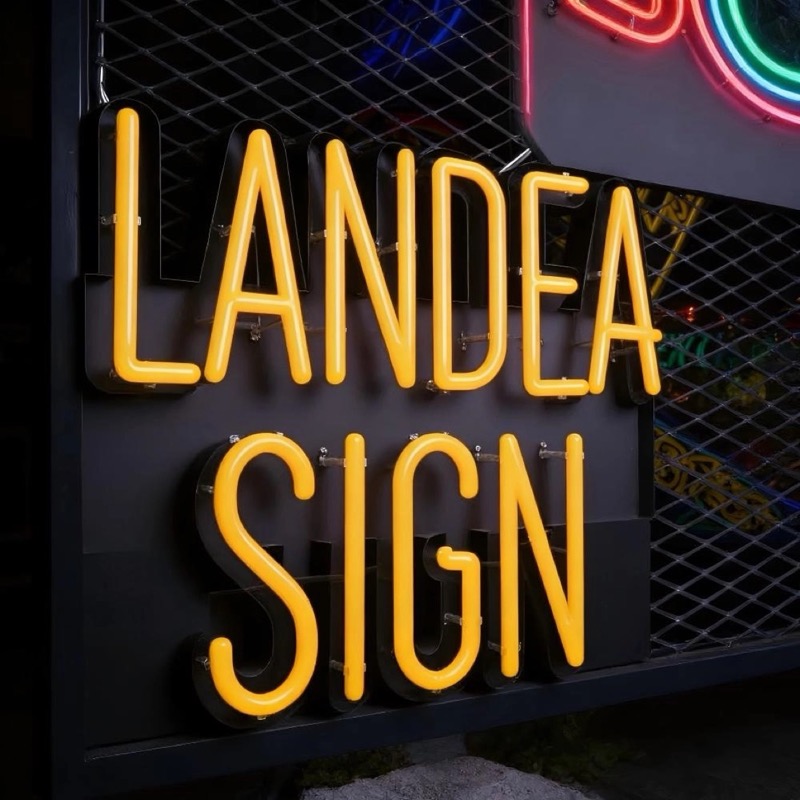
Light passes through a translucent front face, commonly acrylic, while the letter body contains the LEDs. Face-lit letters are a useful starting point when the name must be read directly from a distance. Keep strokes wide enough for even illumination, and inspect the selected face color when lit. A color that looks right in daylight may look different at night.
Opaque-faced letters direct light toward the wall behind them, creating a glow around their outlines. Halo-lit letters can complement architectural materials and an understated brand identity. They need an appropriate gap behind the letters and a suitable background. Heavy texture, unevenness, or a dark wall may alter the glow, so review a sample against the actual finish.
A translucent side, or return, releases light along the letter edge, often alongside a metal face. Side lighting emphasizes dimensional depth and can be effective where people approach from an angle. Check the profile from the real viewing position: an appealing close-up effect may not make the name easy to read across a roadway.
Face and halo illumination can be combined to create both readable front faces and an architectural outline. Specialty lighting may also suit a projecting blade sign that addresses pedestrians moving along a storefront. Each additional effect brings fabrication and wiring considerations. Specify it because it serves a viewing or brand goal, not simply because it is available.
| Lighting style | Useful starting application | Detail to check |
|---|---|---|
| Face lit | Storefront identity viewed from a distance | Face uniformity and letter stroke width |
| Halo lit | Architectural or understated branding | Wall finish and mounting gap |
| Side lit | Dimensional detail at closer range | Edge diffusion and angled views |
| Combination | A layered visual identity | Visual balance, power, and service access |
These are starting points, not fixed rules. The façade, viewing angle, and applicable restrictions may change the best choice.
Begin with the name customers must identify, not a list of services. Prioritize the main wordmark, allow space around it, and simplify details that disappear at a distance. Look closely at narrow gaps: neighboring letters may appear to merge once illuminated. Review daytime artwork and a realistic nighttime rendering at the expected viewing scale.
Choose color in context. White light may appear warm or cool, while a colored face or programmable lighting can change the result again. If an exact brand appearance matters, request an illuminated physical sample. An RGB system is only useful when its desired colors, controls, and permitted operating modes are defined.
Aim for uniform faces rather than maximum brightness. Visible LED points, dark corners, and glare can weaken the finished result. Module placement, face diffusion, and available letter depth all affect appearance. For halo letters, inspect reflected light on the proposed wall. For a blade sign, assess both viewing faces and the bracket as part of the design.
Plan for the surrounding light, too. A setting suitable for a bright urban street may feel uncomfortable on a darker street. Where technically appropriate and permitted, dimming can provide more control. Agree on how the finished sign will be reviewed at night before fabrication begins.
A complete brief makes proposals easier to compare and reduces late changes. Use this sequence for a new installation or major replacement.
1. Document the site. Provide façade dimensions, clear photographs, wall material, proposed mounting height, power location, and approach views by day and night.
2. Define the visual goal. Share vector artwork, brand colors, approximate viewing distances, preferred lighting style, and landlord design rules.
3. Check constraints early. Have the local installer or relevant authority confirm sign size, projection, operating hours, brightness, structural, electrical, and permit requirements.
4. Request construction details. Agree on letter dimensions, face and return materials, finish, lighting layout, driver location, mounting pattern, and service access.
5. Review a proof or sample. Approve the unlit and lit appearance, letter spacing, and relationship to the façade.
6. Define handover requirements. Request installation drawings, wiring information, component specifications, operating instructions, warranty terms, and replacement-part details.
For an export project, separate fabrication responsibility from local permitting and installation. A convincing shop drawing does not establish that the building can support the sign. Qualified local professionals should verify the structure, electrical connection, and approvals before installation.

An aging sign does not always need complete replacement. If its letters or cabinet remain structurally sound and its appearance still suits the brand, an LED retrofit may be worth evaluating. If the housing is corroded, water-damaged, difficult to service, or poorly legible, replacement may be the better long-term option.
Start with an audit, not a promised savings percentage. Record the existing light source, measured power draw, daily operating hours, maintenance history, and cost of access equipment. Compare the proposed system only after confirming that it can deliver an acceptable finished appearance.
Illustrative calculation: If an existing sign draws 300 W and a proposed sign draws 120 W, the difference is 0.18 kW. At ten operating hours a day for 365 days, that equals 657 kWh annually. At an assumed electricity price of $0.20 per kWh, the modeled electricity-cost difference is $131.40 per year. These are example inputs, not measured savings for a particular sign. Include installation, disposal, repairs, and future servicing in the ownership-cost comparison.
LED light sources can have a long useful life, but they are only part of the assembly. Drivers, connections, moisture exposure, heat, and color stability also matter. A general expectation for quality white LED products does not establish the lifespan of a particular outdoor sign. Ask what a supplier's rating covers and how failed parts will be replaced.
An electric sign is a system, not a collection of interchangeable modules. Confirm that its construction and components suit the destination market. For a U.S. project, relevant references may include UL 48 for electric signs, UL 879 for sign components, UL 879A for LED sign and retrofit kits, and National Electrical Code Article 600. Which requirements apply depends on the project and local authority. A certified component alone does not certify the completed sign.
Specify how electrical parts are protected in their installed locations while remaining accessible for service. Establish where the driver and disconnect are located, who can open the sign, and whether replacing a failed part requires removing the whole assembly. Have exposed outdoor mounting checked against local structural conditions.
Give retrofits the same scrutiny. Replacing neon or fluorescent lighting with LEDs may change wiring and the route to approval. Do not assume an older sign approval automatically covers the modified assembly. Arrange the necessary review before work begins.
Two quotes with identical headline dimensions may describe substantially different products. Ask each supplier to state what is included, excluded, and assumed.
- Lighting: Effect, color specification, sample approval, and nighttime control plan.
- Construction: Letter depth, face material, metal finish, mounting method, and access to replaceable parts.
- Electrical: Input requirements, driver and module details, component documentation, and wiring drawings.
- Delivery: Packaging, drawing-approval stages, spare parts, and handover to the installer.
- Commercial terms: Production scope, warranty coverage, exclusions, and responsibility for permits and installation.
A revealing question is: "What would you change if this sign had to remain readable from the opposite side of the street and be easy to repair five years from now?" The answer shows whether the proposal responds to the site and ownership needs rather than merely reproducing a reference image. Request a sample or documented evidence for any claim that materially affects your choice.
Send your logo, façade photographs, approximate dimensions, and preferred lighting effect to Landea Signs Co., Ltd. Request a custom illuminated lettering proposal that compares suitable construction options, identifies information needed for local approval, and explains how components can be serviced. Design the sign for the place people will actually see it—not just for how it looks in a catalog.
Face-lit letters emit light through their front surface. Halo-lit letters direct light toward the wall behind opaque faces, creating a glow around the outlines. Choose according to the viewing distance, desired appearance, and background surface.
They can be when the complete sign, electrical components, mounting, and installation are designed for the actual environment. Confirm the project-specific construction and approvals rather than relying on the word "LED."
It should be noticeable and readable from the intended approach points without uncomfortable glare or excessive nighttime output. Assess the surrounding light, façade contrast, applicable limits, and a realistic mockup.
Sometimes. A qualified assessment should examine its enclosure, faces, wiring, structure, electrical compatibility, and applicable retrofit requirements. Consider whether the change will preserve the appearance you want.
There is no single reliable lifespan for every sign. Light output, drivers, finishes, exposure, and maintenance all affect service life. Request system-specific documentation, warranty terms, and a repair plan.
Send vector artwork, dimensions or a scale reference, façade photos, the intended lighting effect, installation location, expected viewing distance, and any local or landlord restrictions. State your timeline and identify who will arrange installation.
1. [Gemini, "Mastering Lit Commercial Signage: Selection and Best Practices"]
3. [International Sign Association, *Glossary of Sign Terms & Definitions*]
4. [U.S. Department of Energy, *LED Basics*]
5. [UL Solutions, *Electric Sign Certification and Sign Component Solutions*]
6. [International Sign Association, *ISA Position Statements*]


