From idea to market-ready product, our SIGNS solutions make every stage easier, faster. Discover How We Help

Views: 218 Author: Landea Signs Publish Time: 2026-08-27 Origin: Site


Content Menu
● Why Weld Quality Is a Brand Issue
● The Limits of Hand-Welded Aluminum Signs
>> 1. Results Depend Heavily on Individual Skill
>> 2. Excessive Heat Can Distort Thin Aluminum
>> 3. Post-Weld Finishing Often Becomes Necessary
>> 4. Production Speed and Repeatability Can Be Limited
● Machine Laser Welding for Aluminum Signs
>> What Is the Heat-Affected Zone?
● Hand Welding vs. Machine Laser Welding
● Why Aluminum Sign Projects Benefit Most
● Precision and Illuminated Sign Performance
● The Production Controls That Matter
● Questions to Ask an Aluminum Sign Supplier
● When Hand Welding Still Makes Sense
● Choose Precision That Supports Your Brand
>> Is machine laser welding better than hand welding for aluminum signs?
>> Can laser welding reduce distortion in thin aluminum letters?
>> Does laser welding eliminate post-weld finishing?
>> Are laser-welded aluminum signs suitable for illuminated letters?
>> What aluminum thickness is suitable for dimensional signs?
>> Can a machine laser-welded sign have a brushed or polished finish?
A premium aluminum sign should look intentional from every viewing distance: crisp edges, flat faces, clean returns, and a finish that stays visually consistent under daylight and illumination. For brands investing in dimensional lettering, machine laser welding offers a more repeatable way to achieve that result than conventional hand welding.
At Landea Signs Co., Ltd., we view welding as more than a joining process. It directly affects how a finished sign reflects the quality, consistency, and credibility of the brand it represents.

Dimensional aluminum lettering is often chosen for corporate facades, retail storefronts, hospitality projects, office reception areas, and wayfinding systems because aluminum is lightweight, corrosion-resistant, and adaptable to many finishes.
But aluminum is also demanding to weld. Its high thermal conductivity rapidly pulls heat away from the joint, while its relatively high thermal expansion can make thin material vulnerable to warping during welding. A small distortion may be insignificant on an industrial frame, but it is immediately visible on a polished, brushed, painted, or illuminated aluminum sign.
For a brand, this matters because the sign is not merely a fabricated object. It is a public-facing brand asset. Customers may not describe a warped letter as a welding defect, but they will notice when lettering looks uneven, seams appear rough, or illumination is inconsistent.
Precision becomes part of perceived brand quality.
A cleanly made aluminum sign communicates:
- Attention to detail
- Consistent visual standards
- Investment in quality
- Professionalism at the point of customer contact
- Confidence in the brand presentation
By contrast, visible finishing defects can weaken an otherwise strong architectural concept.
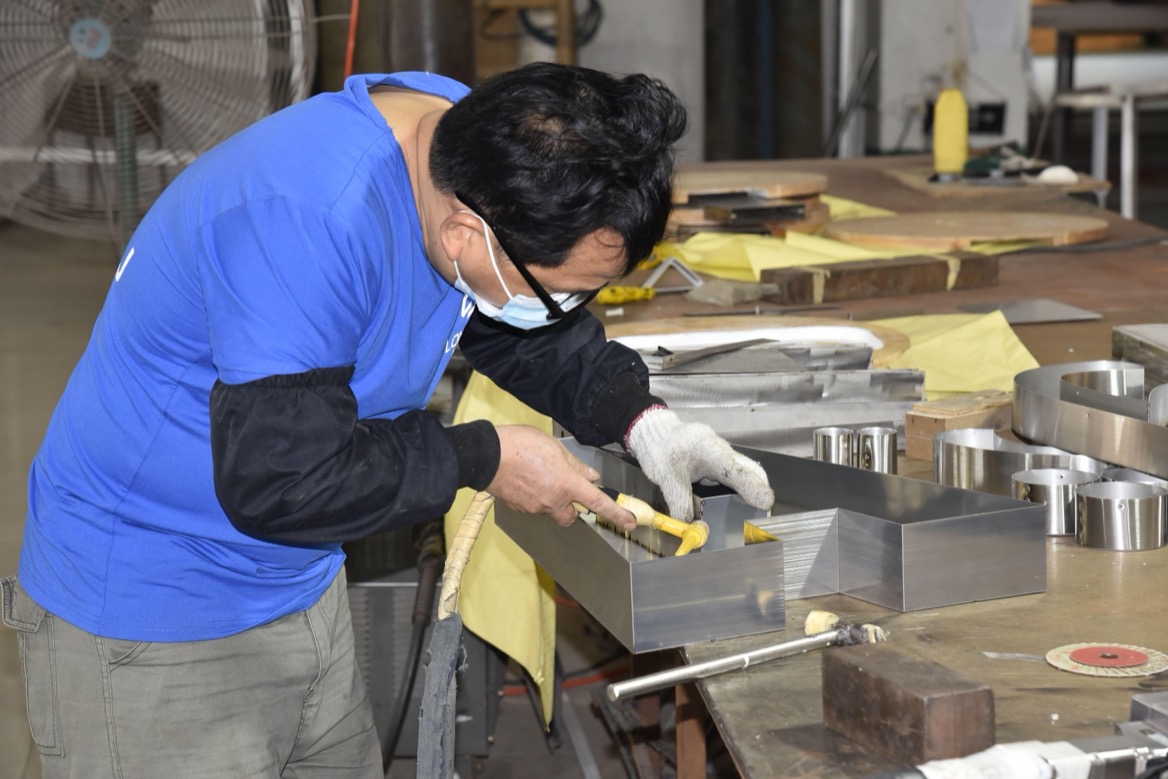
MIG, TIG, and arc welding remain valuable fabrication methods. Experienced welders can produce excellent work, especially for custom structures, thick sections, repairs, and low-volume projects requiring human judgment.
However, hand-welded aluminum signs can present challenges when visual consistency, thin material, repeatability, and production scale are critical.
Traditional welding quality depends substantially on operator experience, hand stability, travel speed, torch angle, heat control, material preparation, and day-to-day consistency.
This does not mean hand welding is inherently poor. It means output variation is harder to eliminate. One highly skilled welder may produce excellent seams, while a different operator may need more grinding, filling, or refinishing to reach the same visual standard.
For brand signage programs with multiple locations, this variability creates a practical risk: will every sign look like it came from the same brand system?
Aluminum disperses heat quickly, so achieving proper fusion requires careful heat management. At the same time, excessive or uneven heating can cause expansion, contraction, warping, and residual stress.
Research and industry guidance consistently identify high thermal conductivity and thermal expansion as central reasons aluminum welding requires precise process control.
For thin aluminum sign returns and letter faces, even minor movement can affect:
- Face flatness
- Corner sharpness
- Return-wall alignment
- Bonding surfaces
- Paint and brushed-metal appearance
- Internal LED placement and light distribution
A sign may remain structurally sound while still failing the visual standard expected for a premium brand installation.
Traditional welds may require several follow-up operations, such as:
- Grinding
- Sanding
- Polishing
- Filling
- Surface correction
- Repainting or color matching
- Inspection and rework
These tasks add labor, lead time, and opportunities for inconsistent finishing. On mirror-polished or brushed surfaces, correcting a weld without leaving visible evidence is especially difficult.
Hand welding is inherently dependent on manual cycle time. For a single custom aluminum sign, this may be acceptable. For a multi-store rollout, wholesale order, or repeated letter set, manual variation can become a cost and quality-control issue.
The real comparison is not simply "fast versus slow." It is controlled repeatability versus individual variation.
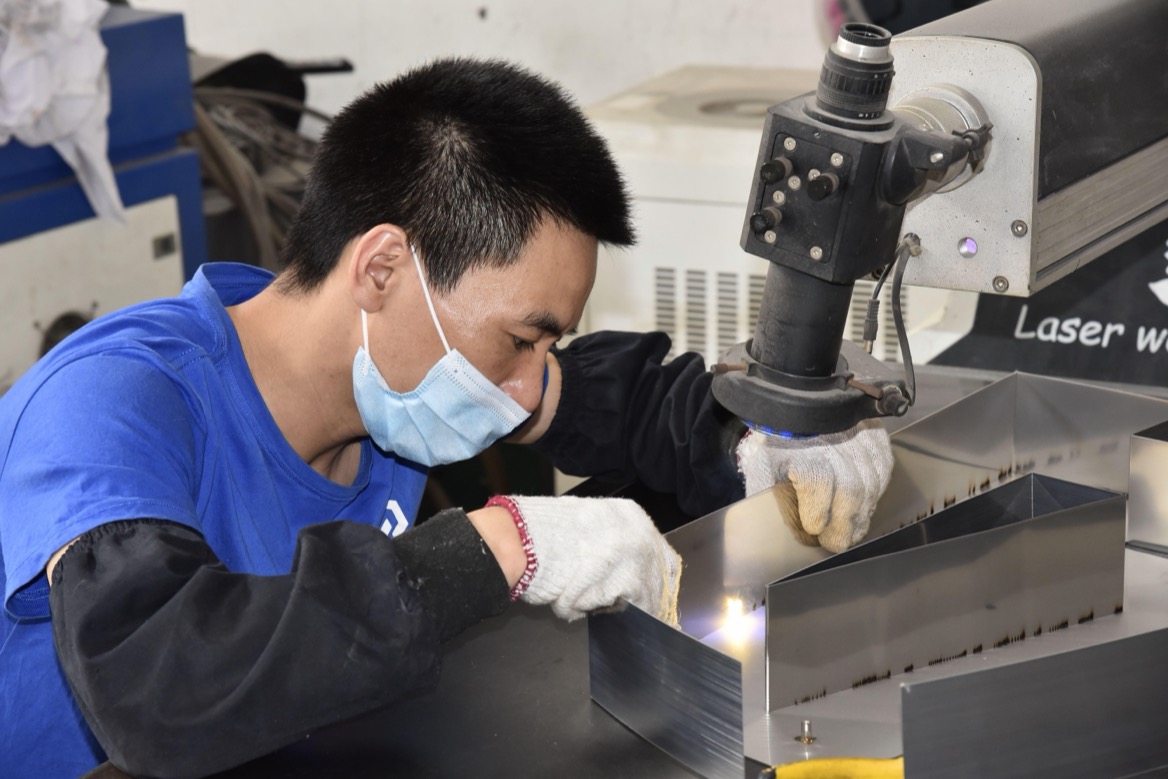
Machine laser welding uses a concentrated laser beam to join metal along a programmed path. In an aluminum sign application, the beam delivers energy precisely where it is needed, helping reduce unnecessary heating of surrounding material.
Laser welding is widely recognized for its narrow weld bead, reduced heat input, small heat-affected zone, minimal distortion potential, and strong suitability for programmable production.
For aluminum, process control is especially important. The material's reflectivity and thermal conductivity make it challenging, but modern high-brightness fiber laser systems can manage these characteristics when the parameters, fixture design, material preparation, and quality checks are properly controlled.
The heat-affected zone, often called the HAZ, is the area next to the weld that does not melt but is heated enough for its structure or properties to change.
A larger HAZ generally means more surrounding material has been exposed to thermal stress. In thin aluminum sign components, that can increase the likelihood of visible distortion.
Laser welding concentrates heat into a much smaller area than conventional arc-based methods. This is why laser welding is commonly selected for precision parts and thin-walled assemblies where shape retention matters.
| Comparison Area | Hand-Welded Aluminum Signs | Machine Laser-Welded Aluminum Signs |
|---|---|---|
| Heat input | Typically broader and more operator-dependent | Highly concentrated and programmable |
| Heat-affected zone | Usually larger | Generally narrower |
| Distortion risk | Higher for thin aluminum components | Lower when parameters and fixtures are validated |
| Weld consistency | Varies by operator and working conditions | Repeatable across programmed production runs |
| Surface finishing | Often needs grinding, sanding, or correction | Can reduce finishing work with a properly tuned process |
| Production scalability | Labor-intensive for repeated projects | Better suited to standardized, repeatable programs |
| Appearance of seams | Can vary from letter to letter | More uniform, narrow, and controlled |
| Quality control | Relies strongly on operator technique and inspection | Enables parameter control, repeatable paths, and documented inspection |
Machine laser welding does not eliminate the need for expertise. It shifts expertise from manual torch control toward process engineering: material selection, joint design, fixture accuracy, beam focus, travel speed, shielding gas, cleaning, validation, and inspection.
That distinction is important. Automation is valuable only when the process behind it is disciplined.
Machine laser welding is especially relevant when a project includes one or more of the following requirements:
- Thin aluminum letter returns
- Fine stroke widths or small dimensional letters
- Large quantities of repeated letters
- Brushed, polished, anodized, or premium painted finishes
- Tight face-to-return alignment requirements
- Illuminated letters requiring accurate internal assembly
- National or international brand rollout programs
- Shorter production windows without sacrificing appearance
- Strict sample approval and consistency requirements
For example, imagine a hospitality brand commissioning 300 sets of exterior aluminum letters for a regional expansion. If each location must present the same visual identity, the production system needs more than a good first sample. It needs a method that can reproduce the same tolerances, seam appearance, and assembly quality across the entire order.
A machine-controlled welding process supports that objective more effectively than relying solely on individual manual technique.
For an illuminated sign, welding precision affects more than the exterior surface.
Inside a dimensional letter, distortion can influence the available space for LED modules, wiring, internal supports, drainage details, and face installation. A return that shifts slightly out of alignment may create uneven clearances, complicate assembly, or contribute to inconsistent illumination.
A precise aluminum letter enclosure supports:
- More predictable LED positioning
- More consistent light diffusion
- Better face alignment
- Cleaner internal cable management
- Easier repeat assembly
- Reduced rework before final inspection
This is particularly important for halo-lit, front-lit, and combination-lit signs, where physical geometry and lighting performance work together.
A visually refined sign should also be mechanically practical. The best outcome is not simply a narrow weld. It is a stable, clean enclosure that supports the intended illumination design and withstands installation conditions.
Laser welding should not be treated as a one-button solution. Aluminum signs still require disciplined manufacturing controls.
Aluminum surfaces can carry oxide layers, oils, moisture, fingerprints, or other contaminants. These can contribute to porosity, inconsistent fusion, or poor seam appearance.
Before welding, a reliable manufacturer should control:
1. Aluminum grade and thickness
2. Surface cleanliness
3. Joint fit-up and gaps
4. Fixture positioning
5. Shielding-gas suitability
6. Programmed weld parameters
7. Final cosmetic and dimensional inspection
Proper cleaning and parameter selection are specifically important in aluminum laser welding because porosity, reflectivity, and alloy behavior can affect weld quality.
A precision machine cannot compensate for a poorly fitted joint. For dimensional lettering, the face, return, and internal support components must be cut and positioned accurately before welding begins.
Well-designed fixtures help maintain:
- Return height
- Corner geometry
- Face flatness
- Consistent gap control
- Repeatable letter dimensions
- Stable placement during welding
The weld path should be designed around the sign's geometry, not simply around the fastest possible machine cycle.
A professional aluminum sign manufacturer should validate a welding process before starting volume production. This may include trial pieces, sample approvals, visual checks, dimensional measurement, adhesion checks after finishing, and illuminated assembly testing.
For projects with unusually thin material, challenging finishes, large letters, special mounting requirements, or complex lighting, pre-production samples are particularly valuable.
The goal is not to promise zero distortion. The goal is to define, control, inspect, and consistently meet the project's visual and functional requirements.
Before choosing a supplier for machine-welded aluminum signs, ask questions that reveal whether the company manages the complete fabrication process.
- What aluminum thickness is proposed for the letter face and return?
- Is the sign welded by a programmed machine process, hand welding, or a combination of both?
- How is face flatness checked after welding?
- What surface preparation occurs before painting, brushing, or polishing?
- Can the supplier provide pre-production samples?
- How are LED modules and wiring arranged inside illuminated letters?
- What inspection points are used before packing?
- Can the supplier maintain color, dimensions, and construction details across repeat orders?
- What export packing method protects painted and illuminated letters?
- Who reviews drawings before production begins?
These questions move the discussion beyond price. They help buyers assess whether a sign supplier can reliably deliver the visual standard their brand requires.
Hand welding still has an important place in sign fabrication.
It may be appropriate for:
- One-off artistic metalwork
- Complex repairs
- Oversized custom structures
- Areas inaccessible to machine tooling
- Heavy-gauge components
- Projects requiring real-time fabrication adjustment
The strongest manufacturers do not frame this as an absolute choice. They combine the right process with the right component.
For repeated, high-visibility aluminum letters, machine laser welding is often the better starting point because it supports predictable geometry, controlled seams, and scalable consistency. For specialized structural details, skilled manual work may still be essential.
Your aluminum sign is often one of the first physical interactions customers have with your business. It should look refined in close-up photography, under retail lighting, at night, and after years of outdoor exposure.
Machine laser-welded aluminum signs help reduce the variables that can compromise that impression. With controlled heat input, narrow seams, repeatable fabrication, and careful inspection, the manufacturing process can better support the visual consistency that modern brands demand.
Landea Signs Co., Ltd. provides customized illuminated sign solutions for brands, architects, contractors, distributors, and project buyers. Share your artwork, dimensions, finish requirements, illumination type, and installation environment, and our team can help evaluate the appropriate aluminum sign construction for your project.
For repeatable dimensional aluminum signs, machine laser welding can offer better consistency, controlled heat input, narrower seams, and lower distortion risk. Hand welding can still be valuable for unique structures, repairs, and complex fabrication details.
Yes. Laser welding generally concentrates heat into a smaller zone than conventional arc processes, helping reduce the thermal exposure that contributes to distortion. Results still depend on material thickness, joint design, fixtures, and validated welding parameters.
Not always. A well-controlled laser weld can reduce grinding and correction work, but finishing requirements depend on the sign design, surface type, paint system, weld location, and customer acceptance standard.
Yes. Accurate welding and controlled letter geometry can support more predictable LED placement, face alignment, wiring space, and illumination consistency. The final result also depends on the LED layout, diffuser or face material, power supply, and assembly quality.
The appropriate thickness depends on letter size, return depth, finish, installation location, wind exposure, lighting configuration, and mounting method. A supplier should recommend thickness based on engineering and fabrication requirements rather than applying one thickness to every project.
Yes, but the manufacturing sequence must be planned carefully. Highly reflective or directional finishes make defects more visible, so material protection, weld placement, finishing methods, and sample approval become especially important.
1. ASM International. "Properties of Aluminum-Alloy Welds." Explains how aluminum's high thermal conductivity makes weld quality sensitive to heat-input variation. [Read the source]. [dl.asminternational]
2. IIETA. "Control of Angular Distortion in Gas Tungsten Arc Welding of Aluminum." Discusses thermal conductivity, thermal expansion, and distortion risks in aluminum welding. [Read the source]. [iieta]
3. Total Materia. "Laser Welding of Aluminum and Aluminum Alloys: Part One." Covers narrow heat-affected zones, high speed, precision heat input, and reduced thermal distortion in aluminum laser welding. [Read the source]. [totalmateria]
4. Fictiv. "Laser Welding Manufacturing Guide." Reviews low heat input, repeatability, precision, aluminum-welding challenges, and the importance of cleaning and parameter control. [Read the source]. [fictiv]
5. Joining Technologies. "Laser Welding Advantages Over Competing Methods." Explains why laser welding produces a smaller heat-affected zone and lower overall heat input than GTAW and related processes. [Read the source]. [joiningtech]
6. The Fabricator. "Laser Welding Aluminum." Discusses aluminum reflectivity and the capability of modern high-power solid-state laser systems. [Read the source]. [thefabricator]
7. Miller Welding. "Understanding Laser Welding Capabilities for Aluminum Applications." Addresses aluminum reflectivity, high thermal conductivity, controlled power density, parameter selection, and process validation. [Read the source]. [millerwelds]


