From idea to market-ready product, our SIGNS solutions make every stage easier, faster. Discover How We Help

Views: 236 Author: Landea Signs Publish Time: 2026-08-23 Origin: Site


Content Menu
● Why Metal Sign Returns Matter
● Two Fabrication Routes Compared
>> Route 1: Fabricate First, Then Apply the Final Finish
>> Why This Route Can Produce a More Continuous Look
>> Route 2: Use Pre-Finished Sheet, Then Cut and Weld
>> The Visible "White Edge" Issue
● What Buyers Should Ask Before Ordering
>> 1. Is the decorative surface applied before or after welding?
>> 2. Can You Show Close-Up Return Photos?
>> 3. What Is the Base Material?
>> 4. How Are Welds Cleaned and Passivated?
>> 5. What Does the Corrosion Test Actually Mean?
● Choosing the Right Finish for the Project
>> Choose a completed-sign finishing approach when:
>> Consider a pre-finished sheet route when:
● Our Quality-Control Perspective
>> What causes a white edge on a metal sign return?
>> Is post-plating always better than pre-finished sheet fabrication?
>> Can a visible weld mark be permanently repaired with paint?
>> Does a 72-hour salt spray test guarantee outdoor durability?
>> Which metal sign finish is best for a coastal project?
>> How can I compare two suppliers fairly?
When specifying a premium metal sign, the most revealing detail is often the return—the sidewall that gives each letter depth. A visible pale line, grey weld mark, or colour break around that return may indicate that the decorative surface was applied before cutting and welding, then disrupted during fabrication. By contrast, a well-controlled post-plating process can create a more continuous finish across the completed metal sign.
For architects, retail-fit-out teams, brand owners, and sign buyers, this is not simply a question of gold versus silver colour. It is a decision about finish continuity, weld treatment, environmental exposure, inspection standards, and lifecycle cost.
At Landea Signs Co., Ltd., we regularly advise buyers to look beyond the front face of a sample. Turn the sign over. Inspect its corners, joints, seams, and returns under direct light. That is where fabrication quality becomes visible.
> Important note: "China process" and "Thailand process" should not be treated as absolute descriptions of every factory in either country. Capabilities vary by supplier. The more useful distinction is between a process that plates or finishes the completed fabricated sign and a process that fabricates from pre-finished sheet without fully restoring the welded areas.
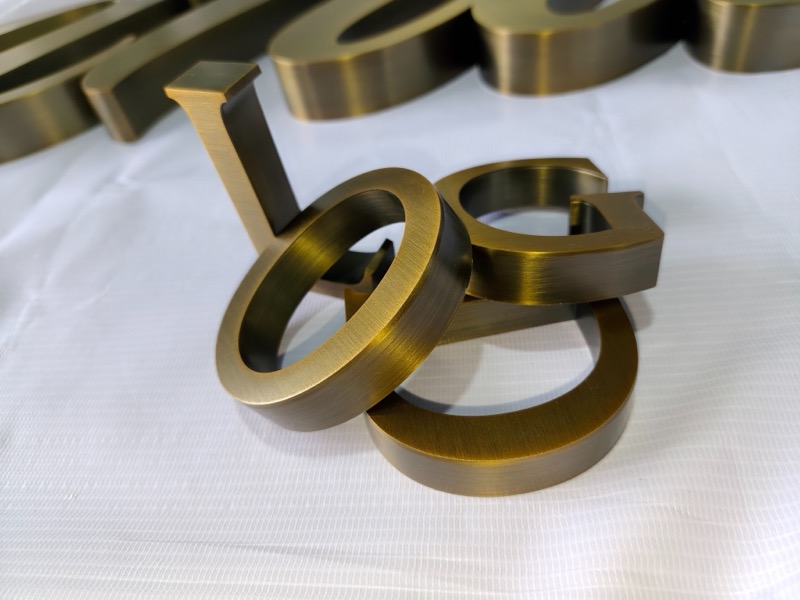
A metal sign return is the vertical sidewall around a three-dimensional letter, logo, or symbol. It creates depth, conceals internal structure where applicable, and strongly affects how the finished sign reflects light.
For premium applications, buyers generally expect:
- Consistent colour across faces, returns, and corners
- Clean welded joints without obvious discoloration
- Controlled brushing or mirror reflection
- Reliable outdoor performance appropriate to the actual environment
- Repeatability across a complete brand rollout
The challenge begins when a decorative metal surface encounters high heat. Welding can create visible oxidation, commonly called heat tint, in and around the heat-affected zone. Technical guidance from TWI explains that this oxide scale can be chromium-depleted and less protective than the original stainless-steel surface, potentially reducing resistance to localized corrosion unless it is properly removed and treated after welding.
In practical terms, a buyer may see this as a white, silver, grey, blue, brown, or rainbow-coloured line beside a weld. On a polished gold, bronze, black titanium, or mirror-finish sign, even a very narrow discontinuity can be visually distracting.
This approach begins with cutting and forming the metal components, assembling the face, return, and back structure, and welding the complete sign form. The supplier then performs the necessary cleaning, surface preparation, and final finishing process.
A typical workflow may include:
1. Cut the face, returns, and internal components from suitable stainless steel, brass, or other specified material.
2. Form the returns to the required depth and shape.
3. Weld and assemble the complete three-dimensional sign.
4. Dress welds and remove weld oxidation or contamination.
5. Prepare the entire fabricated sign for the selected final surface treatment.
6. Conduct visual inspection under controlled lighting.
7. Package with protection that prevents scratching during transport and installation.
When the final decorative treatment is applied after fabrication, the supplier has an opportunity to address the welded structure as a complete object rather than leaving weld-affected areas exposed beside an already-finished sheet surface.
This can offer meaningful advantages:
- More uniform colour appearance around returns and corners
- Reduced visual contrast at finished weld locations
- Better control of the final presentation
- A stronger premium impression for hospitality, luxury retail, corporate reception, and landmark projects
- Greater suitability for close-viewing applications, where customers can inspect every edge at eye level
This route is not automatically superior merely because it is described as "post-plating." Quality depends on material grade, weld quality, surface preparation, process controls, coating chemistry, finish thickness, handling, and inspection. Electroplating itself is an electrochemical process that deposits a metal coating using electric current, and the performance of the result depends heavily on preparation and process control.
In this route, the fabricator purchases decorative pre-finished sheet—such as coloured stainless steel, mirror sheet, or a plated surface—then cuts it into letter components and welds those components into a completed sign.
This method can be efficient. It may reduce the number of finishing stages and allow a shorter production path for straightforward designs. It is often considered for signs where budget, speed, or moderate viewing distance matters more than flawless return continuity.
However, welding after the sheet has already received its decorative surface creates an inherent risk: the heat can alter, burn, oxidize, or otherwise disrupt the finish next to the weld.
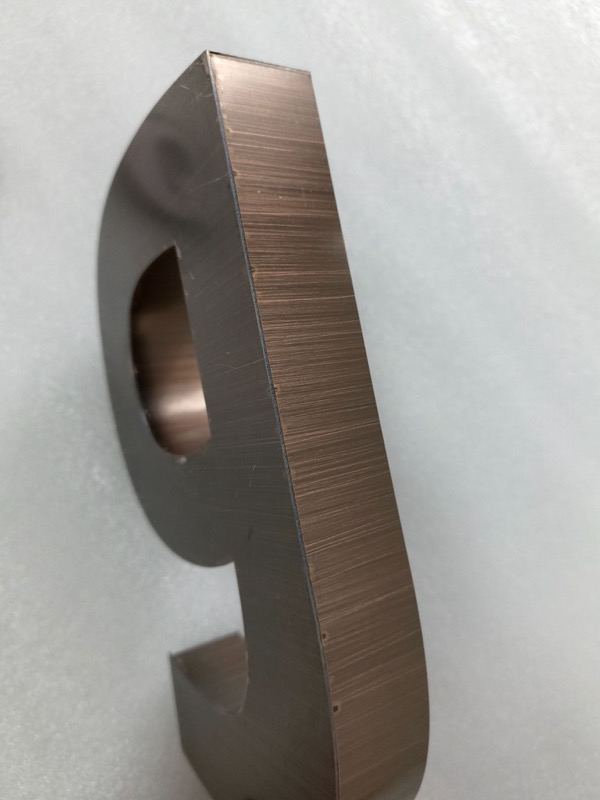
A so-called white edge is not always literally white. Depending on the base metal, finish colour, lighting, camera exposure, and weld method, it can appear as:
- Bright stainless-steel colour against a gold finish
- Grey or dull areas around a mirror surface
- Heat-tint colours near a welded joint
- A patched-looking repaired line
- A loss of brushing continuity around corners
Mechanical polishing may improve appearance, but it can also change the reflectivity, remove nearby decorative material, or create a visibly different texture. Paint touch-up can conceal a defect from one angle, yet it may introduce colour mismatch, reduced abrasion resistance, or a short-lived repair.
For this reason, buyers should never approve a metal sign only from a front-facing photograph.
| Evaluation point | Completed-sign finishing route | Pre-finished sheet then weld route |
|---|---|---|
| Return appearance | Can achieve a more continuous final appearance when preparation and finishing are well controlled | Greater risk of visible weld marks, colour breaks, or exposed base metal |
| Premium visual quality | Better suited to close-up, high-expectation environments | Often acceptable for standard commercial applications |
| Weld-area treatment | Allows finishing decisions after the entire structure is assembled | Weld heat can affect an existing decorative surface |
| Production complexity | Requires more process stages and specialist capability | Usually more streamlined |
| Lead time | Often longer because fabrication and finishing are separate controlled stages | Often shorter for simple designs |
| Unit cost | Typically higher, especially for one-off custom work | Often lower for high-volume or cost-driven projects |
| Recommended use | Luxury retail, hotels, reception areas, flagship stores, high-visibility outdoor projects | Temporary campaigns, budget-sensitive rollouts, signs viewed from distance |
The strongest sign specifications do not rely on vague phrases such as "premium stainless steel" or "high-quality gold finish." They define the details that determine what will actually arrive on site.
Before selecting a supplier, request answers to the following questions.
Ask the supplier to explain the exact sequence, not just provide a material name.
A useful question is:
> "Please confirm whether the sign is assembled and welded before the final decorative finish is applied. If not, how are heat-affected weld areas restored and made visually consistent?"
This question quickly separates a generic quotation from a technically informed one.
Request unedited close-up images of:
- Letter corners
- Welded return joints
- Narrow strokes
- Tight curves
- Brushed surfaces
- Mirror surfaces under direct light
- Gold, bronze, black, and other coloured finishes
A full-project photograph can look excellent while hiding the exact areas that matter most.
The finish cannot compensate for unsuitable base material or poor fabrication. Specify whether the sign uses, for example:
- Stainless steel with a defined grade
- Brass or copper alloy
- Aluminium where appropriate
- A composite construction with a separate decorative face
The chosen material should reflect the installation environment, required depth, fixing system, weight limit, and intended finish.
For stainless steel, weld oxidation should be treated as a technical issue, not just a cosmetic one. The British Stainless Steel Association notes that removal of weld heat tint is important for restoring optimum corrosion resistance, and identifies mechanical dressing followed by pickling among recognised approaches.
Ask for the supplier's documented weld-cleaning procedure, especially for:
- Coastal locations
- Humid climates
- Food-service environments
- Outdoor installations
- Projects exposed to cleaning chemicals or industrial pollution
A supplier may claim that a sign "passes 72 hours of salt spray testing." This can be useful as a comparative quality-control data point—but it should not be treated as a guaranteed number of service years.
ASTM B117 provides a controlled salt-fog test environment for relative corrosion-resistance information. It does not prescribe a universal exposure period, a required test specimen, or how results translate into a specific product's field life. Industry guidance also cautions that continuous salt-fog results do not reliably predict real outdoor performance, which also depends on UV, wet-dry cycling, pollutants, cleaning, drainage, installation, and local climate.
A more meaningful request is:
> "Please provide the test method, specimen construction, exposure duration, acceptance criteria, photographs before and after testing, and an explanation of how the result applies to this sign's intended environment."
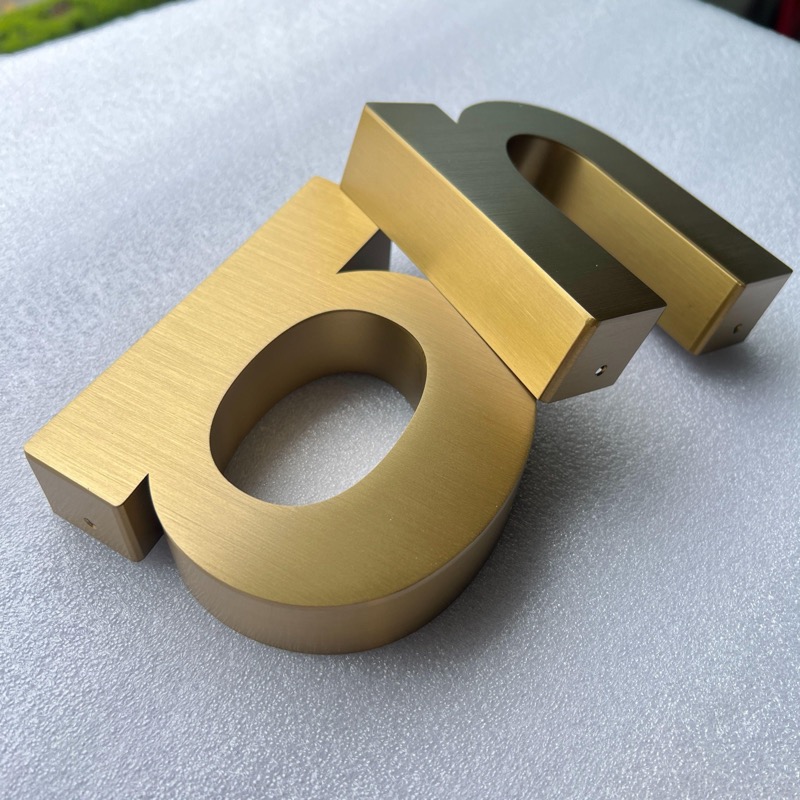
The best fabrication route depends on the sign's job—not simply the lowest quote.
- The sign will be viewed at close range
- The brand demands a luxury or architectural-grade presentation
- The design includes narrow strokes, small radii, or complex curves
- Returns will be clearly visible from customer approach paths
- The sign is installed outdoors for a long-term programme
- The project is in a coastal, humid, or pollution-prone location
- Colour consistency across multiple sites is critical
- The installation is temporary
- The budget is tightly constrained
- The sign is viewed from a substantial distance
- The return surface is less visible
- The design is simple and the acceptance standard is moderate
- The buyer accepts potential variation around welded areas
The key is to align the fabrication method with the project's visual and environmental requirements. A less expensive sign can become costly if it requires repainting, replacement, brand-standard remediation, or difficult high-level maintenance after installation.
At Landea Signs Co., Ltd., we believe the right process begins with transparent technical discussion, not exaggerated claims. For custom illuminated and non-illuminated metal sign projects, we recommend agreeing on the following before production:
- Approved material and finish sample
- Face, return, and back construction
- Weld-location expectations
- Brushed-grain direction or mirror-finish standard
- Colour tolerance across the project
- Installation environment and exposure level
- Inspection photographs before packing
- Packaging and handling requirements
- Warranty scope and maintenance guidance
For high-value projects, we also recommend approving a physical sample that includes a tight corner and an actual welded return. This is far more informative than approving a flat colour swatch.
A premium metal sign should look consistent from every viewing angle—not only in a staged front photograph. If you are planning a hotel, retail, office, hospitality, or outdoor branding project, send Landea Signs Co., Ltd. your artwork, dimensions, installation environment, and required finish.
We can help you compare construction options, identify weld-sensitive design areas, and prepare a physical sample that shows the actual face, return, corner, and finish quality you will receive.
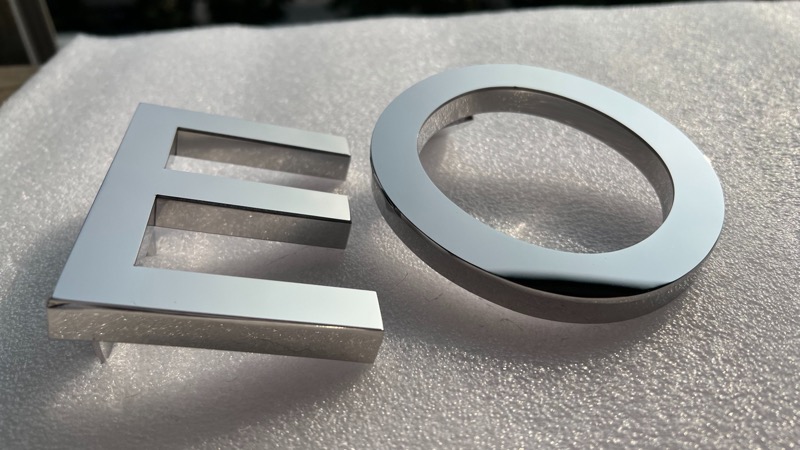
A white edge commonly appears when welding heat damages or discolours a decorative pre-finished surface, exposing base metal or creating a visibly different surface near the weld. It may also result from grinding, incomplete finishing, or a touch-up repair that does not match the original finish.
Not always. A completed-sign finishing route is often preferable for premium visual continuity, but the final result still depends on design, base material, preparation, coating quality, fabrication skill, and inspection. Pre-finished sheet fabrication can be practical for simpler, cost-sensitive projects.
Paint can sometimes reduce the visibility of a weld area, but it may not match the original reflectivity, colour, texture, or durability. For premium mirror, brushed, or coloured metal surfaces, a repair should be evaluated using a physical sample under realistic lighting.
No. It provides comparative information under controlled laboratory conditions. Real service life also depends on local climate, salt exposure, UV, drainage, cleaning methods, material selection, installation details, and maintenance. ASTM B117 itself does not prescribe product-specific exposure periods or interpretation.
The answer depends on the exact location, material, surface treatment, drainage, fixing design, and maintenance plan. For coastal use, specify corrosion-resistant materials, require proper post-weld treatment, avoid water-trapping joints, and ask for evidence relevant to the complete sign construction—not only a flat material coupon.
Provide both suppliers with the same drawing, material specification, finish requirement, installation environment, inspection criteria, and sample request. Compare close-up photos and physical samples of welded returns, not only quotation price or front-view renderings.
1. TWI. "[Avoiding heat-tint during welding of stainless steels]." Explains heat tint, chromium depletion, corrosion susceptibility, and the need for post-weld cleaning. [twi-global]
2. British Stainless Steel Association. "[Post weld cleaning and finishing of stainless steels]." Discusses restoring corrosion resistance through removal of weld heat tint and recognised post-weld cleaning methods. [bssa.org]
3. ASTM International. "[ASTM B117: Standard Practice for Operating Salt Spray (Fog) Apparatus]." Defines a controlled salt-fog environment and clarifies that the practice does not prescribe product-specific specimens, durations, or result interpretation. [store.astm]
4. Sherwin-Williams Protective & Marine. "[The Limitations of ASTM B117 Salt Spray (Fog) Testing]." Explains why salt-fog testing is useful for controlled comparison but not a direct predictor of field performance. [industrial.sherwin-williams]
5. ASTM B456 overview. "[Electrodeposited Coatings of Copper Plus Nickel Plus Chromium and Nickel Plus Chromium]." Describes electrodeposited decorative coating requirements where both appearance and corrosion protection are important. [mat-cs]
6. Sharretts Plating Company. "[Things Engineers Should Know About Electroplating]." Provides an overview of electroplating as a metal-finishing process using electrical current. [sharrettsplating]


