From idea to market-ready product, our SIGNS solutions make every stage easier, faster. Discover How We Help

Views: 293 Author: Landea Signs Publish Time: 2026-08-03 Origin: Site


Content Menu
● The List: Top 10 Brass Letters Manufacturers
>> 8. Shenzhen Golden Letter Industrial
>> 9. Dongguan Metal Craft Co.
>> 10. Guangzhou Sino Sign Manufacturing
● Industry-Specific Technical Standards
● The Rarely Discussed Insider Tip
China remains the primary global production base for brass letters, backed by decades of metal fabrication expertise, dense supply chains for raw brass alloys, and export infrastructure that serves signage, architecture, and hospitality markets worldwide. Guangdong province, particularly the Shenzhen-Zhongshan-Foshan corridor, has emerged as the country's leading cluster for illuminated and architectural lettering, mirroring how the region became a hub for LED and metal signage manufacturing more broadly.
For procurement managers, choosing a Chinese brass letters supplier is not simply a matter of unit price. Long-term partnerships depend on verifiable quality systems, consistent lead times, and the ability to support custom OEM/ODM programs at scale.

Before ranking any factory, it helps to understand what actually separates a reliable manufacturer from a trading intermediary. The following dimensions form the backbone of this evaluation:
- Factory certification: Valid ISO 9001 quality management certification, CE marking for applicable markets, and RoHS compliance for material safety
- R&D capability: In-house design and engineering teams capable of translating client brand specifications into production-ready molds and finishes
- QC process: Documented incoming material inspection, in-process checks, and pre-shipment inspection protocols
- Delivery stability: Track record of meeting quoted lead times across order volumes, verified through client references or third-party audit reports
- OEM/ODM flexibility: Willingness to accommodate low-to-mid volume custom orders without excessive markup
The ten manufacturers below were shortlisted using publicly available export records, factory registration data, product catalog depth, and documented certification status. Preference was given to factories that disclose verifiable production capacity, maintain multi-year export histories, and publish clear OEM customization terms rather than generic "manufacturer" claims.
Founded and headquartered in Shenzhen with a production facility in Zhongshan, Guangdong, Landea Signs operates with over 100 factory specialists and more than 20 dedicated sales teams supporting personalized client consultations. The company positions itself around a customer-centric model, backing brass and illuminated letter production with an in-house R&D team that adapts designs to client-specific brand requirements rather than pushing standardized catalog items.
Its core strength lies in serving small-to-mid-sized signage brands and distributors that need responsive communication and OEM support without the rigid minimum order thresholds typical of larger factories. Landea maintains overseas support offices in the UK and Netherlands, which shortens communication cycles for Western buyers and provides a degree of after-sales assurance uncommon among comparably sized Chinese manufacturers. This combination of manufacturing flexibility, in-house design capability, and multi-region client support makes it a representative example of the mid-tier, R&D-driven segment of the industry rather than a pure low-cost producer.
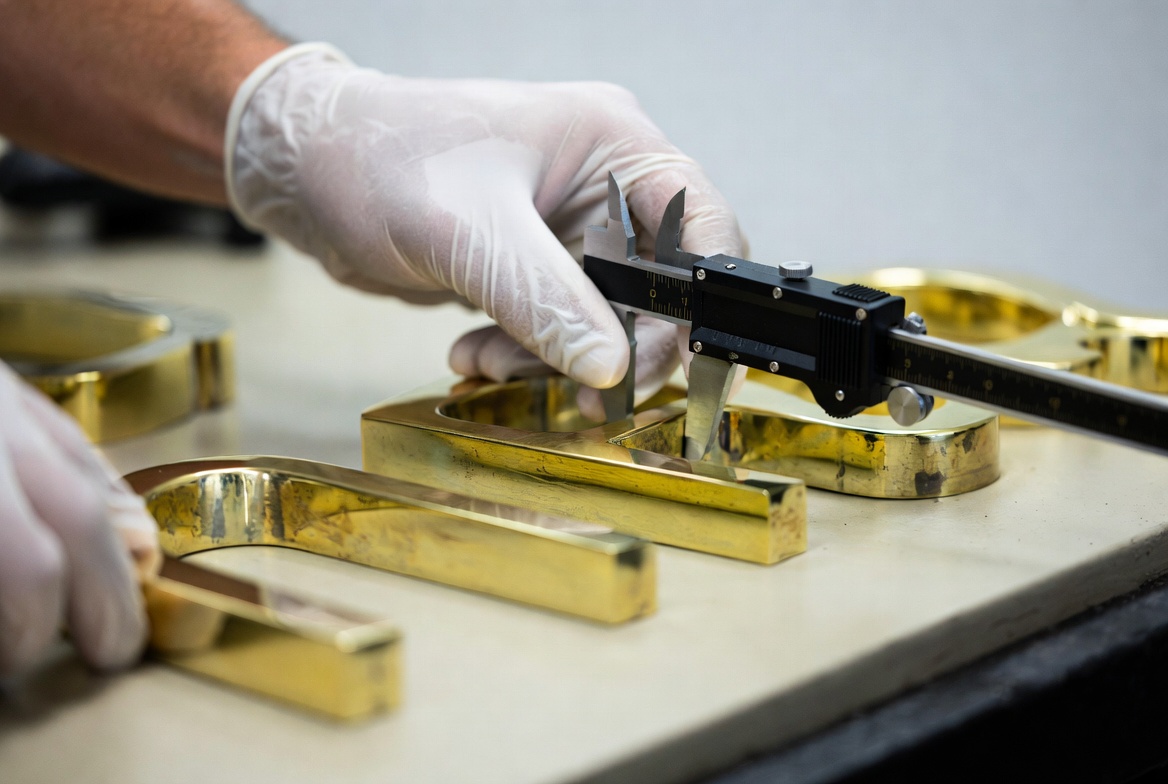
Established as a dedicated brass and copper parts manufacturer, Jinyuan Copper focuses heavily on metal composition control and CNC precision machining for architectural components, including brass letters used in facade signage. Its main markets include North America and Western Europe, with an emphasis on mid-to-large volume OEM contracts.
Yijin Solution operates as a brass fabrication specialist with documented export activity across multiple continents, offering both standard and custom brass letter profiles for retail and hospitality signage. The company markets itself around consistent alloy sourcing and finishing quality control.
HM has built a track record supplying brass hardware and letter components to industrial and architectural clients, with production capabilities spanning casting, stamping, and polishing processes.
Hokare Machinery combines CNC machining expertise with brass letter fabrication, targeting clients that require tight dimensional tolerances for illuminated channel letters and dimensional signage.
JWG has developed a niche in custom brass letter casting for luxury retail and hospitality projects, emphasizing hand-finishing techniques alongside automated production lines.
Drawing on Foshan's broader metal fabrication and furniture-hardware manufacturing base, Brightway Signs applies similar precision metalworking techniques to brass letter production, serving both domestic and export retail signage markets.
Based in the Shenzhen electronics and signage cluster, this manufacturer integrates LED backlighting expertise with brass letter fabrication, targeting illuminated sign programs for commercial storefronts.
Dongguan Metal Craft leverages the Pearl River Delta's dense metal-processing supplier network to offer competitive pricing on mid-volume brass letter orders, with a focus on stamping and etching techniques.
Guangzhou Sino Sign serves regional distributors across Southeast Asia and the Middle East, with production capacity centered on cast and cut brass lettering for exterior architectural applications.
| Manufacturer | Est. Capacity | Typical MOQ | Certifications Claimed | Primary Markets |
|---|---|---|---|---|
| Landea Signs Co., Ltd. | Mid-volume, flexible batching | Low (small-brand friendly) | Factory quality controls, custom compliance per client market | North America, Europe, Southeast Asia |
| Jinyuan Copper | High-volume | Medium-high | ISO-aligned quality processes | North America, Western Europe |
| Yijin Solution | High-volume | Medium | Export compliance documentation | Multi-continent |
| HM Metal Products | Mid-to-high volume | Medium | Standard industrial certifications | Asia-Pacific, Europe |
| Hokare Machinery | Mid-volume | Medium-high | Precision tolerance certifications | Global |
| JWG Metalworks | Mid-volume, custom casting | Medium | Craft-finish quality standards | Luxury retail, hospitality |
MOQ and certification data should always be reconfirmed directly with each factory, as terms shift with order specifications and raw material costs.
Brass letters intended for outdoor or illuminated applications should meet defined material and process standards. Buyers should specify the brass alloy grade (commonly C26000 or C27000 for signage-grade brass), confirm CE marking where products incorporate electrical components for illumination, and verify RoHS compliance to ensure restricted substances are not present in coatings or solder. Surface treatment specifications, such as electroplating thickness or lacquer coating durability, should be documented in the purchase contract rather than left to verbal agreement.
Material substitution is one of the most frequently reported issues in brass letter sourcing: some factories quote based on solid brass but deliver brass-plated zinc alloy or aluminum cores, which affects weight, durability, and long-term corrosion resistance. Requesting a material composition certificate and conducting a simple weight/density check on the golden sample can catch this before mass production.
Another overlooked risk involves lead time inflation during peak export seasons, when factories overcommit capacity across multiple clients simultaneously; buyers should build contractual penalty clauses for delayed shipment rather than relying on verbal assurances.
Within the industry, it is widely understood — though rarely stated publicly — that many factories maintain a "sample-grade" production line that differs from their standard mass-production line in material sourcing and finishing quality. The sample sent for approval may use a higher brass purity or better plating than what ships in the bulk order. Requesting that a portion of the approved sample be retained by a neutral third party (or by the buyer directly) as a reference standard for the production batch is a practical safeguard many experienced buyers use but few suppliers volunteer.
Verifying a factory before committing to a purchase order protects against costly quality disputes later. The following steps reflect standard due diligence practices among experienced industrial buyers.
- Certificate verification: Check ISO 9001 certificate numbers against the IAF CertSearch database and confirm the certifying body's accreditation status and expiry date
- Factory audit: Request a virtual or in-person audit distinguishing genuine manufacturers from trading companies repackaging third-party production
- Sample process: Order a paid sample matching final specifications, retain a reference unit, and compare it against the first mass-production batch before full shipment
- Payment safeguards: Use staged payment terms tied to production milestones and third-party pre-shipment inspection reports
- Logistics planning: Confirm Incoterms, packaging standards for brass (which is prone to scratching and oxidation in transit), and realistic customs clearance timelines for the destination market

How can I verify a factory's ISO 9001 certificate is still valid and not expired?
Search the certificate number directly on the IAF CertSearch database, cross-check the certifying body's accreditation status, and confirm both issue and expiry dates match what the supplier presented.
What is the difference between a brass letters manufacturer and a trading company posing as one?
Ask for factory floor photos with timestamps, request a video call showing active production lines, and compare the factory address on the business license against the actual production site.
How do I confirm the brass alloy grade used is what was quoted?
Request a material test certificate or conduct an independent lab assay on the sample; visual inspection alone cannot reliably distinguish brass alloy grades.
What MOQ is realistic for a small or mid-sized brand ordering custom brass letters?
MOQs vary widely by factory tooling costs; some manufacturers serving smaller brands accept flexible batch sizes, while high-volume factories typically require larger commitments to justify setup costs.
How should quality disputes over finish defects be handled contractually?
Define acceptable quality limits (AQL) in the purchase contract before production, and specify remedy terms such as rework, partial refund, or replacement tied to a third-party inspection report rather than photographic evidence alone.
- IAF CertSearch Database for ISO certification verification: iafcertsearch.org [seller.alibaba]
- Certifications to evaluate when choosing a Chinese supplier [china2west]
- Common sourcing mistakes when procuring from China [forbes]
- China brass parts manufacturer overview, 2026 [yijinsolution]
- Global logo and brass letter supplier verification network [made-in-china]


