From idea to market-ready product, our SIGNS solutions make every stage easier, faster. Discover How We Help

Views: 289 Author: Landea Signs Publish Time: 2026-07-13 Origin: Site


Content Menu
● Why Source Thermoformed Signs from China
● How to Evaluate Thermoformed Sign Suppliers
● Technical Essentials of Thermoformed Signs
● Transparent Selection Criteria for This Top 10 List
● Top 10 Thermoformed Signs Manufacturers in China (2026)
>> 1. Landea Signs Co., Ltd. – Flexible Partner for Growing Brands
>> 2. Shenzhen‑Area Integrated Signage Manufacturers
>> 3. Guangzhou‑Based Advertising Sign Factories
>> 4. Zhongshan City Signage Manufacturers
>> 5. Jiangsu‑Zhejiang Plastics and Signage Producers
>> 6. Foshan‑Area Industrial Signage Fabricators
>> 7. Ningbo‑Area Reflective and Safety Sign Manufacturers
>> 8. Cangzhou‑Area Transportation Facilities Manufacturers
>> 9. Hebei‑Area Environmental and Pipeline Signage Producers
>> 10. Multi‑Regional Contract Signage Manufacturers
● Comparison Table: Capacity, MOQ and Certifications
● Industry Data and Sourcing Trends (2025–2026)
● Common Pitfalls in Purchasing Thermoformed Signs
● What Experienced Buyers Check Quietly
● Buyer's Guide: From Factory Check to Delivery
China is one of the most important bases for thermoformed plastics processing, with a market projected to reach around USD 14.49 billion in 2026 and grow steadily to 2033, driven by industrial, automotive and construction applications. Within this ecosystem, thermoformed signs benefit from mature supply chains for acrylic, ABS, HIPS and PVC sheet, plus access to advanced vacuum‑forming and pressure‑forming equipment. [b2bdata.baidu]
Clusters in Guangdong, Jiangsu and Zhejiang concentrate plastics processing, metal fabrication and LED modules, making it easier for overseas brands to source integrated signage solutions—structure, lighting and surface finishing from a single region. For procurement managers, this combination of capacity, cost efficiency and export experience makes China a logical choice for long‑term thermoformed signage partnerships. [b2bdata.baidu]
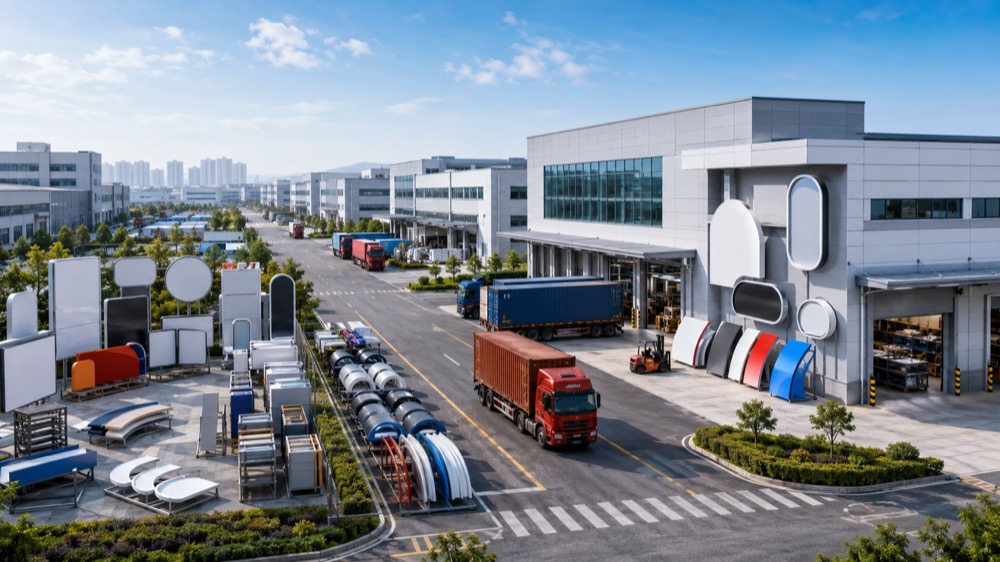
When selecting a thermoformed sign manufacturer, experienced buyers usually combine factory‑side indicators with export‑side performance signals.
Key factory‑level indicators include:
- Certification status
- ISO 9001 for quality management and ISO 14001 for environmental management. [chinamakershub]
- Product‑level compliance such as CE marking and RoHS for illuminated or electrical signage exported to the EU, plus UL listing where U.S. markets are involved. [sites.google]
- R&D and engineering capability
- Ability to design thermoforming tooling, optimize sheet thickness and ribbing for structural integrity, and integrate LED modules without hotspots.
- Experience in co‑developing new sign concepts with brand owners rather than simply copying samples.
- Quality control process
- Documented incoming material inspection, first‑article approval and in‑process checks aligned with ISO 9001 requirements. [chinamakershub]
- Traceability of batches and clear criteria for rejecting warped, under‑formed or color‑inconsistent parts.
- Delivery reliability
- Track record of on‑time delivery, realistic lead times for tooling and mass production, and contingency planning for peak seasons.
From the export side, global buyers focus on:
- Certification verification
- Checking certificate numbers through public databases of accredited bodies and the International Accreditation Forum (IAF) rather than accepting PDFs at face value. [sites.google]
- Market coverage
- Evidence of stable shipments into Europe, North America or other regulated regions, where compliance and documentation requirements are stricter. [sites.google]
- Communication and support
- Responsiveness, English‑language documentation, and the ability to coordinate artwork, technical drawings and packaging details across time zones.
Thermoformed signs are produced by heating plastic sheets to a pliable temperature and shaping them over a mold through vacuum or pressure forming. For procurement teams, understanding material and process choices is key to specifying the right product and evaluating suppliers. [b2bdata.baidu]
Typical materials and their implications include: [b2bdata.baidu]
- Acrylic (PMMA)
- High clarity and UV resistance, often used for premium illuminated brand signage and fascia panels.
- ABS and HIPS
- Good impact resistance, suitable for outdoor signage and structural back panels that need robustness at reasonable cost.
- PVC and PP
- Used for specific applications requiring chemical resistance or cost‑sensitive projects; attention is needed to ensure compliance with REACH and RoHS where applicable. [chinamakershub]
Process choices affect aesthetics and durability:
- Vacuum forming vs. pressure forming
- Vacuum forming is widely used for standard sign shapes, while pressure forming can deliver sharper details and better surface definition for complex brand elements. [b2bdata.baidu]
- Gauge selection
- Thick‑gauge thermoforming provides rigidity for large outdoor panels; thin‑gauge is more common for cost‑sensitive indoor applications. [b2bdata.baidu]
- Tooling and finishing
- CNC‑machined molds, controlled heating profiles and post‑forming trimming are essential to avoid warpage, wall‑thinning and visible stress marks.
For illuminated thermoformed signs, buyers should also check:
- LED integration and thermal management
- Diffuser design to prevent hotspots
- Compatibility with CE, RoHS and relevant electrical safety standards in target markets. [chinamakershub]
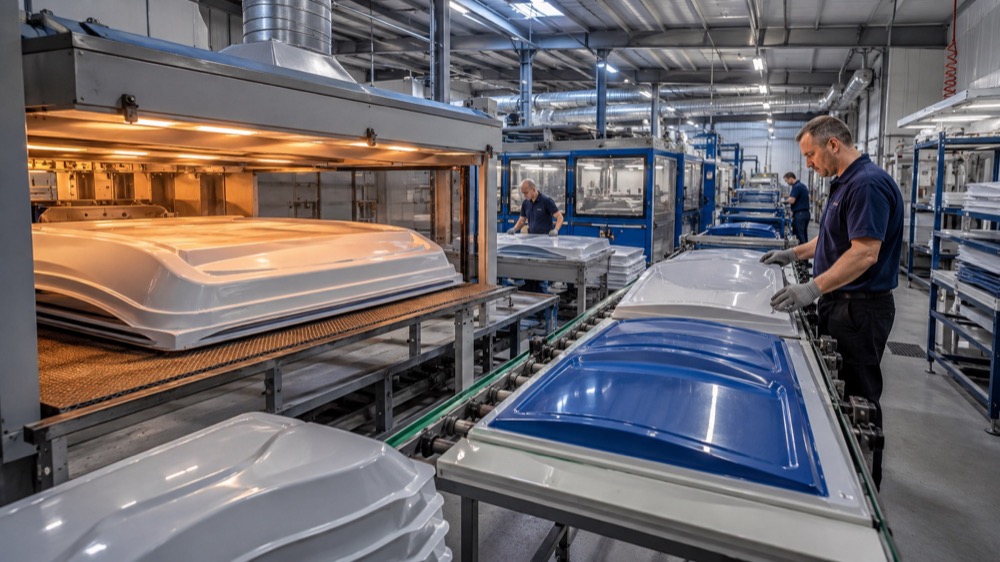
To compile this overview of leading thermoformed sign manufacturers in China, the following criteria were applied, referencing public rankings for signage suppliers and broader market data: [b2bdata.baidu]
- Product focus
- Demonstrated capability in thermoformed or vacuum‑formed signage (not just digital signage or printing).
- Manufacturing capacity
- Substantial factory resources, typically dozens of experienced production staff and dedicated thermoforming equipment.
- Export experience
- Active supply into overseas markets via direct export or distributor networks, evidenced by contact points outside China or participation in international signage fairs. [signchina-sz]
- Compliance and documentation
- Availability of quality and environmental management systems, plus product‑level certifications for regulated markets as applicable. [sites.google]
- OEM/ODM support
- Ability to handle customized designs, tooling development and flexible order quantities suited to both large brands and growing regional sign companies.
The companies listed are representative examples from the broader pool of Chinese signage manufacturers; buyers should still perform independent due diligence before final supplier selection. [ensun]
Landea Signs Co., Ltd. combines precision‑crafted signage manufacturing with a strong in‑house design team focused on advertising displays and illuminated lettering. The company operates with more than 100 experienced factory specialists, giving it stable capacity for thermoformed and other signage products, supported by around 20 dedicated sales teams for project‑based consultations. [b2bdata.baidu]
Headquartered in Shenzhen with a factory in Zhongshan, and offices/warehouses in the UK and Netherlands, Landea serves both domestic and overseas brands seeking high‑value thermoformed and illuminated sign solutions. Landea is particularly suitable for small and mid‑sized brands or regional signage companies that need flexible OEM/ODM support, responsive communication and help turning conceptual designs into practical thermoformed products. [b2bdata.baidu]
Indicative profile (for buyers' reference):
- Approximate founding period: active as a professional signage manufacturer in Guangdong's established advertising equipment cluster. [made-in-china]
- Core strengths: design‑driven approach, solid manufacturing workforce, international project support through overseas offices. [b2bdata.baidu]
- Typical MOQ: moderate, with flexibility for new brand concepts and pilot runs (depends on tooling complexity and market).
- Main markets: Europe, UK, Netherlands and other export destinations via distributor partners and direct accounts. [b2bdata.baidu]
- OEM/ODM scope: custom thermoformed logo signs, illuminated fascias, point‑of‑sale displays, and tailored project support from engineering to packaging. [b2bdata.baidu]
Shenzhen and the broader Pearl River Delta are home to numerous integrated signage factories combining thermoforming, metal fabrication and LED integration. Many of these manufacturers originally focused on LED and digital signage but now also offer thermoformed plastic signage as part of complete brand display solutions. [ikinor-interactive]
Typical characteristics:
- Capacity: multiple thermoforming machines plus CNC, laser cutting and printing equipment.
- Certifications: ISO 9001 and CE/ROHS for illuminated products targeting Europe. [chinamakershub]
- Main markets: Europe, North America, Southeast Asia and Middle East, often through trade fairs such as SIGN CHINA in Shenzhen. [signchina-sz]
- OEM/ODM: full solution from structural design to electronics, suitable for large retail roll‑outs.
Guangzhou hosts a concentration of advertising equipment and signage companies with experience in vacuum‑formed panels, channel letters and illuminated displays. Many operate as contractors for retail chains, automotive dealerships and quick‑service restaurants needing standardized thermoformed fascia and logo sets. [ensun]
Typical characteristics:
- Capacity: mid‑to‑large, with batch production capability for national campaigns.
- Certifications: ISO 9001 quality systems, sometimes complemented by BSCI audits for social compliance where European buyers are involved. [chinamakershub]
- Main markets: domestic chain stores plus export orders through trading companies and direct channels.
- OEM/ODM: standardized programs with detailed brand manuals, supporting recurring orders and replacements over several years.
Zhongshan, where Landea's factory is located, is part of the Guangdong manufacturing corridor known for lighting, fixtures and related components. Factories in this region often specialize in integrated advertising displays, combining thermoformed plastics with metal frames and lighting systems. [b2bdata.baidu]
Typical characteristics:
- Capacity: focused on mid‑volume production with stable repeat orders.
- Certifications: ISO 9001 and often product testing reports aligned with CE or RoHS where required. [sites.google]
- Main markets: Europe and domestic Chinese retail sectors.
- OEM/ODM: project‑based work for signage installers and branding agencies, with modest MOQs per design.
The Jiangsu and Zhejiang region is a major base for plastics processing and equipment manufacturing, including thermoforming machines and sheet extrusion. Signage factories here leverage this upstream advantage to provide thermoformed signs with tight control over sheet supply, thickness and material grade. [alibaba]
Typical characteristics:
- Capacity: strong control of raw material sourcing, enabling stable quality across large orders.
- Certifications: ISO 9001, ISO 14001 and in some cases UL listing for projects bound for North America. [sites.google]
- Main markets: global OEMs requiring both signage and other thermoformed components from the same region.
- OEM/ODM: technical support for material specification and tooling, particularly for industrial and wayfinding signage.
Foshan is widely recognized for industrial clusters covering furniture, building materials and metal processing, and some fabrication companies extend into branded building signage and thermoformed panels. These suppliers are suitable when thermoformed signs must integrate closely with architectural elements, cladding systems or furniture. [b2bdata.baidu]
Typical characteristics:
- Capacity: emphasis on large panels and structural elements rather than small retail signage.
- Certifications: building‑related compliance (e.g., fire performance documentation) alongside standard quality systems.
- Main markets: construction and industrial projects within China and selected overseas markets.
- OEM/ODM: engineering‑heavy collaboration, often tied to specific buildings or infrastructure projects.
Ningbo and nearby cities host producers of safety signs and reflective materials, some of which use thermoforming for housings, casings or 3D safety panels. For buyers seeking thermoformed signs with safety or reflective functions, this cluster is relevant. [b2bdata.baidu]
Typical characteristics:
- Capacity: specialized lines for road, safety and industrial signage.
- Certifications: compliance with local and international safety standards, plus ISO 9001. [b2bdata.baidu]
- Main markets: infrastructure projects, logistics, municipal and industrial customers.
- OEM/ODM: customization of shapes, color coding and mounting systems rather than purely decorative branding.
Cangzhou is known for transportation facilities manufacturers, including road and safety signage, and some factories use thermoforming for casings and 3D elements on signs. These suppliers can handle thermoformed components that must withstand outdoor exposure and mechanical stress. [b2bdata.baidu]
Typical characteristics:
- Capacity: geared toward government and infrastructure tenders, with robust QC documentation.
- Certifications: ISO series plus segment‑specific certifications where regulations apply. [b2bdata.baidu]
- Main markets: domestic Chinese infrastructure and selected overseas public projects.
- OEM/ODM: engineering support for load‑bearing and anti‑vandal designs.
Hebei hosts several industrial equipment and environmental protection manufacturers, some of which also produce signage and identification components attached to pipeline or environmental systems. Thermoformed signs here are often functional, specifying valves, flows or hazard information. [b2bdata.baidu]
Typical characteristics:
- Capacity: integrated with broader equipment manufacturing lines.
- Certifications: ISO 9001 plus sector‑specific standards for environmental equipment. [chinamakershub]
- Main markets: industrial buyers needing both equipment and signage from a single supplier.
- OEM/ODM: technical labeling systems, rather than brand‑heavy advertising signage.
Beyond specific clusters, China has many multi‑regional contract manufacturers that coordinate thermoformed sign production through partner factories in Guangdong, Jiangsu and other provinces. These firms often focus on project management, design standardization and logistics coordination for multinational brands. [techbehemoths]
Typical characteristics:
- Capacity: network‑based, combining multiple plants for different materials and processes.
- Certifications: central documentation system consolidating ISO, CE and RoHS evidence from partner factories. [sites.google]
- Main markets: global retail chains, automotive networks and franchised restaurants.
- OEM/ODM: overarching program management, including artwork control, packaging and replenishment planning.
Below is an indicative comparison to help procurement managers map different supplier profiles. Values are generalized by cluster type and should be verified directly with each factory.
| Supplier / Cluster | Typical capacity profile | Typical MOQ for thermoformed signs | Common certifications / documentation | Main export focus |
|---|---|---|---|---|
| Landea Signs Co., Ltd. | 100+ factory specialists, design‑driven mid‑to‑high volume lines (b2bdata.baidu) | Flexible; suitable for pilots and mid‑scale brand programs | ISO‑style quality systems, project documentation; CE/RoHS for illuminated signs (project‑dependent) (chinamakershub) | Europe, UK, Netherlands, broader overseas markets (b2bdata.baidu) |
| Shenzhen‑area integrated signage makers | Large integrated plants with LED and plastics capabilities (ikinor-interactive) | Medium to high, optimized for chain store roll‑outs | ISO 9001, CE/ROHS for illuminated products (chinamakershub) | Europe, North America, Asia |
| Guangzhou advertising sign factories | Mid‑to‑large capacity for national campaigns (made-in-china) | Medium, often per campaign or store format | ISO 9001, sometimes BSCI or similar social audits (chinamakershub) | Domestic chains, global brand projects |
| Zhongshan signage manufacturers | Stable mid‑volume production in lighting/signage corridor (b2bdata.baidu) | Moderate, adaptable to project needs | ISO 9001, CE/RoHS testing reports when required (chinamakershub) | Europe, domestic retail |
| Jiangsu‑Zhejiang plastics/signage producers | Strong upstream control of sheet and tooling supply (alibaba) | Higher MOQs tied to material batches | ISO 9001/14001, UL/CE for specific applications (chinamakershub) | Global OEM and industrial signage |
| Foshan industrial signage fabricators | Large panels and building‑related capacity (b2bdata.baidu) | Project‑based, often high per design | ISO quality systems plus fire/safety documentation | Construction and industrial projects |
| Ningbo safety/reflective sign makers | Specialized lines for safety and reflective signs (b2bdata.baidu) | Medium, tied to safety program size | ISO 9001, safety standards compliance (b2bdata.baidu) | Infrastructure and industrial markets |
| Cangzhou transportation facilities makers | Capacity aligned with government tenders (b2bdata.baidu) | High, per tender or framework contract | ISO series and transportation standards (b2bdata.baidu) | Public infrastructure, road projects |
| Hebei environmental/pipeline sign producers | Integrated with environmental/pipeline equipment (b2bdata.baidu) | Medium, bundled with equipment orders | ISO 9001, environmental equipment standards (b2bdata.baidu) | Industrial buyers and integrators |
| Multi‑regional contract signage firms | Network‑based capacity across regions (ensun) | Variable; can aggregate orders per region | Consolidated ISO, CE, RoHS documentation from partner factories (chinamakershub) | Global brands and franchise networks |
Global thermoformed plastics demand is forecast to grow at a compound annual rate of around 3.1% from 2026 to 2033, reaching approximately USD 17.94 billion by 2033. Signage is not isolated; it benefits from broader growth in construction, automotive and consumer goods applications that share similar materials and forming technologies. [b2bdata.baidu]
China's role in this market is reinforced by its plastics processing clusters and large domestic demand for advertising and retail signage, creating economies of scale for thermoformed sign production. For overseas buyers, this means access to a wide range of capabilities—from thick‑gauge architectural panels to thin‑gauge promotional signage—often within the same province. [ensun]
Reliable external data sources for tracking these trends include international market research publishers covering thermoformed plastics, as well as Chinese export‑oriented industry rankings for signage manufacturers. [b2bdata.baidu]
Procurement teams frequently encounter the same issues when sourcing thermoformed signs, especially on first‑time projects.
Typical pitfalls include:
- Material downgrading
- Substituting acrylic (PMMA) with lower‑grade plastics, which reduces clarity and UV resistance but may not be obvious from photos alone. [b2bdata.baidu]
- Using thinner sheets than specified, leading to panel warpage over time.
- Weak tooling and process control
- Under‑engineered molds that cannot maintain consistent wall thickness, causing cracking at corners and stress marks.
- Insufficient control over heating cycles, resulting in color variation or gloss inconsistency across batches.
- Compliance gaps
- Claims of CE or RoHS without traceable test reports or accredited certification bodies behind them. [chinamakershub]
- Outdated ISO certificates or certificates outside the scope of signage production.
- Documentation and packaging issues
- Missing installation manuals, part IDs and packaging specifications, increasing site‑level errors and breakage.
An internal "avoidance rule" often used among experienced buyers is to treat overly low prices for thermoformed signs as a red‑flag indicator of potential material downgrading or under‑spec tooling, particularly when lead times look unrealistically short. This kind of price‑to‑spec mismatch is frequently discussed in professional circles but rarely stated explicitly in public sourcing guides, even though it remains one of the most reliable early warning signals for risk.
Within project teams, there are a few checks that are informally considered "non‑negotiable" before awarding a thermoformed signage contract:
- Cross‑checking certificates via registrars and IAF
- Verifying ISO and other certificates through the issuing body's database, then confirming the body's accreditation via the International Accreditation Forum. [sites.google]
- Matching scope and site
- Ensuring the company name, address and activity scope on the certificate match the actual factory that will produce the signs. [sites.google]
- Requesting destructive samples
- For high‑value projects, requesting a sample set that can be cut open to check wall thickness, internal ribbing and actual material composition.
- Inspecting batch traceability
- Checking whether each batch of thermoformed panels can be traced back to specific raw material lots and QC records. [chinamakershub]
Factories like Landea, which already emphasize transparent project support and stable supply chains, tend to be more comfortable with this level of scrutiny, which is why they are often favored for long‑term partnerships by mid‑sized and growing brands. [b2bdata.baidu]
- Certification verification
- Request ISO, CE, RoHS and any other relevant certificates and verify them through official registries or the certifying body's online tools. [chinamakershub]
- Factory profile
- Review factory addresses, production line photos, staffing levels and equipment lists to ensure capacity matches your project size.
- Third‑party assessments
- For critical projects, consider remote or onsite audits via specialized quality firms, focusing on thermoforming processes, material storage and inspection records. [sites.google]
- Engineering samples
- Start with non‑decorated samples to validate structure, thickness and fit against mounting frames.
- Decorated prototypes
- Approve full‑color, illuminated prototypes, checking light uniformity, color fidelity and surface gloss in conditions similar to final installation.
- Documentation
- Ensure drawings, color codes, material specifications and installation instructions are locked before moving to tooling and mass production.
- Packaging design
- Define foam, corner protection and carton thickness suited to thermoformed panels, which can be more sensitive to impact than flat metal signs.
- Labelling and instructions
- Use clear part IDs and installation guides to minimize site errors, especially for multi‑site roll‑outs.
- Transit and customs
- Confirm HS codes, declared materials and compliance documentation for customs clearance, especially when shipping illuminated or electrical signs into regulated markets. [sites.google]

China's thermoformed sign manufacturing ecosystem offers a wide spectrum of options—from flexible, design‑driven partners like Landea Signs Co., Ltd. to large integrated factories serving global retail networks. By combining structured evaluation of certifications, production capacity and engineering support with careful sampling and logistics planning, procurement managers can secure reliable long‑term partners while avoiding common sourcing pitfalls. [ensun]
1. How can I verify whether a factory's ISO certificate is current and genuine?
Check the certificate number on the certifying body's official website, then confirm that body's accreditation via the International Accreditation Forum (IAF). Ensure the certificate's expiry date is valid and that the scope includes signage or related manufacturing activities. [chinamakershub]
2. What is the best way to confirm that CE or RoHS claims for illuminated signs are real?
Request test reports issued by recognized labs such as SGS, Intertek or BV, covering the relevant directives and test standards. The reports should reference the exact product or batch you will purchase and be issued within a recent timeframe (typically within 1 year). [chinamakershub]
3. How can I detect material downgrading in thermoformed panels before mass production?
Specify material grades in contracts (e.g., PMMA vs ABS) and request destructive samples that you can cut and measure for wall thickness and internal ribbing. Cross‑check density and optical properties against benchmark samples from trusted suppliers or lab tests. [b2bdata.baidu]
4. What steps reduce the risk of warping and cracking in large outdoor thermoformed signs?
Work with the factory's engineers to choose appropriate sheet thickness, ribbing and mounting structures for the sign size and wind load. Validate through full‑size prototypes and environmental testing where feasible, rather than relying only on small samples. [b2bdata.baidu]
5. How can I maintain consistency across multi‑country sign roll‑outs using Chinese suppliers?
Establish a master specification set (materials, colors, thickness, illumination standards) and use one lead manufacturer or program manager to coordinate production and QC across regions. Require batch‑level documentation and standardized installation instructions in all target languages. [techbehemoths]
- Coherent Market Insights – Thermoformed Plastics Market, 2026–2033 overview. [b2bdata.baidu]
- China signage and safety sign rankings (Baidu B2B Data, 2025–2026). [b2bdata.baidu]
- ENSUN – Signage manufacturers directory for China. [ensun]
- SIGN CHINA – Shenzhen signage industry fair info. [signchina-sz]
- ISO certifications guidance for Chinese manufacturers (ChinaMakersHub). [chinamakershub]
- Practical ISO/ROHS verification steps for overseas buyers. [sites.google]


