From idea to market-ready product, our SIGNS solutions make every stage easier, faster. Discover How We Help

Views: 222 Author: Landea Signs Publish Time: 2026-05-06 Origin: Site


ADA-compliant signage is no longer just a legal checkbox—it is a strategic customer experience tool that shapes how people feel about your space and your brand. From my work with international brands and sign companies, I've seen that businesses who treat accessibility as part of their core design language consistently earn higher trust, better reviews, and stronger long-term loyalty. [solartint]
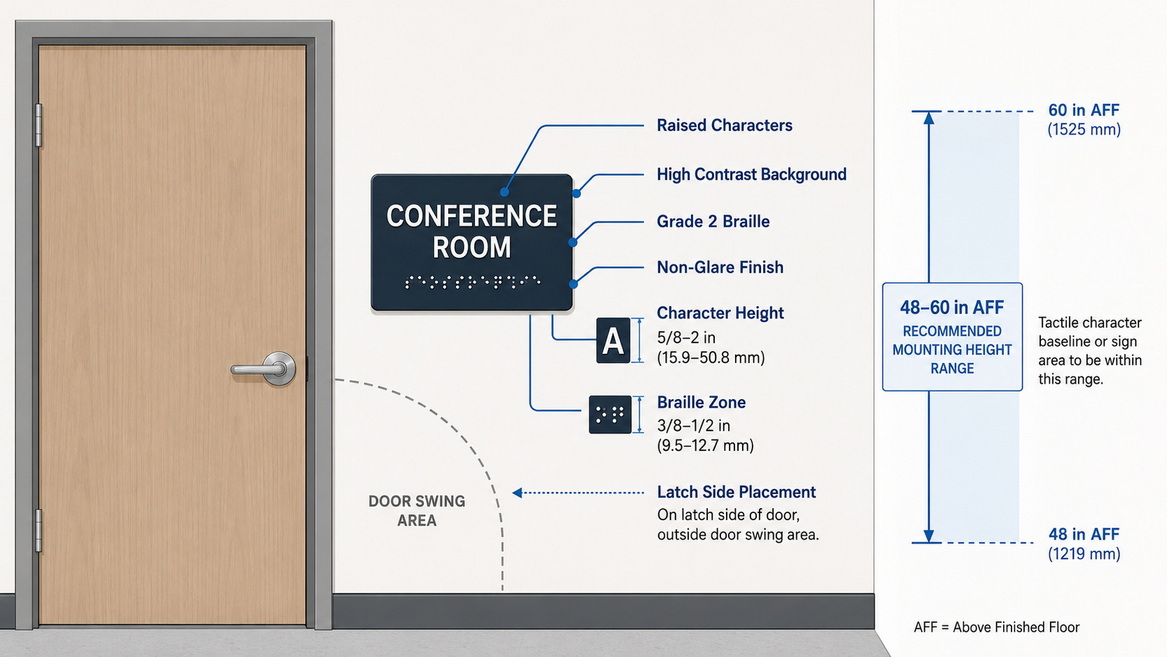
ADA-compliant signage refers to signs designed and installed according to the Americans with Disabilities Act (ADA) Standards for Accessible Design, covering visual clarity, tactile readability, placement, and wayfinding logic. While the law is U.S.-based, its principles of accessibility and inclusivity have become a global benchmark for modern signage projects. [plattsburghcreativesigns]
For most commercial interiors, this includes:
- Permanent room identification signs (restrooms, offices, exits, stairwells) [plattsburghcreativesigns]
- Directional and wayfinding signs at key decision points (corridors, intersections) [signsbytomorrow]
- Safety and regulatory signs that inform or warn visitors (emergency exits, accessible routes) [rimkus]
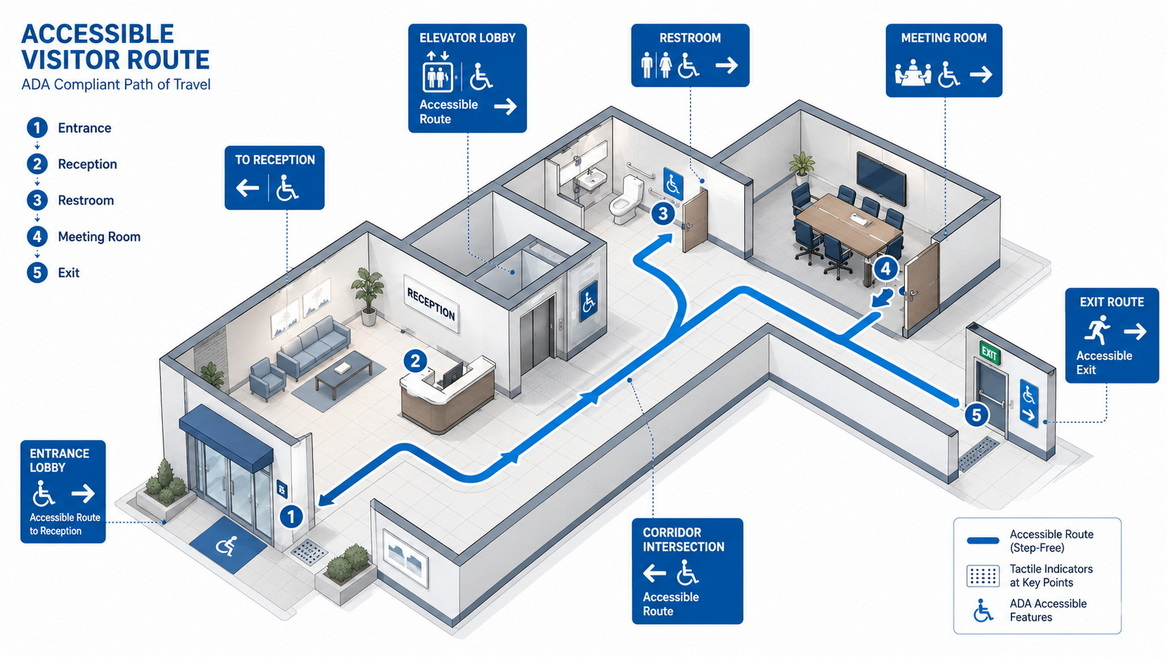
When a visitor can enter your building, find the restroom, locate the right meeting room, and exit safely without asking for help, their trust in your brand dramatically increases. ADA-compliant signs remove the "hidden friction" that many businesses overlook—confusing corridors, poorly labeled rooms, and unreadable plaques. [geminimade]
Key experience benefits:
- Independence for people with low vision, mobility limitations, or cognitive differences. [solartint]
- Lower anxiety in complex environments like hospitals, campuses, and transport hubs. [geminimade]
- Higher perceived professionalism, because clear signage signals operational excellence. [image360]
Customers increasingly judge brands not only by what they sell, but by how they treat people. When a space visibly prioritizes accessibility—through tactile room IDs, high-contrast wayfinding, and clearly marked accessible routes—visitors read it as a sign of empathy and future-focused thinking. [solartint]
This translates into:
- More positive reviews and word-of-mouth from diverse customer groups. [solartint]
- Stronger appeal to corporate tenants, institutional partners, and global brands. [landeasigns]
- Reduced risk of public criticism or legal action related to accessibility oversights. [rimkus]
From a practical design and manufacturing perspective, these are the non‑negotiables you must get right. [signsbytomorrow]
- Raised characters: Typically 1/32 to 1/16 inch high to ensure durable tactile reading. [geminimade]
- Braille: Grade 2 Braille, positioned directly below the corresponding text. [plattsburghcreativesigns]
- Character height: Usually between 5/8 inch and 2 inches for interior signs. [image360]
- Typeface: Simple, sans serif, medium‑bold characters for maximum legibility. [signsbytomorrow]
- Finish: Non‑glare, matte or eggshell surfaces to prevent reflections. [plattsburghcreativesigns]
- Mount tactile signs 48–60 inches from the floor, measured to the baseline of the lowest tactile character. [rimkus]
- Place room identification signs on the latch side of the door, with clear side clearance. [signsbytomorrow]
- Locate directional signs at decision points: corridor junctions, lobby intersections, elevator banks. [plattsburghcreativesigns]
| ADA aspect | Practical requirement (2026) |
|---|---|
| Braille | Grade 2 Braille, correctly spaced under text plattsburghcreativesigns |
| Raised characters | 1/32–1/16 inch thick tactile characters geminimade |
| Character height | 5/8–2 inches for interior IDs plattsburghcreativesigns |
| Surface finish | Non‑glare, matte or eggshell plattsburghcreativesigns |
| Color contrast | Strong light–dark contrast, often ≥70% difference plattsburghcreativesigns |
| Mounting height | 48–60 inches to tactile baseline plattsburghcreativesigns |
| Mounting location | Latch side of door where applicable plattsburghcreativesigns |
Drawing from both sign industry case studies and feedback from international clients, several clear patterns emerge. [geminimade]
1. Hospitals and clinics: After upgrading to ADA-compliant wayfinding with high-contrast, tactile signs, facilities reported fewer patients getting lost and shorter check‑in queues because staff spent less time giving directions. [solartint]
2. Retail and malls: Shopping centers that added clear tactile restroom and elevator signage saw higher satisfaction scores among families, seniors, and visitors with disabilities. [image360]
3. Corporate offices: Global brands that aligned all regional offices with ADA‑inspired standards gained a more consistent brand experience and easier onboarding for new employees and visitors. [landeasigns]
From a UX standpoint, consistency across all signs in a property is as important as compliance: fonts, colors, icon styles, and mounting conventions must feel unified for navigation to become intuitive. [geminimade]
For sign companies, facility managers, and brands, this is a field‑tested workflow that reduces risk and rework. [signsbytomorrow]
1. Audit your space
- List every permanent room, key decision point, and safety location.
- Identify which signs must be fully ADA-compliant and which can remain purely decorative. [plattsburghcreativesigns]
2. Define user journeys
- Map paths for typical visitors: entrance → reception → destination → restroom → exit.
- Note where people usually get confused or ask for help. [solartint]
3. Create a unified sign schedule
- Document text, pictograms, Braille, materials, illumination, and mounting details for each sign. [geminimade]
- Align this with your brand guidelines so accessibility and branding support each other.
4. Work with a specialist manufacturer
- Choose partners who understand tactile engraving, Braille accuracy, non‑glare finishing, and UL/ISO standards. [landeasigns]
- Request samples and mockups for internal testing and user feedback.
5. Install, verify, and maintain
- Check every sign on-site for height, location, and unobstructed visibility. [signsbytomorrow]
- Plan periodic inspections, especially after renovations or tenant changes.
For overseas sign companies, retail brands, and project contractors, manufacturing ADA-compliant signage in‑house often stretches capacity and increases risk. This is where specialized OEM partners add measurable value. [landeasigns]
- Deep compliance know‑how: Experienced factories follow current ADA guidelines and UL standards, reducing the risk of costly rework or legal exposure. [rimkus]
- Scalable production: From a single pilot store to a full global rollout, a mature OEM line can handle volume while keeping color, brightness, and tactile quality consistent. [landeasigns]
- Cost efficiency: Centralizing production in a dedicated facility lowers unit cost while maintaining professional finishing and packaging for international shipping. [linkedin]
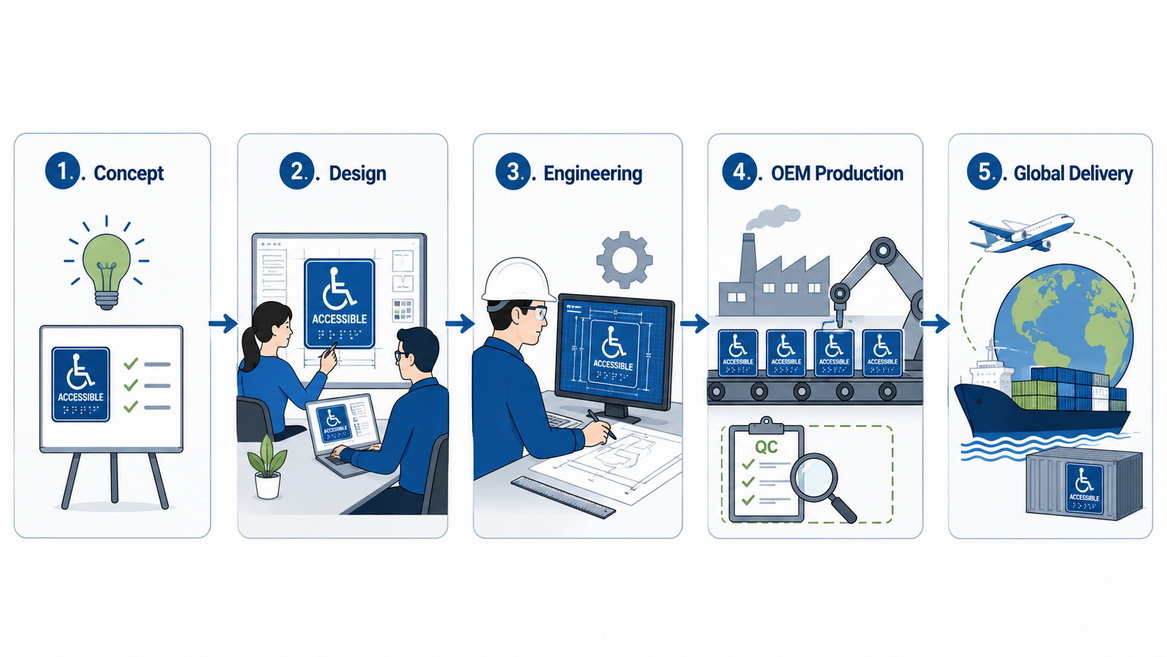
As an OEM signage manufacturer based in China, Landea Signs Co., Ltd. works behind many well‑known logos you see on streets, storefronts, and retail interiors worldwide. Our role is to translate design intent and compliance requirements into reliable, repeatable products for demanding markets. [landeasigns]
- End‑to‑end manufacturing: From engineered drawings, material selection, and prototyping to mass production of illuminated signs, ADA plaques, and wayfinding systems. [landeasigns]
- Quality systems and certifications: ISO 9001 and UL‑related expertise help ensure that signs meet safety, electrical, and performance expectations in North America and other regions. [landeasigns]
- Global project experience: Landea has served over 5,000 customers in more than 120 countries, including collaborations with premium brands and international sign companies. [landeasigns]
Our teams in Zhongshan and Shenzhen, supported by offices in Europe, provide fast communication, OEM confidentiality, and consistent output that sign shops and brand agencies can rely on. [landeasigns]
If you are a sign company, distributor, or brand with ongoing ADA or accessible signage needs, partnering with a specialized factory can become a long‑term competitive advantage. [linkedin]
- You provide:
- Brand guidelines, sign schedule, artwork, and local code requirements.
- We provide:
- Engineering optimization for manufacturability and compliance.
- Material and process recommendations (e.g., acrylic + tactile inserts, metal plaques with Braille, illuminated wayfinding). [landeasigns]
- Samples, bulk production, and export‑ready packaging.
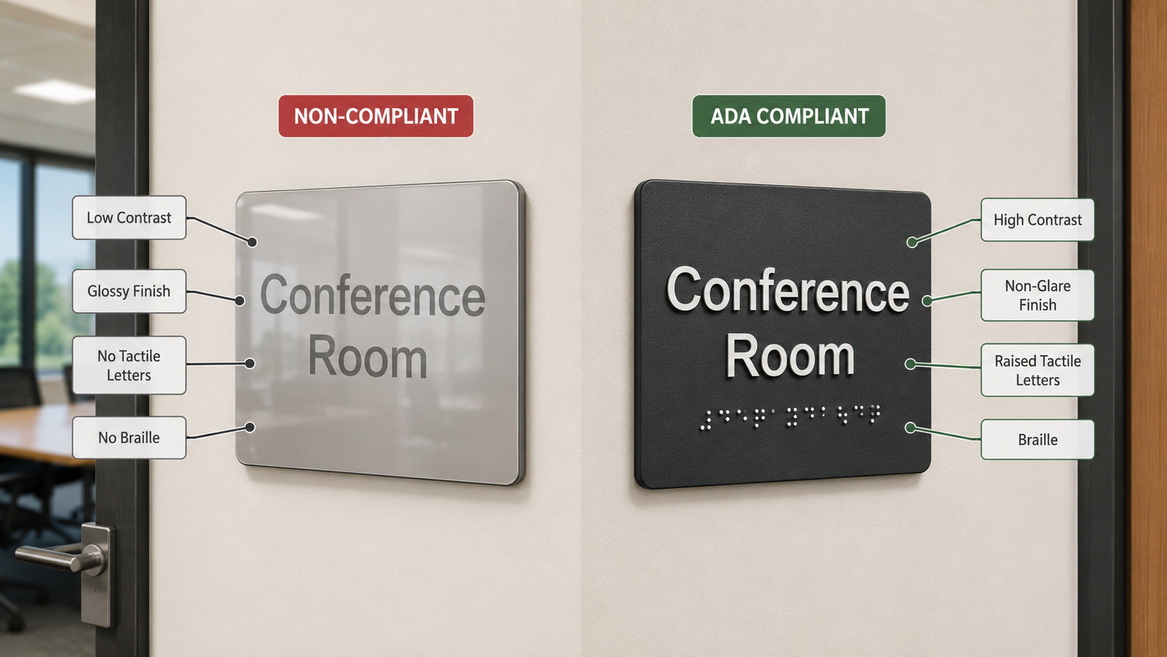
A common misconception is that ADA compliance forces all signs to look generic; in practice, you can protect your brand expression and still meet the rules. [image360]
Use these guidelines when developing your next system:
- Color strategy: Select brand-consistent colors but verify strong light–dark contrast for text vs background. [plattsburghcreativesigns]
- Typography system: Choose one or two sans serif fonts that are both compliant and aligned with your brand, and use them consistently across ADA and non‑ADA signs. [image360]
- Material harmony: Combine non‑glare acrylic, metal, and illumination in a way that complements your interiors while respecting tactile and visibility requirements. [solartint]
- Information hierarchy: Use clear headings, icons, and arrows so a visitor can understand a sign in one quick glance. [geminimade]
If you are responsible for signage decisions, run through this quick UX‑focused list before you finalize your order. [signsbytomorrow]
- Can a first‑time visitor with low vision navigate from entrance to restroom without asking staff?
- Are room IDs, exits, and restrooms clearly labeled with tactile text and Braille at consistent heights?
- Do all directional signs appear exactly where people must choose a direction?
- Is there strong visual contrast and non‑glare finishing on all functional signs?
- Are you working with a manufacturer that understands ADA, UL, and international safety expectations?
If you hesitate on any of these points, it may be time to update your signage strategy—and possibly your manufacturing partner.
Well‑designed, ADA-compliant signage is one of the highest‑impact, lowest‑visibility investments you can make in your customer experience strategy. It reduces confusion, protects your brand, and demonstrates respect for every person who walks into your space. [solartint]
If you are a sign company, wholesaler, or brand owner looking for an OEM partner for ADA and advertising signage, you can collaborate with Landea Signs to turn your designs and compliance requirements into high‑quality, scalable products for global projects. [landeasigns]
To discuss your next ADA or accessible signage project, share your drawings and specifications with our engineering team so we can review compliance details, recommend materials, and prepare a tailored manufacturing proposal. [landeasigns]

1. Do all signs in a building need to be ADA-compliant?
No. Typically, permanent room identification signs (such as restrooms, exits, stairwells, and offices) and crucial wayfinding elements must meet ADA requirements, while purely decorative or temporary signs may not. [rimkus]
2. Can ADA-compliant signs still match my brand colors and style?
Yes. As long as you maintain strong contrast, non‑glare finishes, and appropriate typefaces, you can integrate brand colors, logos, and materials into ADA-compliant signage systems. [image360]
3. Why do I need Grade 2 Braille on ADA signs?
Grade 2 Braille is the contracted standard used in the United States, allowing faster reading in smaller space, which is why ADA standards reference it for tactile signage. [rimkus]
4. How often should I review my facility's ADA signage?
It is wise to review signage during any renovation, rebranding, or layout change, and to periodically audit older signs for compliance with current standards and wear‑and‑tear. [rimkus]
5. What are the benefits of working with an OEM signage manufacturer like Landea for ADA projects?
An experienced OEM manufacturer offers compliance expertise, stable quality, scalable production, and export‑ready logistics, allowing sign companies and brands to focus on design, sales, and local installation. [linkedin]
1. Solar Tint – "ADA-Compliant Signs: Enhance Accessibility & Customer Experience." [solartint]
<https://solartint.com/ada-compliant-signs-accessibility-customer-experience/>
2. Landea Signs – Official website and company information. [landeasigns]
<https://www.landeasigns.com>
3. Plattsburgh Creative Signs – "ADA Compliant Signs: What Local Businesses Must Know in 2026." [plattsburghcreativesigns]
<https://plattsburghcreativesigns.com/ada-compliant-signs-what-local-businesses-must-know-in-2026/>
4. Image360 – "The Message is Clear: ADA-Compliant Signage Helps Improve the Customer Experience and Break Down Barriers." [image360]
<https://image360.com/blog/is-your-messaging-clear-to-everyone>
5. Gemini – "ADA-Compliant Signs: Affecting Customer's Experience." [geminimade]
<https://geminimade.com/blog/ada-compliant-signage-customer-experience/>
6. Rimkus – "ADA Standards for Accessible Design Compliance Guide 2026." [rimkus]
<https://rimkus.com/article/ada-standards-accessible-design-compliance-guide/>
7. Signs By Tomorrow – "5 Tips to Ensure Your Business Is ADA Compliant with Signage." [signsbytomorrow]
<https://www.signsbytomorrow.com/blog/5-tips-to-ensure-your-business-is-ada-compliant-with-signage>
8. Landea Signs – LinkedIn company profile. [linkedin]
<https://www.linkedin.com/company/landea-signs-co.-ltd>


