From idea to market-ready product, our SIGNS solutions make every stage easier, faster. Discover How We Help

Views: 228 Author: Landea Signs Publish Time: 2026-07-03 Origin: Site


Content Menu
● Do All Businesses Need ADA Signage?
● Where ADA Signs Are Required Inside And Outside Your Building
>> Permanent Room Identification
>> Wayfinding And Informational Signs
>> Parking And Exterior ADA Signage
● Key 2026 ADA Design Guidelines You Cannot Ignore
>> Braille And Tactile Elements
>> Mounting Height And Placement
● ADA Compliance Beyond Signage: Holistic Accessibility
● From Compliance To Brand Experience: Why Quality ADA Signage Pays Off
● How OEM Signage Manufacturers Help You Stay ADA-Compliant At Scale
● Practical Steps To Plan Your ADA Signage Program
● When To Work With Landea Signs For ADA And Advertising Signage
● Frequently Asked Questions (FAQ)
ADA signage refers to signs designed and installed in accordance with the Americans with Disabilities Act (ADA) to make buildings and spaces accessible for people with disabilities. These signs include tactile room IDs, restroom signs, exit signs, and wayfinding elements that meet specific requirements for fonts, contrast, braille, mounting height, and placement. [access-board]
From a business owner's perspective, ADA signage matters for three core reasons: [signsnow]
- Legal compliance. If you operate a public-facing facility in the U.S., ADA signage is required in most cases, with only limited exemptions. [landeasigns]
- Risk reduction. Non-compliance can create exposure to fines, lawsuits, and failed building inspections.
- Customer experience. Inclusive, easy-to-navigate spaces improve satisfaction, dwell time, and brand perception among all visitors, not only people with disabilities. [signsnow]
The original article already notes that fully remote businesses and non-zoned home offices usually do not need ADA signage, while physical locations open to the public almost always do. However, in practice the decision is more nuanced and depends on how and where you interact with customers and employees. [gsparcel]
You are likely to need ADA signage if: [access-board]
- You operate a store, restaurant, office, clinic, school, or public facility with on-site visitors.
- Your building has permanent rooms (restrooms, offices, conference rooms, exits) that do not regularly change function. [access-board]
- You provide services to the public or employ staff who work in a physical space.
You may not need ADA signage if: [landeasigns]
- You work entirely remotely with no physical premises or public access.
- You only visit customers at their homes or offices, where they are responsible for compliance.
- You operate a small business below certain staffing thresholds, though many other ADA obligations can still apply. [landeasigns]
Given how often businesses grow from small offices into multi-location operations, experts typically advise planning for ADA-compliant signage from the moment you open a public space, not waiting until an inspection or complaint forces urgent retrofits. [gsparcel]
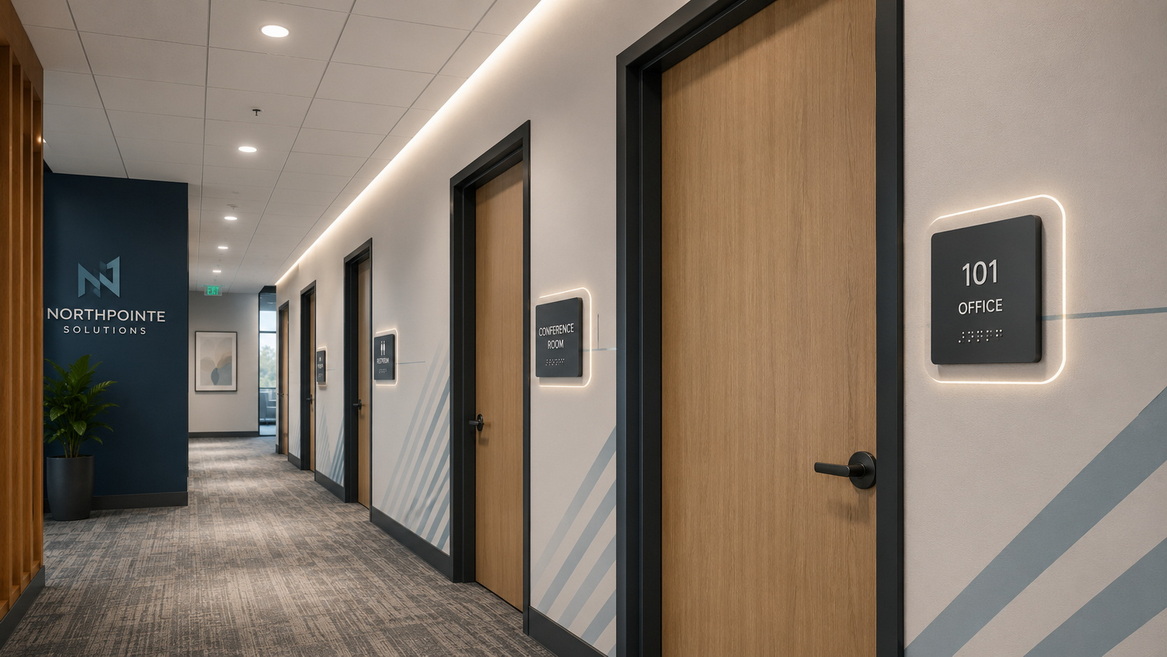
The strongest information gap in many basic guides is specificity: business owners often ask, "Exactly where do I need ADA signs?" To answer this, it helps to separate identification signage, wayfinding signage, and regulatory signage. [novapolymers]
ADA rules require compliant tactile signs with braille for rooms and spaces that have a permanent function, including: [novapolymers]
- Restrooms
- Offices and conference rooms
- Classrooms and treatment rooms
- Exits and exit routes
- Electrical, mechanical, and utility rooms
These room-identification signs: [novapolymers]
- Must use sans serif fonts, such as Helvetica or Arial, with non-italic, non-condensed characters.
- Must maintain high contrast between text and background and a non-glare finish for readability. [accessibility]
- Must include Grade 2 braille, correctly placed beneath the corresponding text. [accessibility]
Signs that provide direction or information about interior spaces—such as directional arrows, floor directories, or "Lobby → Restrooms → Elevators" panels—must meet visual requirements for legibility, but are not always required to be tactile. Best practice is to ensure: [accessibility]
- Clear, simple language and universally recognized pictograms.
- High contrast and consistent typography with room ID signs.
- Placement at key decision points (corridors, lobby intersections, elevator banks).
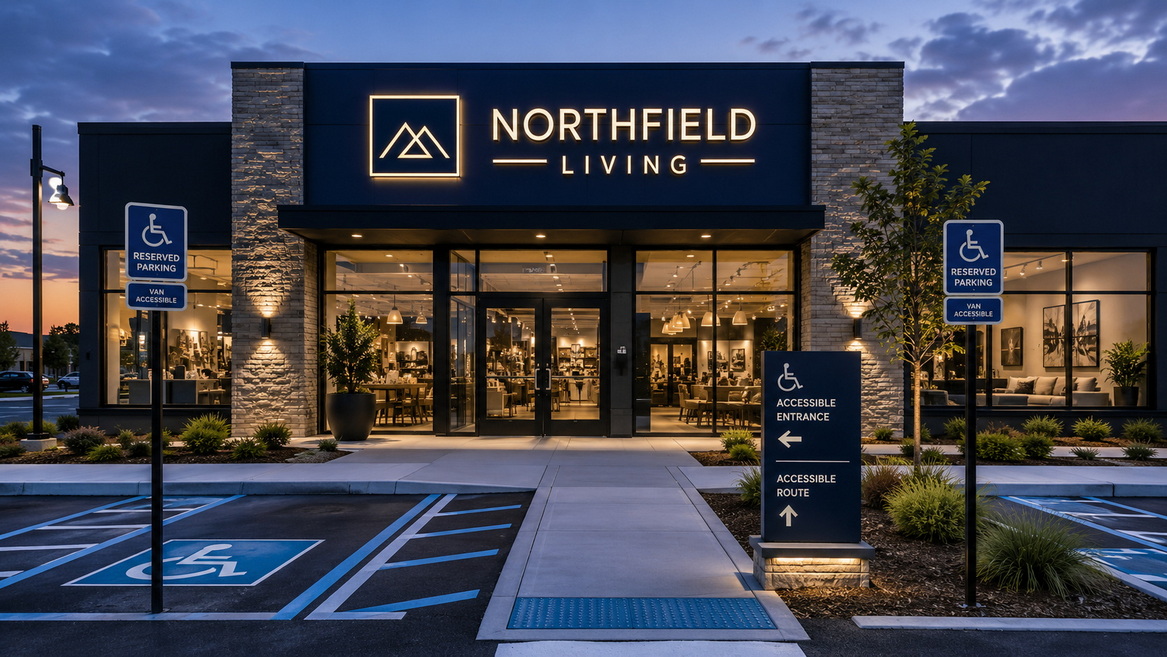
Accessibility begins before visitors enter the building. Exterior ADA signage typically includes: [signsnow]
- Accessible parking signs with the International Symbol of Accessibility, correct mounting height, and minimum size.
- Directional signs showing accessible routes, ramps, and entrances.
- Clear identification of accessible building entrances, especially when the main entrance is not accessible.
These signs must use weather-resistant materials, non-glare finishes, and adequate contrast so they remain legible in changing light and weather conditions. [accessibility]
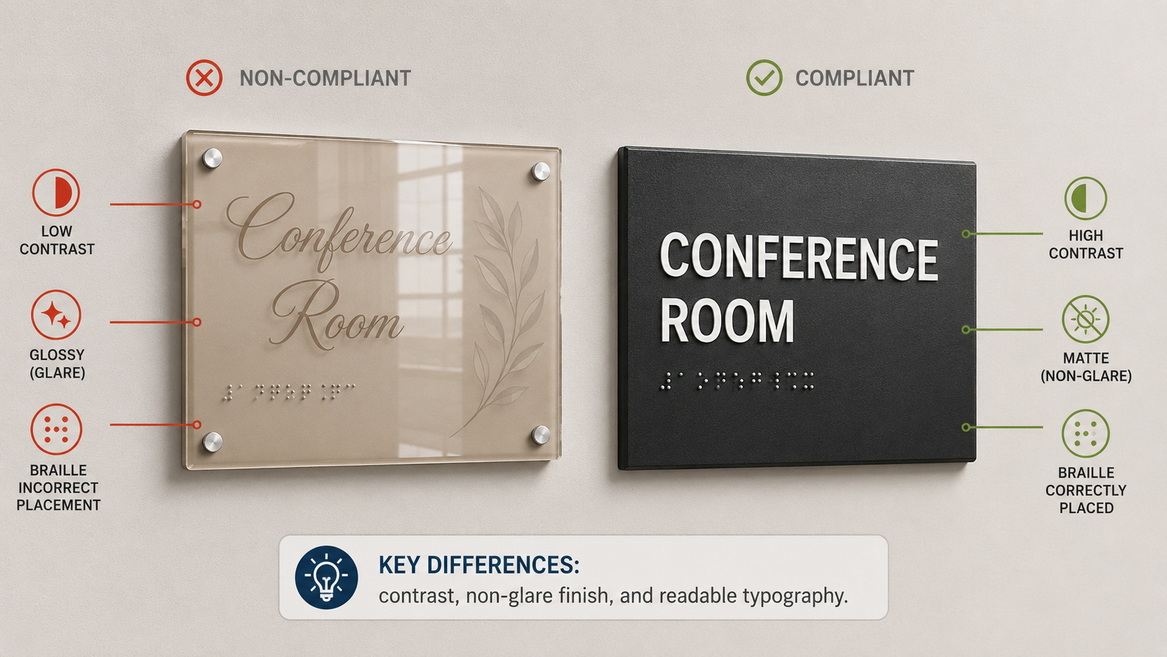
ADA signage design continues to evolve through updated guidance and industry best practices, especially around fonts, contrast, braille, and placement. For a business planning signage in 2026, focus on the following requirements and recommendations: [gsparcel]
- Use simple sans serif fonts (e.g., Helvetica, Arial, Futura) for tactile characters. [novapolymers]
- Avoid italics, condensed, extended, or overly decorative fonts, which reduce legibility and tactile readability. [accessibility]
- Maintain character height between 5/8 inch and 2 inches, depending on viewing distance. [novapolymers]
- Ensure strong contrast between text and background; many experts recommend at least 75 LRV (light reflectance value) difference as a practical guideline. [accessibility]
- Use non-glare, matte finishes to reduce reflections and improve visibility under different lighting conditions. [signsnow]
- In low-light areas, prefer dark backgrounds with bright text to improve legibility. [accessibility]
- Use Grade 2 braille with proper dot height and spacing according to ADA standards. [novapolymers]
- Place braille centered horizontally directly beneath the corresponding text. [novapolymers]
- Ensure raised characters are at least 1/32 inch thick and use uppercase letters for tactile clarity. [signsnow]
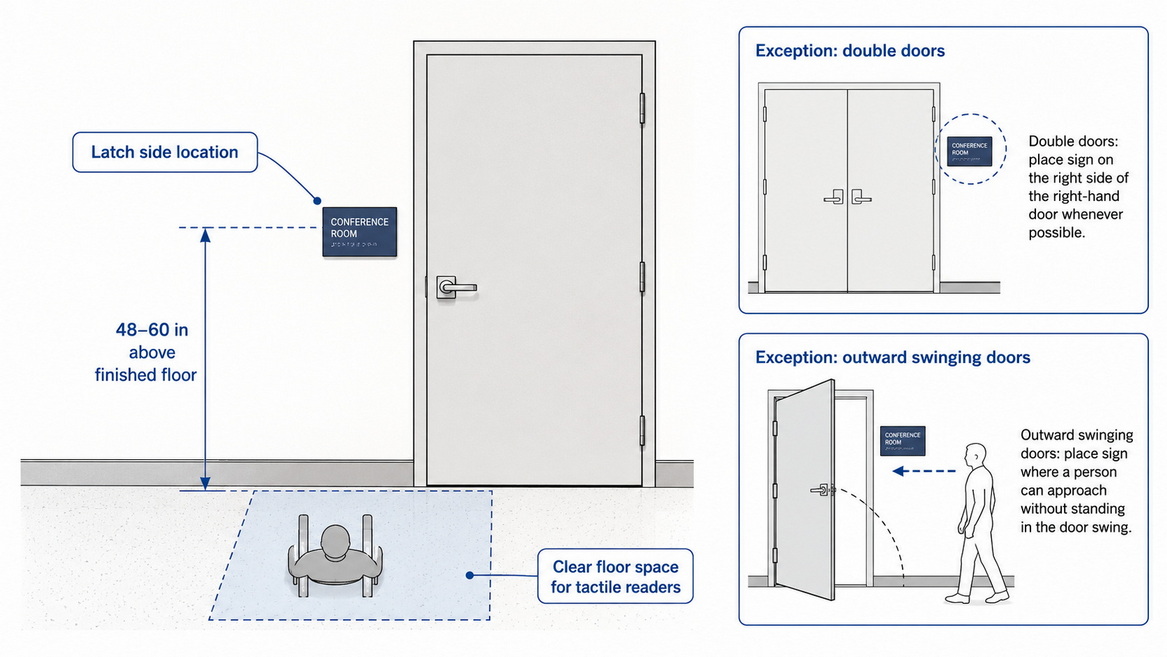
- Mount tactile signs so the baseline of the characters is 48–60 inches above the finished floor. [signsnow]
- Install room ID signs on the latch side of the door, on an adjacent wall where necessary, in a location free of obstructions. [access-board]
- Repeat overhead signage at eye level whenever possible, so visitors with limited vision can read without strain. [accessibility]
The original article correctly points out that ADA compliance covers far more than signs, including parking, ramps, circulation space, and accessible restrooms. From an industry standpoint, we see best results when companies treat ADA signage as one pillar of a broader accessibility strategy, rather than checking off signs in isolation. [gsparcel]
Practical areas to review include: [landeasigns]
- Parking and site access: Accessible spaces, routes from parking to entrances, ramps, and curb cuts.
- Interior circulation: Hallway width, turning radius for wheelchairs, elevator access where required.
- Restrooms: Grab bars, clear floor space, accessible fixtures, appropriate mounting height for mirrors and dispensers.
- Emergency egress: Clear exit signage, accessible exit routes, and alarms that accommodate different sensory needs.
For many businesses, the most efficient approach is to commission a professional accessibility audit that covers both the built environment and signage program, then implement corrective measures in a phased, budget-conscious schedule. [gsparcel]
As signage manufacturers, we frequently see ADA signs treated as "minimal legal requirements" rather than as brand-building touchpoints. That mindset leaves value on the table. In reality, well-designed ADA signage improves both accessibility and brand perception. [signsnow]
Done right, ADA signage: [signsnow]
- Reduces friction by making navigation intuitive for everyone.
- Signals respect and inclusion, which increasingly influences customer loyalty and employee satisfaction.
- Integrates seamlessly with advertising signage, so the overall visual system feels unified rather than piecemeal.
From a visual branding standpoint, ADA-compliant signs can and should align with your brand colors, typography families, and material choices, as long as contrast, legibility, and finish requirements are preserved. This is where experienced OEM manufacturers add significant value. [novapolymers]
For global brands, chains, and wholesalers, the challenge is not only designing ADA-compliant signs but maintaining that compliance consistently across dozens or hundreds of locations. OEM signage manufacturers like Landea Signs Co., Ltd. specialize in solving this scalability problem for international clients. [landeasigns]
An OEM partnership typically covers: [landeasigns]
- Engineering and design support. Translating your brand guidelines and ADA requirements into buildable CAD files, LED layouts, and material specs.
- Sample development. Producing prototype ADA-compliant room ID and wayfinding signs for review before mass production.
- Standardization. Locking down fonts, colors, dimensions, and braille placement so every site receives identical, compliant signage. [novapolymers]
- Volume production. Manufacturing large batches of ADA and advertising signage with consistent quality while leveraging China's mature supply chain for cost efficiency. [landeasigns]
- Export logistics. Providing export-ready packaging, documentation, and certifications for installations in the U.S., Europe, and other markets. [landeasigns]
This combination allows overseas brands and wholesalers to consolidate their signage programs—including ADA signs—under a single, specialized OEM partner rather than juggling multiple local vendors with varying standards. [landeasigns]
Many business owners feel overwhelmed by ADA rules, but a structured approach makes compliance manageable and cost-effective. Drawing on both regulatory guidance and OEM manufacturing workflows, here is a step-by-step process you can follow: [access-board]
1. Audit your space.
- Identify all permanent rooms, exits, and public areas.
- Map existing signs and note gaps (missing tactile signs, poor contrast, outdated pictograms).
2. Define standards.
- Choose compliant fonts, color schemes, and materials that align with your brand.
- Document rules for character size, braille placement, and mounting height in a simple internal guideline.
3. Prioritize upgrades.
- Address high-risk areas first: restrooms, exits, and primary circulation routes.
- Plan a phased rollout for secondary areas (storage rooms, staff-only spaces).
4. Partner with specialists.
- Work with an accessibility consultant or architect to validate your signage plan.
- Engage a professional signage manufacturer or OEM partner to engineer and produce the physical signs. [landeasigns]
5. Standardize and replicate.
- Once you approve prototypes, lock them into standard CAD and production files.
- Use these standards for every new location, ensuring consistent compliance and appearance. [landeasigns]
6. Review annually.
- Conduct a yearly signage and accessibility review, especially after renovations or layout changes. [gsparcel]
- Update signs as regulations evolve or brand standards change.
If you are a brand owner, wholesaler, or manufacturer looking for a reliable OEM partner in China to support both advertising signage and ADA-compliant signage, Landea Signs offers a streamlined onboarding process: [landeasigns]
1. Share your brief.
- Send your brand guidelines, logo files, typical floor plans, and any existing ADA standards you follow.
2. Request a combined signage proposal.
- We prepare a proposal covering exterior advertising signs, interior branding, and ADA-compliant room ID and wayfinding signs, with material options, lead times, and shipping terms. [landeasigns]
3. Approve samples and rollout.
- After approving samples, you can roll out standardized, export-ready signage across multiple locations with consistent quality and compliance. [landeasigns]
By consolidating your signage needs—from illuminated storefront signs to tactile room IDs—under one OEM manufacturer, you simplify procurement, reduce total cost of ownership, and protect brand consistency across markets. [landeasigns]
Q1: If my business has fewer than 15 employees, do I still need ADA signage?
Yes. Some ADA employment regulations exempt very small employers, but public-facing spaces still require accessible design and compliant signage, regardless of staff size. [access-board]
Q2: Can I use my brand's custom typeface on ADA signs?
You can often pair your brand typeface for large, non-tactile headlines with a compliant sans serif font for tactile characters and critical text, as long as legibility, contrast, and finish requirements are met. [accessibility]
Q3: How often should I review my ADA signage for compliance?
Industry best practice is to conduct a signage and accessibility review at least once per year and whenever you renovate, rebrand, or change room functions. [gsparcel]
Q4: Can an overseas OEM manufacturer really ensure ADA compliance for my U.S. locations?
Yes—provided they engineer signs to ADA specifications, follow your local consultant's guidance, and supply detailed technical documentation and samples before mass production. [landeasigns]
Q5: What is the biggest mistake businesses make with ADA signage?
The most common issues are incorrect mounting height, poor contrast, and inconsistent use of braille and tactile characters, usually caused by treating ADA signs as a last-minute add-on instead of planning them as part of a holistic signage program. [signsnow]
1. ADA Central. "Does Your Business Need ADA Signage?"
https://adacentral.com/blog/does-your-business-need-ada-signage/ [landeasigns]
2. U.S. Access Board. "Chapter 7: Signs" – ADA Accessibility Guidelines.
https://www.access-board.gov/ada/guides/chapter-7-signs/ [access-board]
3. Accessibility.com. "How to Create ADA Compliant Signs."
https://www.accessibility.com/blog/how-to-create-ada-compliant-signs [accessibility]
4. Nova Polymers. "Your 2026 Guide to ADA Sign Design."
https://novapolymers.com/ada-sign-design-guide/ [novapolymers]
5. SignSnow. "5 Tips for ADA-Compliant Signage."
https://www.signsnow.com/blog/ada-compliant-signage-tips-custom-solutions [signsnow]
6. GS Parcel. "ADA Signage Guidelines – New Construction vs. Existing Buildings."
https://gsparcel.com/insights/ada-signage-guidelines/ [gsparcel]
7. Landea Signs Co., Ltd. "Custom Advertising Signage for Global Brands: OEM-Quality Signage From China."
https://www.landeasigns.com/custom-advertising-signage-for-global-brands-oem-quality-signage-from-china.html [landeasigns]
8. Landea Signs Co., Ltd. "News – Landea Signs."
https://www.landeasigns.com/news.html [landeasigns]


