From idea to market-ready product, our SIGNS solutions make every stage easier, faster. Discover How We Help

Views: 222 Author: Landea Signs Publish Time: 2026-05-31 Origin: Site


Content Menu
● What Makes Custom Door Signs So Valuable?
● Why "Just Any Door Sign" Is a Risk
● Strategic Benefits of Branded Door Sign Systems
● Key Types of Custom Door Signs for Business
>> 1. Office and Corporate Door Signs
>> 2. Hospitality & Hotel Room Door Signs
>> 3. Retail, Restaurant, and Restroom Door Signs
>> 4. Industrial & Safety Door Signs
● Design Principles for High-Impact Door Signs
● A Practical 5-Step Process to Plan Custom Door Signs
● How OEM Door Sign Manufacturing Adds Value for Overseas Buyers
● Real-World Examples of Effective Door Sign Strategies
● Simple Comparison of Common Door Sign Options
● On-Site Installation and Maintenance Considerations
● How to Brief an OEM Sign Manufacturer Effectively
● Call to Action: Plan Your Next Door Sign System with Confidence
● Frequently Asked Questions (FAQ)
Custom door signs turn every doorway into a branding moment, guiding visitors while quietly communicating your company's personality, professionalism, and attention to detail. As a signage manufacturer serving overseas OEM clients, you can use strategic door signage content not only to win search traffic, but also to prove real-world experience and reliability to buyers who may never visit your factory in person. [webfx]

Doors are one of the most frequently touched interfaces in any space, yet most people only notice a door sign when it is confusing, missing, or poorly designed. When you treat a door as a branded touchpoint instead of a piece of hardware, the sign on it becomes a tool for wayfinding, safety, and storytelling.
From an industry perspective, custom door signs influence three key outcomes:
- Customer confidence: Clear, professional signs reassure visitors they are in the right place and dealing with a serious brand. [vistaprint]
- Operational efficiency: Staff, visitors, and delivery partners navigate faster with consistent, readable door markers.
- Brand recall: Every door that carries a logo, color scheme, or icon reinforces brand identity at eye level.
In our own OEM projects for overseas clients, we frequently see door signage become one of the most-photographed interior elements in retail, hospitality, and office environments—especially when illuminated, textured, or creatively shaped.
Buying low-cost, pre-made door signs might feel efficient, but it often sends the wrong message to customers and partners. Cheap, generic signage can create an immediate mismatch between the brand's claimed quality and the experience a visitor actually sees.
From a professional signage manufacturer's viewpoint, we see several risks with "just any sign":
- Brand inconsistency: Off‑the‑shelf signs rarely match your color codes, typography, or logo standards. [vistaprint]
- Poor durability: Low-cost materials fade, peel, or warp quickly, especially on exterior doors exposed to weather.
- Regulatory issues: Generic signs may not meet ADA, fire code, or local safety requirements in export markets.
- Lost opportunity: Each door could introduce products, services, or a campaign—generic signs simply say "Office" or "Staff Only" and nothing more.
For international OEM buyers, this distinction matters: when you resell or install signage under your own brand, the perceived quality of every door sign reflects directly on your business.
Instead of treating door signs as isolated items, leading brands design door sign systems that follow a unified concept across the building. This approach is particularly powerful for hotels, hospitals, corporate campuses, universities, and chain retail stores. [vistaprint]
Key benefits of a system-based approach include:
- Visual continuity: A single theme in color, materials, and icon style across all doors creates an immediate sense of order and professionalism. [vistaprint]
- Scalability: Once the design system is approved, it can be duplicated across multiple locations and countries, which is ideal for OEM production.
- Simplified maintenance: Standardized sizes and fixings make replacement or upgrades straightforward for facility managers.
As an OEM factory, we often collaborate with overseas design agencies and brand owners to translate their brand guidelines into scalable door sign systems that work in real-life manufacturing, shipping, and installation conditions.
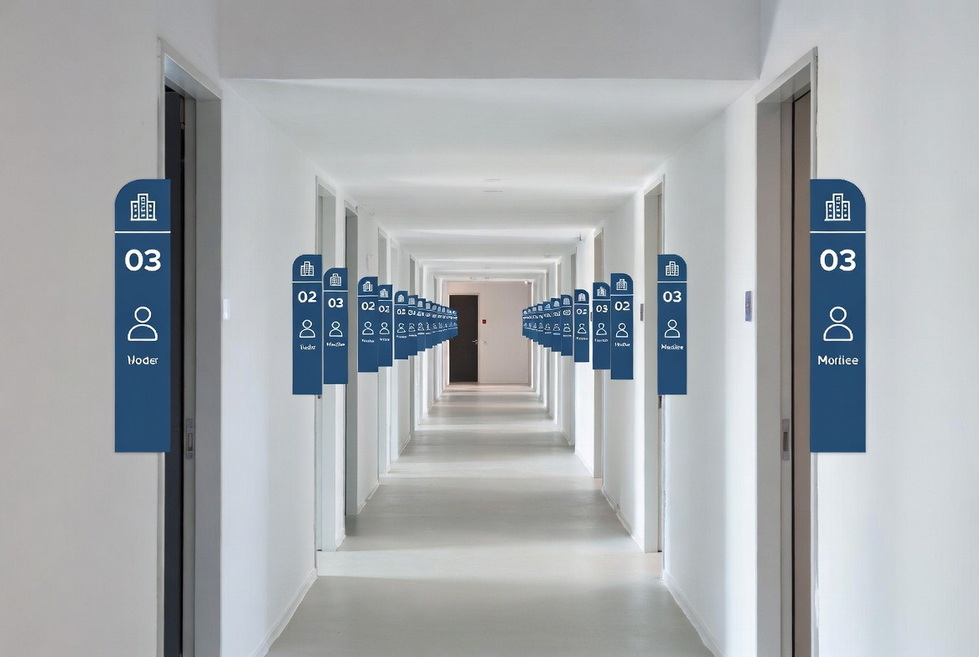
Different environments demand different door signage types, each with its own design and manufacturing considerations. Below are common categories business buyers search for and order repeatedly. [vistaprint]
These are used for individual offices, meeting rooms, departments, and back-of-house areas in commercial buildings.
- Typical materials: aluminum, stainless steel, acrylic, glass, or composite panels.
- Features: changeable inserts for staff names, sliding "In/Out" functions, or removable panels for flexible room allocation.
- Design focus: corporate color palette, logo application, and a clean, legible typeface visible at 2–4 meters. [vistaprint]
In hotels and serviced apartments, door signs are part of the guest experience from the first moment they approach their room.
- Typical materials: wood veneer, brushed metal, acrylic, or illuminated boxes.
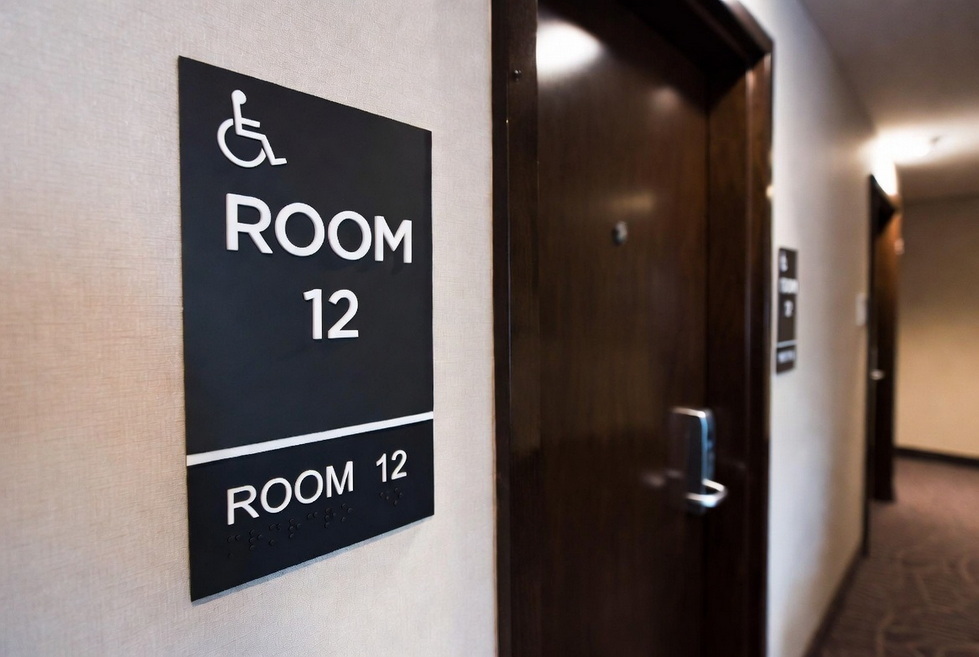
- Features: room numbers, braille/raised characters, integrated lighting, or keycard indicators.
- Design focus: mood and theme alignment with the interior design, plus high visibility in low‑light corridors. [screenfluence]
In consumer-facing environments, these signs must be instantly clear and visually on-brand.
- Typical uses: restrooms, staff-only areas, kitchen doors, fitting rooms, storage, and emergency exits.
- Features: pictograms, bilingual text, safety icons, and sometimes humorous or lifestyle-oriented messaging.
- Design focus: high contrast, quick recognition, and durability in high-traffic areas. [screenfluence]
Factories, warehouses, and laboratories rely on door signs as part of their safety and compliance environment.
- Typical content: hazard warnings, PPE requirements, access restrictions, equipment labels, and fire door instructions.
- Features: reflective vinyl, photoluminescent materials, and standardized safety icons.
- Design focus: compliance with local regulations, maximum legibility, and resistance to chemicals or abrasion.
Regardless of sector, effective custom door signs follow a set of design principles that balance aesthetics with function. As a manufacturer, we see the best results when buyers and designers focus on the following. [screenfluence]
1. Legibility First
- Use a sans-serif font with clear letterforms and avoid overly decorative typefaces. [screenfluence]
- Ensure adequate font size based on viewing distance—larger doors and corridors require larger text.
- Maintain strong contrast between text and background (e.g., dark text on a light panel or vice versa). [vistaprint]
2. Simplicity and Hierarchy
- Keep the message concise; a door sign should be understood at a glance.
- Use typographic hierarchy (larger room number or name, smaller secondary information).
- Minimize visual noise—too many borders, icons, or patterns compete with the main message.
3. Material and Finish Selection
- Match material to the environment: weather-resistant metals for outdoor doors, refined finishes for premium interiors.
- Consider glare and lighting: matte or brushed finishes often read better than highly reflective surfaces.
- For OEM projects, standardize thickness and mounting methods to control cost and assembly time.
4. Accessibility and Compliance
- In markets like the US, many building signs must comply with ADA guidelines, including tactile letters and braille, height positioning, and color contrast. [vistaprint]
- Safety and hazard signs often follow international standards (e.g., ISO‑style pictograms), so consistency is essential.
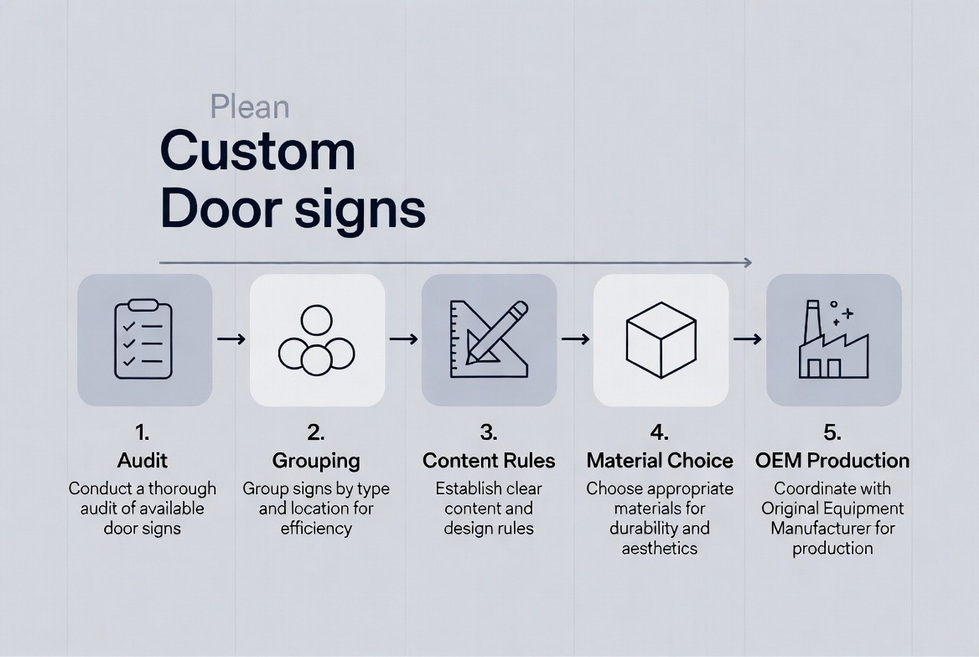
Based on experience supporting overseas distributors and brand owners, we recommend a simple, repeatable process for planning door signage projects.
1. Audit Every Door
- List all doors in your facility or project: public, staff, restricted, and technical.
- Note their function, traffic level, and any regulatory requirements.
2. Group Doors by Sign Type
- For example: room numbers, wayfinding, safety, operational, and branding doors.
- This grouping helps define standardized layouts and sizes, which reduce production cost.
3. Define Content and Language Rules
- Decide on naming conventions (e.g., "Meeting Room A" vs. "Conference A‑01").
- For export markets, confirm language, bilingual needs, and local phrasing preferences.
4. Choose Materials and Mounting Methods
- Align materials with your interior or exterior design concept, budget, and maintenance plan. [vistaprint]
- Confirm whether signs will be surface-mounted, projected, or integrated into door hardware.
5. Create a Master Sign Schedule for OEM Production
- Consolidate quantities, dimensions, finishes, and any variable fields (like room numbers) in a spreadsheet.
- This document becomes the blueprint for OEM manufacturing and quality control.
When overseas wholesalers or brand owners choose an OEM factory for custom door signs, they are not just buying a product—they are outsourcing part of their value chain.
From our vantage point as a signage manufacturer, OEM collaboration adds value in several ways:
- Cost efficiency at scale: Centralizing production for multi-location programs reduces per-unit cost and simplifies logistics.
- Engineering support: An experienced factory can suggest more robust fixing methods, smarter modular structures, or material substitutions that improve durability without sacrificing design.
- Consistency across markets: Producing all door signs under a single quality system helps global brands maintain a uniform look and performance standard.
- Private-label flexibility: Signs can be branded with the buyer's logo and packaging style, allowing wholesalers and resellers to strengthen their own brand equity.
For long-term partners, we also maintain tooling, color recipes, and custom profiles so that reorders remain consistent even years after the initial project.
Looking across the signage industry, certain patterns show up repeatedly in successful projects for hotels, offices, and retail chains. While every brand is different, a few practical examples illustrate what works. [screencloud]
- Hotel chain rollouts: One client standardized its room number signs with illuminated acrylic panels and localized braille layouts; by centralizing OEM production, they cut procurement time by several weeks per project phase.
- Corporate campus rebranding: A multinational company revamped hundreds of office and meeting room doors with a new visual identity; by modularizing the nameplate section, they now update staff names in-house without replacing entire signs.
- Retail restrooms and back-of-house: A specialty retailer replaced mixed, inconsistent restroom and staff-only signs with a unified pictogram style, improving wayfinding and aligning better with its minimalist brand image.
These kinds of projects demonstrate that door signage, when handled strategically, can deliver measurable improvements in efficiency and brand experience, not just aesthetics.
The table below can help potential buyers quickly compare popular door sign choices for business environments. [vistaprint]
| Door sign type | Typical material | Best for | Key advantages |
|---|---|---|---|
| Flat aluminum plate | Brushed aluminum | Offices, corridors | Durable, cost-effective, modern look |
| Acrylic with standoffs | Clear or colored acrylic | Reception, meeting rooms | Premium appearance, depth effect |
| Illuminated box sign | Metal + acrylic + LEDs | Hotels, high-end retail | High visibility, strong brand impact |
| Wood veneer plaque | MDF + wood veneer | Boutique hotels, restaurants | Warm, natural feel, custom shapes |
| Vinyl decal on glass door | Cut or printed vinyl | Shops, studios, small offices | Budget-friendly, easy to update or remove |
Even the best-designed OEM door sign can disappoint if installation is rushed or inconsistent. Professional installers and facility teams should be briefed clearly.
Key considerations include:
- Consistent mounting height and alignment for all signs in a project to avoid a "crooked" look.
- Proper surface preparation (cleaning, priming where needed) to ensure long-term adhesion for adhesive-backed signs.
- Spare units and repair plan so damaged or outdated door signs can be replaced quickly, maintaining a cohesive environment.
For OEM partners, providing clear installation guides and mounting templates in export shipments can reduce errors and callbacks in the field.
To get accurate pricing and avoid redesign cycles, overseas buyers should prepare a clear brief for their OEM signage partner. Based on our factory experience, your request should include at least:
- A brand guideline or reference showing logo usage, color codes, and typography.
- A list of sign types and quantities, ideally in a spreadsheet format.
- Location photos or floor plans for high-value projects such as hotels or flagship stores.
- Compliance requirements for target markets (e.g., ADA for US, bilingual text for specific regions).
Providing this information upfront helps the factory propose optimized structures, select suitable materials, and design for manufacturing from day one, reducing both time and cost.
If you are a brand owner, wholesaler, or project contractor looking to upgrade your door signage, now is the time to treat door signs as a strategic asset rather than a last-minute purchase. With a clear plan, well-defined standards, and the right OEM partner, you can turn every doorway into a consistent expression of your brand and a smoother experience for your visitors.
Whether you are rolling out a new location or rebranding an entire network, start by auditing your current doors, then reach out to a specialized signage manufacturer who can help you translate that vision into a scalable, high-quality door sign system for all your projects.
1. What is the difference between custom and standard door signs?
Custom door signs are designed to match your brand's colors, fonts, and functional needs, while standard signs are pre-made with generic text and minimal design options. Custom solutions typically offer better durability, flexibility, and alignment with your interior design. [vistaprint]
2. How do I choose the right material for my door signs?
Start with the environment: interior vs. exterior, humidity level, and traffic intensity. Metals and high-grade plastics suit demanding conditions, while wood and glass are ideal for premium interiors where aesthetics matter most. [vistaprint]
3. Are ADA or other accessibility rules important for door signs?
Yes, in markets like the US, many permanent room identification and safety signs must comply with ADA standards, including tactile letters, braille, and contrast ratios. Non-compliance can lead to complaints, fines, or required retrofits. [vistaprint]
4. Can OEM factories handle complex multi-location door sign programs?
Experienced OEM signage factories regularly manage multi-location rollouts by standardizing designs, creating master sign schedules, and coordinating packaging and labeling for each site. This ensures consistency and simplifies installation for local teams.
5. How often should door signs be updated or replaced?
There is no fixed rule, but many brands review their signage every 5–7 years or when major rebrands, renovations, or regulatory changes occur. Operational signs—such as staff names or room purposes—may need more frequent updates using modular or changeable components. [brandnewcopy]
- Dave's Signs. "Custom Door Signs – When a Door is Not Just a Door."
<https://www.davessigns.com/custom-door-signs-when-a-door-is-not-just-a-door/>
- Vistaprint. "Ultimate Guide to Signage Design: How to Design a Sign."
<https://www.vistaprint.com/hub/guide-signage-design> [vistaprint]
- Screenfluence. "Mastering Digital Signage: Best Practices for Designing Engaging Content."
<https://www.screenfluence.com/mastering-digital-signage-best-practices-for-designing-engaging-content/> [screenfluence]
- WebFX. "3 SEO Best Practices for Sign Companies."
<https://www.webfx.com/industries/professional-services/sign-companies/seo/> [webfx]
- Brand New Copy. "How to Write Content That Meets Google's E-E-A-T Guidelines."
<https://brandnewcopy.com/content-google-e-e-a-t-guidelines/> [brandnewcopy]


