From idea to market-ready product, our SIGNS solutions make every stage easier, faster. Discover How We Help

Views: 222 Author: Landea Signs Publish Time: 2026-05-11 Origin: Site


When I first started working with overseas buyers in the advertising signage industry, one thing became clear very quickly: a sign is never "just a sign" once you cross borders. It becomes a silent brand ambassador that has to work in different languages, regulations, climates, and customer expectations. As a China-based OEM signage manufacturer (Landea Signs Co., Ltd.), we've seen how a well-designed sign system can make a new store launch feel seamless in New York, Dubai, and Sydney at the same time. [marketveep]
In this article, I'll share practical, first‑hand insights on international signage, drawn from years of helping overseas brands, wholesalers, and manufacturers roll out OEM advertising signage projects worldwide. You'll learn how to evaluate a signage OEM partner, what to watch out for with language and regulations, and how to design for durability, legibility, and ROI in different markets. [workshopdigital]

International signage looks familiar on the surface, but in practice it is shaped by four powerful forces: language, regulations, culture, and environment. [developers.google]
- Language & icons
- Multilingual signs must stay clear and readable, not overcrowded.
- Pictograms and universal icons often carry the real communication load, especially in airports and malls. [screenfluence]
- Regulations & safety
- Different countries enforce different rules for fire safety, accessibility, and illumination levels.
- In some markets, font size or contrast ratios on safety signage are legally defined. [hkcert]
- Culture & brand perception
- Colors and symbols that feel "premium" in one market can feel political or unlucky in another.
- For example, high‑contrast red can imply urgency or warning in Western markets but is associated with celebration in parts of Asia.
- Climate & environment
- Humidity, UV exposure, seaside corrosion, or heavy snow loads all influence material choice and installation structure. [workshopdigital]
From an OEM perspective, the best international signage balances all four dimensions instead of simply copying a domestic design and exporting it.
Based on my daily work with foreign brand owners and distributors, there are three recurring patterns that separate successful projects from painful ones.
Overseas clients often come with very creative design decks. In practice, legibility and consistency matter more than visual gimmicks for wayfinding and regulatory signs. [screenfluence]
- Use sans‑serif fonts with strong contrast.
- Limit line length and avoid dense paragraphs on any sign that people will read in motion.
- Keep pictograms and arrows consistent across all locations.
The most efficient brands define a global signage system (typefaces, colors, hierarchy, icon style) and then localize:
- Translations and language order.
- Local regulatory icons or warning labels.
- Mounting methods and materials based on building type and climate.
A seasoned OEM signage partner should help you standardize what can stay global and flag what must be local before mass production.
Price is important, but for cross‑border signage you're really buying a project partner, not just a product. A responsive OEM will: [workshopdigital]
- Proactively ask for installation photos, local regulations, and brand guidelines.
- Provide drawing revisions quickly.
- Help optimize packaging and documentation for local installers.
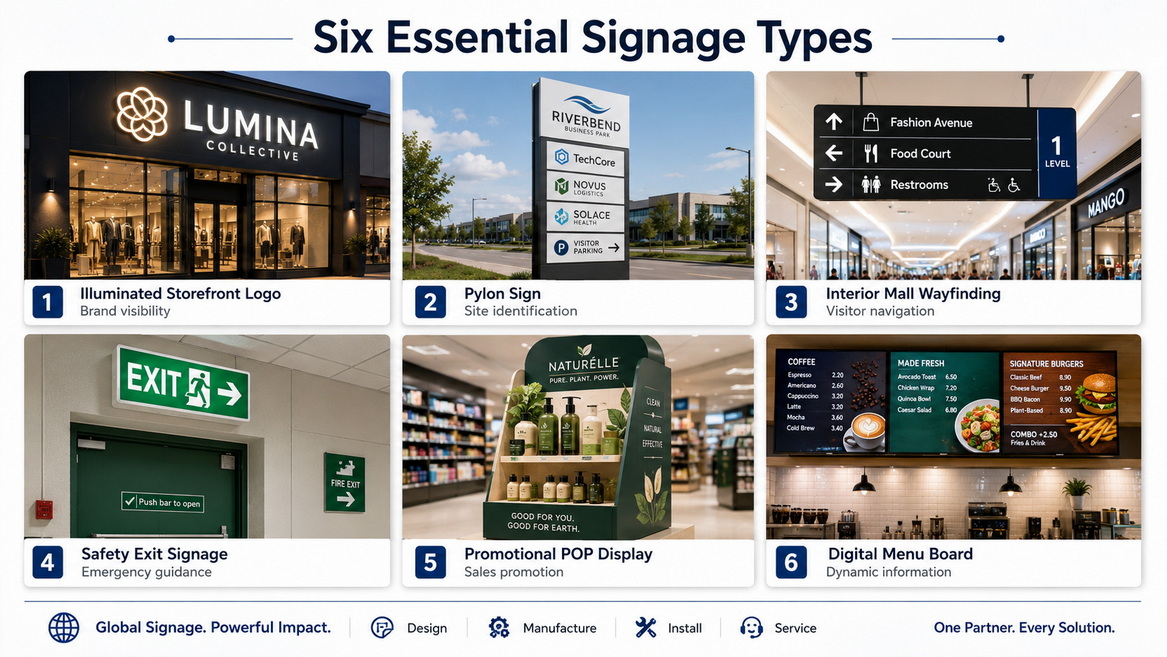
Different projects demand different sign types. Below is an overview we use with many overseas clients when planning a global rollout.
| Sign type | Typical use in international projects |
|---|---|
| Exterior storefront | Main brand identity, day/night visibility, high impact |
| Pylon / totem | Roadside visibility, mall entrances, fuel stations |
| Interior wayfinding | Directing flows in malls, offices, hospitals, campuses |
| Regulatory & safety | Fire exit, emergency routes, warnings, accessibility compliance |
| Promotional / POP | Seasonal campaigns, in‑store offers, product launches |
| Digital signage | Dynamic content, menus, advertising loops, interactive kiosks |
For many of our OEM clients, a project includes a mix of these sign types, with a clear hierarchy: brand identity first, safety and wayfinding second, promotions third.
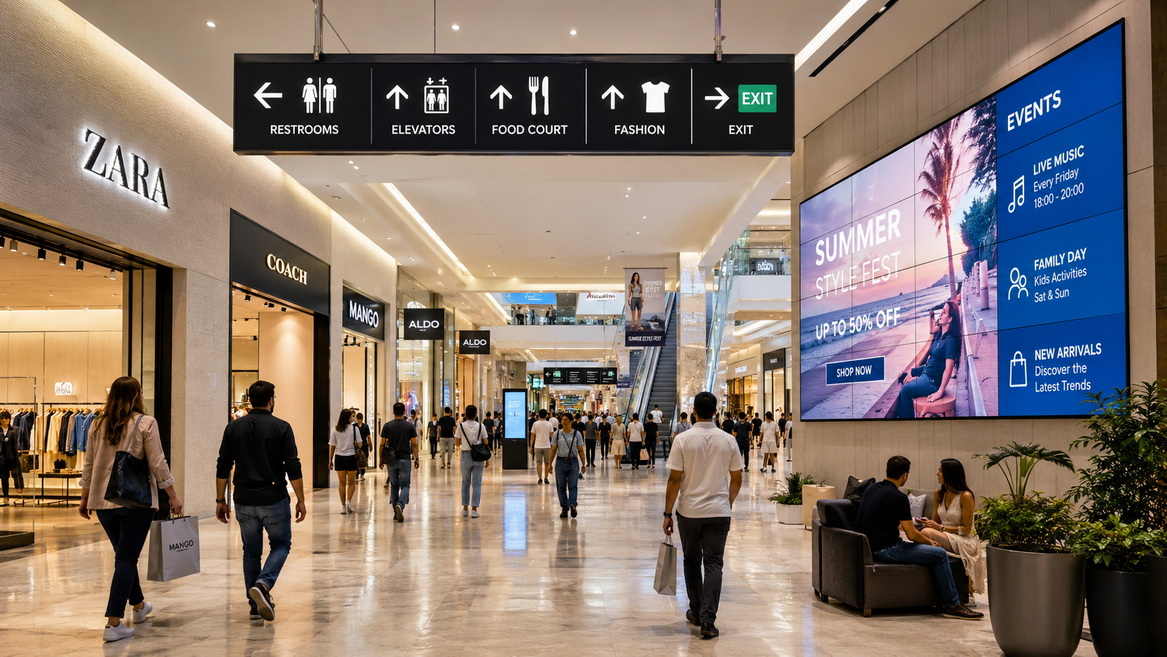
Whenever we design or engineer signage for international OEM clients, we use a checklist that reflects both UX and SEO mindsets: clear, scannable, and purposeful. [webfx]
- Choose sans‑serif fonts and avoid overly condensed styles.
- Define minimum letter height based on viewing distance (for example, larger text for long‑range outdoor signs). [screenfluence]
- Maintain strong contrast: dark text on a light background, or vice versa.
- Assume a viewer has 1–3 seconds to process the message.
- Use one primary message per sign.
- Use short phrases and high‑impact keywords, especially on promotional signage.
- Keep icons consistent across languages.
- Use clear hierarchy: primary language first, secondary smaller or in a different weight.
- Avoid cramming too many languages onto one surface; if necessary, split content across multiple signs.
- Match finishes and colors to the location interior or facade.
- Use consistent lighting style across regions (e.g., halo‑lit letters vs. face‑lit channel letters).
- Consider local mounting conditions (concrete, glass, drywall, curtain wall systems).
Recommended visuals here:
- A photo grid showing the same brand storefront sign in 3 different countries, illustrating consistent branding with localized language.
- A diagram that compares text sizes and viewing distances for exterior vs interior signage.
From the outside, many sign factories look similar. From the inside, the difference shows up in engineering depth, project management, and export experience. [robertsiegers]
- Export track record
- Ask which countries or regions they regularly ship to.
- Look for experience with customs documentation, packaging standards, and international carriers.
- Engineering & prototyping
- Can they provide detailed CAD drawings, section views, and mounting details?
- Do they offer prototypes or pre‑production samples for sign‑off?
- Materials and certifications
- Can they source region‑specific materials (e.g., UL‑listed components for North America, CE‑compliant components for Europe)?
- Do they provide test reports or certificates when needed?
- Communication and project management
- Is there a dedicated English‑speaking contact for your account?
- Do they have clear processes for change requests, artwork updates, and quality approvals?
- Vague answers about export history or reference projects.
- Lack of understanding of basic signage regulations (fire exits, accessibility, electrical safety).
- No structured QC process or documentation.
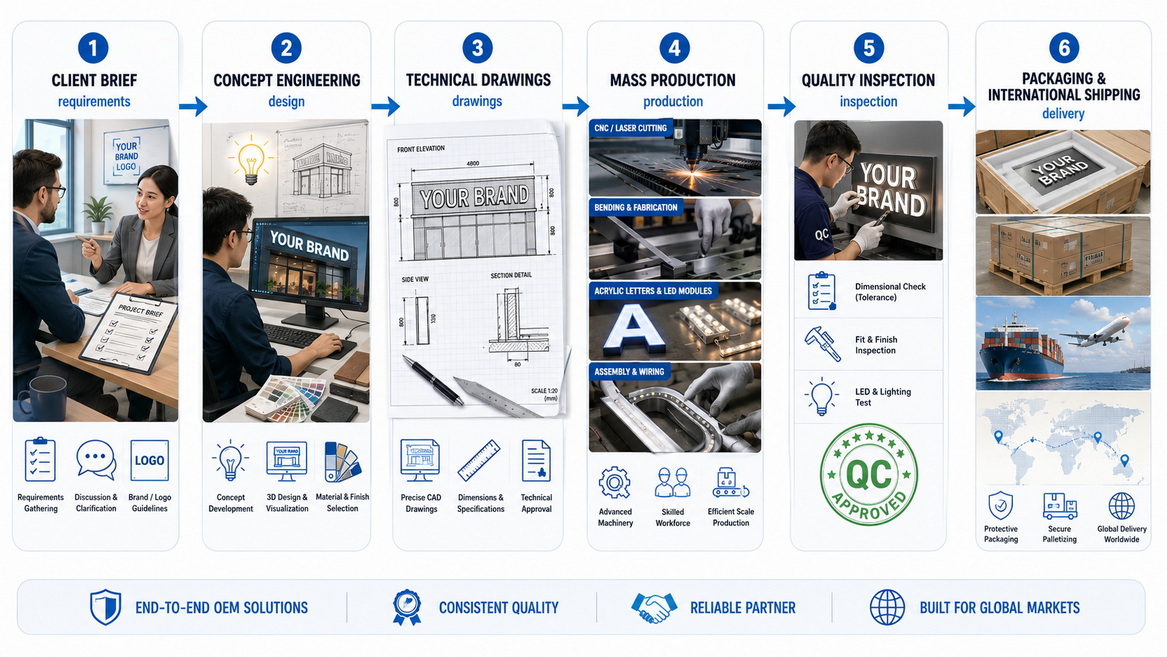
To improve user experience and predictability for overseas clients, we follow a clear project roadmap. Below is a general framework you can expect from a mature OEM signage factory.
1. Discovery & brief
- Collect brand guidelines, existing signage photos, architectural drawings, and location list.
- Clarify target markets, installation conditions, and regulatory constraints.
2. Concept engineering & cost estimation
- Translate design concepts into buildable structures and materials.
- Provide itemized quotations, including options (e.g., aluminum vs. stainless steel).
3. Technical drawings & prototyping
- Produce detailed shop drawings for each sign type.
- Build prototypes or golden samples for approval, especially on large projects.
4. Mass production & QC
- Standardize processes with production SOPs and checklists.
- Inspect critical dimensions, finish quality, illumination uniformity, and electrical safety.
5. Packaging & logistics
- Engineer packaging to protect delicate elements (acrylic faces, LEDs) during long‑distance transport.
- Organize labeling and documentation so local installers can easily identify each sign.
6. After‑sales support
- Provide installation guides, wiring diagrams, and maintenance recommendations.
- Offer spare parts or re‑orders for damaged or additional signs.
A structured process like this significantly reduces project risk for overseas buyers and creates a better experience for local installation teams.
In our experience, many international signage problems appear after installation: discoloration, corrosion, flickering LEDs, or peeling vinyl. Most of these can be avoided with proper material choices and clear maintenance plans. [workshopdigital]
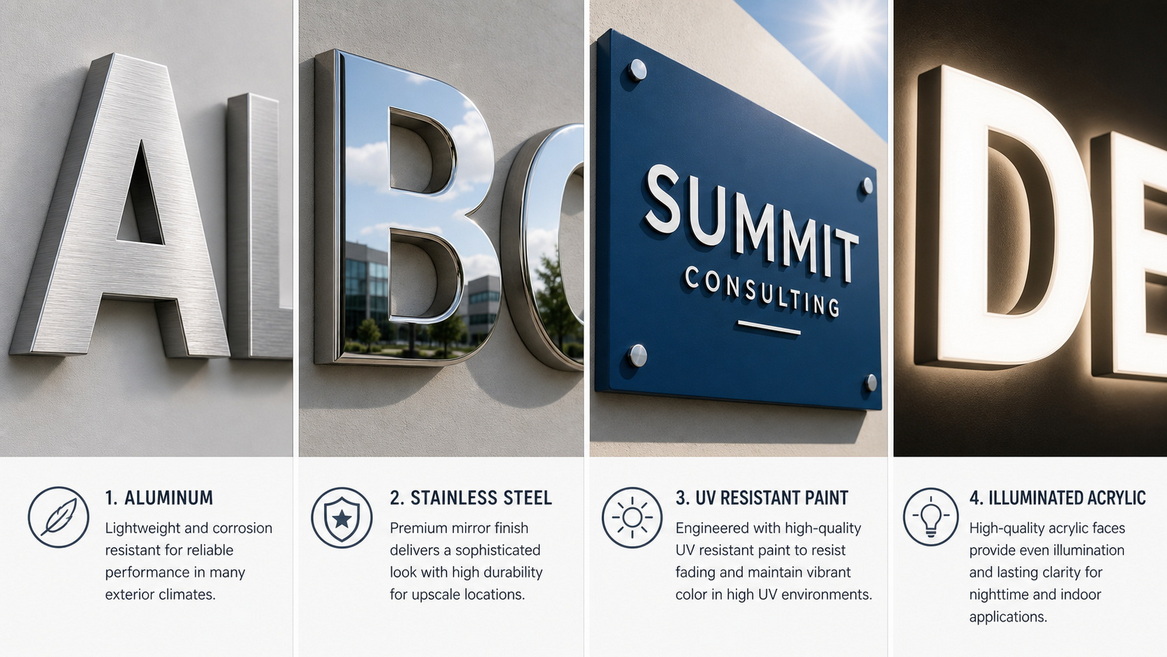
- Metals
- Aluminum for lightweight, corrosion‑resistant structures.
- Stainless steel for premium finishes and high‑end environments.
- Plastics & acrylics
- High‑grade acrylic for illuminated faces to avoid yellowing.
- Polycarbonate where impact resistance is critical.
- Finishes
- UV‑resistant powder coating or automotive‑grade paint for exterior signs.
- Anti‑graffiti laminates in urban environments.
- Provide a maintenance schedule with every project (e.g., cleaning frequency, safe cleaning agents).
- Specify expected component lifetimes (e.g., LED modules, power supplies).
- Recommend periodic inspections of mounting hardware, especially in coastal or high‑wind areas.
More global brands are combining traditional fabricated signs with digital signage—LED screens, menu boards, or interactive kiosks. This opens new possibilities, but also new responsibilities.
- Content flexibility
- Central teams can update promotions and messages across regions in real time. [screenfluence]
- Local teams can adapt content to language and cultural context.
- Security & reliability
- Networked displays must follow basic IoT security guidelines: secure configuration, software updates, and monitored access. [hkcert]
- Choose media players and CMS platforms with vendor support and security patch policies.
- Hardware integration
- Ensure housing, ventilation, and cable routing are designed for local climate and building codes.
- Plan for service access so technicians can maintain devices without damaging the surrounding sign.
For OEM customers, it is often more efficient to work with a signage factory that understands both traditional fabrication and digital integration, rather than managing two separate vendor ecosystems.
If you are planning an international store rollout, rebranding, or OEM signage project, you don't need to navigate all these decisions alone.
As a China‑based OEM advertising signage manufacturer, our team at Landea Signs Co., Ltd. can review your brand guidelines, local requirements, and project timeline, then propose an optimized signage package for your target markets.
- Share your drawings, reference photos, or brand book.
- Tell us which countries and site types you're working with.
- We'll provide engineering suggestions, material options, and quotations tailored to your global rollout.
Get in touch today to discuss your international signage project and explore how a specialized OEM partner can make your global brand visible, consistent, and reliable across every location.
1. What is the biggest challenge in international signage projects?
The biggest challenge is aligning brand consistency with local regulations and practical installation realities across multiple countries. A structured system and an experienced OEM partner can significantly reduce surprises. [robertsiegers]
2. How early should I involve an OEM signage manufacturer in my project?
Ideally, involve your OEM partner once you have initial brand guidelines and architectural plans, but before finalizing all sign types and dimensions. Early collaboration avoids expensive redesigns later. [workshopdigital]
3. Can one signage design work in every country?
The core visual identity can stay consistent, but sizes, materials, languages, and regulatory elements often need local adaptation. A modular design approach works best. [hkcert]
4. How do I control quality when manufacturing signage overseas?
Look for factories with documented QC processes, test reports, clear sampling stages, and photo or video reporting for each batch. You can also use third‑party inspection services for key milestones. [robertsiegers]
5. Is digital signage always better than static signage for international brands?
Not always. Digital signage excels at dynamic content and frequent updates, but it comes with higher upfront cost, technical complexity, and security considerations. Many successful brands use a combination of static identity signage and selective digital displays. [hkcert]
1. Google Search Central – Creating Helpful, Reliable, People‑First Content (E‑E‑A‑T guidelines) – [https://developers.google.com/search/docs/fundamentals/creating-helpful-content] [developers.google]
2. Wildcat Digital – How Do You Write E‑E‑A‑T Content? – [https://wildcatdigital.co.uk/blog/how-do-you-write-e-e-a-t-content/] [wildcatdigital.co]
3. Workshop Digital – SEO for Manufacturers: Driving Success – [https://www.workshopdigital.com/blog/how-seo-can-drive-success-for-manufacturers/] [workshopdigital]
4. WebFX – SEO Best Practices for Sign Companies – [https://www.webfx.com/industries/professional-services/sign-companies/seo/] [webfx]
5. SEO Auckland Chap – SEO for Sign Companies – [https://seoaucklandchap.co.nz/industries/professional-services/seo-for-sign-companies/] [seoaucklandchap.co]
6. Motion Marketing – SEO for Manufacturing Businesses – [https://www.motion-marketing.com/blog/practical-tips/seo-for-manufacturing/] [motion-marketing]
7. HKCERT – IoT Security Guideline for Digital Signage – [https://www.hkcert.org/blog/iot-security-guideline-for-digital-signage] [hkcert]
8. Screenfluence – Digital Signage Content Design Best Practices – [https://www.screenfluence.com/best-practices-for-digital-signage-content-design-effective-signage-strategies/] [screenfluence]
9. MarketVeep – Content SEO Strategy for Manufacturing – [https://www.marketveep.com/blog/4-best-practices-for-your-content-seo-strategy-in-manufacturing] [marketveep]
10. Robert Siegers – Manufacturing SEO in the Age of Industry 4.0 – [https://robertsiegers.com/en/seo-for-manufacturers] [robertsiegers]


