From idea to market-ready product, our SIGNS solutions make every stage easier, faster. Discover How We Help

Views: 268 Author: Landea Signs Publish Time: 2026-07-16 Origin: Site


Content Menu
● Understanding ADA Compliant Signs
● What General Wayfinding Signs Cover
● ADA Compliant Signs vs. Wayfinding Signs
>> Functional and Design Differences
● Where ADA Compliant and Wayfinding Systems Overlap
● Designing ADA Compliant Signs
● Designing Effective Wayfinding Systems
● Manufacturing Materials, Durability, and Customization
● Inclusive Wayfinding Beyond Minimum Compliance
● FAQs
ADA compliant signs and general wayfinding signs may look similar from a distance, but they serve very different roles in how people safely navigate a building or public space. As someone who has spent years helping facility managers and global brands audit and upgrade their signage, I've seen firsthand how treating these two categories as interchangeable can quietly expose a business to risk—and leave visitors confused or excluded. [landeasigns]
ADA compliant signs are designed to ensure that people with disabilities can independently find, understand, and use key spaces in a building. They follow strict rules for typography, layout, tactile elements, and installation, especially in the United States where these requirements are tied to the Americans with Disabilities Act. [landeasigns]
From a practical, industry perspective, ADA compliant signage focuses on three core aspects that I always highlight in client workshops:
- Accessibility: Clear contrast, legible fonts, tactile characters, and Braille for people with visual impairments. [landeasigns]
- Consistency: Unified standards for room IDs, exits, restrooms, stairs, elevators, and permanent spaces. [landeasigns]
- Legal exposure: Non-compliance can lead to complaints, fines, and costly retrofits after inspections or incidents. [landeasigns]
In recent projects for international brands, we've seen a growing trend of companies treating ADA-compliant design not just as a regulatory checkbox but as a core part of their inclusivity and brand experience strategies. [landeasigns]
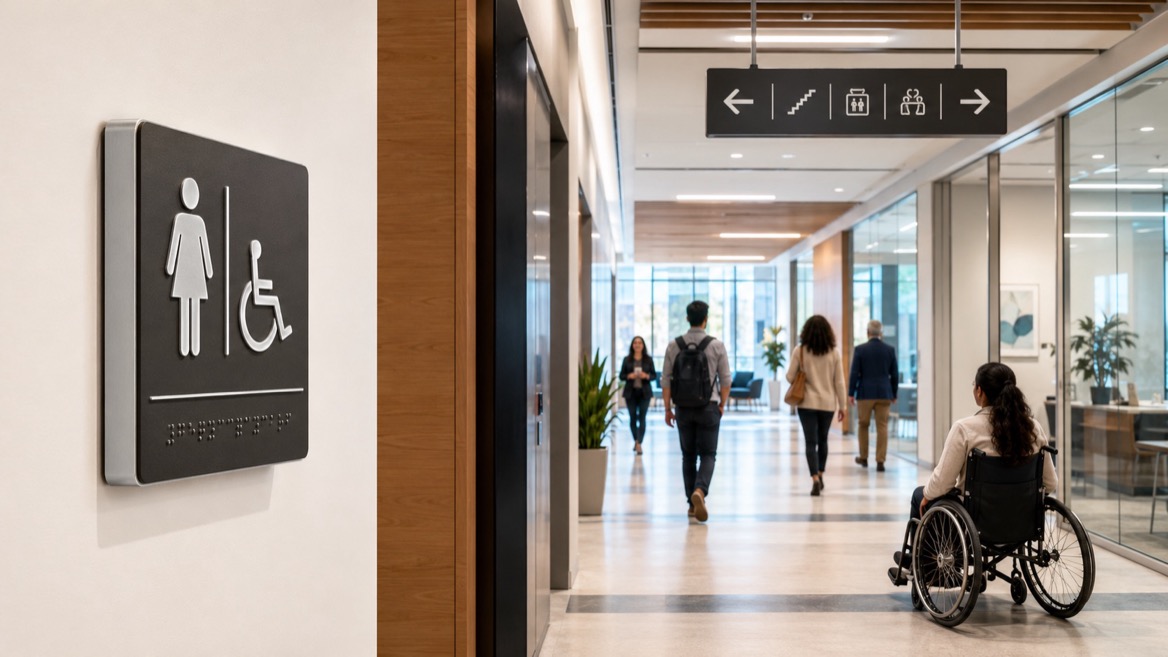
General wayfinding signs are designed to help people move from point A to point B as easily and intuitively as possible. They include overhead directional signs, directory boards, parking guidance, campus maps, and branded navigation elements that don't necessarily follow a formal accessibility code. [landeasigns]
In real-world deployments, general wayfinding signage usually focuses on:
- Flow and orientation: Helping first-time visitors quickly build a mental map of the site.
- Branding and aesthetics: Colors, icons, and materials that align with corporate or retail identity. [landeasigns]
- Operational clarity: Keeping foot traffic and vehicle traffic organized, especially in large campuses, hospitals, airports, and malls. [landeasigns]
Because these signs have more creative freedom, they often become the most visible part of a visual identity system, even though they are built on top of a more technical layer of ADA-compliant signs. [landeasigns]
In conversations with architects and facility operators, I often describe ADA compliant signs as the "safety and inclusion backbone", while general wayfinding signs form the "experience and navigation layer" on top.
- Purpose
- ADA signs: Guarantee inclusive access and safe navigation for people with disabilities in line with specific legal standards. [landeasigns]
- Wayfinding signs: Optimize overall navigation, traffic flow, and experience for all visitors.
- Design constraints
- ADA signs: Strict rules on fonts, character height, contrast, Braille placement, and mounting height. [landeasigns]
- Wayfinding signs: More freedom in typography, color, iconography, and layout to match brand identity. [landeasigns]
- Content focus
- ADA signs: Room numbers, exits, restrooms, floor levels, stairwells, elevators, areas of refuge. [landeasigns]
- Wayfinding signs: Directional arrows, map overviews, department lists, parking zones, reception, services.
- Risk impact
- ADA signs: Direct link to legal risk, insurance issues, and accessibility complaints. [landeasigns]
- Wayfinding signs: Indirect impact through visitor frustration, longer wayfinding times, and poor first impressions. [landeasigns]
| Aspect | ADA Compliant Signs | General Wayfinding Signs |
|---|---|---|
| Core role | Inclusive access and safe navigation for people with disabilities (landeasigns) | Efficient movement and orientation for all visitors (landeasigns) |
| Main locations | Exits, restrooms, stairwells, elevators, room IDs (landeasigns) | Corridors, lobbies, parking, campus routes (landeasigns) |
| Design freedom | Limited: strict rules for fonts, contrast, Braille, mounting (landeasigns) | High: can be strongly branded and visually expressive (landeasigns) |
| Primary risk if ignored | Complaints, penalties, expensive retrofits (landeasigns) | Confusion, poor user experience, lost sales or missed appointments (landeasigns) |
| Typical materials | High-durability substrates, tactile panels, stable finishes (landeasigns) | Broad range: illuminated, digital, architectural features (landeasigns) |
In well-designed environments, ADA compliant signs and general wayfinding signs are not two competing systems; they are two layers of a single, integrated sign strategy. When these layers are planned together, visitors experience a space that feels both easy and inclusive to navigate. [landeasigns]
From my work with multi-site companies, the most successful signage programs share these characteristics:
- Shared visual language: The same icon sets and color logic used across ADA and wayfinding elements to avoid cognitive friction. [landeasigns]
- Clear hierarchy: Critical safety and access information always remains readable even when decorative or promotional content is nearby.
- Location-based pairing: ADA-compliant room ID signs installed alongside directional wayfinding elements leading to those rooms.
This integrated approach is especially important when sites mix static wall-mounted signs with illuminated channel letters, digital screens, and overhead directional boards. [landeasigns]
One recent industry case that illustrates the difference between ADA compliant signs and general wayfinding signs involved a large hospital campus planning a multi-phase signage upgrade. [landeasigns]
The facility team initially treated "signage" as a single budget line, assuming that a visually unified wayfinding refresh would automatically cover accessibility requirements. After an external audit, they discovered several issues:
- Missing tactile and Braille room IDs for critical spaces such as imaging rooms and consultation rooms. [landeasigns]
- Inconsistent mounting heights and low contrast on stair and elevator signs.
- Overly branded overhead wayfinding signs that were attractive but hard to read for older visitors.
The solution was to divide the project into two coordinated tracks:
1. ADA compliance track
- Full inventory of required ADA signs (restrooms, exits, stairwells, elevators, refuge areas, permanent rooms). [landeasigns]
- Standardized layouts, type specs, tactile manufacturing, and installation protocols.
2. Wayfinding optimization track
- Clear directional paths from entrances, parking, and transit stops to priority destinations.
- High-visibility overhead signs, illuminated exterior identity elements, and clear floor directories. [landeasigns]
Only after these two tracks were aligned did the hospital achieve a coherent system where a blind visitor, an elderly patient, and a first‑time visitor all found the campus easy to navigate. [landeasigns]
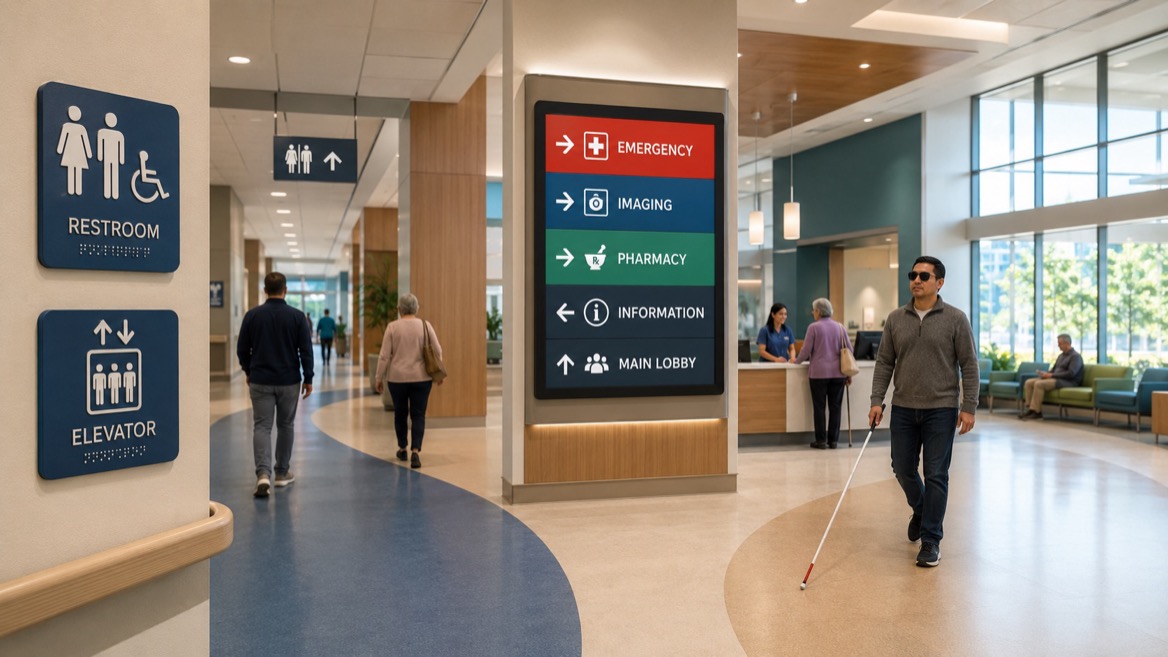
When advising building owners and project managers, I use a simple checklist to quickly evaluate whether their ADA signage system is robust enough:
1. Identify all permanent rooms and spaces
- Ensure each has tactile room ID signage where required.
2. Check contrast and font choices
- High contrast between foreground and background, with non‑decorative, easy-to-read type. [landeasigns]
3. Verify Braille and tactile implementation
- Properly sized raised characters and correctly formatted Braille placed below the text. [landeasigns]
4. Confirm mounting height and location
- Consistent mounting heights near the latch side of doors, following the relevant standard. [landeasigns]
5. Review emergency and egress signage
- Clear identification of exits, areas of refuge, and accessible routes.
Using such a checklist during site surveys dramatically reduces the risk of missing critical compliance details, especially in complex buildings with multiple renovations over time. [landeasigns]
For general wayfinding, my focus shifts toward visibility, cognitive ease, and branding alignment rather than compliance specifics. A simple yet powerful checklist I often share with design teams includes: [landeasigns]
1. Map key journeys
- Track how first‑time visitors move from entrance to reception, parking to main lobby, lobby to priority departments. [landeasigns]
2. Define sign hierarchy
- Primary entrances and routes, secondary corridors, and local confirmation signage along the path.
3. Establish a visual logic
- Use consistent arrows, icons, and color coding to represent floors, zones, or services. [landeasigns]
4. Test sign visibility on site
- Walk the routes and verify that signs are visible from appropriate distances and angles.
5. Align with architectural and brand elements
- Integrate materials, colors, and illumination with the environment while keeping information legible. [landeasigns]
Teams that follow this process tend to reduce wayfinding complaints and support smoother traffic flows, especially during peak hours or events. [landeasigns]
From a manufacturing standpoint, ADA compliant signs and general wayfinding signs demand slightly different engineering decisions, even when they are produced in the same facility. [landeasigns]
As a specialist in custom illuminated and ADA signage, Landea Signs has seen several patterns across global projects:
- ADA compliant signs
- Often use robust substrates with stable finishes to maintain tactile readability over long lifecycles. [landeasigns]
- Require precise machining or molding for raised characters and Braille dots.
- Favor consistent color standards to ensure predictable contrast.
- General wayfinding signs
- Make heavier use of illuminated elements, channel letters, and architectural features for visibility. [landeasigns]
- Frequently incorporate brand colors, metallic finishes, and specialty materials.
- May blend static panels with digital screens and programmable displays in large or evolving environments. [landeasigns]
For multi-site rollouts, a structured specification set that clearly separates ADA-compliant elements from general wayfinding components makes manufacturing more efficient and keeps long-term maintenance predictable. [landeasigns]

Looking ahead, the distinction between ADA compliant signs and general wayfinding signs is slowly evolving. Many organizations are moving from minimal compliance toward genuinely inclusive wayfinding that considers a broader range of user needs. [landeasigns]
Three notable trends are emerging across projects and industry discussions:
- Universal design principles
- Applying legibility, contrast, and simplicity from ADA standards across all wayfinding elements, not just the legally required signs. [landeasigns]
- Multilingual and icon-driven systems
- Combining clear pictograms with multiple languages to support international visitors and reduce reliance on text alone. [landeasigns]
- Integration with digital tools
- Linking on-site signage with mobile wayfinding, QR-linked maps, and building directories to provide layered guidance for different user groups. [landeasigns]
For manufacturers and facility owners, adopting these trends early can turn signage from a static cost center into a flexible tool for better experiences and safer spaces. [landeasigns]
Q1: Are ADA compliant signs only required in the United States?
In practice, formal ADA rules apply specifically to the United States, but many international brands voluntarily follow similar accessibility standards across global locations to maintain consistent, inclusive environments. [landeasigns]
Q2: Can one sign serve both ADA compliance and general wayfinding purposes?
Yes, a single sign can combine compliant tactile information with clear directional or branding elements, as long as the accessibility requirements for layout, contrast, and tactile features are correctly implemented. [landeasigns]
Q3: How often should ADA compliant signage be reviewed or updated?
Periodic audits are advisable whenever a building undergoes renovation, layout changes, or tenant turnover, and at regular intervals to check for wear, damage, or evolving best practices. [landeasigns]
Q4: Does illuminated signage play a role in ADA compliance?
Illumination is more common in general wayfinding and branding, but good lighting around compliant signs supports readability and safety, especially in emergency routes or low‑light environments. [landeasigns]
Q5: What is the most common mistake facilities make with ADA signage?
The most frequent issue is assuming that attractive wayfinding or decorative door signs automatically meet accessibility standards, which can leave critical rooms and routes effectively invisible to some users. [landeasigns]
1. [Landea Signs Co., Ltd – Company overview and product focus] [landeasigns]
2. [How Landea Signs Helps Global Brands Design, Build And Scale High‑Impact Signs] [landeasigns]
3. [Landea Signs – Blog] [landeasigns]
4. [ADA Signage In 2026: A Practical, Expert Guide For Safer, More Inclusive Spaces] [landeasigns]
5. [What ADA Compliant Signage Really Means Today] [landeasigns]
6. [Why ADA Compliant Signage Still Matters In 2026] [landeasigns]


