From idea to market-ready product, our SIGNS solutions make every stage easier, faster. Discover How We Help

Views: 222 Author: Landea Signs Publish Time: 2026-05-08 Origin: Site


For accessibility-focused wayfinding, tactile legibility is no longer a "nice-to-have"—it is a regulatory, brand, and UX requirement. As a manufacturing partner, Landea Signs Co., Ltd. works every day with sign companies, brand agencies, and architects who must balance compliance, durability, and design flexibility when they choose between Braille overlays and direct-to-substrate tactile printing. This article combines hands-on manufacturing experience with current tactile printing research and market data to help you choose the right technology for your next accessibility project. [watermarx]
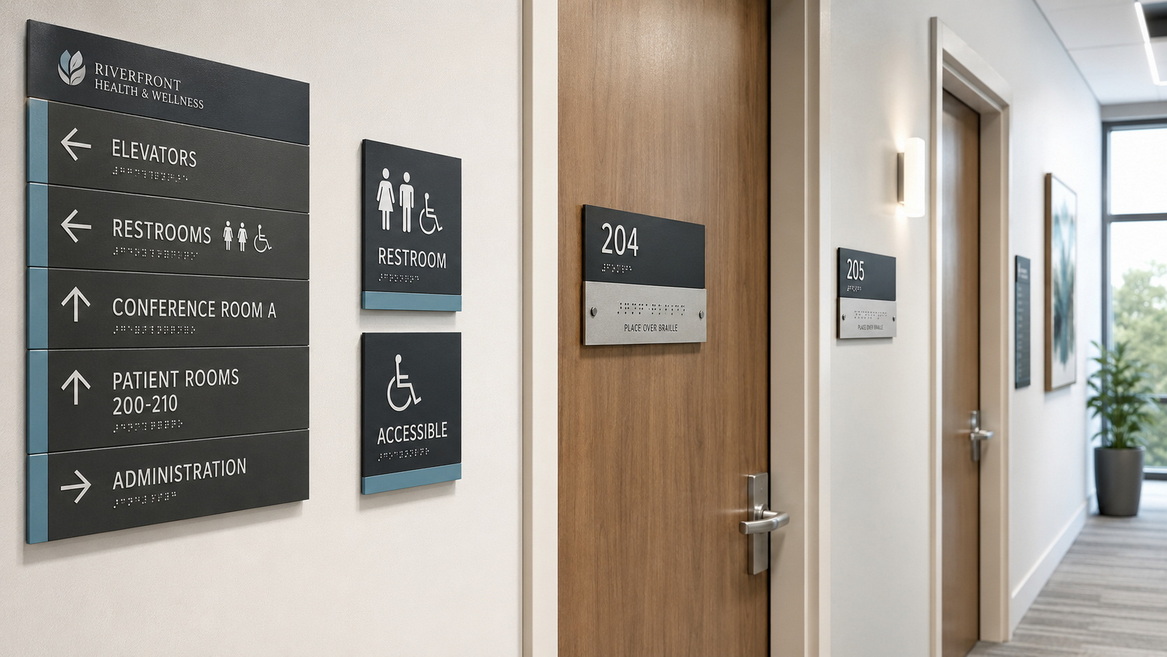
Braille overlays are separate tactile layers—often clear or contrasting plastic, polycarbonate, or acrylic—applied on top of a printed or painted base sign panel. The overlay contains raised Braille and tactile characters that meet standard dot height, spacing, and alignment requirements. [journals.sagepub]
Key characteristics of Braille overlays
- Modular construction: Braille and tactile elements are produced as an independent layer and then mechanically or adhesively fixed to the base sign. [hongchenad]
- Retrofit-friendly: Existing flat signs can be upgraded with tactile overlays without replacing the entire sign body. [watermarx]
- Material flexibility: Overlays can be produced in thin, UV-stable plastics or acrylics, then mounted onto metal, wood, glass, or composite substrates. [littlerockprinting]
From a UX standpoint, overlays are often chosen for complex environments where content changes (room numbers, tenant names, schedules) must be updated without re-fabricating the entire sign. [landeasigns]
Direct-to-substrate tactile printing uses UV-curable or 3D-style raised inks printed directly onto the final sign material to create both visual and tactile content in one integrated structure. The raised ink builds up Braille dots and tactile lettering to a controlled height and radius that is detectable by touch. [refinecolor]
Key characteristics of direct-to-substrate tactile printing
- Single-step fabrication: Graphics, text, and tactile elements are printed directly onto aluminum, acrylic, composite panels, or plastics in one consolidated process. [littlerockprinting]
- Consistent depth and shape: Modern UV and 3D printing platforms can generate very uniform tactile height and rounded shapes for comfortable reading. [3dprint]
- High design freedom: It becomes easier to combine full-color graphics with compliant tactile and Braille in a single pass, which is ideal for branded ADA and wayfinding systems. [landeasigns]
For many sign makers partnering with Landea, direct tactile printing offers a scalable, repeatable workflow that fits large roll-outs and multi-location brand programs. [landeasigns]
| Dimension | Braille overlays | Direct-to-substrate tactile printing |
|---|---|---|
| Construction | Separate overlay applied to base sign watermarx | Tactile printed directly on substrate refinecolor |
| Best use case | Retrofitting, changeable content, small batches watermarx | Large programs, integrated branding, complex graphics refinecolor |
| Mechanical durability | Good if laminated/secured; overlay edge is a risk point watermarx | Excellent surface integration; fewer failure points refinecolor |
| Design flexibility | Moderate; limited by overlay shape and attachment watermarx | High; full-color plus tactile in one pass refinecolor |
| Initial tooling cost | Low to moderate | Higher equipment cost, low per-unit cost at volume refinecolor |
| Retrofit capability | Very strong | Limited; usually requires new panel watermarx |
For many accessibility programs, the correct decision is not "either/or" but a hybrid strategy: overlays for retrofits and small updates, direct tactile printing for standards-based rollouts and new builds. [landeasigns]
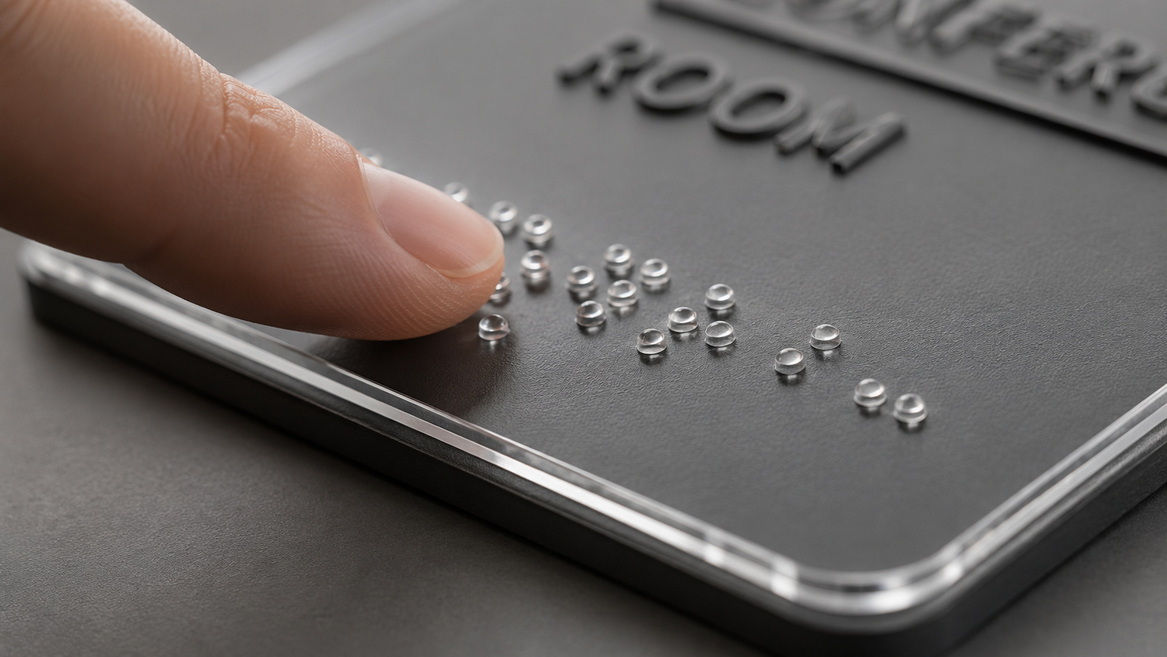
For blind and low-vision users, the tactile ergonomics of dots and raised letters are critical: dot height, radius, spacing, and surface smoothness all affect reading speed and comfort. [mjaf.journals.ekb]
- Overlays tend to produce sharp, well-defined dots when manufactured with high-quality molds or embossing processes. [mjaf.journals.ekb]
- However, if overlays are too thin or not perfectly bonded, the tactile experience can degrade over time due to flexing, warping, or edge lift. [mjaf.journals.ekb]
- When installed respecting distance from sign edges and proper line spacing, overlays can deliver accurate, easily discoverable Braille zones. [hongchenad]
- Digital tactile printing technologies have improved to the point where 3D-printed Braille can match or exceed traditional embossing accuracy and reading speed. [journals.sagepub]
- Raised UV ink can create dots with a pleasant profile and controlled height, which testers have rated as clear and comfortable for sliding finger reading. [3dprint]
- Because the tactile is integrated into the sign body, the transition from background to dot remains consistent across large runs, supporting predictable UX in multi-site environments. [refinecolor]
From an accessibility-expert point of view, the best practice is not just to hit minimum standards but to test your tactile prototypes with real users before locking in a specification. [pzn.org]
Accessibility signage lives in tough environments: hospitals, schools, transit hubs, parking structures, and outdoor campuses. [reanin]
- Mechanical vulnerability: Overlay edges and adhesive layers can be attacked by cleaning chemicals, vandalism, or frequent contact, potentially causing peeling. [watermarx]
- Replaceable component: On the plus side, if content changes or damage occurs, the overlay can be replaced without scrapping the entire base sign. [landeasigns]
- Cleaning: When properly bonded and edge-sealed, overlays can be cleaned with mild detergents, but harsh solvents can cloud plastic or weaken adhesives. [watermarx]
- High surface integrity: Because tactile elements become part of the sign face, there are fewer seams or joints to fail over time. [littlerockprinting]
- Chemical and UV resistance: UV-cured inks and coated substrates can provide excellent fade and abrasion resistance, especially in outdoor or high-touch environments. [refinecolor]
- Lifecycle cost efficiency: While initial investment in equipment is higher, long-term per-sign cost—especially for standardized systems—is often lower due to reduced labor and rework. [linkedin]
For facility managers rolling out region-wide accessibility programs, direct tactile printing frequently delivers the best total cost of ownership over several years. [linkedin]
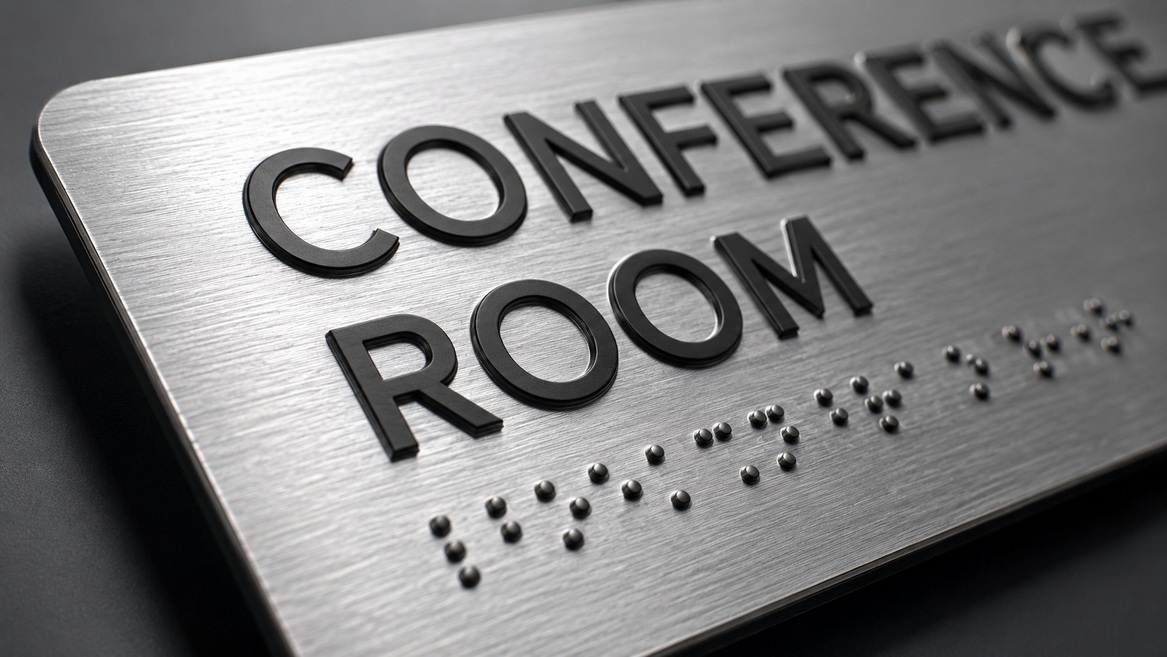
Today's architectural signage must balance strict accessibility rules with the need for visually rich brand expression. [pzn.org]
- Add-on to premium materials: You can mount clear or color-matched overlays onto substrates like wood veneer, glass, or stone, preserving the underlying material's aesthetics. [watermarx]
- Localized updates: Overlays excel where tenant names or room uses change, but the main sign structure must remain intact—common in co-working, educational, or multi-tenant office environments. [landeasigns]
- Single-surface storytelling: Raised ink, flat color, gradients, and images can live on the same panel while still meeting tactile and contrast requirements. [landeasigns]
- Large programs: For hotel chains, healthcare networks, or retail brands, direct printing offers precise color consistency and layout control across thousands of signs. [landeasigns]
- Advanced tactile graphics: Tactile maps, diagrams, and multi-texture zones become more practical via 3D-style printing than via overlays. [pzn.org]
When Landea develops brand-led ADA systems for international clients, direct-to-substrate tactile printing is often the baseline technology, with overlays used tactically for content that changes. [landeasigns]
Most jurisdictions reference standards similar to ADA, EN, or local accessibility codes that define minimum tactile height, Braille positioning, and installation heights. [hongchenad]
Key requirements typically include:
- Correct Braille cell dimensions, dot height, and spacing for the target language. [journals.sagepub]
- Raised characters at a specified height and stroke thickness for tactile readability. [pzn.org]
- Installation heights that place tactile within a comfortable reach range, often around 700–950 mm from the floor for wall-mounted signs. [hongchenad]
- Sufficient contrast between foreground text and background, even when tactile is used. [pzn.org]
Both Braille overlays and direct tactile printing can meet these requirements when correctly engineered. The crucial factor is process control: calibrated equipment, verified artwork, and QC checks on every batch. [mjaf.journals.ekb]
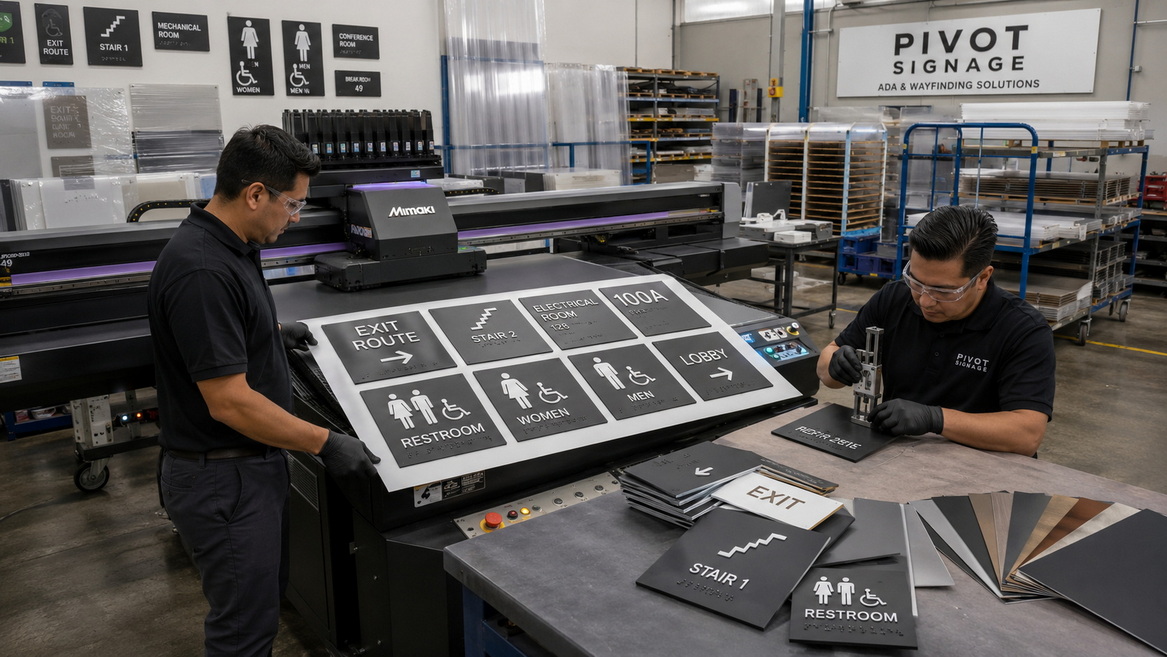
The global tactile printing market is growing steadily, driven by accessibility legislation, inclusive design, and technology advances such as 3D and UV printing. [reanin]
- One 2024 market review valued the tactile printing sector at over USD 1.7 billion, projecting growth to nearly USD 2.9 billion by 2031 at around 7–10% CAGR. [linkedin]
- Adoption is expanding in education, healthcare, public transport, and smart city projects, where tactile wayfinding and Braille signage are now baseline infrastructure. [linkedin]
- Research into tactile ergonomics and 3D-printed Braille continues to support more comfortable and accurate reading at scale. [3dprint]
For sign companies and distributors, partnering with a manufacturer that can handle both traditional overlay techniques and advanced direct tactile printing provides resilience as codes tighten and expectations rise. [reanin]
From an expert manufacturing and UX standpoint, here is a clear, action-oriented way to choose between Braille overlays and direct-to-substrate tactile printing.
1. You are upgrading existing signage in a building and need a fast route to accessibility without replacing full panels. [landeasigns]
2. Content changes often, such as room names, departments, or tenant listings. [landeasigns]
3. Your volumes are relatively low and manual or semi-manual production is acceptable. [watermarx]
1. You are implementing a new standardized signage program across multiple sites, brands, or countries. [landeasigns]
2. Design integration and brand consistency (color, layout, material palette) are a top priority. [refinecolor]
3. You need high durability for transport hubs, hospitals, campuses, or outdoor environments. [linkedin]
In practice, many Landea projects mix both: direct-printed tactile signs for core wayfinding and room IDs, plus overlay-based modules for changeable areas and temporary functions. [landeasigns]
To move from theory to execution, use this step-by-step workflow when you brief a manufacturer like Landea:
1. Define the environment: Indoor/outdoor, exposure to chemicals, vandalism risk, traffic volume. [linkedin]
2. Specify regulations: ADA, EN, local standards; include dot height, letter height, mounting height, and contrast requirements. [hongchenad]
3. Clarify lifecycle expectations: How often will content change? How long must the signs last before replacement? [reanin]
4. Select core technology: Decide where Braille overlays and direct tactile printing each make sense within the same signage family. [refinecolor]
5. Prototype and test: Produce sample panels, then involve visually impaired users or accessibility consultants for final validation. [journals.sagepub]
Following this process helps ensure both compliance and a genuinely usable experience, rather than simply checking boxes. [mjaf.journals.ekb]
As a vertically integrated advertising signage manufacturer with over 15 years of experience, Landea Signs has built production lines for both overlay-based tactile signage and direct UV/3D tactile printing. [landeasigns]
- Global project expertise: Landea delivers custom ADA and tactile signage to clients across Europe, North America, the Middle East, and Asia, supporting multi-language Braille and regional codes. [landeasigns]
- Flexible production models: The team handles small-batch prototypes, regional retrofits, and large-scale rollouts for design firms, sign shops, and brand owners. [landeasigns]
- Consultative engineering: Engineers and project managers review artwork, substrates, and installation conditions to recommend overlay or direct tactile solutions that balance cost, UX, and longevity. [landeasigns]
For agencies and sign resellers, this means you can consolidate production while still offering your end clients a full spectrum of tactile signage options. [landeasigns]
If you are evaluating Braille overlays vs. direct-to-substrate tactile printing for an upcoming project, the safest approach is to co-design your system with a manufacturing specialist. [refinecolor]
Landea Signs can help you:
- Audit your current signage against accessibility expectations
- Prototype both overlay and direct tactile options using your actual branding
- Develop a scalable sign family that balances compliance, durability, and design
You can share your drawings, schedules, or brand guidelines and request engineering-backed recommendations for tactile materials, production methods, and installation details. [landeasigns]

1. Are Braille overlays still compliant with modern accessibility standards?
Yes. When produced with correct dot dimensions, spacing, contrast, and installation heights, Braille overlays can fully comply with ADA-style and regional accessibility codes. [mjaf.journals.ekb]
2. Does direct-to-substrate tactile printing always cost more?
Not necessarily. While the equipment investment is higher, once the process is in place, per-sign costs for standardized programs are often competitive or lower, especially at scale. [linkedin]
3. Which option is better for outdoor signage?
Direct-to-substrate tactile printing on UV-stable substrates often performs better outdoors because the tactile layer is fully integrated and more resistant to weather and abrasion. [littlerockprinting]
4. Can I mix Braille overlays and direct tactile printing within one project?
Yes, and many organizations do. Overlays are ideal for retrofits and changeable content, while direct tactile printing is used for long-life standard signs such as room IDs and directional signs. [landeasigns]
5. How do I verify that my tactile signage is actually usable?
Beyond formal standards, the most reliable approach is user testing with blind and low-vision participants, supported by accessibility specialists, using prototypes produced in your target materials. [3dprint]
1. Kamal, M. (2021). The difference between traditional braille embossing and digital braille printing embossing tactile ergonomics. [Link] [mjaf.journals.ekb]
2. Refine Color. Braille Printer vs UV Printing: A Professional's Guide to ADA-Compliant Signage. [Link] [refinecolor]
3. Watermarx Graphics. Good News: Tactile Printing. [Link] [watermarx]
4. Wabinski, J., et al. Guidelines for Standardizing the Design of Tactile Maps. [Link] [pzn.org]
5. Thomas, A., & Prabhakar, A. (2023). A comparative evaluation of sliding contact tactile systems displaying braille and raised print. [Link] [journals.sagepub]
6. Reanin. Tactile Printing Market Size, Share & Outlook. [Link] [reanin]
7. Landea Signs. Official Website – Custom Signage Solutions. [Link] [landeasigns]
8. Hongchen AD. [Link] [hongchenad]
9. 3DPrint.com. Study Compares 3D Printed Braille to Traditional Methods. [Link] [3dprint]
10. LinkedIn. The Tactile Printing Market Outlook: Growth Trends and 6% CAGR 2026–2032. [Link] [linkedin]
11. Landea Signs. News & Case Studies. [Link] [landeasigns]
12. Landea Signs. Braille Signs vs. Tactile Signs: What's the Real Difference? [Link] [landeasigns]
13. Little Rock Printing. What Is Direct to Substrate Printing? [Link] [littlerockprinting]
14. LinkedIn. Tactile Printing Market Forecast and Highlights 2026–2033. [Link] [linkedin]
15. Landea Signs. Company Profile – LONGLU / Landea. [Link] [landeasigns]


