From idea to market-ready product, our SIGNS solutions make every stage easier, faster. Discover How We Help

Views: 231 Author: Landea Signs Publish Time: 2026-07-04 Origin: Site


Content Menu
● What Do We Mean By Modular Braille Systems vs. Permanent One-Piece Signs?
● Why This Choice Matters In 2026 ADA Sign Design
● Core ADA and Accessibility Requirements Both Systems Must Meet
● Modular Braille Systems: Flexibility, Change Management, And Multi-Site Programs
>> When Modular Braille Systems Make Sense
>> Practical Advantages Of Modular Braille Systems
● Permanent One-Piece Signs: Durability, Vandal Resistance, And Brand Cohesion
>> What Makes One-Piece Signs "Permanent"
>> Key Advantages For Long-Term Programs
>> Where Permanent Systems Fall Short
● Side‑By‑Side Comparison: Modular vs. Permanent Signs
● Expert Insight: How We Advise Clients To Choose In Real Projects
● Operational Checklist: Implementing Modular Braille Systems Correctly
● Design And Engineering Considerations For Permanent One-Piece Signs
● Case-Style Scenario: Multi-Site Retail Rollout
● How An OEM Manufacturer Like Landea Signs Supports Your Choice
● CTA: Plan Your ADA Signage Strategy With An OEM Expert
● FAQs
As an OEM signage manufacturer working with global brands every day, I've seen both modular Braille systems and permanent one-piece signs succeed—and fail—depending on how they're specified, installed, and maintained across multi-location projects. This guide shares practical lessons from the field, so facility managers, architects, and brand owners can choose a signage strategy that is compliant, scalable, and cost-effective over the full lifecycle of a program. [landeasigns]
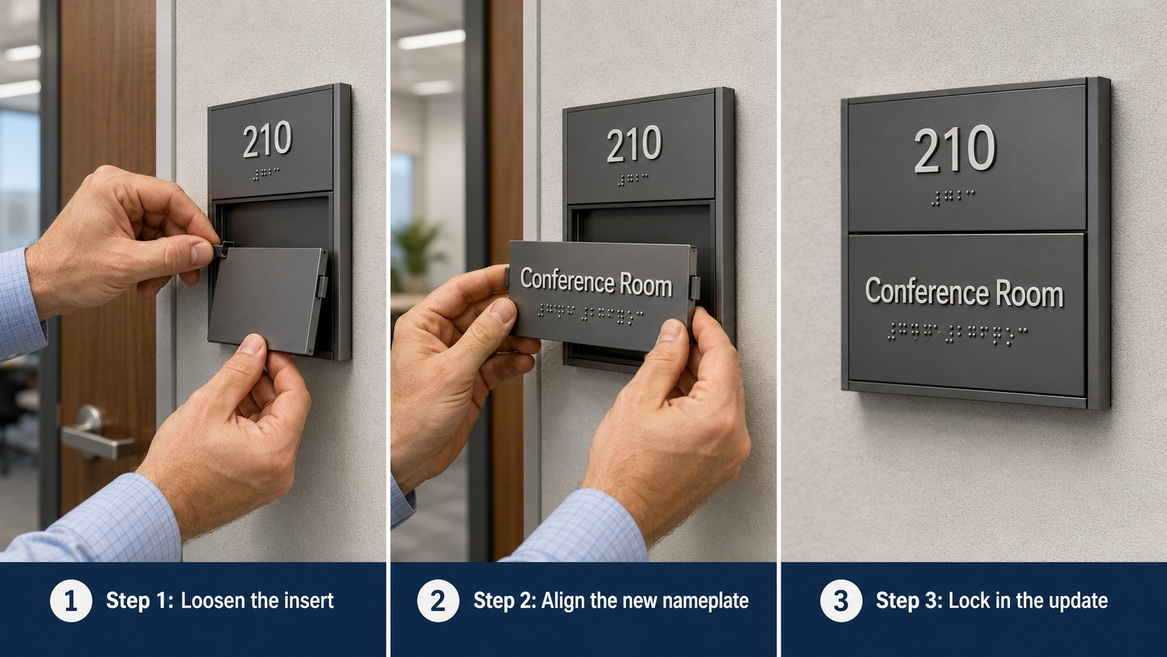
Modular Braille systems use separate tactile and Braille elements—often beads or caps—that are mounted into a base plaque or interchangeable modules. They are designed for flexibility: rooms can be renamed, layouts can change, and individual components can be swapped without reordering a full sign. [landeasigns]
Permanent one-piece signs integrate tactile characters and Braille directly into the sign body—via photopolymer, cast, or molded substrates—creating a single, vandal‑resistant unit that cannot be easily modified after installation. For long-term, code-driven room identification, this approach emphasizes durability and consistency. [novapolymers]
ADA signage is no longer a "tick-the-box" requirement; it is a core part of inclusive wayfinding and risk management for every public facility in the US and many international markets. The decision between modular Braille systems vs. permanent one-piece signs influences: [gsparcel]
- Compliance risk (will the signs pass inspection across multiple jurisdictions?)
- Brand consistency (does every site "feel" aligned with your visual identity?)
- Lifetime cost (are you paying more over 5–10 years for changes, repairs, or replacements?)
From an OEM perspective, we see that teams who treat this as a strategic design decision—not a last-minute procurement line—achieve better accessibility outcomes and lower total cost of ownership. [landeasigns]
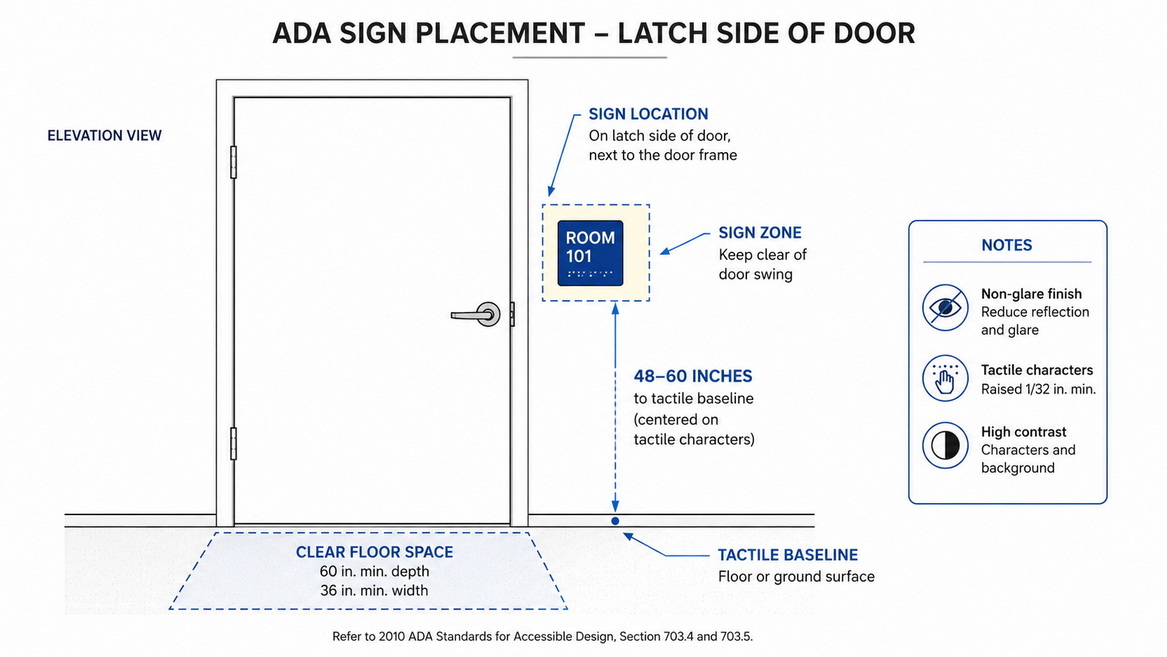
Regardless of the system you choose, ADA‑compliant signage must respect a set of non‑negotiable rules for tactile readability, Braille, and placement. Key requirements include: [accessibility]
- Tactile letter height: typically 5/8–2 inches for raised characters. [eriecustomsigns]
- High contrast and non-glare finish between characters and background. [accessibility]
- Grade 2 Braille, placed directly beneath the corresponding text with precise dot spacing. [novapolymers]
- Mounting height and location: usually 48–60 inches to the baseline of tactile characters, on the latch side of the door, free from obstructions. [access-board]
As a manufacturer, we guide clients to lock copy early, align wording with size constraints, and avoid "extra small" plaques that simply cannot fit compliant tactile text and Braille. [landeasigns]
From a project owner's viewpoint, modular Braille systems shine in environments where room functions and naming change frequently. Typical scenarios include: [blinksigns]
- Hospitals and clinics with evolving departmental layouts
- Universities and co-working spaces where rooms are repurposed often
- Corporate campuses undergoing phased renovation and rebranding
In these cases, being able to update Braille inserts or modular panels without removing the entire sign dramatically reduces disruption and maintenance cost. [blinksigns]
For facility teams, modular systems offer several operational benefits:
- Easy updates: Replace a module or insert instead of the whole plaque.
- Reduced downtime: Room signage can be updated overnight with minimal impact on users.
- Simplified inventory: Keep standard bases in stock and order new inserts as needed.
From an OEM angle, we see modular programs work best when there is a clear standard for module sizes, materials, and color codes, combined with a strong naming convention that keeps tactile and Braille wording consistent across sites. [landeasigns]
The main risks we observe with modular Braille systems are:
- Vandalism and tampering, if modules or caps are not securely fixed or are installed in high‑traffic, unsupervised areas. [landeasigns]
- Inconsistent visual appearance, when different vendors or teams produce inserts with slight variations in color, font, or finish.
- Compliance drift, as frequent manual changes introduce opportunities for spacing or Braille errors.
Where security, vandal resistance, and visual cohesion are top priorities, these issues often push large brands toward permanent one-piece signs instead. [landeasigns]
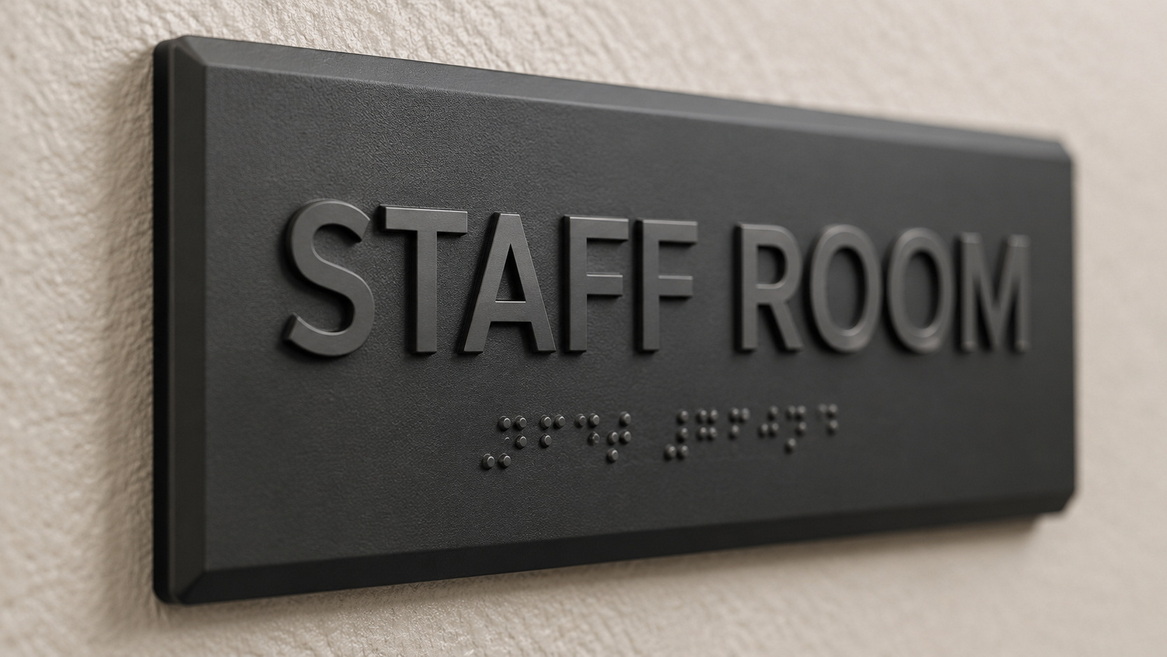
In permanent one-piece signs, the tactile characters and Braille are formed as part of the sign body—through photopolymer, engraving, casting, or molding—making it extremely difficult to remove or alter individual elements without destroying the sign. This integrated construction is favored in environments where long-term stability matters more than short-term flexibility. [landeasigns]
Typical use cases include:
- Hotels and residential buildings with stable room numbering and functions
- Government and civic facilities where signage changes are rare
- Retail chains and banks that prioritize brand consistency across hundreds of locations
From an OEM manufacturing standpoint, permanent one-piece signs deliver crucial benefits:
- High vandal resistance: Integrated Braille resists prying, scratching, and impact better than surface-mounted beads. [landeasigns]
- Visual consistency: Fonts, colors, textures, and finishes are locked into a single specification and replicated at scale. [landeasigns]
- Reduced compliance risk: With controlled tooling and fabrication, it's easier to ensure each sign meets ADA standards and passes inspection. [eriecustomsigns]
For global brands, this is often the default choice for room ID and code signage, while modular solutions are reserved for temporary or rapidly changing spaces.
The trade‑offs are clear:
- Limited flexibility: Any change in wording, numbering, or layout usually requires ordering a new sign.
- Higher replacement cost: While unit price can be optimized via OEM production, each change still means a full plaque replacement.
- More planning required upfront: Copy, placement, and sign families must be carefully defined early in the project.
This is why many experienced facility managers adopt a hybrid approach, reserving permanent one-piece signs for code‑critical, stable rooms and using modular systems for dynamic, tenant‑driven spaces.
| Aspect | Modular Braille systems | Permanent one-piece signs |
|---|---|---|
| Flexibility | High – easy to update text/Braille modules as rooms change. landeasigns | Low – wording and Braille are fixed into the plaque. landeasigns |
| Vandal resistance | Moderate – depends on attachment method; surface-mounted components more exposed. landeasigns | High – integrated Braille and text resist tampering and impact. landeasigns |
| Visual consistency | Variable – risk of color, font, or finish variation across modules and batches. landeasigns | Strong – one specification replicated at scale via OEM manufacturing. landeasigns |
| Change management cost | Low per change – replace modules rather than full plaques. blinksigns | Higher – each change typically requires a new sign. novapolymers |
| Compliance control | Requires strict change procedures to avoid spacing/Braille errors. accessibility | Easier to control via standardized fabrication and QA. novapolymers |
| Best suited for | Dynamic environments: hospitals, campuses, co-working, multi-tenant offices. landeasigns | Stable environments: hotels, retail chains, civic facilities, long-term rollouts. landeasigns |
Working with overseas brand owners and wholesalers, we usually start with three practical questions: [landeasigns]
1. How often will room functions and naming change over the next 5–10 years?
2. How critical is vandal resistance in your highest-risk areas (parking, transit, schools)?
3. How important is brand uniformity across all sites and countries?
A typical recommendation pattern looks like this:
- If functions change frequently and the environment is relatively controlled (corporate, education), we lean toward modular Braille systems with a strict change protocol and central vendor management.
- If brand consistency, vandal resistance, and inspection success are top priorities, especially in public or lightly supervised spaces, we specify permanent one-piece signs as the default.
- For multi-country rollouts, we often design standardized permanent ADA cores plus localized modular overlays for language variants and tenant details.
This hybrid approach leverages the strengths of both systems while containing risk.
If you choose modular Braille systems, treat them as part of a managed program, not just a product. Based on real project experience, a robust implementation usually includes: [blinksigns]
1. Standardized module sizes and materials
2. Approved font, color, and finish specifications aligned with ADA contrast and non‑glare requirements. [accessibility]
3. Documented change procedures for facility staff, including diagrams showing correct Braille placement and spacing. [access-board]
4. Central purchasing or vendor management, to avoid mismatched inserts from multiple suppliers.
5. Annual compliance audits to catch spacing, mounting height, or copy errors introduced during updates.
Without this structure, modular systems can drift away from brand and compliance goals in just a few years.
For permanent signs, most of the value is won—or lost—during design and engineering. Current industry guides emphasize: [gsparcel]
- Early copy locking: Final wording must be approved before tooling or photopolymer plates are made.
- Size planning: Ensuring plaques are large enough for compliant tactile letter height, spacing, and Braille placement. [eriecustomsigns]
- Material choice: Durable substrates with non‑glare finishes and stable pigments that maintain contrast over time. [novapolymers]
- Mounting details: Specifying exact locations and heights within construction documents to prevent installation mistakes. [access-board]
As an OEM, we often support architects with ADA sign design guides, CAD details, and sample programs to validate the specification before mass production. [landeasigns]
Imagine a retail chain planning a 150‑store rollout across several countries. Based on similar projects we've supported as an OEM signage partner, the winning configuration often looks like this: [landeasigns]
- Permanent one-piece ADA room ID signs for restrooms, staff rooms, electrical rooms, and back-of-house areas.
- Modular Braille or visual inserts for tenant names, promotions, and flexible areas like community rooms.
- Centralized sign family specification with strict rules on fonts, colors, and materials to protect brand consistency.
This combination keeps code signage stable, simplifies auditing, and gives marketing teams space to adapt messaging without compromising accessibility.
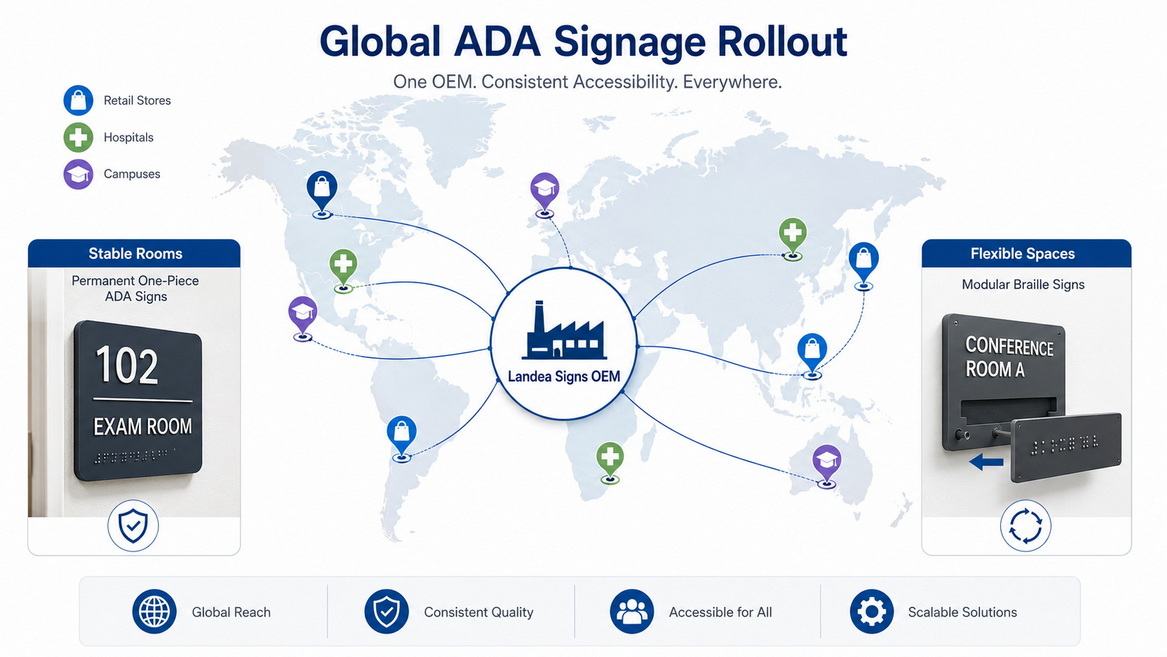
As a China-based OEM advertising signage manufacturer, Landea Signs Co., Ltd. designs, engineers, and mass‑produces custom ADA signage for overseas brands, wholesalers, and fixture manufacturers. We help project teams by: [landeasigns]
- Advising on system choice (modular vs. permanent) based on your operational and branding needs.
- Standardizing sign families to ensure consistent materials, colors, and Braille quality across all sites.
- Providing export‑ready, pre‑tested samples to validate ADA compliance before large orders. [landeasigns]
For complex rollouts, we often collaborate with local partners in your target markets to align on code requirements and installation practices.
If you're planning a new facility or a multi‑site rollout and are unsure whether modular Braille systems or permanent one-piece signs are right for your project, it's best to decide before construction documents are finalized. Talk to an OEM signage manufacturer who understands both ADA compliance and large‑scale brand implementation—so your signs stay readable, consistent, and cost-effective over their entire lifecycle. [gsparcel]
1. Are modular Braille systems fully ADA‑compliant?
Yes—when they use Grade 2 Braille, correct dot spacing, high‑contrast, non‑glare finishes, and are mounted at the required height and location, modular systems can be fully ADA‑compliant. Issues arise when local changes are made without following the original specification. [accessibility]
2. Do permanent one-piece signs always cost more than modular systems?
Unit prices vary, but permanent signs often cost more to replace when wording changes, while modular systems reduce the cost of updates. Over a 5–10‑year period, total cost of ownership depends on how frequently your spaces change function. [blinksigns]
3. Which system is better for high‑vandalism environments?
For transit hubs, schools, or exposed public areas, vandal‑resistant, integrated Braille signs are generally preferred because they resist tampering and impact better than surface-mounted beads or caps. [novapolymers]
4. Can I mix modular and permanent signs in the same facility?
Yes, and many experienced facility managers do exactly that: permanent one-piece signs for stable, code‑critical rooms, and modular solutions for flexible or tenant‑specific spaces. [landeasigns]
5. How early should I involve an OEM sign manufacturer in my project?
Ideally during concept design or schematic design, before copy and sign families are locked into construction documents. Early involvement avoids redesigns, ensures ADA sizing and placement are feasible, and reduces costly last‑minute changes. [gsparcel]
1. Accessibility.com – "How to Create ADA Compliant Signs" – [https://www.accessibility.com/blog/how-to-create-ada-compliant-signs] [accessibility]
2. Nova Polymers – "Your 2026 Guide to ADA Sign Design" – [https://novapolymers.com/ada-sign-design-guide/] [novapolymers]
3. U.S. Access Board – "ADA Guidelines – Chapter 7: Signs" – [https://www.access-board.gov/ada/guides/chapter-7-signs/] [access-board]
4. Erie Custom Signs – "ADA Sign Sizing Rules and Guidelines" – [https://eriecustomsigns.com/blog/ada-sign-sizing-rules-and-guidelines.html] [eriecustomsigns]
5. Blink Signs – "Guide to Selecting & Implementing ADA Compliant Signage" – [https://blinksigns.com/guide-to-selecting-ada-compliant-signage/] [blinksigns]
6. Landea Signs – "Custom Advertising Signage That Works: How OEM Sign Manufacturers Help Your Brand Stand Out" – [https://www.landeasigns.com/custom-advertising-signage-that-works-how-oem-sign-manufacturers-help-your-brand-stand-out.html] [landeasigns]
7. Landea Signs – "Integrated Braille vs. Surface-Mounted Braille: Which Resists Vandalism?" – [https://www.landeasigns.com/integrated-braille-vs-surface-mounted-braille-which-resists-vandalism.html] [landeasigns]
8. Landea Signs – "ADA Signage in 2026: A Practical, Expert Guide for Safer, More Inclusive Spaces" – [https://www.landeasigns.com/ada-signage-in-2026-a-practical-expert-guide-for-safer-more-inclusive-spaces.html] [landeasigns]
9. GS Parcel – "ADA Signage Guidelines" – [https://gsparcel.com/insights/ada-signage-guidelines/] [gsparcel]
10. Landea Signs – Company News page and OEM capabilities overview – [https://www.landeasigns.com/news.html] [landeasigns]


